Tools for NaNoWriMo: Aeon Timeline

crest-bda7b7a6e1b57bb9fb8ce9772b8faafb

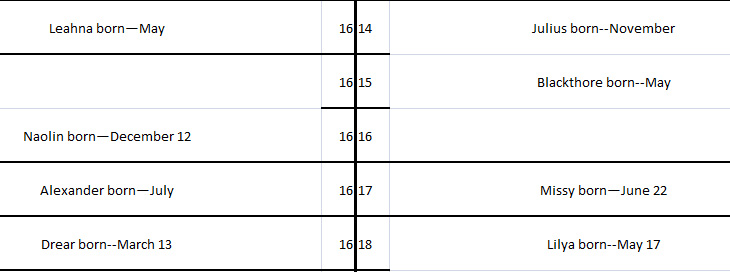
Years ago, when I was writing fanfiction, I struggled to create a timeline for my large group of stories that stretched across many years and contained a lot of the same characters. I started on paper, and eventually tried to make something with Excel. I did end up with a format that I have since used for other writing, but it was still a pain to use and especially to make edits.

timeline

It gets really messy when the events of the story pick up.

A few years ago, at the end of NaNoWriMo, I noticed amongst the winner goodies a discount for a program called Aeon Timeline. I downloaded the free trial and spent a few days putting several stories worth of information into it. I discovered very quickly that it was exactly what I needed.

There are many settings you can play with, including having the timeline stretch out over thousands of years, or one single day. If you choose the latter, the timeline will show much more detail than with the former. I’ve read that a user can create their own calendar system in the program too, which would be useful for fantasy writers, though I haven’t used the feature myself.

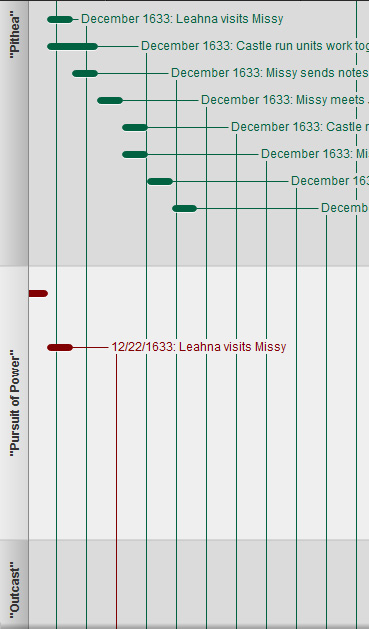
You can have individual sections for different stories, different story arcs, or whatever else you may need. You can also toggle those individual arcs on or off to your liking.

Aeon arcs

“Arcs” are shown along the left.

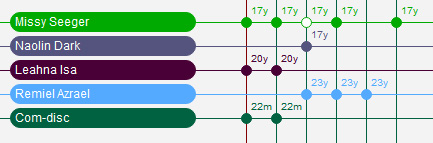
And one of my favorite things about the program is that you can add in all of your characters and attach them to the entries. If you set up a birth date, it will even tell you how old the character is at the time of that entry. The feature is called “Entities,” because it pertains to more than just characters too. I used it to remind myself of when a particular device (listed in the picture below as “com-disc”) was introduced into my story world, because I was having a hard time remembering when it was available to be used by characters.

Aeon entities

The lines go up to entries. The dots indicate that the character was a participant in that event (the one that’s not colored in indicates “observer” rather than “participant”).

Not every story needs a timeline. Sometimes events only happen over the course of a few days. The story I’m planning for NaNo this year will cover 9 days. I still plan to make a timeline for it as I plan this month. Even if in the end it turns out to be unnecessary, I know I’d rather have it anyway.

Though I’ve been mocked (all in fun, I assure you) for how meticulous I am with my timeline, it is crucial for keeping track of things for my group of stories that include “Pithea,” “Pursuit of Power,” “Outcast,” and other plans that will take place before, after, and during the others. There is so much to keep straight–character’s ages, how long ago a certain event happened, how long a certain event lasted, etc. So whether your writing is as complicated as mine or not, if you’ve ever felt the need for a timeline for your stories, Aeon Timeline is worth checking out.

How about you? Have you ever used Aeon Timeline before? Do you have a program you use for keeping track of a timeline?

Daily Challenge Check-in: October 5, 2015

Words/Time: 155 words and 30 minutes, the latter of which was spent adding revisions for “Pithea” that were made on paper into the computer.

The words were a short introduction I wrote for the main character of my NaNoNovel. Just a few minutes ago, when I went to put my novel into the newly relaunched NaNo site, I decided to title it “Too Many Irons in the Fire.” I’m not sure I’ll keep it, because it’s a little long, but for now, I like it. Maybe just “Too Many Irons” would be better? It implies the same expression but is more succinct. Any thoughts?

Outlining for NaNoWriMo

crest-bda7b7a6e1b57bb9fb8ce9772b8faafbIf you’re just coming across this now, at the beginning of October, there’s still plenty of time to plan a story from scratch. Here is a list of posts I’ve made about NaNo, which includes starting with story seeds and beginning to develop a plot. I’m not finished with that series of posts, as I wanted to give people time to work on the various steps. Personally, I’m still in the “take a nugget of a plot and see what you can flesh out of it” stage myself. However, I think this is a good time to talk about outlining, in case anyone is ready for that step.

The Great Debate

This isn’t a new topic. Even I have discussed the debate between panters and planners more than once before. I’ve been doing a lot of reading about others’ NaNo prep on WordPress in the last month, and have come to a few conclusions about pantsing and planning: Most pantsers actually do some planning, but not enough to consider themselves planners. Most planners leave room to pants along the way, but still find that they need to have a certain amount of stuff planned in advance.

So basically, there are extreme panters–all they know at the beginning of NaNo is a basic idea like, “It’s set on Mars and involves werewolves.” Or more of a plot point like, “Everywhere she goes, Sarah hears voices. She thinks she’s schizophrenic until the things the voices say start coming true.” With no more than that basic idea, they start writing on November 1st and just let the words flow out of them.

There are extreme planners–they have a 10,000-word outline, detailed character sheets for everyone down to the MC’s hairdresser, and a notebook full of notes about the world they’ve built.

Most of us fall somewhere in between these extremes–plan a little and wing most of it, or plan a lot but still let the story change itself. And I’ve noticed that many panters think that having an outline before starting to write the story means you’re locked into what is in that outline.

The Case for Outlining

Let me just say right now that most planners do give themselves room to follow the story or characters in unexpected directions. Sometimes, I write 2/3 of an outline, then start writing, knowing that I’ll veer off the outline before I get to the end anyway. Or I’ll change the outline to suit the new direction, or throw it out completely. Not too long ago I took a little offense at a blogger who implied that pantsing was creative, and writing from an outline wasn’t. Don’t take my tone to be too severe here, but I’d just like to state that writing fiction is creating, no matter what way you go about it. Simply because I do more of my creating before I start the actual writing by no means makes it less creative.

And let me just put this out there–the more you plan before you write, the more intricate your story can be. You can weave subplots together, work in foreshadowing more easily, and find plot holes before you’ve written them into the story. Outlining doesn’t make your story perfect, but I do believe it adds more potential for depth.

One more reason that I find planning to be important is that if I don’t write down ideas as I have them, and get them into place in the story, I will simply forget them. Even for this post, when I was falling asleep last night, I had an idea for a random plot point for the example up above. I really liked it, even if it was just an illustration. By this evening, I’d forgotten it completely.

Types of Outlines

1.) Perhaps the first thing that comes to most people’s minds when they hear the word “outline” is the formal outline. You know the kind–with the roman numerals and indentation and such. outlineThey provide some scene organization and truly, if this works for you, great! Though they always made writing research projects easier, I still disliked making these in school. And a few years ago, I tried to make one for my NaNo project anyway. About 1/4 of the way through the outline, I decided it was more difficult than it was worth and switched to my normal way of outlining.

outline2.) My outlines usually look like this. Actually, they’re normally handwritten, but this one I typed was easier to share. I simply write plot point after plot point, events as I want them to happen. Sometimes a single line in the outline is so broad that it takes several pages to write that plot point. Sometimes the story flows quickly through several pages of outline. The important thing is that I’m getting down, in order, what I want the story to look like. And sometimes the details don’t require much extra thought during the writing (which, by the way, can be really helpful during NaNo…less slowing down to think of what else should happen means I get the words out faster). But sometimes the outline only tells me that “MC grows up after the important thing happens at the beginning of the story,” and I end up spending several thousand words making up things that happened to him while he was growing up.

3.) I recently learned about worksheets and templates for outlining. I knew of them for characters, so it makes sense that they’d exist for outlining too. If you think you’d benefit from having a template, you may try doing a web search for one that works for you. From what I can tell, there are those that give you lines to fill in an introduction, several plot points with supporting material, a climax, and a conclusion. Or there are some that show the image of a story (sort of like a mountain) and tell you to fill in the points along the way. If you’re new to fiction writing or even just new to outlining, perhaps the structure would help.

4.) Another way of outlining or plotting I have heard of, but never tried, is making a plot board. Some sort of board on which you place individual cards, post-its, whatever, each one of which is a different plot point or detail. You can color code it (which to my thinking would come in handy to show different subplots), see it all at a glance, and move points around as you need to. Something like this can probably be done on different mediums, and there are probably online that you can find better information on this than I can provide.

I personally plan to try outlining in Scrivener this year. I still have the free trial, though it won’t last all through November. But I’m still testing out different aspects of the program to decide if it’s worth buying. Since you can create a new scene for each outline point and then write directly into the scene space, thus organizing your story as you write, it seems like a nice tool…I’m just not sure how it will work for me in practice.

During October

Wherever you may be in your NaNo prep, I strongly advise that you start gearing up for NaNo now (if you haven’t already been). It’s not that it’s impossible to dive right in on Nov. 1 and win, but there are certainly ways to make it easier. As I’ve mentioned before, making writing part of every day now will make needing to do that in November easier. Even if you only spend 15 minutes per day free writing or working on novel planning, you can start building the habit now.

Are you gearing up for NaNo too? Do you have a different style of outlining?

Daily Challenge Check-in: October 1, 2015

Words/Time: 23 minutes working on developing the plot for my 2015 NaNoNovel. I’ve semi-officially decided that I’m going to write a murder-mystery novel tentatively titled “Murder at the Rendezvous.” I’m nervous about it, because I’ve never written any kind of mystery story. Also because the plan is for the story to be a lighthearted take on the genre, and I’m not sure I’m good at light, comical writing. So this will certainly be a challenge to me in many ways.

The reason I say it’s semi-official is because I am not above changing my mind at the last minute. Some may find this lazy or cheap, but until a month ago, I had planned to write another novel in my “Pithea” world. It’s around two-thirds outlined already. If in the next month I don’t produce a solid enough outline for this story, I will fall back on the previous plan. I would rather put “Murder at the Rendezvous” on a shelf, maybe trying again next year, than to risk wasting NaNoWriMo. Besides, it’s not even like I’d be wimping out on the challenge of writing something I’m not used to. The novel I’ve already partially outlined is a mystery/suspense novel…no matter which way I turn, it appears I’m writing mystery this year.

I won’t post anymore daily check-ins until Sunday or Monday. I’ll be out of town this weekend, attending a rendezvous. My dad demonstrates blacksmithing at historical reenactments, and I go along to some of them to sell his products. The next two weekends are our biggest shows of the year. (This weekend is Feast of the Hunter’s Moon in West Lafayette, IN, if anyone happens to live nearby. It’s a pretty big deal.) This year, I’ll be paying more attention to my surroundings than usual at these shows, because I’m basing the setting of my novel on these events. This will probably be the biggest case of “write what you know” I’ve ever done.

Tips for NaNoWriMo, Part 2

crest-bda7b7a6e1b57bb9fb8ce9772b8faafb

Happy October! For those of us who are planning to participate in NaNoWriMo, October should be a very important month. (And I see by the WordPress Reader under the tag of NaNoWriMo that I am not alone in this thinking. Seriously, for the last month, I’ve been obsessively reading every post on WordPress that has been tagged as such, and it really exploded today!) There is a lot to prepare in advance, and I don’t just mean the story. Let’s face it, planning a story is only part of what one should to do prepare for NaNo.

Today, I’m going to share some more tips for what you could do throughout this month to make sure you’re ready to write on November 1st.

A few weeks ago, I shared some ideas for these pre-NaNo months that could help anyone who was planning to participate get ready. All of those tips still work for this month too. Honestly, if you’re new to NaNoWriMo especially, I suggest you learn what works for you now, because you’re not going to want to spend your first few days of writing trying to figure out where the best place is to write, or when you can get to it, or other things like that.

1. Consumables
NaNoWriMo is not the time for sleep. Caffeine can be a crucial ingredient for the month, so make sure you’re stocked up on your favorite poison. I don’t care for coffee, so I usually drink cappuccino (the kind from a powder). I drink iced tea, even in cold months, but it’s normally decaf. Last year someone suggested switching to regular tea for November, so I may try that too. But for my birthday this year, I got a Keurig machine. Strange for someone who doesn’t like coffee, I know, but since I discovered that I rather enjoy flavored coffees, I’ve gone kind of crazy for it. So I have a lot of that stocked up for November.

More than beverages, though, many people find that they want to snack more during NaNoWriMo. I know not everyone is as self-indulgent as I, so if you’re more health conscious, you may want to skip the chocolate. Personally, though, I have plans to go to some stores on November 1 in the afternoon and buy up a bunch of post-Halloween-sale candy. Chips are also a staple for some, or any other snack-type foods you like.

2. Writing Tools
This may seem kind of obvious, but there are plenty of things that you may assume you’d remember, or you’d have available, but won’t be able to find when the time comes. Make sure you have any notebooks you may need, pens or pencils, binders, planners, whatever physical items you use for writing. Put them all in one place and even contained in a transportable bag, box, etc. if your location for writing tends to change (either within the house or to coffee shops, library, or friend’s house). I would advise that even if you are a true computer writer and don’t use pen/paper for any stage of writing that you still carry a notebook and pen or pencil with you during November. It’s a good back up in case anything goes wrong with electronic devices, and this is not a time to risk that.

In the virtual sense, make sure you know what programs or apps you want to use and have them on any computers or devices you may use. If you’ve heard a lot about a program but haven’t tried it yet (like Scrivener or Evernote), download it now and play around with it before November. During NaNoWriMo is no time to be trying to learn a new software. I have some more virtual tools that I use for writing that I’ll share during the rest of this month too.

3. Writing Buddies
I’ve mentioned before that now is the time to be finding your home region on the NaNoWriMo website. More than that, this is a good time to start scheduling your month for local events, if you can make it to those. I won’t say that it’s a necessity to attend, as I would be a hypocrite if I did. I’ve never been to a write-in, just the last few years’ kick-off parties. Write-ins are usually 45 minutes away, and I’m a stay-at-home, homeschooling mom, so it’s hard to get away. This year, though, my local library, which is about 5 minutes away, is going to have weekly write-ins, so I’m working out plans to at least go to the first one and see how it goes.

Whether you go to in-person events or not, it can be nice to connect with others in your area, even if only online. Introduce yourself in the forums, see if there is an online chat you can join in on, and just be part of the community. It’s easy to get overwhelmed with the community if you let yourself, which is why I mostly stick to my region’s forums, and don’t venture much into the main forums.

Something else to be thinking about now is how you might best go about doing some word wars once November starts. (Word wars are where you and at least one other person agree on a set amount of time, usually 10-15 minutes, start writing at the same time, and compare your word count at the end.) Last year I was part of my first word wars, and let me tell you, they are very motivating. They were all virtual, taking place over Skype in a group some people from my region created. Almost every day there were word wars going on in the evening, and most of the Wrimos who were there regularly finished NaNo at least a week early, citing word wars as the reason why.

If you know people in person who are also doing NaNo, they’d be the obvious choice for word war competitors. However, you can usually find someone to go head-to-head with in your region, at write-ins esp, or if all else fails, there’s a forum for that: http://nanowrimo.org/forums/word-wars-prompts-sprints

4. Involve Other Senses
So number 1 kind of covered taste, but that’s not really what I mean. I’ve mentioned in a previous post about how the time leading up to November is a great time to discover what kind of writing atmosphere you need (if you don’t already know). Do you require absolute silence? Some kind of white noise? Music? The last one is what I’m referring to right now.

Some people create a playlist for every story. I’ve read about people who will find music that matches the theme of their story, make a playlist from it (even if just on YouTube), and listen to it all month. Then, when November is over and they want to go back later and either finish the novel or revise it, they can listen to that music again, and it will put them right back in the mood. I’ve never done this, I think because music doesn’t work that way in my head. Or maybe it’s because I’m too lazy to spend time tracking down what music would fit my novel (though this year, I may just have the perfect music, given the subject matter).

One year, I did spend the whole month going back and forth between these two playlists: D&E NaNo songs, NaNoMusical songs

Whatever your taste in music is, an alternative to creating an audio scene for your story is creating an olfactory scene. Scent memory is said to be very powerful. Go to the store and smell all the candles or all the scented wax (if you have or are willing to buy the wax melter to go with it). Think of your story, what it’s about, where it’s set, who the main character(s) is/are. Is it a romance? Maybe something flowery or sensual. Is it set in a tropical location? Something with coconut or tropical fruit, perhaps. There are outdoor scents if your story involves a lot of forest or other outdoor scenes. Not every story lends itself easily to a scent, but pick something that smells right and have it burning/melting near you while you write all month. Then later, you may just be able to immerse yourself back into the book by activating that scent again.

5. To Sprint or Not To Sprint
NaNoWriMo begins at midnight on November 1. This year, that falls on Saturday night/Sunday morning. If you’re the kind who stays up late, or can make an exception for one night, you can start writing right at midnight and get some words under your belt before going to bed. It’s purely a mental trick, getting a jump start on the day’s word count, but many people love to do the midnight sprint.


If you read my first Tips post, hopefully you have been getting used to how you like to write–what format you prefer, what items you’ll need, what kind of writing environment you desire. If not, there is still time to do that. The best advice I can give is to start writing every day right now. Whether that writing is pre-writing for your NaNoNovel (brainstorming, outlining, character creation) or just free writing to get in the habit, it’s a great idea to warm up before November starts, and not jump in cold.

Are you considering NaNoWriMo? Give me a shout if you’re participating, and share what you do in October to get ready. Feel free to add me as a buddy on the site, though let me know you came from here somehow.