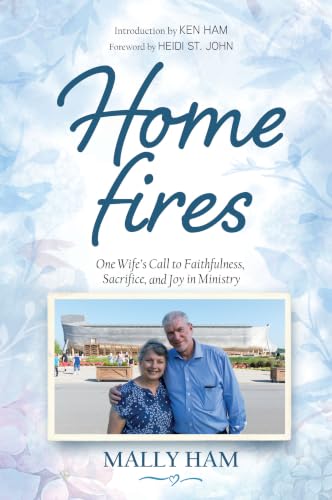
Home Fires by Mally Ham My rating: 5 / 5 Genre: Memoir, Christian non-fiction
Ken and Mally Ham have been married for over 50 years, and for much of that time, Ken has traveled all over to teach people about Genesis, creation, and biblical truths that have been under attack for decades. In this book, Mally shares the ups and downs of their lives together, her perspective on the beginnings and growth of Answers in Genesis, and how God provided what she needed throughout it all. I am so grateful for and appreciative of what AIG has taught me over the years through its various resources and the ministry’s commitment to the truth, so seeing the incredible ways God opened the doors for it to become what it is today didn’t surprise me at all. I enjoyed the additions from Mally’s children and some other family members; it grounds the book in a way, showing that Mally’s humility is not exaggerated. I truly loved getting this behind-the-scenes look at their family, and it made the entire book an absolute joy to read.
The primary audience for the book seems mainly to be wives of men in ministry, but there is also a lot to glean about godly marriages in general. Though many of us won’t have the same personality as Mally (I share her incredible shyness, but not her humility and gentleness, at least not naturally), she does offer insight that goes beyond her own experiences. As someone preparing to enter ministry life alongside my husband, I found her perspective incredibly comforting and deeply encouraging. This book is a great read for Christian women or anyone interested in the background of Answers in Genesis.
Life Is Hard. God Is Good. Let’s Dance. by Brant Hansen
My rating: 5 / 5 Genre: Christian living
It’s all right there in the title. Our world is fraught with anxiety, fear, and depression. But God truly is good, and understanding that truth can help us trade in the anxiety for peace and joy. Radio show host Brant Hansen offers insight, suggestions, and examples on this topic. He uses scripture as well as quotes from both Christian and secular writers and thinkers to back up his claims, and he does it all with his signature humor.
I have a lot of respect for Brant Hansen, his take on God and the Bible, and the ways he lives out his faith. He talks a lot about CURE International in this book, as people he’s met through that organization seem to have given him a lot of insight into the subject matter of this book. (I don’t mean this in a bad way, by the way, as CURE is a wonderful program and absolutely worthy of all of the attention he gives it.) Brant’s casual style makes the book easy to read and understand, which I appreciate so much. And because I listened to the audiobook, I got to hear it all in his own voice, which always adds a layer of enjoyment for me. Whichever way you go, I recommend this book, as well all of Brant Hansen’s books, really, to everyone.
Robert Mullen brings together several different artists with paintings, sketches, and photographs of the North American boreal forest in this colorful, informative book. I enjoyed the descriptions of various expeditions into the wilderness and especially encounters with animals during these voyages. Canoeing through little-traveled areas and experiencing what few others experience is something I would loved to have done at some point in my life (it’s definitely not feasible for me anymore), and this book brings that to life. The artwork is breathtaking, and I’d imagine it’s even more so in print version, compared to the ebook I read (though thank goodness I at least have a decent-size tablet to do justice to the full-page spreads).
I’ll admit that I did skim some of the sections about different wildlife, when the information shared was about where they lived or nested and how endangered they were, paying more attention when the author shared personal experiences with certain species. My main issue, though, is with the extensive references to the world being billions of years old, which is pure conjecture but referenced here as fact (and often). It’s nothing I’m not used to and doesn’t keep the book from being beautiful and interesting. I could see this being a great gift for someone interested in the subject matter and is an overall enjoyable book.
I received a review copy for free, and I am leaving this review voluntarily.
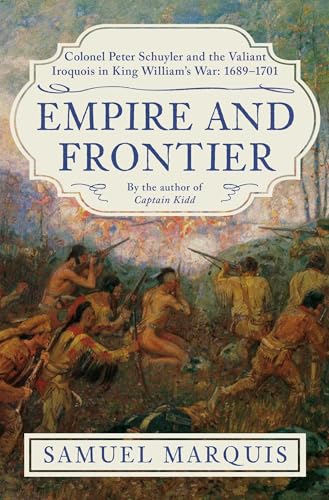
Empire and Frontier follows Colonel Peter Schuyler in New York during King William’s War (1689–1701), showcasing alliances and conflicts with various Native American groups, the French, and other colonists. The language in the synopsis led me to think this might be a fictionalized story of this time in history, but it’s actually nonfiction. While that’s fine, it just wasn’t quite what I was looking for. Weirdly, though, there are moments where it becomes more subjective than I’d expect a history book to be, with the author attributing feelings and reflections to various people in the book—details I find difficult to believe are described to that degree in letters or journals. The author also seems to include some bias for or against some of the historical figures in the book, religions involved, things like that.
There’s a pretty in-depth list of all historical figures involved at the front of the book, which I mostly read through, but that turned out to be unnecessary, because the same details given there are also given each time one of those people is first introduced in the book. That and other repetitive sections caused me to start skimming the book in parts. The book would zoom out and cover several months quickly, and then zoom in and focus on a battle in detail, which made the flow a little hard to follow. I will say, though, that the battle descriptions were some of the most interesting parts in the book. I could have done without explanation of some of the ways people were “slow tortured” by their enemy though.
It’s not that I didn’t find anything of interest in the book, and I can definitely see it being fascinating to history buffs. If you’re looking for historical fiction, this isn’t that, but if you enjoy reading about history, are interested in this time period in American history, and are okay with some subjectivity by the author, then you may be the right audience for this book.
I received a review copy for free, and I am leaving this review voluntarily.
So You Want to Be an Architect takes what could be a complicated subject and makes it accessible to kids and teens. But it also doesn’t talk down to them—there are areas younger kids may not be able to follow, but there’s enough context to get the point across well enough, I think. I also think that if something is a little over a kid’s head and sends them to asking someone about it or looking it up, that’s not a bad thing at all. The book goes beyond explaining what architects do and what they need to learn to be able to do it; it also talks about what kinds of interests, innate skills, and even indefinable ways of seeing the world around them that might lend themselves to a potential future architect. There are segments on famous architects and fun facts as well and beautiful, colorful illustrations throughout. (The illustrations are done with AI assistance, as Soules explains at the back of the book.)
I really like how the book talks about both the good and the bad (or at least the difficult) sides of being an architect, as well as the glamorous and more-common “normal” aspects. The book is intended for pre-teens through teens aged 10-14, and I definitely could see it being a great one for anyone in or near that age range, on either side of it.
Four Windows, One Jesus is a 40-day devotional focusing on Jesus as portrayed in the four gospels. Each gospel is given 10 days (11, if you count the intro to each gospel’s section that is about as long as the daily devotional), with the intention to show the different facets of Christ that are provided by the 4 different gospel writers.
I think many will find a lot to appreciate in this devotional. I wrote down a few nuggets that I gleaned and that made me think about Jesus, myself, or my relationship with Jesus a little differently. The author pushes the reader to not just skim passages that are familiar or even thought of as boring, like the genealogy at the beginning of Matthew, but to slow down and try to focus on the text and why it has been included. As someone who has been a Christian for many years and has read/heard passages from the gospels many times over the years, I appreciate this slower approach. I also like that the reader is tasked with reading a passage for themselves and then reading the devotional about that passage, rather than 1) the devotional covering only a verse or two, which can be done well, but often ends up feeling a little shallow or out of context (though there are a few of these devotionals that cover only a verse or two as well) or 2) feeding you the passage instead of leading you to look it up in your own Bible.
However, I struggled with a few aspects of the devotionals along the way. There is a lot of repetition in each devotional, and the author’s overall literary style is not my preference. He weirdly seems to pit one gospel/gospel writer against another when the day’s passage is one that is also included in another gospel, comparing them in a way that, at least to me, seems to say that the other one has parts to it that aren’t worth thinking about right now (even though the idea here is supposed to be to bring the different views of Christ together). And in the same way, he seems dismissive of the Old Testament and other historical context, as he will vaguely reference something that would give a scene in the gospel more depth and meaning and tell the reader to not let that bog down the reading/understanding. But as my church’s pastor is fond of saying, “There’s no text without context.” Sometimes that context makes all the difference in understanding why what happened in the gospel matters or what it means! There were a few spots I noted that I think he may have interpreted something wrongly, but nothing I felt was theologically wrong.
I am not sure who the audience for this devotional is meant to be. I feel that some of his vague references to context would confuse newer Christians or those who don’t have a decent background with the Bible. More mature Christians might find enough of value here to make the book worthwhile, so I suppose that’s where the correct audience is best found. I could see a case being made for reading this with a group, because good discussion about what is brought up in the text (and even the question about whether or not the reader should ignore the context or whether one angle of an account is “better” in Mark vs. Matthew) could arise.
I received a free review copy from the author in exchange for my honest unedited feedback.
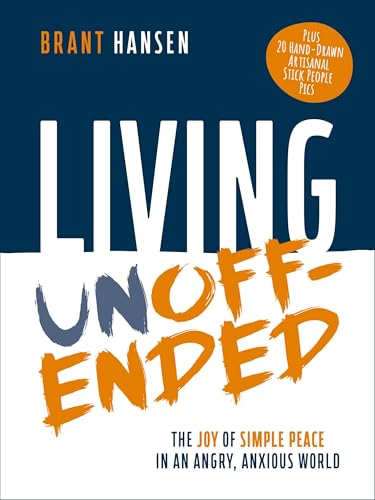
Radio show host Brant Hansen counters the common opinion that Christians are entitled to “righteous anger,” while also making a case about how learning to let go of our “right” to be offended can change our lives.
I read Unoffendable by Brant Hansen 6 years ago and found that it had a lot to offer; it helped me examine a lot in my life, not only about anger and anxiety but also hypocrisy and self-righteousness. As Brant says in the intro to this book, “We need to keep talking about this stuff.” Brant does a good job here of laying out why righteous anger doesn’t really make sense and how anger and worry mean we’re not trusting God like we should. He uses scripture as well as examples from both Christian and secular writers and thinkers to back up his claims, and he does it all with his signature humor. Brant also offers some practical advice for learning to let go of offense, becoming more humble and Christ-like, and trusting God more fully.
The book is basically a series of short essays, and some of the content comes from at least 2 of Brant’s other books (Unoffendable and Life Is Hard. God Is Good. Let’s Dance.). I haven’t read the 2nd of those books yet, and fortunately I read the 1st long enough ago that it didn’t feel like a repeat to me. However, if you have read either or both of those books, you may not feel the need to read this one. Not that there isn’t anything new here, but I’m not sure how much is new. I do recommend this book, as well all of Brant Hansen’s books, really, for Christians and non-Christians alike.
Thank you to Netgalley and W Publishing for providing me a copy of this book to review.
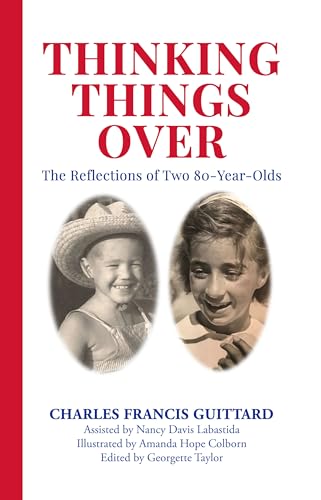
There are 3 main styles within this book about two 80-year-olds meeting online and falling in love. First, there is a series of essays written by the author himself, Charles Francis Guittard, who is clearly very interested in history, especially that of his own family. The essays cover Guittard’s time growing up, focusing on what his parents both did to try to make him a well-rounded individual, with some included backstory of his parents’ lives. Then there’s a large middle sections that is a collection of emails between Guittard and his now-wife Nancy Davis Labastida, when they first met and got to know each other, all the way through about a week before their marriage. This covers only around 3 months, but includes a lot of emails. Finally, there’s a section of stories about Labastida’s tiime growing up in semi-interview format—Guittard asking questions for her to answer. The last section of the book is a fictional imagining of someone facing judgement upon their death, so I guess that’s sort of a 4th style, but that and the section about Labastida’s childhood are comparatively short.
Strangers to married in 3 months sounds crazy to most people, but I have to say that the amount of info they shared in their emails does make it a lot more understandable. I can also understand a desire to not wait very long to be with someone you feel so connected to, when you’re in your 80s. The emails read like two teenagers falling in love for the first time, though they had both been married before. There are parts of their romance that I did not connect with, but that’s not to say that made it bad somehow. Overall, I did enjoy the book more than I didn’t.
I question the inclusion of the short story at the end. It’s essentially a courtroom drama where God, Jesus, and the Holy Ghost are sitting in judgement over a man who claims to have lived a good life. There are 2 lawyers questioning making arguments and even questioning a couple of witnesses, but it leaves me really confused about what Guittard understands about salvation and eternity. He includes a lot of church lingo and seems to have a decent understanding of what is important to salvation, but at the same time, he seems confused as well. For one thing, the fictional defendant sort of claims that the Trinity is made-up, which he says to the panel made up of the triune God…so…that makes sense (unless he’s making the theological point that Jesus and the Holy Ghost aren’t God?). But more importantly, he talks about a “come to Jesus” moment vaguely and talks about denominations and baptism and tithing as if those are a big part of whether or not someone is saved. The question is simple: have you repented of your sins and accepted Jesus as Savior and Lord? I think the clear answer here for J. Hiram Harmless (the fictional defendant) is: no.
Though normally, I don’t have a lot of negative to say about an autobiography or memoir, understanding that the author has shared what they wanted to share, whether I wish there was more or less of anything. But, the dip into fiction aside, I will say, there are portions of this book that I had to skim. A lot was included about tennis and bridge, neither of which I’m particularly interested in (or know anything about at all, in the case of bridge). There are other personal details that I also skimmed, but I may just not be the right audience—I have a feeling that people interested in genealogy or personal family histories will enjoy those parts a lot more than I did.
Newsboy: My Story of Hope and Second Chances by John James
My rating: 5 / 5 Genre: Memoir, Christian non-fiction
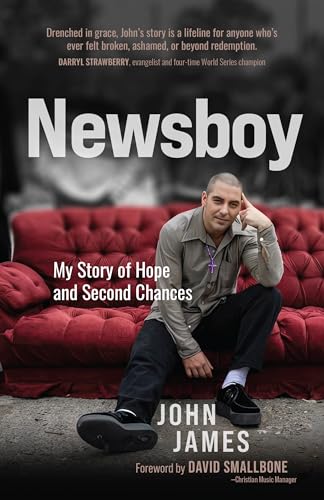
When John James first stepped down as the Newsboys lead singer in the late 90s, I was in high school. I had no idea what had led to this decision, but the band kept making great music, so I was content enough. Then, I remember very well the Newsboys concert my husband, son, and I attended (it had to have been around 2009-2011, since it was soon into the band’s new era), when John James stepped out onto the stage to talk. I’m pretty sure most of the people around us had no idea who he was, but I did. I had been to at least one concert before he left, owned several cassette tapes or CDs of the early Newsboys, and had seen Down Under the Big Top many times (I even had several of his lines memorized from the movie—still do, in fact, and still have the VHS tape). I hadn’t seen him in a long time and was excited he was there! He began to tell his story, talking about his addictions and sinful behavior that had led to his departure from the band. He talked about the moment he thought about killing himself, making a joke about it, and the people around us laughed. I didn’t find any humor in it, though; my husband and I stood there with mouths agape. I’m pretty sure I was holding back tears. I’m really glad I didn’t know about any of that back when I was a teen and the Newsboys was fasting becoming my favorite band (especially since the info circulating at the time was largely worse than the truth), only hearing some of the details after James had allowed Christ’s redemptive work to change his heart and his life.
This book expands a lot on what he shared during that concert over 10 years ago, and James is transparent and vulnerable in the text, not hiding or sugarcoating his choices and downward spiral. He starts with his childhood, a foundation that shows that he wasn’t just paying lip service to Christian tenets when he first started writing songs and speaking on stage as the frontman of the band. But like all of us who are sinners saved by grace, he made wrong choices, which he then compounded with more wrong choices and the decision to hide those choices from friends and loved ones. He talks of danger points, like disconnecting from a local church and neglecting one’s personal time with God, and he ends the book with a very hopeful note. I don’t think I’d call it a “happy ending,” exactly, because he is still suffering some consequences from how he lived for a while. But the major theme here, which is infused throughout the book, is that God can redeem those that are lost and is waiting to do so, if we’ll turn and repent. This book is definitely worth reading for anyone who is a fan of the Newsboys (in any iteration), is interested in stories about the Christian music industry, or is in a position where you believe you’ve fallen too far to be forgiven by God.
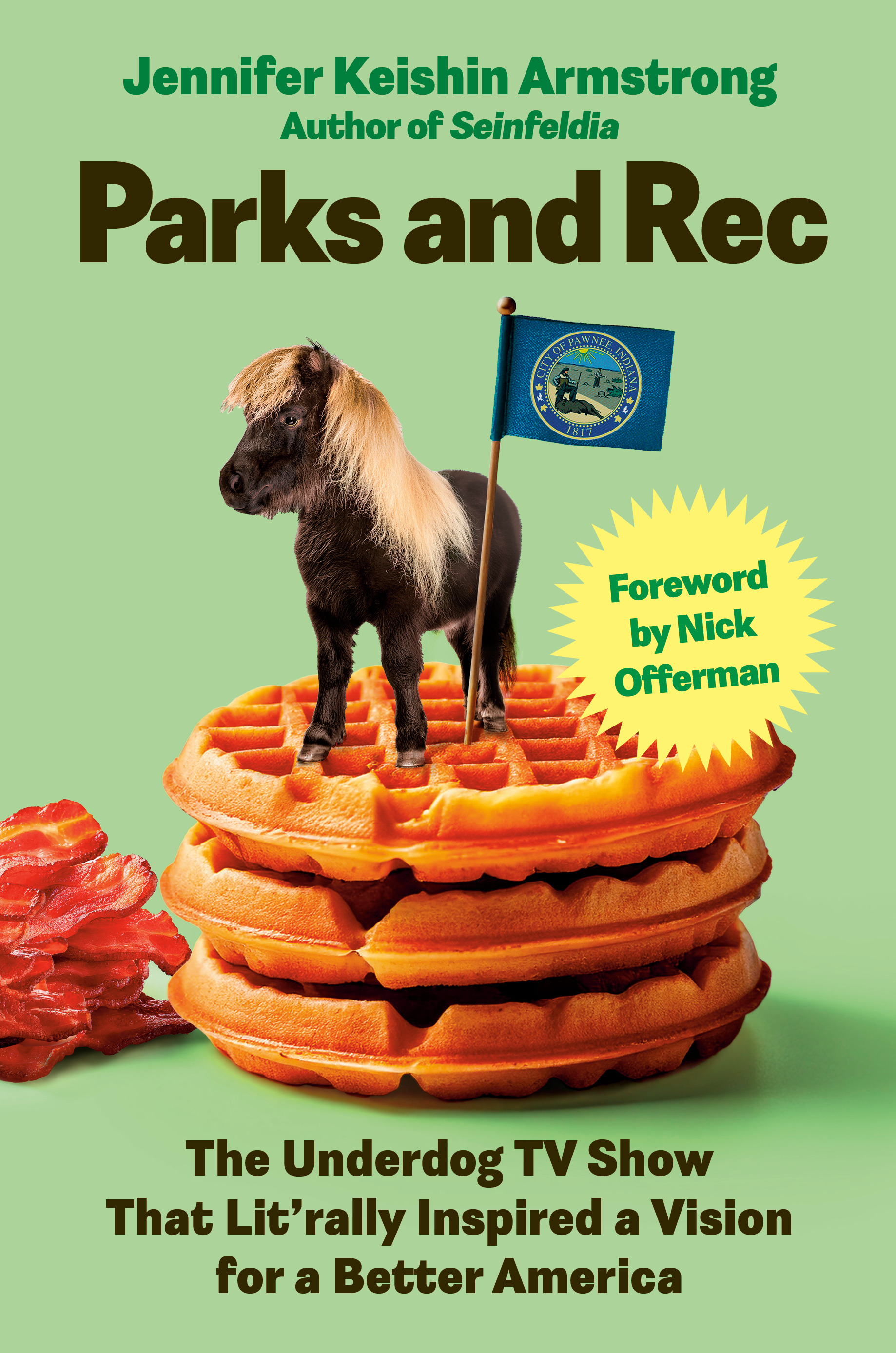
There was a little bit of interesting information in this book, but it was a slog to get through. Half of the time the author was giving us the backstory of every actor/writer as they joined the show or giving us a synopsis of an episode, sometimes up to a few paragraphs, usually with no reason for it other than to tell us about the next great episode they made. I have seen the show several times, but I am not one who has already read a lot of other books that talk about the show, so in a way, I feel like I’m in the middle of the fandom in regards to knowledge of the show. The explanations of various episodes was completely unnecessary for me, and the background details just didn’t interest me. There were a few tidbits here and there that I appreciated, but it wasn’t enough to keep the book from feeling slow and boring.
Weirdly enough, this book made me question my feelings for Parks and Recreation, a show that I have always liked and rewatched multiple times. I never liked it as much as The Office, though, and I think this book gave me insight into the reasons for that. The show was funny and well-cast, but very liberal (which I am not). Though yes, veiled under a local government trying to be bipartisan and show people from different sides working together, having one libertarian does not cancel out the overall liberal leaning of the show, especially since. I’m used to this from Hollywood, of course (both the people there and what they produce, generally speaking), but this show actually being about government and politics brought all of that more to the forefront. And in this book, the author doesn’t even pretend to be unbiased with her political leanings, praising the Obama era continually, denigrating President George W. Bush, and basically demonizing President Trump. Whatever your feelings on any of these past/current presidents, I really feel like Armstrong crossed a major line. She apparently either assumes that every fan of Parks and Recreation is a hardcore liberal like her or she could not care less about those who aren’t. Being from a rural area in Indiana, the state in which the show is set, and being a Christian (the conservative kind, since there are liberal Christians as well), I was already aware that this show heavily mocks people like me, or to be more accurate, a caricature of people like me, but somehow, this book made it bother me more. I don’t think I’ll rewatch the show anymore after this.
If you are a huge fan of this show, are a liberal, and haven’t already consumed info about how the show was made elsewhere, you’ll likely enjoy this book more than me (though keep in mind that wasn’t my only gripe; if it was, my rating would have been higher). Anyone else…you might want to pass. (I’m currently re-watching The Office (superfan episodes) while slowly going through the book Welcome to Dunder Mifflin by Brian Baumgartner and Ben Silverman. It’s amazing. I was hoping this book would be something at least similar to that. It’s not.)
Thank you to Netgalley and Dutton for providing me a copy of this book to review.