Book Review: Stealthy Steps

Stealthy Steps
Nanostealth
#1
by Vikki Kestell

My rating: 3.5 / 5
Genre: Christian sci-fi thriller
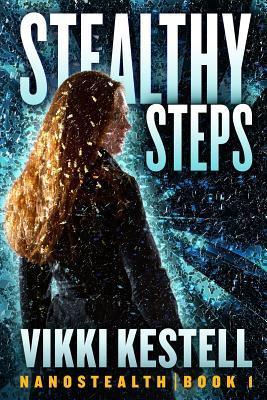
I didn’t fully understand the premise of this book going into it, because the synopsis is more like a boiled-down excerpt from part of the book, with a little extra character introduction. Most of the information is there, but it’s cryptic. Here’s my synopsis though: Gemma Keyes is a young woman fresh out of college, and takes a job as a project manager at a top secret lab. She mostly organizes things and takes meeting notes, but this makes her privy to some classified information. When she hears the wrong information (not her fault), she is fired. Months later, after an accident in the same lab claimed the lives of the 2 top scientists she was working for, she’s contacted covertly by one of those scientists, Dr. Bickel (obviously not dead). She ends up being asked to help him continue his work, which he’s keeping secret from everyone at this point. This work is in nanotechnology. When the government, and in particular, a nasty military general who has no scruples about how she gets information & technology for her military, closes in on Gemma and the man she’s helping, an unexpected incident leaves her invisible. Literally. (Some people see the invisibility aspect as a spoiler, but it’s how the prologue ends, so I see it as part of the set up.)

So…now Gemma has to figure out how to live life completely invisible, which presents all sorts of problems, especially since she practically lives in a fish bowl. Half of the book is about this, as well as her concern about being discovered by the general who went after Dr. Bickel. This half of the book is entertaining and interesting. I liked the relationships Gemma developed both before and after her invisibility. My favorite thing was the ways she tried to communicate with the nanotechnology that is responsible for her uncontrollable invisibility.

The first half of the book had some interesting parts as well–especially the relationships that began and/or developed between Gemma and Dr. Bickel, Gemma and the associate pastor of her old church (more on that below), and an established relationship between Gemma and an older neighbor. However, the first half of the book was bogged down heavily by a lot of exposition and repetition.

First, there is a long and tedious description of how Gemma first got into the secret, abandoned military based where Dr. Bickel directed her to meet him. It might not have been so bad, had we not already given given those steps (most of them), but backward. Then there are the 37-8 pages of Dr. Bickel talking and explaining. Explaining how he avoided dying in the lab explosion, explaining how he got himself set up in this mountain base, and longest of all, explaining how the nanotechnology works. In detail. That most of us reading aren’t going to really follow. Some of it did prove to be important to the rest of the story, but honestly, much of it wasn’t. (At one point, after about 33 pages of explanation,  Bickel says, “‘Would you like to hear more about the nanomites before you go, Gemma?'” And I literally thought, “I wish could say no.”) Since the book is told in 1st person, and Gemma didn’t understand a lot of what he said, I have a very difficult time believing that when she wrote this account some weeks or months later, she could remember all of the science that he spouted. It could have definitely been boiled down for us, and even more so, would have then fit in with the style of narration that the rest of the book has.

Much of the information in the first half of the book would have been okay on its own, but since it was all told together in the first half, it made it difficult to keep reading. I totally understand why the prologue is a long description of the point when Dr. Bickel is discovered in his secret lab by the general, ending with Gemma finding herself invisible. It needed that action and intrigue to get people hooked. Still, if I hadn’t been recommended this book series by my mom who has recently been very anxious for me to read it so she could hear what I thought, I might have at least set it down and come back to it later. As such, once you’re past that half of the book, it does get more interesting. It’s the first book in a short series, so some of the expositiony first part can be explained as set-up to an entire series, and it does have an ending that left me wanting to know more. Still, I think setting up an entire series isn’t an excuse for so much info-dump all at once.

The associate pastor I mentioned above, named Zander, is where the Christian aspect of the book comes in, for the most part. He’s invited to visit Gemma by her older neighbor, and he is a good example of a Christian in fiction. He is generous, compassionate, flawed, and complicated. Gemma sees a lot of sides of him, some of which draw her to him, but others of which push her away. His very Christianity is the biggest obstacle to their developing relationship, though, because Gemma is quite against Christianity. He speaks the truth in love, and shows Christ’s love through his action, while still being a believable human being. I look forward to seeing how this develops in the rest of the series.

I was particularly bothered by some of Gemma’s actions in this book, and the way she excused them, but I think that was intentional. She also got angry, or at least upset, at weird things, which made her seem like sort of a petulant child to me sometimes. I don’t know if that part of her personality was intentional or not. There were a few inconsistencies that stuck out to me (like why Dr. Bickel let Gemma take pictures in his secret lab, after the intense precautions he’d asked her to take in getting there, and in their communications). Also, I feel the need to give some trigger warnings: domestic abuse, child neglect and endangerment, descriptions of or allusions to gang violence.

So to sum up, yes, the first half of the book was slow, but the rest was good enough, and I have faith that the following books will pick up the pace, that I felt the book was worthy of 3.5 stars. I would recommend the book to fans of Christian mysteries & thrillers and lovers of this type of sci-fi.

Find out more about Stealthy Steps

See what I’m reading next.

If you’ve read this book, or read it in the future, feel free to let me know what you think!

Book Review: Swipe

Swipe
Book #1
by Evan Angler

My rating: 3 / 5
Genre: YA dystopian

Everyone who knows end-times Christian fiction understands the setting of this book. The world is setting up for a global government, already has a global religion, and an implanted Mark is required for buying, selling, basically for living. With this backdrop, we are introduced to Logan Langly, who has been terrified of receiving his Mark (which happens when a child turns 13) ever since his sister died when receiving hers. Around this time, a new girl, Erin, moves to town. Her father works for the government, specifically the branch that deals with trouble related to the Mark. When Erin learns that her father is basically a spy, she gets caught up in the case he came to town to work on. And that case happens to involve Logan as well.

This book was not bad, though also could have been better. From the very beginning (the prologue, even), there was a mystery set up that drove me through the story. It was a short, easy read, so that helped too.  The plots set up for both of the main characters were interesting as well, but it all kind of fell apart at the end. It took far too long to really get the answers I was looking for, and in the meantime, I was reading characters that just fell flat for me.

The two main characters are annoying and bland. There is little to no character development. My favorite was a boy who is part of a rebel group. He’s not the leader, but he’s the leader’s right-hand man. But the rest of that rebel group is so crazy that the whole rebel group aspect is just bizarre. (Two of them play a card game like War, but whoever has the highest card gets to punch the other player in the face. And it’s written like it’s completely normal. It was really weird.)

The world building is hit-or-miss. The background of how the country (and really the world) gets to where it is was well thought-out, pretty logical. The explanation of some of the current world is also interesting (though I don’t know how realistic it would be). But some of it almost comes across lazy. Many things have a prefix of “nano-“, which apparently just means it’s enhanced in some way?

It is revealed part way through the book that the rebel group has a mole at the school that the main characters go to. It comes off like it’s supposed to be a secret to the reader, but it was pretty obvious. Around the time the mole is identified, we’re also finally given some answers to why the rebel group does what it does, but the answers are unimpressive. Noble, but not nearly as interesting as I’d hoped for. And in my opinion, not presented with nearly enough evidence for at least one character to fall in line with them as easily as he does.

The ending felt a bit rushed to me, and I didn’t fully buy the way the characters acted at the end. I was also left with the question about whether or not there were meant to be romantic feelings between the main characters, and even more than that, if we were supposed to care if there were. The characters are 12 & 13, so…not really a romance I’m looking to read.

Final thoughts: the book is a set up to a 4-book series, and given the ending of this one, I’m hoping book #2 will take off quite a bit, comparatively. As I mentioned in the first paragraph, the series is said to be Christian end-times fiction, but you really wouldn’t guess it to read the first book. The only thing that hints at it is the Mark, and to a lesser degree, the possible antichrist set-up, but it’s so lightly touched on, if I couldn’t see from Goodreads that it was Christian, I would never classify it as that. Again, presumably that will come into play in the rest of the series (my son says it does–we bought these for him when they were newer, and he’s read them all). For now, it’s difficult to come up with someone to recommend this book/series to.

Find out more about Swipe

See what I’m reading next.

If you’ve read this book, or read it in the future, feel free to let me know what you think!
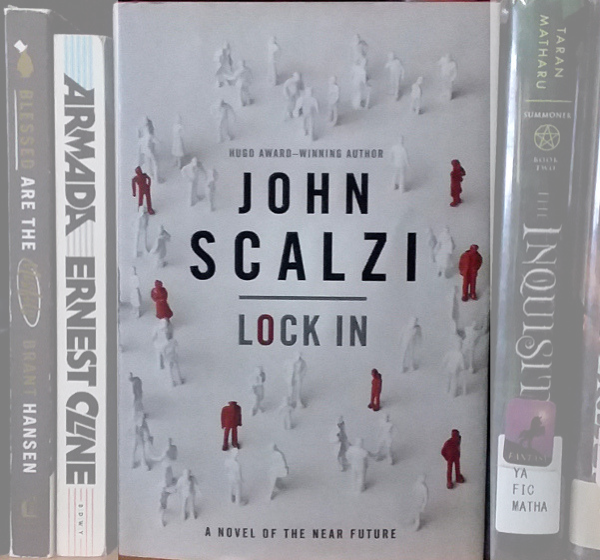
Book Review: Lock In

Lock In
by John Scalzi

My rating: 4.5 / 5
Genre: Sci-Fi mystery

Lock In

In the near future, a disease ravages humanity, leaving a large population of Earth completely paralyzed. In the time period of Lock In, technology has been developed to allow those “locked in” to live as normally as possible, either putting their consciousness into a robotic being, or into the mind of someone who has the ability to accept the mind of someone else. Set against this backdrop, the book is a mystery that starts with a murder, but deepens continually as the story goes on.

I wasn’t really expecting to like this book that much, though I don’t know why. However, I ended up liking it a lot. The sci-fi element, mainly the roles the Hadens (those who were locked in) and the Integrators (those who could let a Haden use their mind & body) played in the mystery, really enhanced the mystery plot.

The main character, Chris Shane, is a Haden and an FBI agent, who interacts with the physical world in what they call a “threep” (basically a robot that is controlled by a Haden’s consciousness). In a lot of ways, the book was similar in this area to Ready Player One, which I only read recently, so it was fresh in my mind. I was interested reading about the laws surrounding Hadens and their threeps, when it comes to crimes committed both by and against them. I also enjoyed the main character’s intelligence, ingenuity, and stoicism.

Another thing that I found myself appreciating throughout the book was the writing style. There is not a lot of description or figurative language, which to my taste, at least, can slow a story down or add unnecessary filler. There were even times that I would read through an entire page and get this feeling in the back of my mind that I’d skipped some text (I do that sometimes, essentially accidentally skimming for a bit before deciding I need to go back), but when I’d go back to try to find what I’d skipped over, there was nothing. Conversations flowed quickly, with little in the way of descriptions of what the characters were doing. Some may find this a flaw, but I personally liked it. If the characters aren’t really doing anything but sitting and talking…maybe sometimes it’s okay to not add minor actions in just because. I usually write dialog this way too, but end up going back and adding more in, because I feel like it’s expected.

Scalzi’s world-building was brilliant too, from following the progression of politics, laws, and citizen response brought on by Haden’s syndrome in America, to the slang and lingo that seemed so natural in this world. My main detraction in the book is involved in this area though. At one point in the last quarter of the book, a side character who is an expert in a field that is needed for the investigation spends about 10 pages explaining some technological and coding mumbo jumbo that I had a difficult time wading through and understanding. I was at least able to come away with some idea of what was going on, though, so it didn’t cause enough problem for me to be more than a short frustration. I also feel it prudent to mention that there was a lot more language than I prefer.

I had seen that there is a follow-up to this novel when I wasn’t even halfway into reading it yet, and I didn’t expect to have much desire to read it. However, by the end of the book, I knew I had to read Head On at some point soon!

I would recommend Lock In for fans of near-future sci-fi and for mystery lovers too.

Find out more about Lock In

See what I’m reading next.

If you’ve read this book, or read it in the future, feel free to let me know what you think!

Book vs. Movie: Ready Player One

RP1 movie vs book

I watched the movie about a week and a half after I finished the book. At first, I wanted to watch the movie quickly, before I forgot details about the book. Only a few minutes into the movie, I thought it might have been better to have waited several months (or more) to watch the movie. Maybe forgetting the details of the book would have allowed me to enjoy it in its own right. I understand that movies adapted from books have to be changed for various reasons, whether that’s to shorten the story, to add excitement, or even because a lot of what happens in the book is internal (which would be fairly hard/boring to show). And there are other reasons too. But that doesn’t mean I have to like it!

In my review of the book, I gave it a rating of 3.5 out of 5. It’s intriguing to me that the movie actually gave me more appreciation for the book. I’d probably rate it higher now. As with other posts I’ve made, some of my notes about what I didn’t care for in the movie are personal preference. Some of them, though, are places where I don’t think the movie did justice to the book, or even where I felt the movie just didn’t do well in general. I am going to give my notes, but without too much detail, mostly because my list is a little too long to go into much detail here. These are by no means all of the differences between the book and the movie, just the ones that bothered me. Also, I’m splitting these notes into things that aren’t too spoilery (shown first), and then notes that I feel would spoil either the book or movie enough to give a proper warning for.

Note: There are a lot, so it probably seems like I’m ranting. Well, I am. Again, I am well aware that movie adaptations are often very different from the book. If you think I’m being unfair, that’s fine. I didn’t realize how many notes I had about this until I started writing them down, and I considered cutting it short. But in the end, I decided to keep them all (and frankly, there may be some I forgot). So read on, or jump ship right now; it’s up to you!

  • From the very beginning of the movie, the atmosphere didn’t feel right to me. When I read the book, I got a feeling of desolation and isolation in the real world, especially where Wade lived. People didn’t go out much, because they could do much more from the comfort of their couch (and because the real world was fairly dangerous). But we first see Wade outside of his “home,” and it’s pretty lively. People are shown outside a lot during the movie, and it just felt wrong.
  • The book was heavy in 80s pop culture references. The movie expanded that to just general pop culture, but even that was very light (I get that a lot of this might have been copyright issues, but it’s still worth mentioning).
  • In the book, Wade started out overweight (spent most of his life in a virtual environment, after all), but had a physical transformation once he gained the means to be active while also in the OASIS. There was no change of this sort in the movie.
  • Also, in the book, Wade started out completely destitute. The things he had to do to make any progress in the OASIS showed ingenuity and a real struggle. This was barely touched on in the movie.
  • Because The Hunt had gone on for years already when the book started, everyone who was hunting (called gunters) knew pretty much everything there was to know about Halliday, his life, and every book, movie, video game, song, or TV show that he liked. In the movie, Wade was explaining how he’d figured out a clue to other gunters often, and it really bothered me that he knew so much more than the others.
  • Though I said in my original review that the time that Wade was alone (pushed away his friends) was not a time I enjoyed, I realized watching the movie that I missed it when it didn’t happen. Most likely, that means I didn’t enjoy it because it was depressing (which it was meant to be), not that it was a bad story element.
  • I loved Ogden Morrow’s role in the book. In the movie it was kinda…meh (and it seemed like a waste of Simon Pegg).
  • It really bugged me that they called the IOI gunters Sixers, but had absolutely no explanation as to why. It wouldn’t have been difficult to explain it. Even not coming from a book, it was an unnecessary lack of explanation.
  • Similarly, in the book, the first 5 gunters to find the first key were known as the “High Five,” because of their positions on the almighty leader board. When watching the movie, I’d completely forgotten about that until some time in the last 20-30 minutes when Wade uses that term to reference those 5 characters, and I actually sat up and said, “Wait, what?! How are we supposed to know what he means by that, when this is the first time anyone’s said it?”

Before I go into the spoilers, I want to mention a few things about the movie that I liked:

  • The visual effects in the OASIS were great. Much better than I could imagine in my head, I’m sure. I also enjoyed the way it looked when characters accessed things from their inventory and such. I’ve had dreams about actually being inside a game world, i.e. being my character, and it reminded me a bit of that. (Is that weird?)
  • There were some nods to some of the things in the book that weren’t used in the movie at all, which was nice. Seeing the planet Ludus early in the movie, for example, made me smile.

Below here are the rest of my notes, which have what I would consider spoilers. Read on at your own discretion.

Continue reading

Book Review: The Curious Conspiracy on Gamma Ceti

The Curious Conspiracy on Gamma Ceti
by Nemo West

My rating: 2.5 / 5
Genre: YA sci-fi

51833148._SX318_SY475_

Gamma Ceti is a planet in another galaxy, with a remote colony of vaguely religious people living in a vaguely 20th century world. Dex is an outcast in his class, which essentially means he’ll be an outcast for life, because of the closed-off and tight-knit nature of this community. When a new girl arrives from Earth, he’s infatuated by her, but too timid to approach her. However, it’s not long before an encounter with a bully forces Dex onto Tabitha’s radar, and then life really changes for Dex. He and Tab spent a lot of time alone together, which she eventually admits started as an attempt on her part to try to uncover some strange happenings in the school. What neither of them ever expected was to encounter a massive conspiracy involving brainwashing, a conspiracy that those involved would kill to keep secret.

When I first decided to read this book, I expected a fun YA adventure with a mystery to unravel. There were some interesting elements to the mystery as it unfolded, and I appreciated the way that the main character had some real drawbacks, even as he started to evolve through the story. Even Tab broke some stereotypes I expected from her character.

Unfortunately, I was distracted by a few issues. One was the amount that the two main characters had frivolous conversations in the middle of dire circumstances. I’m not saying that the conversations themselves were unimportant to the characters, especially in high school. However, running away from bad guys, or trying to escape a secret lair, are not the best times to have arguments about relationships. Maybe this was a result of the author wanting to keep the action going, while also trying to resolve the relationship, but to me, it just made absolutely no sense. At one point, the characters even stopped moving toward their escape to have one of these discussions!

Another thing that bothered me about the book was the writing. Maybe it’s only because I read the entire thing over the course of a day, but I noticed such a repetition in character actions and dialog tags that it grew distracting by the end of the book.

I also have to mention the cringe-worthy items for me. First, there was the f-bomb right off the bat that made me realize the book would be just as language-heavy as the adult books I’ve been reading lately. Then there was the rather graphic sex scene with two teenagers that was very unwelcome and uncomfortable for me. That blind-sided me in particular, considering the YA/Teen shelving and the cartoonish cover art (though I didn’t notice the blood on Dex’s sock until after I’d read the book). I would not want my teens reading this book.

By about halfway through the book, the characters had hinted at what was going on, and it never really deviated from that. I expected some sort of twist, or final reveal, but outside of a few small unexpected things, it followed through to the end much like I expected. And there was no real resolution, not even a firm answer about whether what the characters hinted at is what was even going on. It looks to be the beginning of a series, but I don’t know which thread the continuation will follow, so for now, I just feel let down. In some ways, this is what you want from a book in a series, and to be honest, it did its job. I will look for the next book in this series and give it another chance, going into it this time with an understanding of what I’m in for. That’s the main reason I am giving this book 2.5 stars, when originally I planned to give it 2.

Final thoughts: The book is a strange mixture of being too mature for teen/YA (in my personal opinion), but too juvenile for anything above that. I honestly couldn’t recommend this book for teenagers, but for people who enjoy sci-fi that is less complex and tech-heavy, it could be worth a read.

Thank you to Netgalley for providing me an ARC of this book.
Publication date: Aug 20, 2019

Find out more about The Curious Conspiracy on Gamma Ceti

See what I’m reading next.

If you’ve read this book, or read it in the future, feel free to let me know what you think!

Book Review: Ready Player One

Ready Player One
by Ernest Cline

My rating: 3.5 / 5
Genre: Science Fiction

RP1.png

Over 100 years in the future, mankind has been largely driven inside the virtual world. They work in the OASIS, go to school, hang out with friends, rely on it for entertainment, and even treasure hunt in the OASIS. The main storyline in the book is a treasure hunt that was created by the man who created the OASIS. The person who finds the Easter egg hidden in the virtual environment, by following all of the clues, will basically be the wealthiest person alive.

Ready Player One is my husband’s favorite book. He’s tried to get me to read the book or watch the movie here and there, but I told him that I didn’t think I’d enjoy it as much as him, because the 80s references would largely be lost on me. I was a teenager in the 90s, and a fairly sheltered one at that. I don’t even know much about pop culture in the 90s and know way, way less about pop culture in the 80s. But now that I’ve started to get back to my bookworm roots, I knew it was time to give this book a read.

Keep in mind when reading the rest of this post that I was correct about the heavy 80s references not providing much nostalgia for me. However, I don’t think that’s the only reason that the plethora of references fell flat for me. I came to a point pretty early on when I realized how shallow most of the references are. Movies, games, books, TV shows, comics, music—all of these things are briefly named, often in lists, but that’s about it. So I guess the people who get the references get to go, “Oh! That show!” and move on. Not much substance.

On the flip side, however, the times when the 80s pop culture was part of the challenges in The Hunt, even though I didn’t get the hit of nostalgia during those sections that others would get, I really enjoyed them! So not diving into spoilers too much, the Easter egg hunt involves finding 3 keys, which each open a gate. So the hunters have to find the keys, find the gates, and “clear” the gates, all of which involved solving some sort of challenge, even if just a riddle. Those were my favorite parts of the book. Unfortunately, in between these sections, the book mostly dragged for me, especially when the main character, Wade, pushes his friends away and is alone for a while.

Another thing I enjoyed about the book was the way the author described things inside the Oasis. I actually thought it would seem silly or weird to read about the mechanics in this virtual world, but Cline did a good job of explaining it. I’ve played a decent amount of games that allowed me to imagine how the interface worked, so that might have helped.

As the book ramped up to the end, I kept expecting a huge twist. A certain specific trope that I won’t mention so I don’t spoil that it doesn’t happen was especially on my mind, but it doesn’t happen. Not that there wasn’t any kind of twist near the end, but not what I was expecting, and not as big as I was expecting. I weirdly found the end of the book and the challenges the characters had to go through too easy and very difficult at the same time. It’s hard to explain without giving anything away though.

My husband tells me that the movie is different from the book, but good in its own right. He also says it focuses more on The Hunt (the parts I liked the most). I’m looking forward to watching it!

Find out more about Ready Player One

See what’s coming up.

If you’ve read this book, or read it in the future, feel free to let me know what you think!