The Kaiju Preservation Society
by John Scalzi
Read by Wil Wheaton
My rating: 3 / 5
Genre: Sci-fi
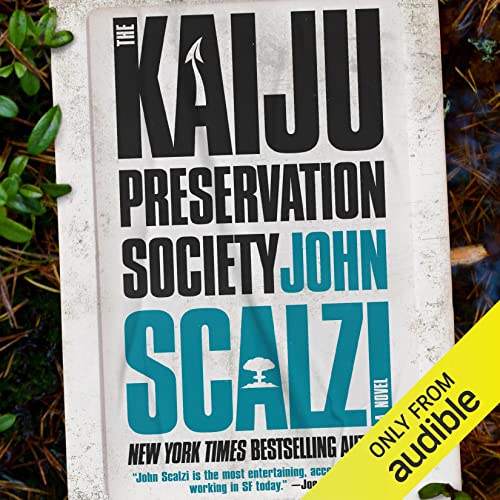
When Jamie Gray is fired right before COVID lockdowns, he has to resort to food delivery for the very company that fired him. (Note: Yes, Scalzi again here never assigns a pronoun to the MC, but since the narrator I listened to is male and it would be a pain to continue to refer to the MC by the MC’s name rather than use a pronoun, I am going to refer to Jamie Gray as “he” in my review.) Then a delivery to an old acquaintance lands Jamie a better job (because really, anything would be better) with an animal rights organization that turns out to be Jamie’s entrance into his very own sci-fi story.
Overall, this book is a fun, light sci-fi adventure. I did not know the backstory of the name, but I’m sure many others will be aware that kaiju is the general term of movie monsters like Godzilla and Mothra. The story here is that kaiju are from an alternate dimension and occasionally cross over to our dimension, and sightings led to the famous monster movies. The Kaiju Preservation Society is set up in that alternate dimension and basically studies the giant creatures while attempting to keep the two dimensions separate. Jamie is dropped into the middle of this situation and has to learn the ropes basically on the fly. I struggled to understand what the main conflict/plot was for a while, but by the time it really got going, I was mostly enjoying the story. Based only on that, I probably would have rated the book higher.
Unfortunately, Scalzi’s style and political/social leanings detracted heavily from the book for me. When I read Lock In, my first Scalzi, I noted that he tends to write conversations with little in the way of descriptions of what the characters are doing. In that book, it worked for me, at least partly because the main character was just a consciousness within a metal suit. In this book, the lack of descriptions and the overused, super basic dialog tags constantly back and forth (i.e. “I said.” “Kahurangi said.” “I said.” etc.) made the style a little too bland for me. (And by the way, kudos to Wil Wheaton for making it through the many odd names in this book.) Aside from those issues, I actually almost stopped listening to the book when, after the main character leaves behind his two homosexual roommates, he meets a character who is introduced with the “they” pronoun (which, by the way, confused me greatly about how many people were being introduced before I realized what the author was going for). It was a judgment call on my part to keep listening, but I feel that other Christians who read this review should be made aware of the concerns I had that almost led me to stop. There is also quite a bit of language, though I have come to expect that from books like this. I’m overall glad I read the book and tend to think that fans of Scalzi will generally enjoy this book as well. If you are new to his style, though, I don’t know that I’d recommend you start with this one.
Find out more about The Kaiju Preservation Society
If you’ve read this book, or read it in the future, feel free to let me know what you think!









 A Journey of Words