Book Review: Already Gone

Already Gone
by Ken Ham & Britt Beemer with Todd Hillard

My rating: 5 / 5
Genre: Christian living

The results of a survey of 1000 20-somethings who attended conservative Christian churches regularly growing up, but have since left the church, are here presented in a way that shed light on the traditions and teachings that are not working like we think they are. With a call to action for parents, Christian educators, youth pastors, and pastors, this book is an important read for anyone who has a heart for seeing young people continue to grow in their faith once they have more say over whether to attend church or not.

Though this book, and the survey it’s based on, is over 10 years old, I can’t imagine the results and impact are any less relevant today. In fact, I can say from my own personal life that the danger of a child growing up and not finding church relevant (and possibly, by extension, God) is still very real. With admonitions like not leaving it up to the church/Sunday school/youth group to teach your kids the fundamental truths of the Bible, this book should be an eye opener for many parents of children and teens. And I have to agree that while one’s individual salvation may not be dependent on whether or not they believe in a literal six days of creation, amongst other ways the the world is trying to undermine the Bible, the impact that an individual’s belief can have on young Christians (meaning young in age or simply new to the faith) can be devastating. Put simply: if you can’t trust the first chapters of Genesis, what makes you think you can trust the gospels? Is it really more believable that a man could be born to a virgin and then rise from the dead than that a supernatural being could create the world in 6 days?

I know that I was one who was really confused about things in this area when I was younger. I don’t remember it leading me to question whether God was real or the Bible was infallible, but I also think I learned the facts about Genesis early enough that I didn’t have the chance to question these things, and I thank God for that. In fact, it was Answers in Genesis that led me to the understanding that the existence of dinosaurs does fit with the Bible (that was the first eye opener for me, as I remember having this vague uncertainty about how what I learned in school about dinosaurs made any sense if Adam and Even in the garden of Eden was also true). But therein lies the issue the book addresses—my family attended church regularly when I was young; why did I not learn about this there?

Though I do wish I’d read it years ago, this book comes at a good time for me, as I’m poised to take over the VBS program at my church in a year or two, along with my husband. Though it’s only a week-long program once a year, we’ll definitely be taking this book and its admonitions to heart. And on that note, if you’re thinking about reading this book, understand that it makes the assumption that the reader believes the Bible 100%, including on matters like creation in 6 literal days, a young earth, the global flood, and…well, find out more about what the authors of this book believe at this link. If you do not believe the Bible is true, or to be taken literally, on all of these points, this may not be the book for you. Sadly, as Ham puts it, it has now become acceptable “to use man’s ideas to re-interpret the Bible, rather than to use the Bible to judge man’s ideas.” To put it bluntly, somewhere along the line, we decided that we knew more than the author of the Bible (God), Who was there when everything was made.

My only issue with the book is that it can be repetitive. I almost rated it 4 stars for that reason, but I think doing so would undermine the truth presented within. If you are interested in reading this book, you don’t have to purchase it, as you can find the entire contents online at this link (it can be purchased there, too, but scroll down the page to find each chapter linked).

Find out more about Already Gone and Ken Ham’s ministry at Answers in Genesis

See what I’m reading next.

If you’ve read this book, or read it in the future, feel free to let me know what you think!

Book Review: Things We Couldn’t Say

Things We Couldn’t Say
by Diet Eman with James Schaap

My rating: 5 / 5
Genre: Memoir

Diet Eman, along with her fiance Hein Siestma, watched as the Nazi’s occupied their country, started imposing rules and restrictions, and then began to persecute the Jewish people living there. What started as quiet, minor resistance turned into a movement, with Hein and his brother leading their own group. Both Diet and Hein were arrested and spent time in prison, and then concentration camps. Fifty years later, Diet tells her story in Things We Couldn’t Say.

This is the third book I’ve read now that centers on Dutch resisters during WWII and the Holocaust. I was fascinated to hear about the citizens’ reactions to the occupation and the royal family fleeing in advance of the invasion, followed eventually by the realization that the royal family’s decision hadn’t necessarily been as cowardly as first thought. Diet also talks about why it was so natural for people in her country to resist, as she explains how stubborn the Dutch tend to be, easily forming splinter churches if there’s a difference of opinion.

In 2015, upon receiving the Faith and Freedom Award from the Acton Institute, Diet Eman said, “…you think it’s something special. But when your country is taken—and Hitler had said he would respect our neutrality, and then he marches in and he starts killing all of the Jews—and we had so very many Jewish people in our country. So, you would have done the same there, when you had friends who were Jewish and they were in danger.” However, from this book, it’s clear that not everyone would do the same thing. Even as Diet tried to find people who would help her early in her work, she was disappointed in her Christian friends who valued their own safety over that of others.

Diet was in the same prison, and then later, the same concentration camp, as Corrie & Betsie ten Boom, and though she didn’t meet them at the time, her observances of these fellow Dutchwomen of faith only strengthen my admiration of the ten Boom family (their story can be found in The Hiding Place). It’s inspiring to read how Diet’s faith grew during the toughest times and how she continued with her resistance work even after suffering very difficult things. I highly recommend this book to anyone interested in true WWII resistance or Holocaust accounts, especially those from a Christian worldview.

Find out more about Things We Couldn’t Say and Diet Eman

See what I’m reading next.

If you’ve read this book, or read it in the future, feel free to let me know what you think!

Book Review: Lead Me

Lead Me
by Matt Hammitt

My rating: 5 / 5
Genre: Christian living, memoir

Former Sanctus Real lead singer Matt Hammitt talks about the difficulties he faced for many years trying to balance life on the road with life at home. With a wife and eventually 4 kids, he wanted to be the husband and father they needed while also following God’s calling on his life and providing for his family. In this book, he lays bare the doubts, anxieties, even depression he went through while his wife was at home simply wanting him to lead the family the way he was meant to.

This book really hit home to me in so many ways. My husband and I are at a good point in our 21-year marriage right now, but it hasn’t always been so, and I know it won’t always be so. When Sanctus Real’s song “Lead Me” came out, it spoke to me every time I heard it, and I used the lyrics to explain to my husband where I felt our relationship was lacking at the time. I’m sure the song spoke to countless others as well, just as I’m sure this book will speak to many hearts. Hammitt’s insights into what it means to be present in a marriage, even if you can’t be physically present (though that certainly helps) come from a place of experience, all of which he shares in this book. That his marriage survived some of what he describes is a testament to what can happen if two people refuse to take the easy way out and instead determine to do life together, even when it gets rough (really rough, from the sound of it).

I also found some insight into an issue my extended family is dealing with right now, and highlighted some quotes that apply to that situation. Though we all have our own stories that we’re writing as we go through life, we can certainly learn from each other along the way, even if circumstances don’t match up perfectly. And though I can’t fully connect with what Hammitt and his wife went through during and after the birth of their first son, my heart broke to read about the pain and uncertainty they went through.

My favorite thing about the book is that he points back to the Bible with every uncertainty he has, with every lesson he learns. It’s all right there for us to discover, and Hammitt lays some of it out in a way that could be beneficial to so many people who are struggling with their own families, marriages, or other relationships, whether their issue is trying to balance work and home or a plethora of other possible things that can cause a divide. Also, fans of Matt Hammitt and/or Sanctus Real might appreciate this peek into his life and why he left the band in 2015. I highly recommend this book to anyone who has interest for any reason. (Plus, any book that mentions Psalty the Singing Songbook, not once but twice, is a winner in my book!)

Thank you to Netgalley and WaterBrook & Multnomah for providing me a copy of this book to review.

Find out more about Lead Me and the band Sanctus Real

See what I’m reading next.

If you’ve read this book, or read it in the future, feel free to let me know what you think!
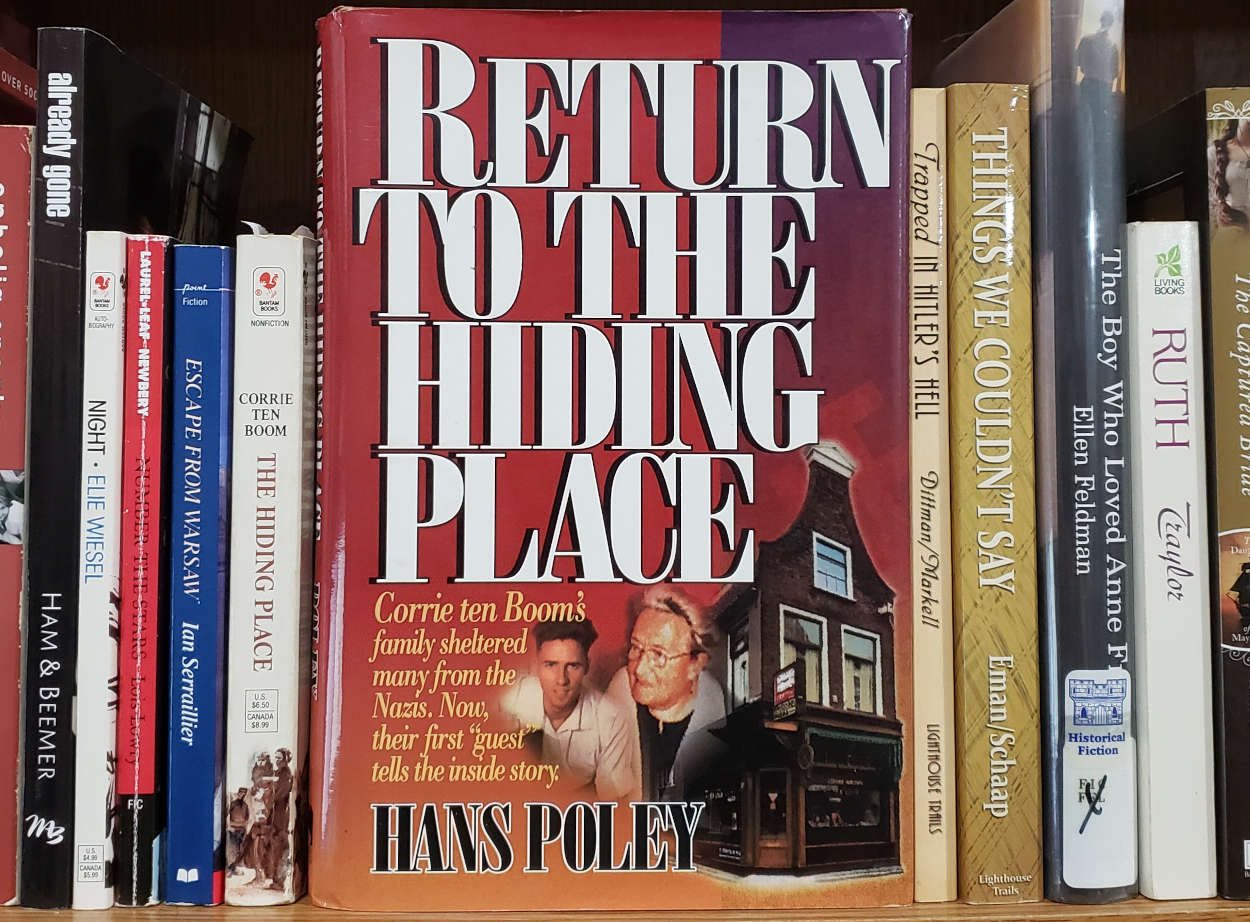
Book Review: Return to the Hiding Place

Return to the Hiding Place
by Hans Poley

My rating: 5 / 5
Genre: Memoir

During the time of Nazi persecution, a Christian Dutch family called the ten Booms welcome into their home various people who were hiding from the Nazis, both Jewish and not. 18-year-old Hans Poley was the first guest, hiding to avoid being sent to Germany to do hard labor in replacement of Germans who’d been sent to fight. Here he tells the story of his time at the ten Booms’ house and his own arrest that took him to a prison, then a concentration camp.

Having read The Hiding Place earlier this year, it was really interesting to see the Beje and the ten Boom family from the perspective of one of their “guests.” Not only does Hans Poley echo Corrie ten Boom’s assertions about the incredible faith of her father and sister, he shows Corrie herself as more open and giving than she portrayed herself in some areas. For example, when her room was chosen as the location for the secret room in her book, she tried to protest it. According to Poley, however, she “readily agreed.” I think we’d all be surprised to find out how others view us, compared to how we view ourselves, and in this case, Corrie ten Boom may have been a little hard on herself. Another small thing I noticed that didn’t match up between the books is that both authors claim to be the one who gave Eusi, one of the most prominent long-term Jewish guests, his fake name, and I wonder if this, and any other possible discrepancy, is simply due to faulty memories.

Yet again I was struck by how incredibly selfless this family was, giving up their own comfort and safety to help so many others. And Casper ten Boom, Corrie’s father, is even more inspirational to me after reading this. He repeatedly expressed a desire to help the Jewish people as if it weren’t even a choice to make. If you’ve read The Hiding Place, you should consider reading this too. Overall, though, I recommend it to anyone interested in true Holocaust accounts, especially those from a Christian worldview.

Find out more about Return to the Hiding Place

See what I’m reading next.

If you’ve read this book, or read it in the future, feel free to let me know what you think!
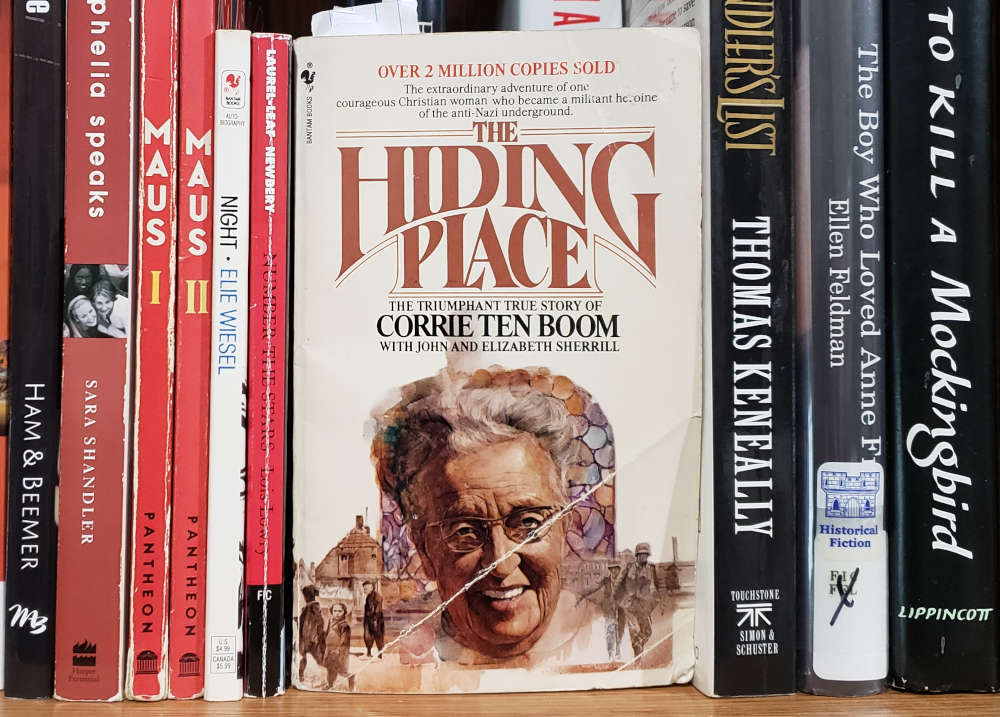
Book Review: The Hiding Place

The Hiding Place
by Corrie ten Boom with John & Elizabeth Sherrill

My rating: 5 / 5
Genre: Memoir

At 50 years old, Corrie ten Boom lived a simple life with her older sister, both of them unmarried, and their elderly father in a small house in Holland. When the Nazis invaded and occupied their country, Corrie quickly saw the need around her as Jews began to be shipped out. The ten Boom house and watchmaker shop became part of the Dutch Underground, helping those who were persecuted find a safe place, even to the point of building a small hiding place in their own house. In this book, Corrie shares much of her life before the occupation, including the faith that led her and her family to help those in needs, culminating in the arrest and imprisonment of many members of her family, and later to her time in a concentration camp alongside her sister Betsie.

This book is incredible in so many ways. It’s inspirational, and not only because of what the ten Booms did to help others. It’s the reason behind their desire to help, the way that it really wasn’t even a question about whether or not they would help, and the way that they affected everyone around them, even in the darkest of places. The strong faith in God that Corrie’s parents had, exhibited, and passed on to their children shows through every page of this book. Corrie herself struggled the most in this area, constantly learning from her other family members and being surprised by their heart for the oppressors. Yet she never questioned whether or not she should help the Jews around her at the risk of her own well-being.

Not many Holocaust-related accounts that I have read are from a Christian perspective, and I really appreciated seeing the little and big ways that Corrie and Betsie could see God involved in their plight. Though they never demanded that He help them, they trusted Him (again, Betsie more than Corrie) and gave Him credit when they saw Him work. I can only hope that in my everyday life, and even moreso when times of difficulty come, I can have the wisdom of Mr. ten Boom, the love of Mrs. ten Boom, the hope of Betsie ten Boom, the courage of Corrie ten Boom, and the faith exhibited by all of them.

Below are some quotes from the book that I marked to remember.

Casper ten Boom (Corrie’s father) upon the realization that Holland would soon be invaded:

“…I am sorry for all Dutchmen now who do not know the power of God. For we will be beaten. But He will not.”

Corrie discovered that a large piece of sharp debris had landed on her pillow while she was out of bed:

“Betsie, if I hadn’t heard you in the kitchen–“

But Betsie put her finger on my mouth. “Don’t say it, Corrie! There are no ‘if’s’ in God’s world. And no places that are safer than other places. The center of His will is our only safety…”

And the one that stuck out to me the most, from an elderly member of Corrie’s family who spent much of her life running clubs, writing tracts, always trying to further God’s kingdom. When she learned she didn’t have long to live, her family members told her she was going to the Father with hands full, due to all of her work. She replied:

“Empty, empty! How can we bring anything to God? What does He care for our little tricks and trinkets?”

And then as we listened in disbelief she lowered her hands and with tears still coursing down her face whispered, “Dear Jesus, I thank You that You have done all–all–on the cross, and that all we need in life or death is to be sure of this.”

Find out more about The Hiding Place

See what I’m reading next.

If you’ve read this book, or read it in the future, feel free to let me know what you think!
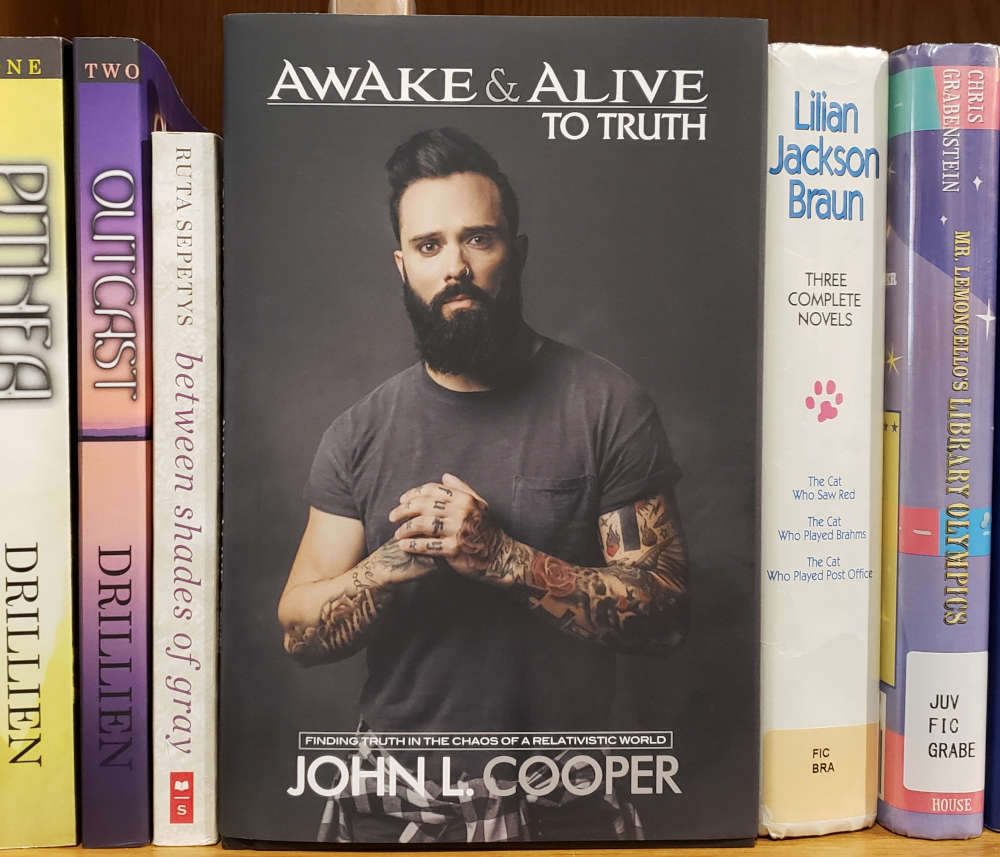
Book Review: Awake & Alive to Truth

Awake & Alive to Truth
by John L. Cooper

My rating: 5 / 5
Genre: Christian nonfiction

Skillet lead singer John Cooper presents a thoughtful look at today’s culture, both from Christian and secular mindsets. The main focus is on truth—where does truth come from, how do we distort it, and what happens when we let each individual decide what’s true for them? With relativism pervading the society around us, is it any wonder so many are unhappy? Broken? Searching? This book provides some insight.

I wasn’t really sure what to expect with the book. It wasn’t published traditionally, though presumably Skillet’s John Cooper could have gotten a publishing deal if he wanted one. As he put it, “I decided to release this book myself so that I would have the freedom to write something that I believe in and know to be true. I didn’t want to be pressured to write the book that someone else wanted me to write, or to write things that I don’t believe in.” I respect that a lot; he didn’t want to compromise. It seems to be a common theme for him. As a result, it does have typos and errors throughout, but even for someone like me who really picks up on that kind of thing, it isn’t enough to distort the message.

I think that what is within this book could ruffle some feathers, but he doesn’t pull punches or water down what the Bible says. His lays out some hard truths about today’s culture making “love” a god, ignoring parts of the Bible we don’t like, and shying away from God as judge. Depending on where you are in your life, you may find this book unnecessary or too shallow. But if you’re unhappy with the noise and chaos around you and aren’t sure what voices to listen to, this is a great book to pick up. It also has a great message to unbelievers or those undecided about God. The only downside is that this book is not widely available. The Kindle version can be bought on Amazon, but if you want a physical copy, a search online might produce some indie bookstores that have the book for a normal price.

Find out more about Awake & Alive to Truth and Cooper’s band Skillet

See what I’m reading next.

If you’ve read this book, or read it in the future, feel free to let me know what you think!

Book Review: The Truth about Us

The Truth about Us
by Brant Hansen

read by the author

My rating: 5 / 5
Genre: Christian living

The truth about us is that we are not all “basically good, deep down inside.” We are flawed, sinful humans. Yet we tend to believe at some level that we are better than average. We are biased towards ourselves, whether we consciously recognize it or not. Starting with this and going on to other cognitive biases, radio show host Brant Hansen challenges us to examine the way we view ourselves and the world around us and to maybe, just possibly, admit that we’re not “good” and that we need help from the only One who is.

This book intrigued me, entertained me, and challenged me. He has a way of getting to the heart of the matter, and he infuses insight and humor into the points he makes along the way. Early in the book Brant describes various studies that show how our brains work. I was fascinated, and at times astounded, by these studies. It’s surprising, really, to learn how little we actually observe and retain, and how we can fool ourselves. And yet, when someone who isn’t me forgets something important, how often do I give them grace?

Though I have more of an inferiority complex in some of the areas he talked about, there were some that were right on point for me. One easy example is about driving speed. I am one who tends to think that if I come up on you on the road, you’re driving too slowly (and sometimes you’re also ruining my day). But if you come up behind me, or pass me on the road, you’re driving entirely too fast. Clearly my chosen speed is the perfect speed (and no, it’s not usually exactly the speed limit), and while I don’t usually think about it more than in the moment (and no, I don’t get road rage), I can easily recognize this bias in myself. This book changed my viewpoint in a lot of areas, hopefully for the better.

One of the biggest take-aways from this book is the need for humility. We’re truly not as amazing or good as we think we are, but that’s okay! It’s good news, and understanding how it’s good news can be very freeing. I think everyone can benefit from this book, even those who hear about it and think they don’t need it, or think about others they know who need it. In fact, maybe the ones who are thinking those things are the people who need to read it the most. No matter who you are or what you’re thinking about this book, though, I suggest you check out The Brant & Sherri Oddcast.

Find out more about The Truth about Us

See what I’m reading next.

If you’ve read this book, or read it in the future, feel free to let me know what you think!

Book Review: Eye of the Storm

Eye of the Storm
by Ryan Stevenson

My rating: 4 / 5
Genre: Memoir, Christianity

AtD

Singer and songwriter Ryan Stevenson shares the story behind his hit song “Eye of the Storm.” Years of struggling in his personal life and his musical life led to doubt and depression. Stevenson had to learn to fully rely on God, to allow Him to be in charge of his dreams and ambitions, but it wasn’t a quick realization, a “flash of inspiration” that fixed everything at once. It took time and some very dark moments, which Ryan lays bare for us in this book.

It’s never easy to read about the difficulties of someone else’s life, and Stevenson had a lot of them. From watching his mom die of cancer, to his wife having a miscarriage of twins, and to Stevenson’s own bad choices that nearly ruined his life. Through all of this, Stevenson had a love for Jesus, though I’m not clear on where his faith really stood. Still, there’s inspiration to be found in the pages of this book.

I appreciate the humble and vulnerable way that Stevenson wrote about his history. He found some success throughout his life, but suffered many setbacks. And he never holds back from taking the blame for his own mistakes. His wrong choices, mingled with things that were out of his control, caused some of the problems he had. Yet, along with the understanding that he should, and could, trust God in everything, he also came to learn that his mistakes did not have to define him. That, as long as he allowed it to happen, God could wipe them away and he could move on from who he used to be.

Though I have not had nearly the hardships in my life that he had, I gleaned plenty of insight from Stevenson’s story. In particular, it was a reminder when I really needed it to continue to do plug away at my writing, which feels stalled at the time of my writing this review. But rather than waiting for a big, obvious lit-up path (which I didn’t even consciously realize I was doing until now), I should be faithful to the work as I know to do it. God may or may not open doors for me, but waiting around for something to happen feels more like giving up than trusting God to use my abilities as he sees fit.

One thing I want to mention for anyone who may read this book–I think it’s important to be clear that not everyone hears that “still small voice” quite so clearly as Stevenson did so many times in his life. If we assume that God will lead us in this way, and we never feel an obvious nudging of the spirit, we may feel like God has abandoned us in the way Stevenson felt at times during his life. Even if we never experience a monologue from God, a whisper in the wind, we can still follow God faithfully, and he can use us in ways we’d never expect. I don’t want to discount Stevenson’s account of how God spoke to him, but it is not the only way, and for those of us who do not have those experiences, we should not feel less important to the kingdom.

With that in mind, I do recommend this book for Christians who could use some inspiration in trusting God in the storms, or for those who enjoy Ryan Stevenson’s music.

Thank you to Netgalley and Harvest House Publishers for providing me a copy of this book to review.

Find out more about Eye of the Storm

See what I’m reading next.

If you’ve read this book, or read it in the future, feel free to let me know what you think!

Book Review: Unoffendable

Unoffendable
by Brant Hansen

My rating: 5 / 5
Genre: Christian living

Unoffendable

Radio show host Brant Hansen counters the common opinion that Christians are entitled to “righteous anger,” while also making a case about how learning to let go of our “right” to be offended can change our lives. He uses scripture as well as examples from both Christian and secular writers and thinkers to back up his claims.

This is the kind of book that you can get a lot out of, or you can dismiss as not for you, or even dismiss as flat-out wrong. One of the biggest arguments people seem to have for anger being all right (even a good thing) is that Jesus himself got angry. But I think one of the most important things to remember is that Jesus is God. He was perfect and sinless when he threw out the money changers. We need to remember that when we get angry about the sin of others…we’re just as bad, even when we find a way to feel like we aren’t.

It’s also important to note that Brant is not necessarily claiming that we should be able to find it easy to never get angry. We’re human; we get angry. The issue is feeling justified in holding onto that anger. In letting it drive us, and especially, in letting it drive us to sin.

More than just anger, Brant also addresses self-righteousness and hypocrisy. I think some of these areas convicted me more than the issue about anger. Not that I don’t get angry, but I definitely am guilty of letting myself believe I’m “not as bad as that other person.” I’m not going to pretend I’m all better now, but I’m noticing these things more in myself and I think that’s the first step to letting God get rid of them in me.

When I first started reading this, I really wondered how Brant could write an entire book about anger. But there were a lot more facets to it than I realized. He speaks simply and honestly, makes some really good points, and I can see from my personal life that there is a lot of truth in the claim that learning to be unoffendable can make your life better. I recommend this book for all Christians; even if you don’t feel like you need it, I’ll bet you can find some understanding here. I also believe, and see from reviews of others, that non-Christians can find some truth in this book as well. And no matter who you are, I suggest you check out The Brant & Sherri Oddcast.

Find out more about Unoffendable

See what I’m reading next.

If you’ve read this book, or read it in the future, feel free to let me know what you think!
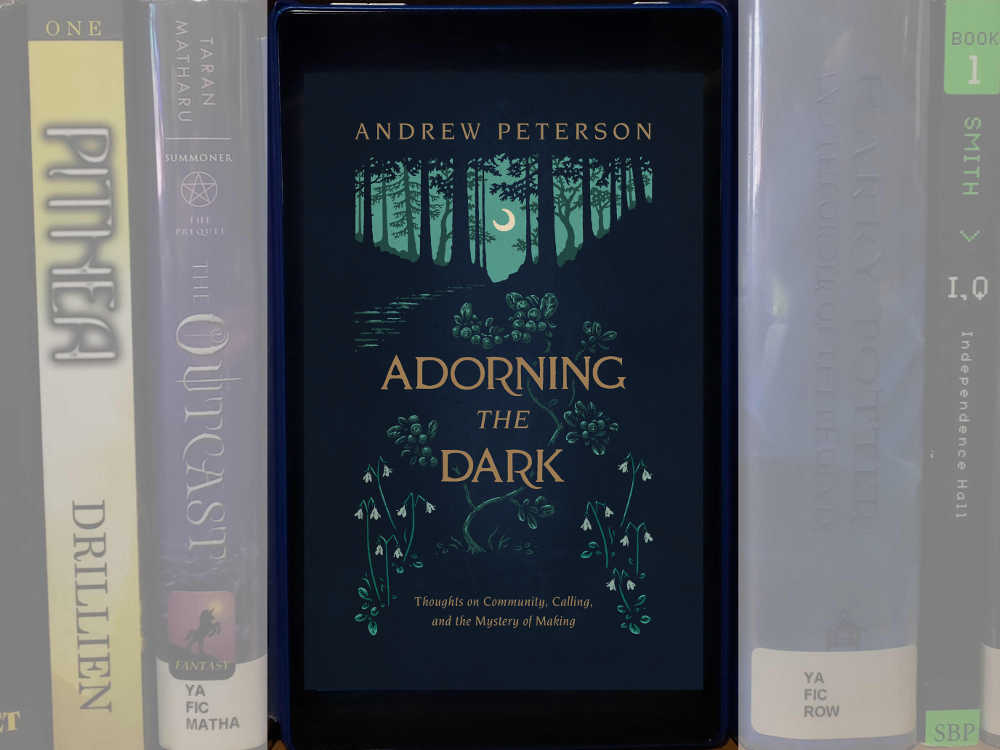
Book Review: Adorning the Dark

Adorning the Dark
by Andrew Peterson

My rating: 4 / 5
Genre: Memoir, Christian living

AtD

Singer, songwriter, and author Andrew Peterson shares his insight on creating in this book. He uses personal experience as well as wisdom from other songwriters and authors to discuss the process of writing songs, the ups and downs of the business, and using one’s creative abilities to tell a story.

I’ll start my review by saying that I was not the main target audience for this book. While Peterson does do his best to expand beyond songwriting into fiction-writing and other kinds of art, the heavy focus is on the musical realm (and poetry to a lesser degree). I’m a fiction writer, but have no experience with or even much of an understanding of writing songs. Plus, he referred to songs and books by various songwriters and authors a lot and talked about them as if the reader should know them as well as he did. I’m not nearly as well read as him, and I am definitely not as immersed in music culture, nor do I listen to as wide a range of music as he. As such, I do think that quite a bit of the book was lost on me.

Another way this book did not resonate with me is that I came to realize by maybe halfway through the book that my personality, and the way I see the world around me, is vastly different from his. He sees beauty in everything, but I’ve never been all that sentimental. So that was another chunk of the book that fell flat for me.

However, that does not mean that I did not find plenty of gems in the book, things that work for any kind of creating. For example: “If you wait until the conditions are perfect, you’ll never write a thing.” Or: “The songs won’t write themselves, and neither will the books, the recipes, the blueprints, or the gardens.” Even with the difference that Peterson describes between songwriting (which can also apply to poetry to a degree) and writing fiction, the clear point is that you have to get through the bad to find the good.

He also addresses the different between “Christian art” and art from a Christian perspective, which I really appreciated. As an author, I’ve struggled in the past with thinking that I should only be using the gift God gave me to write specifically Christian fiction. However, I no longer think that’s true. Instead, I can write stories with a Christian worldview, which will most likely be acceptable to most Christians, and will even be acceptable to many non-Christians who just want something good to read. And in approaching the art that way, perhaps it would allow the artist to actually reach more for Christ.

There were a few things about which I disagreed with the author, but even in those I think it mostly comes down to a difference in mindset or preference. I did agree with the idea that calling some people “creatives” excludes many people who really are more creative than they think. Just because “art” isn’t the end result, pretty much everyone creates in their own way–that can come out as critical thinking or problem solving, or so many other things that don’t seem as creative. In the end, I’m very glad I read this book, as it gave me some interesting insight into a singer whose music goes back as far as my marriage, and plenty of solid advice on writing, some of which I needed to hear even today. I recommend this book for Christians who are interesting in creating, no matter the form it takes.

Thank you to Netgalley and B&H Publishing Group for providing me a copy of this book to review.

Find out more about Adorning the Dark

See what I’m reading next.

If you’ve read this book, or read it in the future, feel free to let me know what you think!