Writing Wednesday: Character Interviews

WW

In my writing past, I remember hearing other writers talk about their characters haranguing them. Complaining about their lack of page time, about unpleasant things that happened to them, or about who knows what else…but they always seemed to be complaining. I remember always being a mixture of jealous and certain that those writers were making it all up. While I didn’t believe that it was very likely that their characters just jumped into their thoughts out of nowhere to start talking to them, now I can see the plausibility—the writer might have been thinking about their story at that time, or just letting their mind wander in general. And now, I have seen the amazing benefits of talking to my characters.

There are likely many different ways people refer to this phenomenon. For me, it usually involves a discussion that is led along by me asking questions of my characters. Thus, I use the term “character interview.” And understand that the way I go about having these discussions with my characters are by no means the only way to do it. It is what works best for me, and you should definitely figure out what works for you (if this method works for you at all).

I will dispense with the history of how I came to utilize this technique in my writing, and just explain how helpful it can be. In the different stages of writing (which I would break down into dreaming, planning, writing, and revising), character interviews have been most useful to me during planning and revising stages. During the dreaming phase, you likely wouldn’t even have characters very clearly in mind. If you have enough to start talking to your characters about, you might be more in the planning stage. During the writing stage, well…you’re writing. Unless you run into a block and decide to stop and hash it out, you won’t likely be stopping the prose to have a chat.

So now you may be wondering how to start. Or what kinds of things to talk to or ask your characters about. Usually at the point that I decide it’s time to start one of these discussions, I am struggling with some kind of plot hole, or a question about how to proceed in a scene, how to get something to happen that I really want to see happen in the story, how to fill out a story, or even which character should actually be the protagonist or main character in a story. And then I literally just pose these questions to the characters I think can help me the most, and go from there.

The next question might be how you know which character(s) would be the best to talk to for the questions you have in mind. Sometimes it’s obvious, but sometimes it requires thinking outside the box. Earlier this year, I was struggling to rework the plot of one of my books, which has a murder-mystery element to it, and when I wrote the first draft, it came out incredibly weak. I had a long conversation with the main character of that book, but still couldn’t figure out what I was missing in the middle of that story. I was considering setting it aside for a while, but decided to talk to a different character instead first—the antagonist. By the time I was done (a week and a half later), I had not only filled in that saggy middle, but realized that this person was not the main antagonist. Such a productive interview!

Now for the tangible question—where/how to conduct the interview. I’ve done them multiple ways—all in my head, recording myself audibly in some way, typing the conversation on a computer or my Neo, and writing it in a notebook. I don’t recommend doing it only in your head unless you have a great memory; I prefer to be able to look back on it somehow later. I recorded myself with a headset and Audacity one time, but decided that listening to the conversation later was just too weird, so I’m not doing that again. Typing it out works, as long as you make sure to clearly designate who is saying what. My preferred method is to write the conversations out longhand, though, and even a step further, I like to use a different color pen for each person talking (including myself). It makes it so much easier to read over again later, which I do a lot. Plus, I really like the tactile element of writing by hand.

A few more tips about conducting these interviews:

  • Give yourself the freedom to explore without worrying about accuracy. I have had interviews where, by the time I got to the end, things we discussed at the beginning were obsolete, because the plot took a turn during the discussion. That’s okay.
  • I use the term “interview,” but often I don’t ask questions for a while, instead just carrying on an actual conversation. But since the basic idea behind this (for me, at least) is that the characters know more about their story than I do, because it’s their story, I am generally coaxing the truth out of them.
  • If you have more than one character involved, they might start talking to each other, instead of you, and that’s okay too.
  • Don’t get too caught up in the nebulous world your characters are inhabiting for these interviews. They are outside of the time and space bubble of their stories. And yet, I find that it helps me to think of the times that I interact with them as a continuation of time in itself, and even reference back to previous discussions (like having one character say I’d just yell at him again if he told me his theory about something in particular, because yes, I’d gotten frustrated with him in a previous interview).
  • It might feel weird at first to do this, because of course you know these characters aren’t real, but they really can feel real. And in truth, if you don’t think of your characters as their own people (rather than just part of you), then maybe they won’t come across as real to the reader.

If you think talking to your characters might help you with your own writing, but still aren’t sure how to start, pick a character that you think might have some helpful insight, and just start out by asking, “What do you think of the story so far?” or “What would you change if you could?” You might be surprised what comes out.

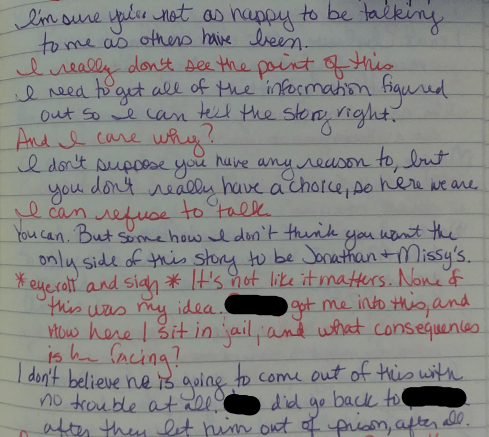
In case anyone is interested in what most of my interviews looks like, below is a picture of the beginning of one of them, the one I mentioned above with the antagonist of the murder-mystery story (and an example of one where what I wrote at the beginning became incorrect by the time I was done). Purple is me, red is the antagonist. It took me to the end of the page to get past her refusal to help (which was totally true to her character), but after that, I immediately started to gain insight into the story. I’ve blocked out a few spots due to possible spoilers. Also, I use erasable pens, which are just amazing!
character interview

Top Ten Tuesday: Titles with Numbers

It’s time for another Top Ten list from That Artsy Reader Girl. The topic this week was “Book Titles with Numbers in Them.” While of course, it would be easy to just randomly find 10 books with numbers, it makes more sense to me to choose books I’ve read or that I’m planning to read. And for a little added challenge, I tried to find titles with the numbers 1-10.

So without further ado:

1. One of Us Is Lying by Karen M. McManus

I have not read this YA thriller that has been on my TBR list for about a month and a half, but I’m looking forward to it.


2. Do You Dream of Terra-Two by Temi Oh

This sci-fi book is also on my TBR list, and is one of the first I added based on the recommendation of another book blogger.


3. Maus II: A Survivor’s Tale by Art Spiegelman

I first read this book in high school, for my English class. It was on a list of books that were deemed “new classics,” and could be read in place of an older classic. I was especially fascinated by the Holocaust in high school, and hadn’t cared for most of the classics I’d read so far, so I jumped on it. Later, I read the first book as well. They contain not only a true account of the author’s father surviving Hitler’s Europe, but also show how he and his family cope in the aftermath, years later. It is depressing, but also enlightening and encouraging.

4. Thr3e by Ted Dekker

This Christian thriller has long been one of my favorite books, even after a recent re-read. Click here to see my review.


5. Fahrenheit 451 by Ray Bradbury


This is one classic I read in high school that I did enjoy. I plan to read it again someday. (This book has both a 4 and a 5 in it, which is why I put 2 books related to the number 2 on the list.)


6. Six of Crows by Leigh Bardugo

I don’t actually have this book on my TBR list, but it’s on a back-up list of books I want to revisit in the future. I’m not quite sold enough to start this fantasy series soon, but may choose to add it to my list in the future.


7. The 7 1/2 Deaths of Evelyn Hardcastle by Stuart Turton

This was the second book I read when I started making reading a regular hobby again back in July. I enjoyed it, and recommend it to fans of mystery and thriller books. Click here to see my review.


8. Eight Cousins by Louisa May Alcott

I have Little Women on my TBR list, and if I enjoy that (which I suspect I will), I will likely end up adding this to read as well.


9. Ninth House by Leigh Bardugo

This fantasy novel first came onto my radar last Tuesday, when it was on the Top Ten Tuesday list of many people. I eventually decided to check it out, and then added it to my TBR list.


10. Ten by Gretchen McNeil

This YA mystery is on my TBR list only because of this week’s TTT. In figuring out what books I wanted to use, I searched for books with the word “ten” in the title, and found this one. Though some of the negative reviews give me pause, but I’m going to give it a try anyway.
 

Have you read any of these? What would you add to the list?

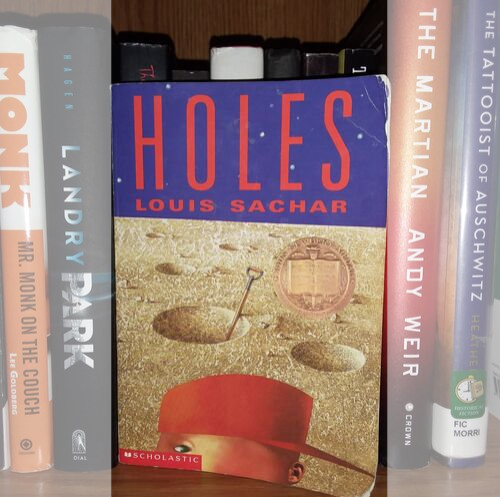
Book Review: Holes

Holes
by Louis Sachar

My rating: 4.5 / 5
Genre: Middle grade fiction

Holes

This is the story about 2 curses that come together in a place called Camp Green Lake, where there is no lake. Teenage boys are sent there for rehabilitation in the form of digging a hole the depth and width of their shovel every day. The camp’s newest inmate, Stanley Yelnats, quickly realizes there’s more to the hole-digging than character-building, but can he dig up the truth?

I like this book so much. I remember watching this movie about a year after it first came out, going into it without any clue what it was about. I was an adult, so not exactly the age group that the book was intended for, but I’ve never had a problem watching or reading things for a younger audience. I enjoyed the movie, and still do to this day. A few years after watching the movie, I found the book at a garage sale or thrift store or something like that, and picked it up. I’ve read it a few times, so this was a re-read, at least 10 years since the previous times I read it.

The way the author brought basically three different stories together, and in a really interesting and even believable way is so fun to follow along with. This book takes the idea of coincidence in storytelling (which is normally better to avoid) and embraces it to the point of being so well connected, you’re excited to see how the coincidences come together.

The kids are just trying to get by in conditions that definitely make it clear that the justice system has failed them, but they still have heart. The adults at the camp are apparently all terrible people, right down to the counselors who aren’t in the story much, which I think is a little unrealistic.

Since I saw the movie before reading the book, and have watched the movie several times now, of course I pictured the characters as they were portrayed in the movie, but I like the casting, so this isn’t a problem for me. There are some differences in the movie, a few things added to the movie, and of course some extra details removed, but overall, it is incredibly similar. My biggest issue with the book is that it is wrapped up awkwardly. There’s not a lot of closure. The movie did this better (even if a slight bit less realistically).

Overall, Holes is a fun, edgy book for kids approximately 8-12 years of age, but really can be appreciated by older people as well. The culmination of the different storylines in the latter half of the book is a lot of fun to discover, and I recommend it for all.

Find out more about Holes

See what’s coming up.

If you’ve read this book, or read it in the future, feel free to let me know what you think!

Weekly Writing Update: September pt. 5

I had another somewhat unproductive week, though I did work on “Outcast” a little. I also spent some time getting ready for the local author booth at a local festival. That was today. It was terrifying at first, and I kicked myself for not saying the right thing after several interactions, but I did generate some interest in my future release, get some hits on possible future author appearances, and tell one teenager about NaNoWriMo’s Young Writers Program.

Tomorrow, I will start working on making a few changes to “Pithea” that I already know need done, then format it for the print version, and get a proof copy, which I will use to do a final revision, to be ready to publish soon. I will also start making sure I’m ready for NaNoWriMo this coming week, as Preptober starts on Tuesday!

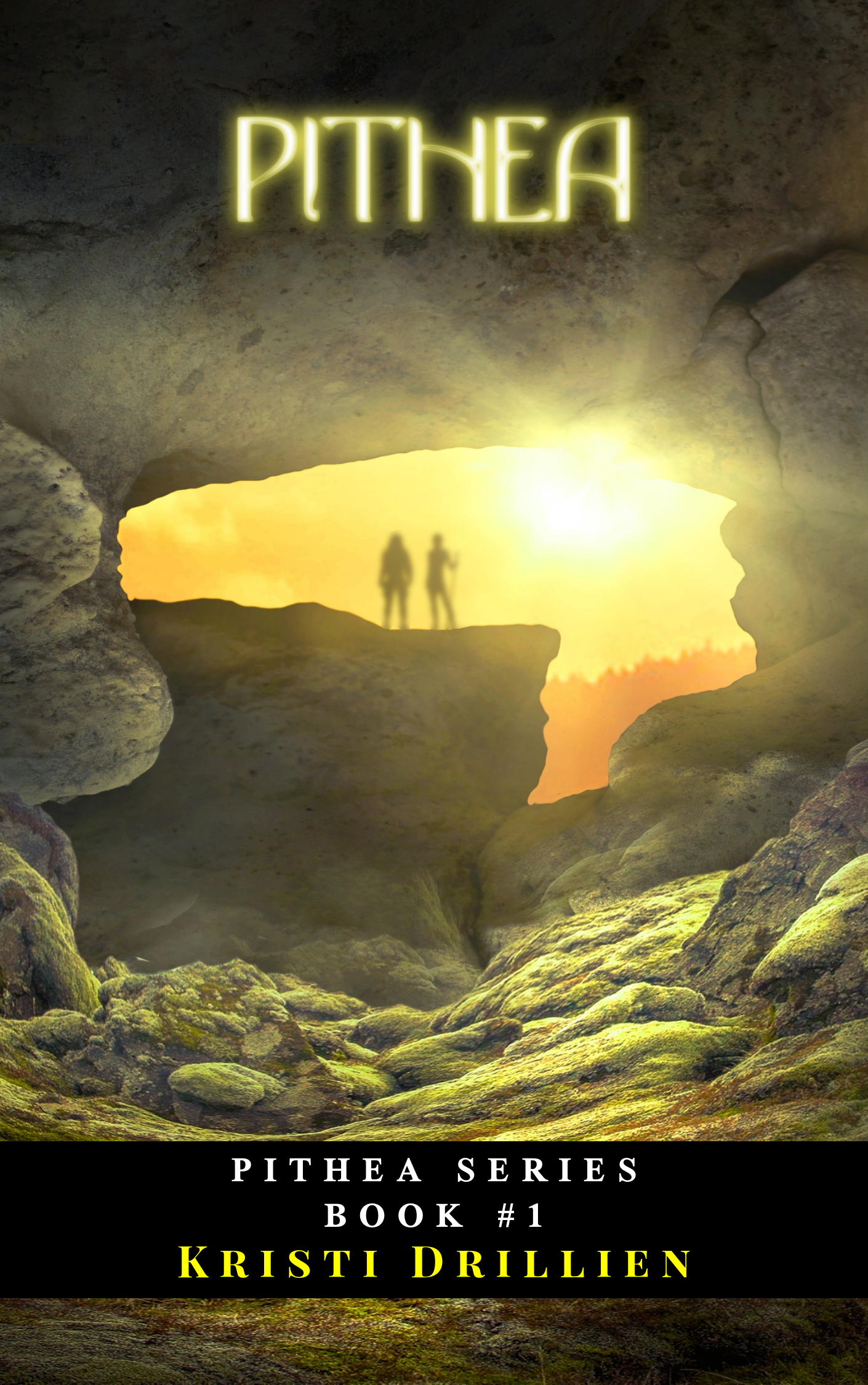
Cover Reveal: Pithea

Pithea cover, Kindle.png

This will be the cover for my first full-length novel, which is set to release on January 10, 2020. It will be available for pre-order in December, and I’ll post about that when it gets closer.  Below is the synopsis for the book:

In the near future, a devastating global war has led to a worldwide ban on the use of all technology. A few hundred years after the catastrophic war, a sort of magic—called “the Power”—manifested in every living person. Thousands of years later, the world has settled into a lifestyle that is part pioneer times, part medieval times, but with a more modern mindset. The Power has become a part of everyday life in the country of Pithea.

Missy Seeger is struggling to find her place in the world. She reluctantly decides to follow in the footsteps of her well-known and well-respected father. As other options begin to call out to her, she can’t let go of the need to please her father.

Naolin Dark is a solitary young man who knows exactly what he wants to do with his life. He finds the adventure and excitement of life in his local militia, with a sword strapped to his side, to be the only worthy path. The primary goal of Pithean militias is to protect the country’s citizens from animals afflicted by the Madness, and Naolin is eager for his chance to prove himself.

Missy’s and Naolin’s abilities, ideals, and even bodies are put to the test in many ways as they are forced to deal with villains and monsters that are made possible—and all the more dangerous—by the Power and the Madness.

Book Review: Cilka’s Journey

Cilka’s Journey
by Heather Morris


My rating: 4 / 5
Genre: Historical fiction

From a Nazi death camp to a Siberian gulag, we follow Cilka Klein, who was charged with spying for the enemy and conspiring, due to her role of senior officers’ mistress and death block leader in Auschwitz II-Birkenau. In the Russian prison camp, she faces 15 years of conditions not much better than they were in Auschwitz, plus the addition of frigid weather nearly year-round. She manages to stand apart yet again, but this time mostly because she shows herself to be a quick learner, which makes her valuable at the prison hospital.

This book is a sequel to The Tattooist of Auschwitz, but only in that Cilka is introduced in that first book, and some of the characters from the first book are brought up again in this one. I do recommend reading The Tattooist of Auschwitz first, for a more full experience, but you wouldn’t lose a lot if you didn’t. Click here to see my review of The Tattooist of Auschwitz.

I liked Cilka’s Journey a bit more than its predecessor, and I think that is because of the writing. I didn’t find it quite as stilted as in the first book. The subject matter is nearly as dark, especially since there are flashbacks to Cilka’s time at Birkenau, but we also get to see glimpses of her life before she went to the camp.

Cilka was very compassionate, even to her own detriment many times. I appreciated the way that her heart ached when a friend was hurt (physically or otherwise), or when a rift came between her and someone she cared about. She even managed to find a way to understand and forgive those who persecuted her, by acknowledging that they were simply trying to survive this place like she was. She may have been a bit on the Mary Sue side, somehow being the best at everything she did, but it wasn’t glaring.

There were a few events and situations that seemed unnecessary, or that were maybe only there to show again how wonderful Cilka was. I know that this book was even more fictionalized than The Tattooist of Auschwitz, with no first-hand account to draw from, so I did at times wonder how realistic certain things were.

In the end, it was a good read, and I would definitely recommend it to readers of historical fiction, especially of the WWII era.

Now if you’ll excuse me, I have to find something much lighter to read, especially since the book I had originally planned to read next (Priceless by Joel & Luke Smallbone) also involves sexual abuse, and between these 2 books, I’ve had enough of that for a while.

Thank you to Netgalley and St. Martin’s Press for providing me a copy of this book to review. 

Find out more about Cilka’s Journey
Publication date: October 1, 2019

See what I’m reading next.

If you’ve read this book, or read it in the future, feel free to let me know what you think!

Writing Wednesday: Prompt

WW Prompt

Here’s today’s Writing Wednesday Prompt:

I couldn’t help but wonder if it was a trick.

If you write something from this prompt, by all means let me know! Feel free to share what you wrote, if you want!

**If you’re looking for more like this, you might want to check out the story seeds posts I wrote for NaNoPrep a few years ago. They are not specific to NaNoWriMo, and each contains a list of several different types of prompts or ways to generate story ideas. You can find them here: Story Seeds 1, Story Seeds 2, Story Seeds 3, Story Seeds 4**

Top Ten Tuesday: Books On My Fall 2019 TBR

It’s time for another Top Ten list from That Artsy Reader Girl. This one was easy for me because I had the next 9 books I’m going to read planned, and was easily able to add a 10th. I recently went a little crazy requesting ARCs from Netgalley, so I’m trying to get caught up (I don’t know how others do it without letting the pile of ARCs awaiting reviews drive them mad). But I wanted to space out the ARCs with other books from my TBR, so in the below list, every other book is an ARC. This list should take me through most of the fall (I’ll probably slow down in November because of NaNoWriMo), and I suppose they’re not necessarily fall-oriented…I don’t usually think in those terms when it comes to reading (except I probably will at Christmas time).

So without further ado…the ones near the end of the list may change as I get closer to them, but I think the order will be mostly this:

1. Priceless by Joel & Luke Smallbone
2. Smoke Screen by Terry Blackstock
3. Harry Potter and the Chamber of Secrets by J.K. Rowling
4. The Passengers by John Marrs
5. The Battlemage by Taran Matharu
6. Mother Knows Best by Kira Peikoff
7. The Martian by Andy Weir
8. Claiming T-Mo by Eugen Bacon
(Not technically an ARC, I won it in a Goodreads giveaway, and have gotten a couple of emails requesting that I review it soon.)
9. Anne of Green Gables by L.M. Montgomery
10. On the Edge of the Dark Sea of Darkness by Andrew Peterson
(This book was released in 2008, but was re-released in hardcover with new illustrations, so is still an ARC.)

Have you read any of these? What do you plan to read over the next few months?

Book Review: Synapse

Synapse
by Steven James


My rating: 3.5 / 5
Genre: Christian sci-fi

Set at a time in the future when robots (or Artificials) have been taught to not only think for themselves, but to have emotions, and even the option of pain, there is still a lot that is unknown about how similar robots are to humans. Do they have souls? Can they believe in and worship God? Kestrel Hathaway doesn’t know, and neither does her Artificial, Jordan. Amidst their discussions of these concepts, Kestrel is pulled into a plot to put an end to the advances in AI by people known as Purists. Working with federal agent Nick Vernon, Kestrel and Jordan do their part to help prevent a deadly attack.

This book was an interesting mash-up of theology exploration and sci-fi elements. For much of the book, Kestrel is simply trying to cope with a fresh tragedy, while being slowly dragged into a deadly cat-and-mouse game between federal agents and terrorists. Jordan was probably my favorite character, as he tried to figure out what hope there was for him, especially in eternity. And there were some twists near the end that I enjoyed. But overall, the book was mostly just okay.

The very beginning of the book shows Kestrel delivering a stillborn baby (that she didn’t know was stillborn). It’s told in 2nd-person perspective, so it’s describing the events as if they happened to you. I think this is important to know for those who have gone through this or something similar. She is a pastor, and spends most of the rest of the book idly questioning her faith in God. I say idly, because it’s as if she’d forget her questions now and then, and have to remind herself she was still uncertain about if God existed, or he was actually all-powerful, or if he cared about her. She also carries some PTSD from a tragedy 9 years old, and I was surprised by the way some of that played out as well. But I suppose PTSD is not a consistent syndrome (meaning it’s not the same from person to person, and probably difficult to pin down and define). I would say that maybe the way she does respond shows her strength, but I didn’t really get that characteristic from her otherwise.

I believe Jordan’s role in the book was to parallel humanity’s question of an afterlife. How can we ever know for sure if Heaven exists, if no one who has been there can return to tell us about it? Artificials are told that there is a manufactured afterlife where their consciousnesses will go when they “die.” Jordan’s mother “died,” and he is desperate to know if she’s in the afterlife. Where this parallel falls apart, though, is that Artificials are guaranteed this afterlife by a fallible man, while humans who follow Christ are guaranteed their afterlife by an infallible God. Some of the discussions that arise between Jordan and Kestrel about afterlife and the ability to believe in and worship God are interesting though. Except for the times that Kestrel is just mean to Jordan about his inhumanness.

As for the twists near the end, they did mostly catch me off guard. But there was a weird thing that happened that got my heart pumping about a possible twist coming, but instead, it turned out not to be true. It was a huge letdown, and I can think of a few ways that some dialog could have been written to avoid this letdown. I had some questions that were left unanswered–about Jordan’s mom, about some of the Purists’ involvements and questionable actions, and some other things that came out during the climax, but are never given any kind of explanation.

I think the sci-fi plot were simply a vehicle for the theology discussed in the book, which is why the plot was fairly weak. And for me, at least, some of the theology was weak too. Kestrel’s brother, an atheist, asks her some very good questions about God, and her replies are the type I often see from the token “religious character” in TV or movies. She does go deeper than the stereotype sometimes, but I still found myself wishing for more. And very likely, this can all be chalked up to the author and me having different views on some theological aspects, which will certainly happen. I just found myself very sad about Kestrel’s brother’s view of God, and wished her responses had been more fulfilling.

One more thing that adds to my lower rating, which I almost forgot, was the way the story was told. As I mentioned above, it starts out in 2nd person (“you”), then switches to 1st person out of the blue (“I”), but is only 1st person when the perspective is on Kestrel. When it’s on a plethora of other characters, it’s 3rd person. And to make it even more confusing, when the perspective is on Jordan, it’s 3rd person and present tense, when it’s past tense the rest of the time. There’s a reason jumping POVs, tenses, and even character perspectives is meant to be kept simple, and while it’s not completely impossible to try something different…it was just confusing in this case, and made the reading disjointed.

In the end, I would recommend this book for those who are interested in the exploration of how humans approach God and the afterlife, and what it means to have a “soul,” and understand that there is some sci-fi around that. I don’t think I’d recommend this for readers of sci-fi, unless they are willing to wade through the theology.

I received a complimentary copy of this book. Opinions expressed in this review are completely my own.

Find out more about Synapse
Publication date: October 8, 2019

See what I’m reading next.

If you’ve read this book, or read it in the future, feel free to let me know what you think!

Weekly Writing Update: September pt. 4

I didn’t get much done in the way of actual revising of either “Pithea” or “Outcast” this week. I started to work on “Outcast,” but didn’t get far, due to some new things going on in my family this week, and trying to settle into a new schedule. I did make some decisions about the imminent release of “Pithea,” though, and hope to be able to make an official announcement next weekend! Stay tuned!