Book Review: Time Benders: The Machine

Time Benders: The Machine
Time Benders #1
by J.B. Yanni

My rating: 2 / 5
Genre: YA science fiction, Christian

When the four Fitzgerald children are orphaned, their aunt sends them off to boarding school. There, the four siblings grow closer than they had ever been before, as they rely on each other in their grieving and new, sudden situation. As the kids settle into life at the school, eldest sibling Ken begins to investigate the circumstances surrounding their aunt taking custody of the kids and excluding them from the will reading. Meanwhile, his brother Joe, a math and science whiz, finds a fascinating math problem, coupled with a machine. When he discovers that the calculation might just be the secret to time travel, the kids have to decide whether or not they should go back and prevent their parents’ death, and how they would even do that.

I have to say that this book was really not for me. There were two main areas that brought the story down the most for me, and sadly one of them was the plot itself. The other area was the writing style. I’ll explain a little:

Time travel plots can be difficult to do well, and since they always require suspension of disbelief, for some people, it doesn’t pay to be too picky about what you’re expecting from one. However, the assumptions the kids make in this book about how time travel would work for them and anyone who didn’t come along one the trip make no logical sense to me. And even when they see evidence that it doesn’t work that way, I don’t see them re-thinking their ideas. Also, they decide to go back and change a major point in history (won’t say what it is due to spoilers), because they feel that it will stop the beginning of a long progression of events that led to their parents death. And yet, they say more than once that they’re sure changing this major point won’t affect their friends’ families and lives. Even after saying that this event will potentially change another event in history, which affected millions of lives. It just makes no sense to me. And it’s not because they’re kids, since they’re generally shown to be smart (the oldest, who isn’t even one of the professed brains in the family, is going to Harvard). Oh, and I almost forgot that as the kids debate whether they even should go back to stop their parents’ deaths or not, their arguments actually make it seem like they’re against doing it…even as they decide to do it.

The writing itself seemed like it needed some more work. From the very beginning the dialog just felt stilted, and I realized that the kids don’t use contractions as much as an average person in America would. A lot of the story is told in a way that feels very zoomed out, rather than up close to the action. Conversations are told to the reader, rather than shown. For example, “she told him she wanted to go to the store, and he said he thought that was a good idea,” rather than seeing the actual conversations taking place. Coupled with these zoomed-out conversations having little to no explanation of what anyone was doing while talking, they felt shallow. A lot of the time, the story felt more like an outline (though granted, a really detailed outline) than a final draft.

I found the question of whether or not there was something sinister in the way Aunt Alicia handled the estate and kids she was charged with after her sister’s death more interesting than the time travel part of the story, which is sad, because it kind of fizzled out. The rest of the plot involved everyday life for the kids–they had classes, holidays away from school, got boyfriends/girlfriends, at least one lost a boyfriend/girlfriend, etc. I think far too much of that was shown, considering how little it affected the plot, but it probably wouldn’t have bothered me too much without the other issues I’ve mentioned, or if it would have at least served to show the kids’ personalities more. But there wasn’t much there.

I found this book when I saw the author was putting out the 2nd in the series, and wanted to see if it would be a good series to get into. Even though the first book ends on a huge cliffhanger, I don’t think it hooked me enough to put money into reading the next one. There may be an audience out there for this book, and it might just be the teenage audience that it’s meant for, though I personally wouldn’t recommend it to the YA group either. The book is in at least 1 Christian category on Amazon, and I could see where some of that was trying to come out. It might be brought out more in the next installment, but I can only speculate. I applaud the author for the work she’s put into this book, truly, but I think it needs quite a bit more work to be the great book it could be.

Find out more about Time Benders: The Machine

See what I’m reading next.

If you’ve read this book, or read it in the future, feel free to let me know what you think!

Writing Wednesday: Prompt

WW Prompt

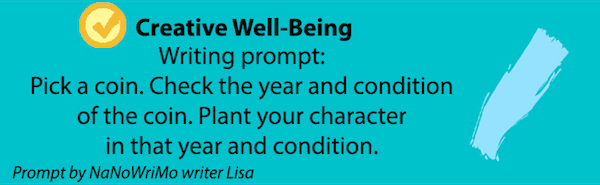
Here’s today’s Writing Wednesday Prompt:

Include all of the following words in a scene:
consequent
afflict
self-consciously
indulgence
sadistically

bonus: capitulation

If you write something from this prompt, let me know! Feel free to share what you wrote, if you want!

**If you’re looking for more like this, you might want to check out the story seeds posts I wrote for NaNoPrep a few years ago. They are not specific to NaNoWriMo, and each contains a list of several different types of prompts or ways to generate story ideas. You can find them here: Story Seeds 1, Story Seeds 2, Story Seeds 3, Story Seeds 4**

Weekly Writing Update: 5/10

Last week, I finished reading “Outcast” aloud to myself and started transferring the notes from the proof copy to the computer. I was trying to decide if I want to do line edits with the proof copy, which means working around the marks I made, or if I should use the updated computer file. I’d rather use the proof copy, because I’ve discovered that when I read my writing in actual book format, I notice things I otherwise wouldn’t. However, I decided that to be safest, I need to use the updated file, because otherwise, I could miss a typo or mistake in the corrected sections of the file. So that is my next step.

I have plenty of time, because I checked in with my two advance readers, and they’re both still a ways from being done. I still have two months until my hopeful publish date, though, so I’ll do what I can, and then most likely dive into revision of book #3 in the meantime.

While I work on continuing the series, if you’re interested in reading where it all starts, Pithea is available on Amazon as both an e-book and paperback (it’s also on Kindle Unlimited).

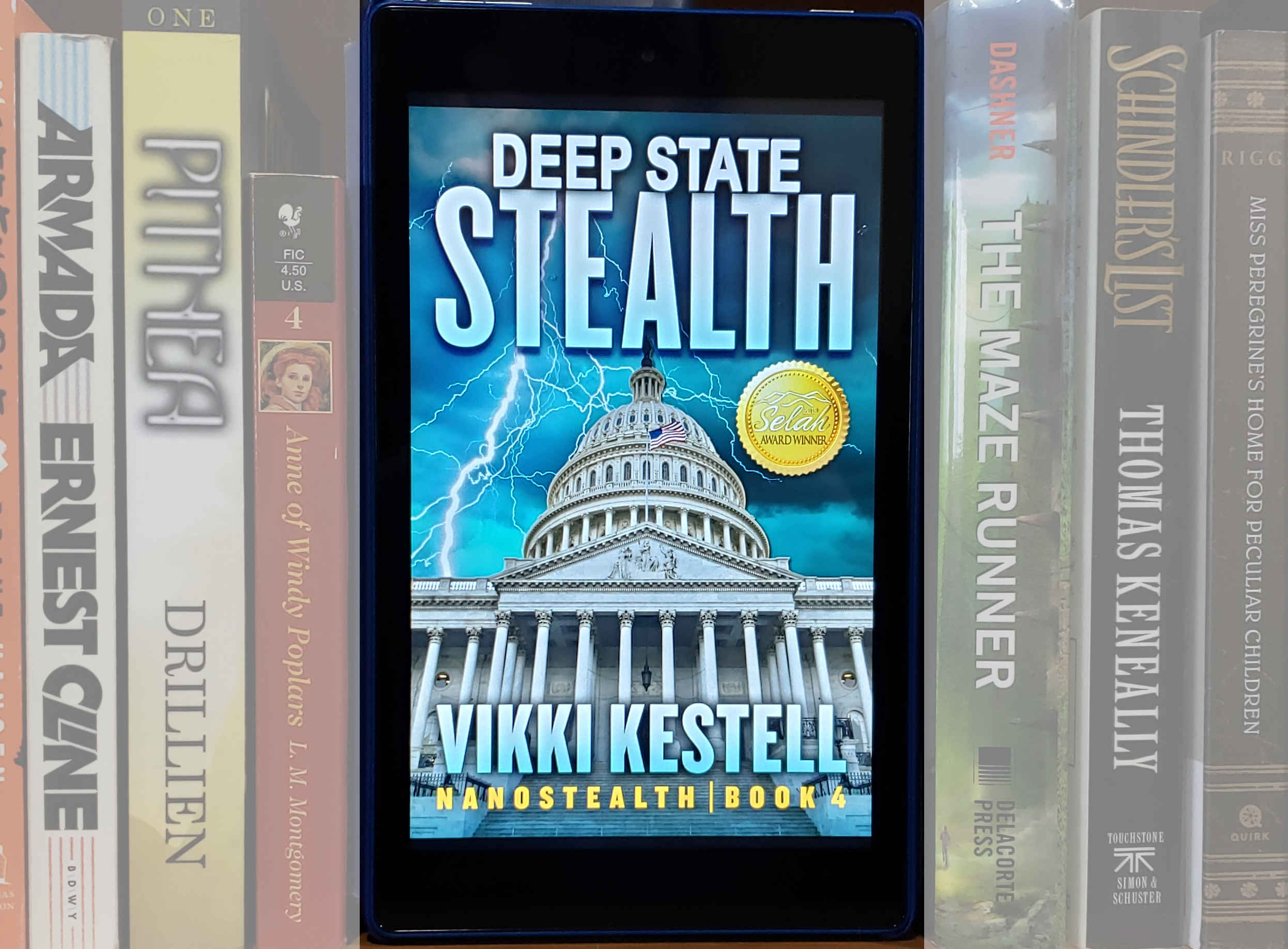
Book Review: Deep State Stealth

Deep State Stealth
Nanostealth
#4
by Vikki Kestell

My rating: 3 / 5
Genre: Christian sci-fi thriller

Nano 4

Spoiler notice: The following review will contain spoilers for the previous books in the series–Stealthy Steps, Stealth Power, and Stealth Retribution.

Now that Gemma (make that Jayda) and Zander are both super-powered and married, they’re all set to save the president’s life (again). Tasked with rooting out the conspiracy that did not end with the death of the vice president, Jayda will go undercover in the NSA. Will she and Zander be able to root out the corruption and get out of the espionage business?

I struggled with this book quite a bit early on. I almost gave up on it after the first few chapters. But I stuck with it, and when the storyline about the conspiracy involving the president got going, the story picked up. In the end, though, this was the weakest book in the series, in my opinion.

This book has the odd distinction of being a bit too religious for me, and yet having some things that made me uncomfortable, especially in a Christian book. I’m not against Christianity in a book by any means. But in a book of this type, it’s much better off being spread out, rather than shoved at the reader all at once, which is how the beginning of the book felt. But even while that was happening, there were discussions of and references to the newlyweds’ “nap times” that were just too much for me–both near the beginning, and later in the book too (nothing graphic, but uncomfortable). And throughout the book, there was a lot of “bleeped” cussing. I know that Christian authors have to decide how to handle real-world language in their books, and Kestell’s approach isn’t a bad one, but there was a lot of it. And my mind does fill in the missing words, so I got a point where I was irritated by the amount of cuss words the book was putting into my head.

I don’t mean to imply that the book was bad, though. It provided more resolution to the rest of the series than I expected. There was a reveal later in the book that I thought was going to turn out to be anti-climactic, but was pretty interesting. And going into this book, I was really worried about the way the 2 clouds of nanomites behaved at the end of the previous book–almost like a form of sibling rivalry, and I was happy to see that that was largely downplayed in this book. Like with the previous book, the main plot was engaging, and I really liked the way Jayda and Zander utilized the nanomites.

One more thing–like with the previous book, this one is written in mixed perspectives. Most of it is 1st-person from Jayda’s point of view, with some 3rd-person if the author wanted to show things happening with other characters. For as strange as it was in the previous book, it was even more strange in this one, as more than once, Jayda herself was referenced in one of the 3rd-person sections, and it took me out of the story, since she’s the character whose eyes we view most of the story through. The writing style in general really isn’t for me.

Looking back at the series as a whole, it has its pros and cons. The story itself was good–I really liked the premise, especially the initial accidental invisibility, and Gemma learning to work with the mites. The author’s style and insertion of religion detracted from the series overall, but I think many other Christians wouldn’t be so bothered by the things that bothered me. Be sure to check out other reviews if you’re interested, as there are many positive ones for this series.

Find out more about Deep State Stealth

See what I’m reading next.

If you’ve read this book, or read it in the future, feel free to let me know what you think!
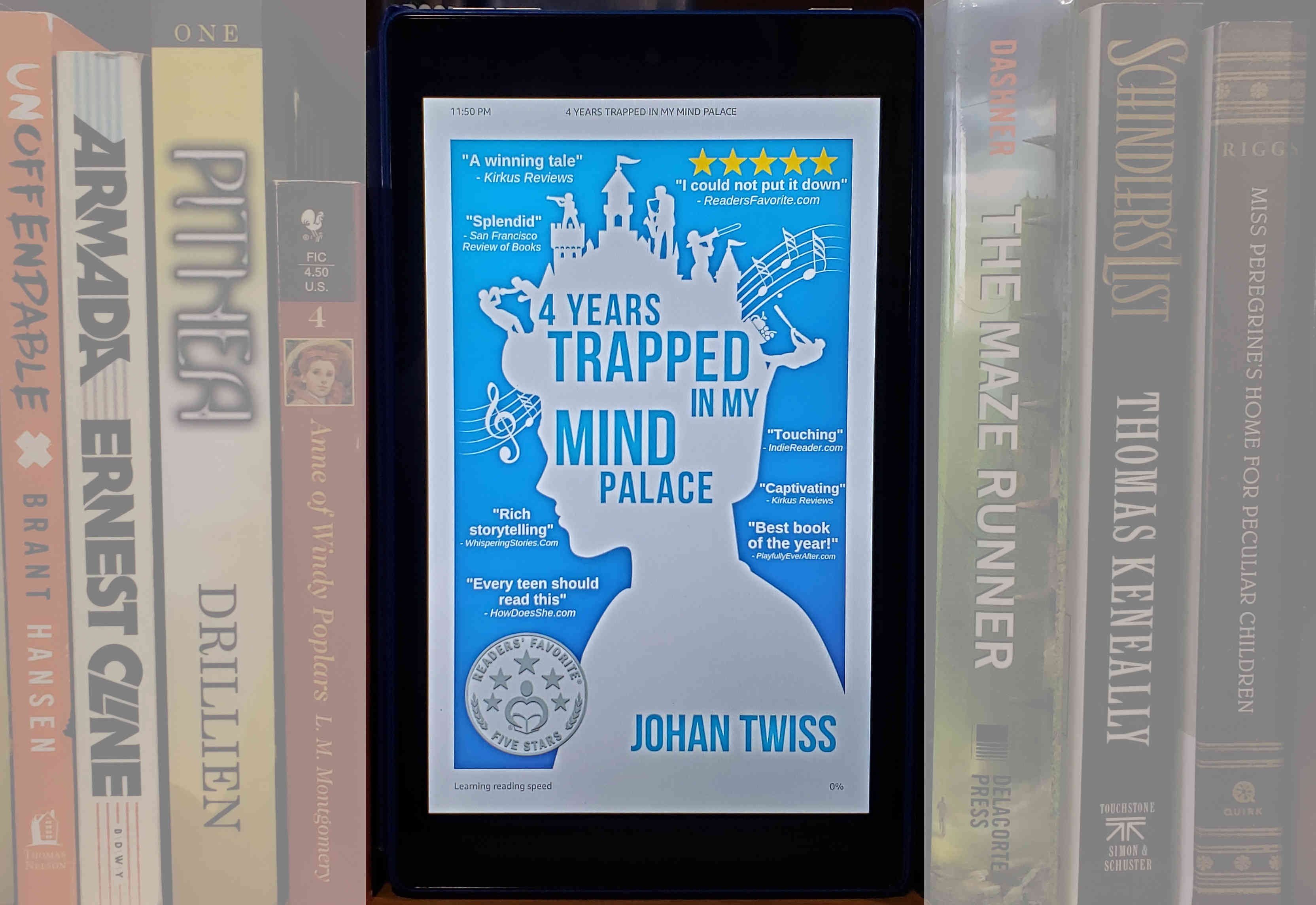
Book Review: 4 Years Trapped in My Mind Palace

4 Years Trapped in My Mind Palace
by Johann Twiss

My rating: 4.5 / 5
Genre: YA historical fiction, fantasy

4 Years

Fourteen-year-old Aaron spends two years paralyzed, but still aware of his surroundings. He’s believed to be brain dead, though, and left to his own thoughts during that time. After two years with only his imagination to sustain him, inside of which he created a world he calls his Mind Palace, he gets a new roommate–Solomon, a dementia patient with a colorful history. The next few years are the best of Aaron’s life, so far. An unlikely friendship is forged, and neither Aaron nor Solomon will ever be the same.

This is a book that I worry I’m going to have a difficult time reviewing. I really liked it, but it’s hard to explain why without giving anything away. There were moments that made me laugh, moments that made me cheer, and even moments that made me tear up. It was an interesting conglomeration of historical fiction and fantasy, and I really liked the characters.

Before Solomon moved in, Aaron had to find ways to cope, and he became a bit snarky and sarcastic (in his mind). This led to some humorous observations. And his paralysis led to a similar situation to someone who’s lost a sense, and the way their other senses compensate for that loss. As such, each other character that ever entered Aaron’s room was associated with a specific scent, which carried on throughout the book. I really appreciated this small touch.

The book takes place in the late 80s, and we get to experience some specific points in history, thanks to Solomon. 1920s NYC, the Chicago jazz scene of the 40s, and a night during WWII, amongst other things. Not to mention the first-hand experience of the 1989 earthquake in California.

Considering the name of the book, I thought the Mind Palace was fairly under-represented. In the end, I think it could have been written out of the book and it wouldn’t have made much difference. Partly because of this, and partly because of some comments made in the second half of the book, I expected a vastly different ending. I did like the ending, but was waiting for something more that never happened. That is my only real negative comment.

Overall, I thoroughly enjoyed every moment of this book, and would highly recommend it for everyone who enjoys historical fiction, as the fantasy aspect is not a detraction whatsoever, and for readers of all ages.

I received an advance review copy for free, and I am leaving this review voluntarily.

Find out more about 4 Years Trapped in My Mind Palace

See what I’m reading next.

If you’ve read this book, or read it in the future, feel free to let me know what you think!
Weekly Writing Update: 5/3

Camp NaNoWriMo ended on Thursday, and I finished strong, averaging just over an hour of work done per day (my goal was 1 hour). I’ve been working my way through my proof copy of “Outcast,” currently about 63% done with this revision. I am reading the story out loud to find awkward wording and, in theory, proofreading issues. But I’ve realized as I go that I’ve been focusing less on those tiny details like commas, missing words (I’ve twice now discovered a missing “to” or “a”, things like that) than I meant to, as I’m apparently paying more attention to the wording. So I’ll likely still have to do a line edit after this, but it’s okay, because I’m waiting on some advance readers to finish with the book anyway.

I took a couple of days off after Camp ended, but plan to start back in tonight. I’m going to use the NaNoWriMo site to track my current goal of 45 minutes worked per day, because I know that watching a graph that shows if I’m under or over my goal has always been an important motivator to me, as I work on an arbitrary goal.

While I work on continuing the series, if you’re interested in reading where it all starts, Pithea is available on Amazon as both an e-book and paperback (it’s also on Kindle Unlimited).

April in Review

I read 13 books last month. This is a new record for me in my recent reading life, which will probably stand for a while. It was definitely due to not working for the last month, but I have picked up a bit of work. I don’t know how long it will last (I work as a sub-contractor), but I’ll take it while I can, even though it’ll take away some of my reading time.

Here are the books I read in April:

Landry Park by Bethany Hagen (3.5 / 5)
On the Edge of the Dark Sea of Darkness by Andrew Peterson (5 / 5)
The Outcast by Taran Matharu (3.5 / 5)
Star of Persia by Jill Eileen Smith (4 / 5)
Storm by Evan Angler (4 / 5)
The Wounded Spirit by Frank E. Peretti (5 / 5)
Anne of the Island by L.M. Montgomery (4 / 5)
Harry Potter and the Half-Blood Prince by J.K. Rowling (5 / 5)
Harry Potter and the Deathly Hallows by J.K. Rowling (4 / 5)
Adorning the Dark by Andrew Peterson (4 / 5)
When You Reach Me by Rebecca Stead (5 / 5)
The Sea Before Us by Sarah Sundin (4 / 5)
Fahrenheit 451 by Ray Bradbury (3.5 / 5)

This list includes 2 ARCs and 2 re-reads*. My favorite book from April was When You Reach Me. I finished 2 series, continued 2 series, and started 1 series. My ever-changing short list of to-be-reads, as well as a flag for the book I’m currently reading and an ongoing list of those I’ve read and posted about can be found here.

*One of the re-reads involved listening to the author read a few chapters of his book every night live on Facebook/YouTube to beat the quarantine blues. I count it the same as listening to an audio book.

I’m also keeping my Goodreads page updated with a more extensive list of to-be-reads. Despite my almost too-long TBR list, I’m always looking for more to add. Feel free to offer suggestions of your favorites or just recent reads you enjoyed.

Book Review: Fahrenheit 451

Fahrenheit 451
by Ray Bradbury

My rating: 3.5 / 5
Genre: Classic sci-fi, dystopian

451

I read this book as a sophomore in high school, 22 years ago. I remember it being one of the easier-to-read classics of my 3 years of Honors English. All I really remembered about it, though, is the basic premise of book burning, the parlor screens, and a vague creepy idea of the Mechanical Hound. After reading it again now, I’m actually surprised that I remember it as a “simple” read, due to the writing style and a plethora of metaphors, but it does probably make a difference when you’re pushed to analyze it after reading each third. I didn’t dissect it for symbolism and analyze every paragraph like I did other classics, though, and I still have the short papers I wrote for assignments about it. It was fun to read those again after reading the book.

As an adult, I see the book differently than I did back then. For one thing, I have come to realize that the book is not about the censorship involved in book burning. The fire captain makes it clear that society turned from books long before it became illegal to own them. Rather, the technology that led them to that point seems to be what is being demonized. I suppose it’s a call to make sure we don’t let it take over our lives.

Though to be honest, I think there’s a mixed message here, because despite the explanation the captain gives, it’s also clear that the government doesn’t want the people thinking for themselves. Wants them distracted while they’re about to go to war–why and with whom, we never know. And due again to the writing style, I am not sure I understand what happened at the very end regarding the war.

I would say a strong theme, which is perhaps more relevant today, is the control the government is able to exert over the people. If the majority of society decides it doesn’t care about books, then those people just don’t read books. Why does that have to lead to books becoming illegal? The government decides that it needs to regulate the people’s “fun” and oppose the potential of anyone offending anyone else at all, and apparently the people let it happen. Especially considering how recently Faber was a professor at a liberal arts school, it’s amazing how quickly it must have happened.

One thing that I was absolutely correct about in remembering this book was how creepy the Mechanical Hound is. I actually had some unpleasant dreams the night in between the two days it took me to read the book this week, and the Hound was a highlight. (I don’t have specific memories of the dreams, but a general understanding that they were related to the book.) It’s seriously disturbing.

In the end, for me, at least, this book doesn’t hold up as the classic it’s hailed as. It’s not a bad story, but I don’t know that it’s worth studying or holding up as a warning. Between this and Ender’s Game, maybe I’m just not a fan of classic sci-fi.

Find out more about Fahrenheit 451

See what I’m reading next.

If you’ve read this book, or read it in the future, feel free to let me know what you think!

Book Review: The Sea Before Us

The Sea Before Us
Sunrise at Normandy #1
by Sarah Sundin

My rating: 4 / 5
Genre: Historical Christian romance

Sea Before

Wyatt Paxton is a lieutenant in the US Navy. Dorothy Fairfax is a first officer in the Women’s Royal Naval Service. Both of these divisions of the US and UK military are working closely together to plan the invasion of Normandy in June of 1944, which is when Wyatt and Dorothy meet. Dorothy’s job is to piece together thousands of holiday pictures of the beaches of France so that Wyatt can make informed decisions for the invasion. Though Wyatt is drawn to Dorothy, she has her eyes set on another man…who has his eyes set on several other women. Both have to find a way to keep romantic entanglements, as well as other family drama, from distracting them from the ultimate goal—winning the war.

What I liked about this book is that it was not just about the romance. Wyatt and Dorothy both had a lot of other things going on in their lives, and that’s besides the looming invasion. In fact, the romance plot line is what detracted the most, or at least a particular aspect of it, as I’ll explain a bit further below. Overall, though, the book was engaging, enjoyable to read, and clearly well-researched.

The book begins by showing an incident in Wyatt’s past that haunts him throughout the book. It was especially interesting to me, because I’ve already read book #3 in this series and knew of the event, and now got to see it happen. Wyatt himself is a great character—great guy with a lot of depth, and I had an easy time imagining his Texas drawl, because his dialog was well-written. Feeling guilty about his part in the incident that happened before he joined the Navy, Wyatt sees himself as a prodigal son, leaning on God to get him through this tough time, and sharing his faith with Dorothy.

Dorothy has a lot more going on in her story, but I liked her less. She is a good daughter, and not necessarily mean to Wyatt (for the most part). But frankly, it takes her way too long to see Eaton, her crush, for what he really is. There were times I was sure she was on the turning point, but she just keeps pushing Wyatt aside in her mind and crushing on Eaton. And why is she so set on this? Because of what I felt was the weakest part of the book—her mother once told her that she regretted marrying her father, because he was boring, and she needed excitement. Her mother said that Dorothy was just like her, and warned her to marry someone exciting like Eaton. Why she wrote Wyatt off as “boring” so very quickly, I’m not sure, but she sticks by that assessment for far too long.

Other than a further contrivance later in the book, the rest of it was great. The book follows Wyatt into the invasion, from his position on a naval ship, and though a lot of the terminology was lost on me, I was caught up in it. There were several scenes in the last quarter of the book that made me so happy. In the end, I definitely recommend this book to all who enjoy Christian romance and Christian historical novels.

Find out more about The Sea Before Us

See what I’m reading next.

If you’ve read this book, or read it in the future, feel free to let me know what you think!

Writing Wednesday: #StayHomeWriMo

WW Prompt For today’s Writing Wednesday Prompt post, I’m going to again share a recent #StayHomeWriMo prompt from NaNoWriMo. StayHomeWriMo-checklist-4-29 I’m really excited to try this prompt out! For more, follow this link. How are you staying sane and healthy during this time? If you write something from this prompt, by all means let me know! Feel free to share what you wrote, if you want! **If you’re looking for more like this, you might want to check out the story seeds posts I wrote for NaNoPrep a few years ago. They are not specific to NaNoWriMo, and each contains a list of several different types of prompts or ways to generate story ideas. You can find them here: Story Seeds 1, Story Seeds 2, Story Seeds 3, Story Seeds 4**