Weekly Writing Update: October Week 2

I got the interior of “Pithea” formatted for paperback with minor difficulties, and after some real frustrations with the cover, ordered my first proof copy. It’s set to arrive tomorrow!! Once I have it in my hands, I’ll start reading through it with an eye for final details that need changed while also making sure the formatting is good. Visually speaking, I’m more concerned about the cover coming out good, so I’m really anxious to see it for the first time.

After I ordered the proof copy on Tuesday, I tried to turn my attention to prepping for NaNoWriMo. But that was when I realized that I only had a week until my next writers group meeting at my local library. Last month, I volunteered to lead a talk on writer’s block this month, and I hadn’t done any prep for that. So I spent a couple of evenings making notes and preparing a handout. I think I’m basically set for that now.

I have done a little of the prepping I had planned for NaNo, but I need to make sure to focus on that more in the coming weeks. There are just over 2 weeks left of Preptober, and I still need to go over the outline I made 4 months ago for the story I’m writing this year and flesh it out. Also re-read the first draft and new plans for the story that comes before. And read a couple of character interviews I wrote as part of the planning stage for this story. I’ll have to find a way to balance my writing time between “Pithea” and my NaNoNovel (working title: “Ophaela”).

Writing Wednesday: Prompt

WW Prompt

Here’s today’s Writing Wednesday Prompt:

You’re avoiding yourself.

(Today’s prompt is a quote from the book Weave a Circle Round by Kari Maaren.)

If you write something from this prompt, by all means let me know! Feel free to share what you wrote, if you want!

**If you’re looking for more like this, you might want to check out the story seeds posts I wrote for NaNoPrep a few years ago. They are not specific to NaNoWriMo, and each contains a list of several different types of prompts or ways to generate story ideas. You can find them here: Story Seeds 1, Story Seeds 2, Story Seeds 3, Story Seeds 4**

Weekly Writing Update: October Week 1

Last week, I finished making immediate changes to “Pithea” that I already knew needed made. My plan now is to format the updated draft for print, get a proof copy, and read through the book that way (probably reading it out loud), hopefully one last time, making notes for anything else that needs changed. I want to have the final draft as settled as possible before November.

This brings me to NaNoWriMo. October is what many of us call Preptober. I already have a preliminary outline for what I’m planning to write this year, which I wrote 4 months ago. But I need to re-familiarize myself not only with that outline, but also with the story that comes before it. I have a few areas of the outline to flesh out, too. I’ll have time to do this while waiting on my proof copy to arrive, I’m sure.

Writing Wednesday: Character Interviews

WW

In my writing past, I remember hearing other writers talk about their characters haranguing them. Complaining about their lack of page time, about unpleasant things that happened to them, or about who knows what else…but they always seemed to be complaining. I remember always being a mixture of jealous and certain that those writers were making it all up. While I didn’t believe that it was very likely that their characters just jumped into their thoughts out of nowhere to start talking to them, now I can see the plausibility—the writer might have been thinking about their story at that time, or just letting their mind wander in general. And now, I have seen the amazing benefits of talking to my characters.

There are likely many different ways people refer to this phenomenon. For me, it usually involves a discussion that is led along by me asking questions of my characters. Thus, I use the term “character interview.” And understand that the way I go about having these discussions with my characters are by no means the only way to do it. It is what works best for me, and you should definitely figure out what works for you (if this method works for you at all).

I will dispense with the history of how I came to utilize this technique in my writing, and just explain how helpful it can be. In the different stages of writing (which I would break down into dreaming, planning, writing, and revising), character interviews have been most useful to me during planning and revising stages. During the dreaming phase, you likely wouldn’t even have characters very clearly in mind. If you have enough to start talking to your characters about, you might be more in the planning stage. During the writing stage, well…you’re writing. Unless you run into a block and decide to stop and hash it out, you won’t likely be stopping the prose to have a chat.

So now you may be wondering how to start. Or what kinds of things to talk to or ask your characters about. Usually at the point that I decide it’s time to start one of these discussions, I am struggling with some kind of plot hole, or a question about how to proceed in a scene, how to get something to happen that I really want to see happen in the story, how to fill out a story, or even which character should actually be the protagonist or main character in a story. And then I literally just pose these questions to the characters I think can help me the most, and go from there.

The next question might be how you know which character(s) would be the best to talk to for the questions you have in mind. Sometimes it’s obvious, but sometimes it requires thinking outside the box. Earlier this year, I was struggling to rework the plot of one of my books, which has a murder-mystery element to it, and when I wrote the first draft, it came out incredibly weak. I had a long conversation with the main character of that book, but still couldn’t figure out what I was missing in the middle of that story. I was considering setting it aside for a while, but decided to talk to a different character instead first—the antagonist. By the time I was done (a week and a half later), I had not only filled in that saggy middle, but realized that this person was not the main antagonist. Such a productive interview!

Now for the tangible question—where/how to conduct the interview. I’ve done them multiple ways—all in my head, recording myself audibly in some way, typing the conversation on a computer or my Neo, and writing it in a notebook. I don’t recommend doing it only in your head unless you have a great memory; I prefer to be able to look back on it somehow later. I recorded myself with a headset and Audacity one time, but decided that listening to the conversation later was just too weird, so I’m not doing that again. Typing it out works, as long as you make sure to clearly designate who is saying what. My preferred method is to write the conversations out longhand, though, and even a step further, I like to use a different color pen for each person talking (including myself). It makes it so much easier to read over again later, which I do a lot. Plus, I really like the tactile element of writing by hand.

A few more tips about conducting these interviews:

  • Give yourself the freedom to explore without worrying about accuracy. I have had interviews where, by the time I got to the end, things we discussed at the beginning were obsolete, because the plot took a turn during the discussion. That’s okay.
  • I use the term “interview,” but often I don’t ask questions for a while, instead just carrying on an actual conversation. But since the basic idea behind this (for me, at least) is that the characters know more about their story than I do, because it’s their story, I am generally coaxing the truth out of them.
  • If you have more than one character involved, they might start talking to each other, instead of you, and that’s okay too.
  • Don’t get too caught up in the nebulous world your characters are inhabiting for these interviews. They are outside of the time and space bubble of their stories. And yet, I find that it helps me to think of the times that I interact with them as a continuation of time in itself, and even reference back to previous discussions (like having one character say I’d just yell at him again if he told me his theory about something in particular, because yes, I’d gotten frustrated with him in a previous interview).
  • It might feel weird at first to do this, because of course you know these characters aren’t real, but they really can feel real. And in truth, if you don’t think of your characters as their own people (rather than just part of you), then maybe they won’t come across as real to the reader.

If you think talking to your characters might help you with your own writing, but still aren’t sure how to start, pick a character that you think might have some helpful insight, and just start out by asking, “What do you think of the story so far?” or “What would you change if you could?” You might be surprised what comes out.

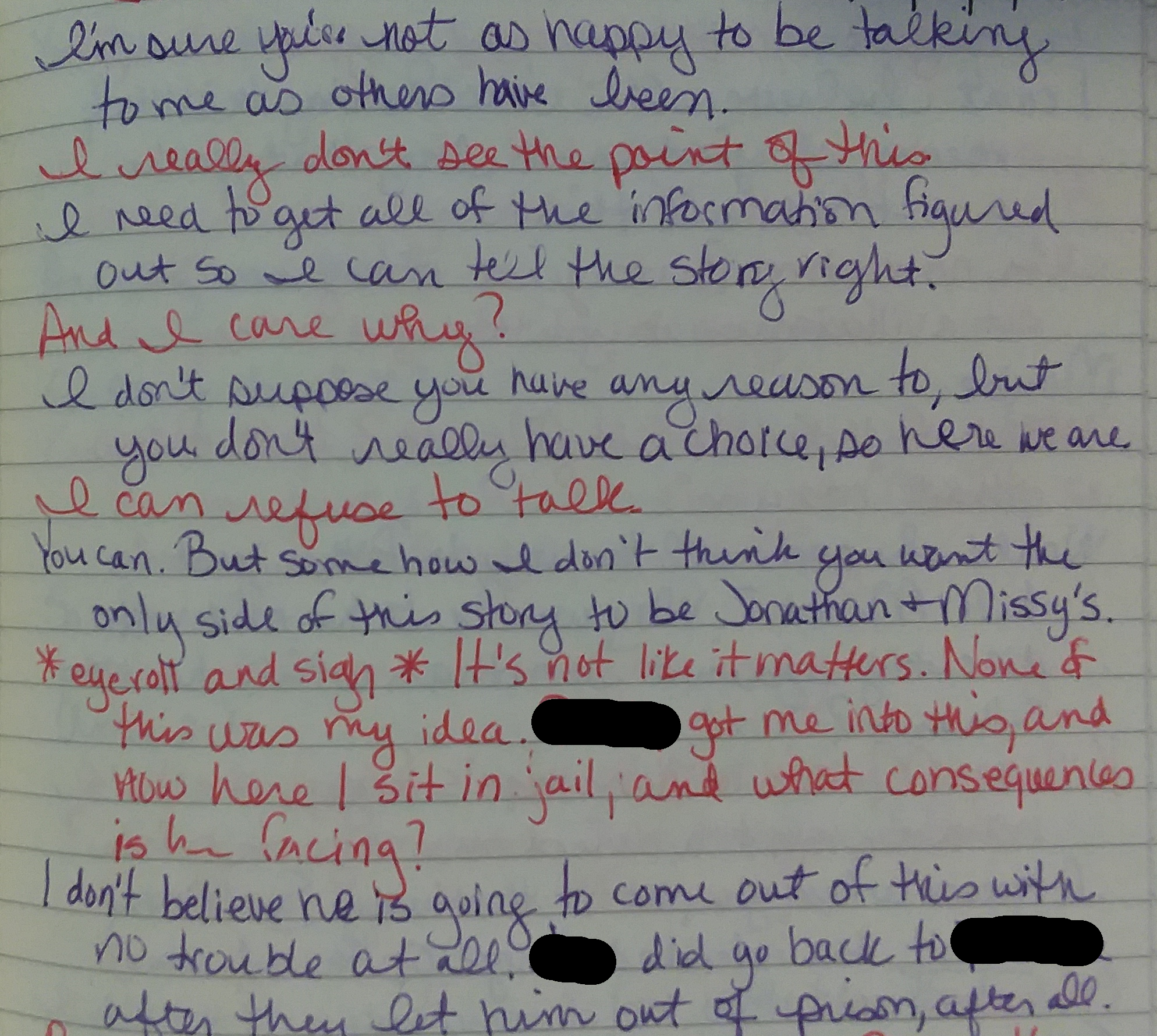
In case anyone is interested in what most of my interviews looks like, below is a picture of the beginning of one of them, the one I mentioned above with the antagonist of the murder-mystery story (and an example of one where what I wrote at the beginning became incorrect by the time I was done). Purple is me, red is the antagonist. It took me to the end of the page to get past her refusal to help (which was totally true to her character), but after that, I immediately started to gain insight into the story. I’ve blocked out a few spots due to possible spoilers. Also, I use erasable pens, which are just amazing!
character interview

Weekly Writing Update: September pt. 5

I had another somewhat unproductive week, though I did work on “Outcast” a little. I also spent some time getting ready for the local author booth at a local festival. That was today. It was terrifying at first, and I kicked myself for not saying the right thing after several interactions, but I did generate some interest in my future release, get some hits on possible future author appearances, and tell one teenager about NaNoWriMo’s Young Writers Program.

Tomorrow, I will start working on making a few changes to “Pithea” that I already know need done, then format it for the print version, and get a proof copy, which I will use to do a final revision, to be ready to publish soon. I will also start making sure I’m ready for NaNoWriMo this coming week, as Preptober starts on Tuesday!

Writing Wednesday: Prompt

WW Prompt

Here’s today’s Writing Wednesday Prompt:

I couldn’t help but wonder if it was a trick.

If you write something from this prompt, by all means let me know! Feel free to share what you wrote, if you want!

**If you’re looking for more like this, you might want to check out the story seeds posts I wrote for NaNoPrep a few years ago. They are not specific to NaNoWriMo, and each contains a list of several different types of prompts or ways to generate story ideas. You can find them here: Story Seeds 1, Story Seeds 2, Story Seeds 3, Story Seeds 4**

Weekly Writing Update: September pt. 4

I didn’t get much done in the way of actual revising of either “Pithea” or “Outcast” this week. I started to work on “Outcast,” but didn’t get far, due to some new things going on in my family this week, and trying to settle into a new schedule. I did make some decisions about the imminent release of “Pithea,” though, and hope to be able to make an official announcement next weekend! Stay tuned!

NaNoWriMo Rebels

NaNo handouts

Many people who are new to the world of NaNoWriMo only know it as National Novel Writing Month. And of course, at its heart, that’s what it is. But let me tell you about the wonderful world of NaNo Rebels.

When I first did NaNoWriMo in 2007, the rules were more strict. You write a new piece of lengthy fiction, and if you reach 50,000 words, you win. Though rebelling did happen, I don’t think it was as prevalent or as acknowledged as it is now. In the time since then, the people who run the event have opened their arms to those who want to join in the fun, but don’t necessarily want to (or somehow aren’t able to) write a new, lengthy work of fiction. (And actually, they’ve even changed the standard “rules” to say that continuing a previous story is no longer rebelling, but only new words added in November count.)

So, what can you do as a NaNo Rebel? Almost anything you want to. For example:

  • Write non-fiction
  • Write short stories (though if the stories are related to each other, it’s not rebelling)
  • Write a script or screenplay
  • Revise a previous work

All of these things and more are acceptable for NaNoWriMo. Some of them may require a different way of tracking your work done (for example, for revision, you may track time instead, and equate an hour to 1000 words). If you’re curious about what is or isn’t considered rebelling, you can find more information here.

And if the month of November just really doesn’t work for you, consider participating in Camp NaNoWriMo, which takes place during April and July.

**Note: The website & forums have very recently relaunched with a lot of changes, so some things aren’t working quite correctly. I understand kinks are still being worked out, but be aware that what you see now may not entirely be accurate or permanent.

Are you participating in NaNo this year? Will you rebel or stick with the normal format?

For anyone out there who is participating, feel free to check out my series of tips and tricks for the month, and also to add me as a writing buddy! (Let me know you came from here, and I’ll add you back!)

Writing Wednesday: Prompt

WW Prompt

Here’s today’s Writing Wednesday Prompt:

Combine the following 3 elements into a scene, short story, story synopsis, etc:
safety deposit
hospital room
dog catcher

(These elements were 3 randomly drawn cards from my Storymatic deck.)

If you write something from this prompt, by all means let me know! Feel free to share what you wrote, if you want!

**If you’re looking for more like this, you might want to check out the story seeds posts I wrote for NaNoPrep a few years ago. They are not specific to NaNoWriMo, and each contains a list of several different types of prompts or ways to generate story ideas. You can find them here: Story Seeds 1, Story Seeds 2, Story Seeds 3, Story Seeds 4**

Weekly Writing Update: September pt. 3

For 5 1/2 years, I have tracked my writing work by time or by words, and reported it on this blog. I started this blog as a way to motivate myself to working on my writing regularly, and it worked most of the time. There were some small breaks here and there–weeks or even months long. And there was the 2 1/2 years where I did no type of writing outside of November (NaNoWriMo kept me coming back for at least that month), due to a difficult and time-consuming job.

A couple of months ago, I realized that I didn’t want my blog to focus so much on this anymore. I had started to post other things–writing advice, snippets of my own writing, and was planning to start posting book reviews. A daily update of what writing work I’d done just didn’t fit very well anymore. So since the beginning of July, I’d done a weekly update instead. And in the last week, I realized even further that I didn’t think quantifying how much work I’d done made much sense anymore either. I am at a point where I’m seriously working publication for my first novel and pretty deep in revision for the second. As such, I don’t really need the self-motivation of posting such specific amounts of work done.

I will continue posting an update weekly, but it will be an overview of what I accomplished on my books or other writing in the last week, without the specific time worked. This is a huge milestone for me, since, as I mentioned at the beginning of the post, I’ve recorded the time I spend working on my writing for a long time now. So anyway, without any more exposition, here’s my update for this past week:

I’m continuing to work with an advance reader to tighten the plot and world-building details of “Pithea.” I am really happy to know that, at least according to this reader, I can focus on details, because much of the book is otherwise sound. I have 2 other advance readers who are still reading, so I’m anxious to hear what they say as well.

I am very strongly hoping to have an idea of a release date by the end of this month, so that I have that information to share when I am at the local festival I am attending as one of several local authors. But at this point, I am mostly waiting (which is so difficult!).

I also spent some time this week working on “Outcast”. I did not go back to the draft I was revising, opting instead to use a couple of cards from my Writer Emergency Pack to try to brainstorm some more content for the book, since I now know for sure it will be too short. I’m not worried about making it as long as “Pithea” (a little over 100k words), but more than its current length of ~50k would make a lot more sense.