Dream Every Day: Story Cubes

 dream plan write

I used to think that if I ran out of spontaneous story ideas (those that came to mind on their own, and were not sought after in any way), it would be the worst thing in the world. There have been gaps in my writing that came from not being able to go forward on my current work, but not having new ideas that interested me much, and so I simply did nothing for months at a time. Though I love NaNoWriMo, I’ve skipped several years since my first time participating in 2007, because I didn’t know what to write.

I used to think that not having an idea readily available would mean I’d have to sit and stare at a wall, racking my brain for anything that could be a story. It’s not a pleasant concept, which is obviously why I chose to do nothing instead. Most of you, I’m sure, know how ridiculous that is. I regret this attitude, and those lost NaNo chances. In the last few years, I’ve finally come to see that not having a story to write may not be so terrifying. There are all sorts of tools and exercises that we can use to find ideas. Writing prompts, plot generators, and many other things can lead to an idea.

The one I’m looking at today is called Rory’s Story Cubes. It’s a set of dice that is billed as a game–two or more people rolling the dice and using the images that come up to create a story. There are several variations of game play, including one where several people roll the dice, one at a time, in turn, and add to a group story as they go.

007

These cubes prompted a story about old flames, murder, and the mafia.
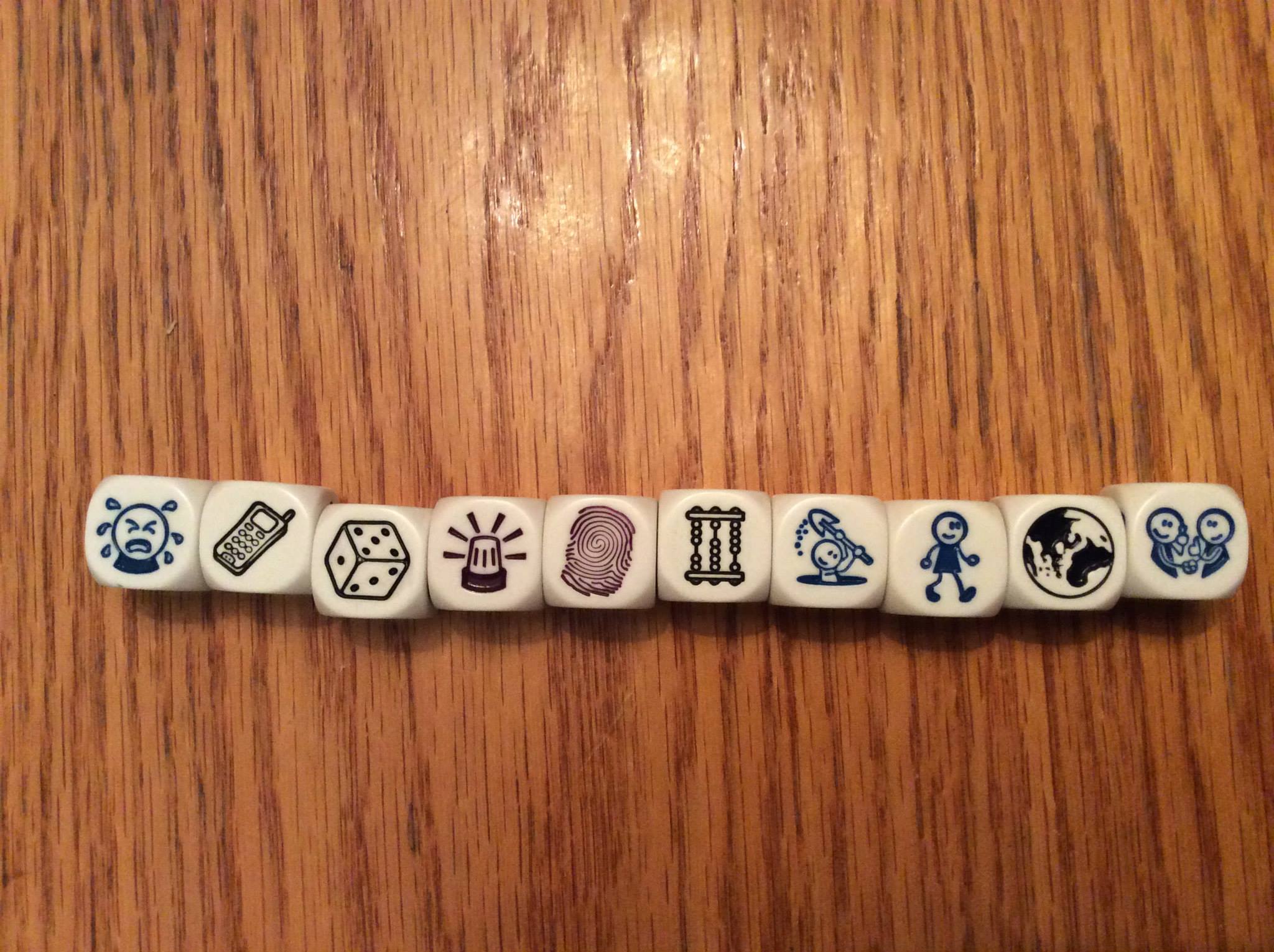
story cubes2

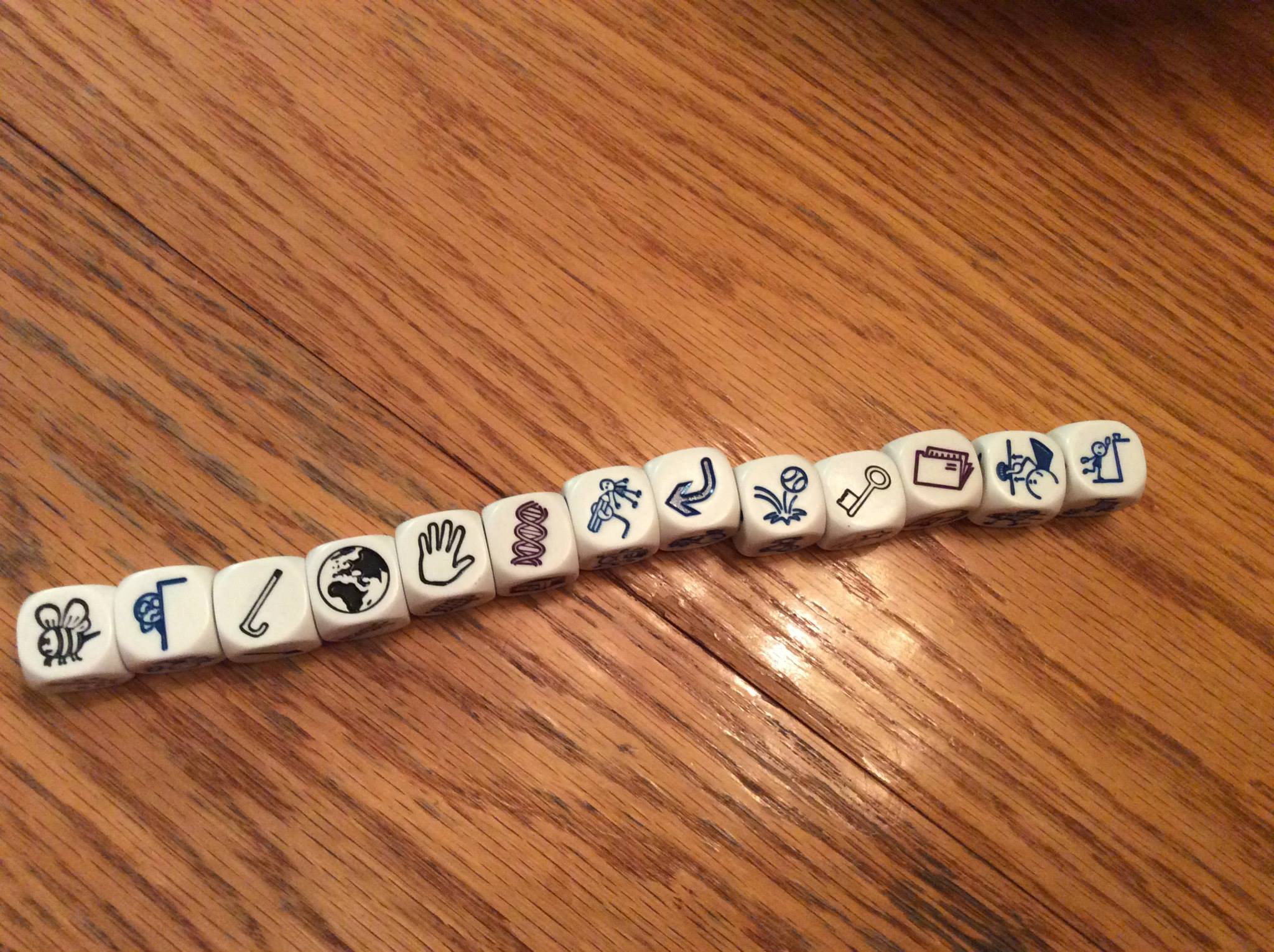
This chain of dice turned out to be about awards, thieves, and Greek detectives.

I’ve played with the cubes in groups a few times, and it’s fun to see what we come up with. When we first got the dice, my husband thought they may be useful for me as a writer, though I didn’t think it was likely. I believe one of the first things I said was that I didn’t know if the themes of the dice would really fit into my story world.

I’m still learning how prompts, seeds, and other tools can be beneficial to writing practice. I tend to think that if I’m not generating new ideas for my current project, it’s a waste of time. I have failed to understand that even the most innocuous writing practice can lead you to a new character, plot device, bit of dialog, or even just a feeling you want to explore.

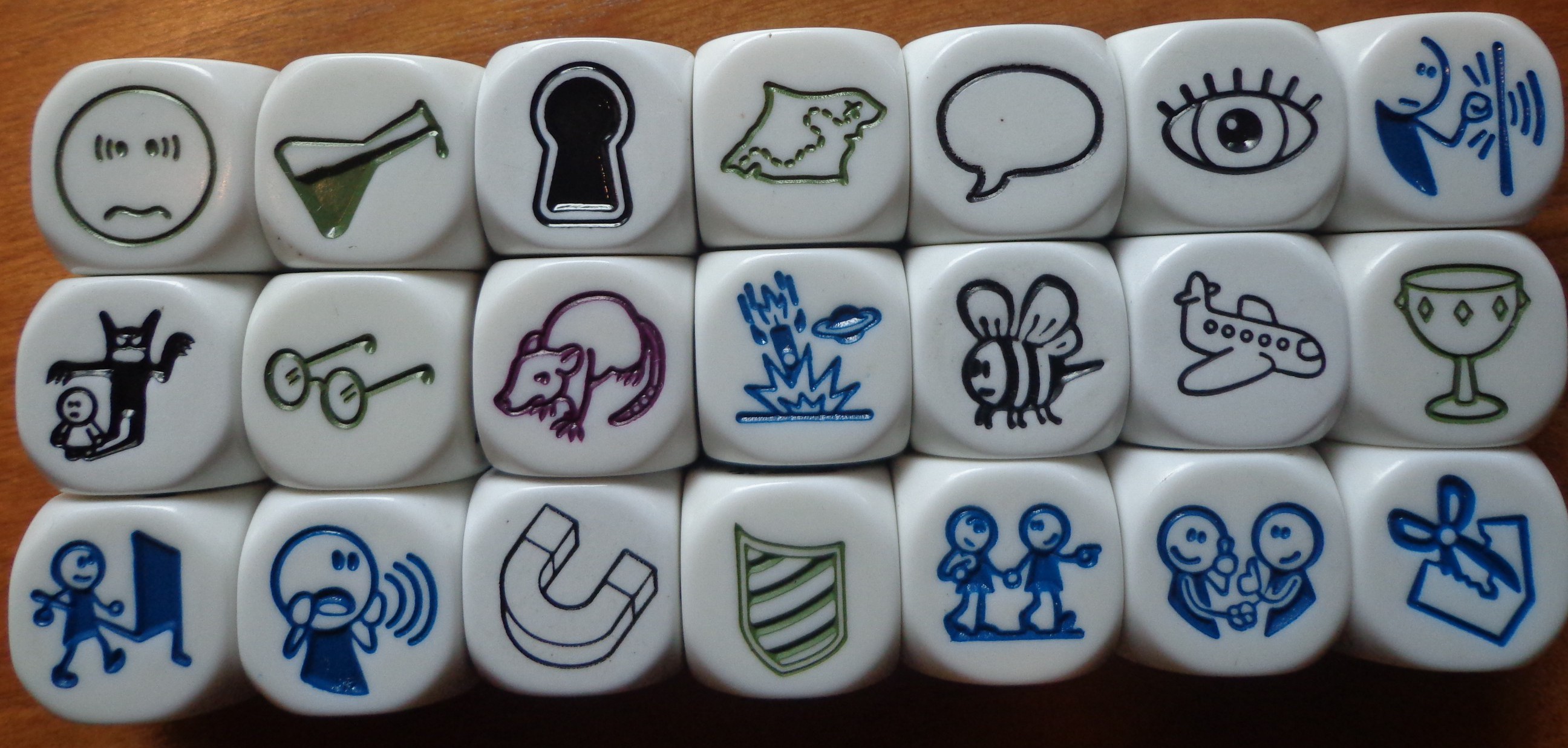
So when I went on my writer’s retreat, I took the cubes and tried out using them alone. The method I chose was simply to mix all the dice together (we have 4 sets), choose one without looking, and roll it. Then I wrote a line or two based on the image. I proceeded to do this until i felt I had reached an adequate ending. That took 21 out of the 30 dice.

I enjoyed writing something completely unrelated to the world I’ve been so immersed in lately. Something with no importance whatsoever. I enjoyed it so much that I feel it would help keep my mind fresh for my writing if I were to do free writing practice more often. Most days, though, I barely have time to do my normal work, let alone finding extra time for that. Maybe when I can devote more of my life to writing (i.e. when my kids are older).

006

This one involved aliens and their bodily functions.
story cubes1

Here we have the tale of an elderly beekeeper; it turned into a government conspiracy with DNA-manipulated animals and giant graphite men.

One thing about using the story cubes that I’ve noticed and want to mention is that I have to be willing to let whatever comes from using them be completely ridiculous. Often, the dice will lead in some sort of impossible direction, and the stories end up being supernatural or dream-like in some way. One of these days I should try the method of rolling several dice at once and looking at them together to find a way to piece them together into a story, rather than going one at a time and not knowing what might come next.

Dream for yourself: You don’t have to have a set of story cubes to be able to give them a try. I have included 4 pictures above of chains of the cubes that you could use for your own writing practice. Use the dice in order or mixed up; look at the chains as a whole, or only one die at a time. See what comes to mind. Below, I have shared the picture of the dice I rolled during my writer’s retreat. Feel free to write your own story from any or all of the cubes below, and then share it with me somehow. If you want to read what I came up with, you can find that here. (Note: If you’re thinking about writing your own, don’t read mine yet!) It would be fun to compare what other people come up with.
108

What are your thoughts on story prompts and other such tools? How do you fit free writing/writing practice into your day?

Plan Every Day: Those With Whom We Spend Most of Our Time

dream plan write

Character creation is an important part of developing a story. It’s one of the key elements of fiction, right up there with plot and setting. A unique character can make a stale plot seem new again. Alternatively, an overused character type can drag down a brilliant plot. So what do we do? We plan. We carefully craft our characters before we start to write. Sometimes, before we even start to outline.

(Obviously not all characters are planned in advance–you’re not always able to plan for everything that may come up as you’re writing. And maybe pantsers don’t have any characters figured out before they start. Is that a thing? I don’t even know. If so, though, at some point, I would think they’d have to slow down and flesh out the characters that came as they wrote.)

For me, character creation can sometimes go hand-in-hand with the outlining. As I’m weaving the plot, the characters are being defined by what the story needs. Sometimes, an idea for a character is sharp in my head before I’ve even figure out what may ever happen to that character.

In my early writing, I wasn’t great at making various characters have their own distinctness. That doesn’t mean there were 5 of the same person, but with different names and genders, wandering around interacting and moving the plot forward. Rather, I seemed to have a general nice, friendly type of character and a general crabby, anti-social type of character. I noticed that a lot of my side characters almost mirrored the main character.

In the time since then, I’ve been more careful to give each character their own sense of being. It has been an important part of my current revision of “Pithea” to flesh out side characters who are actual people in my head, but don’t get a lot of “screen time,” so to speak. Just because they have small parts doesn’t mean they shouldn’t be as much themselves as I can make them in those parts.

There can be a question, though, of how to really craft your character into a real person. Character sheets are an obvious answer, and you can find different forms of those all over the place. I’ve tried that before, but I’ve realized I don’t care for them. For a while, I thought that if I couldn’t answer a question like, “What is your character’s philosophy on death?” it was because my characters weren’t deep enough. Obviously I needed to answer that to have a really good character. But the truth is, no matter how I answered, it felt silly. It felt forced. It just didn’t work for me. (Character sheets or profiles can be a great tool if it works for you. I’d never discourage anyone from doing it. I may even try it again someday. Maybe I just need the right template.)

To get to know my characters, give them their own voice, or discover why they are who they are, my favorite method is just writing. Write a scene unrelated to the plot, centered around the character in question, maybe even from the point-of-view of that character, even if the main story isn’t. Writing prompts can come in handy for something like this, if an idea doesn’t readily present itself. But the general idea is to write out a scene and let that character shine in their uniqueness, and it gives you a better feel for that character.

As I’ve been working on “Pithea” with my sisters, one of them defended a character that was meant to be disliked by other characters and readers alike. My sister said, “He’s tactless, but everything he says makes sense. Why does everyone else always jump on him? They’re all really mean to him.” I was shocked and confused. He was a bully! Rude! Horrible! But as I read through his parts in the story, I realized that she was right. He wasn’t the nicest guy, but the other characters reacted to the man I saw in my head, not the one on the page.

So I spent some time getting to know him. I started with the personality I wanted him to have and asked what in his life could have led him to be that way. Then I wrote out important points about his early life. Over the course of a couple days, I did some writing practice from his perspective. None of this would ever make it into the story, but it was important to me. I shared it with my editing-partner sisters so that they could understand how I saw him. Then I changed some of his parts in the story, based on the deeper understanding I have of him now.

One more thing–while I don’t fill out a pre-made character sheet, I do make sure to write down traits or other important notes about my characters that I realize along the way.

Plan for yourself: Think about any characters you may have that you feel are not very well developed. Or that you feel have confusing motivations. Consider why they are in the story in the first place, and what specific personality or outlook on life their role would require of them. Then go backwards from there and think through why that personality might develop in them. Does he look down on women because he had three older sisters who treated him harshly? Did she become a nurse because when she was younger, she remembered how her sick grandfather’s nurse had brightened his stay in the hospital?

Spend some time getting to know them. Fill out a character sheet if you like and haven’t already, but go further than that. Write more with them than you might plan to for your story. Write as them. How would they describe themselves? How do they see the world? What do they think of the main character? Put them into a conversation with someone else, about something important or just what to have for dinner. How do they talk, react, or move during the conversation?

Make sure to write down anything you learn about your character during this time, somewhere that you can easily refer back to it.

How do you get to know your characters? Do you have a character sheet template that you use for every one? Do you ever struggle to avoid copy+paste characters, or do you excel at creating unique individuals? How many times do the words “character” or “characters” appear in this post?

Dream Every Day: Revisiting High School

 dream plan write

When I was in high school, I took a creative writing class. It’s the only one I’ve ever taken, and I couldn’t tell you how alike or different it was from other such classes. There was a process we went through before we ever started writing for the short story part of class that has stuck with me for fifteen years. It was a process of coming up with multiple story seeds, before then choosing the one we wanted to develop into a story. One day we were instructed to come up with a setting and character that didn’t really go together. For example, I chose a British soldier at a Minnesota lake. Under that, it says:
“Why–the queen of England decided she wanted a vacation in a secluded spot and he was assigned to guard the family.
Conflict–the people who live around there are secretive, don’t know why he’s there, and don’t want him there.”

The scenario sounds ridiculous to me now, and I never wrote any further with that idea. However, for some reason, this exercise has stuck with me for a long time.

On the other hand, what is just an innocuous picture–a field of wildflowers–became the short story I turned in for that class. A short story the teacher loved and helped me to remember that I enjoy writing (I had written a lot in elementary school, then abandoned it for poetry). In an essay in that class, though, I apparently wrote that I didn’t think I’d have much reason to write fiction again in the future. That was fun to dig up from my past.

flowers prompt

This colorful, foggy field became the setting of a frenzied, fear-filled search for a briefcase and a race against time for the protagonist in the story I wrote from it.

At the same time I was taking this creative writing class, I had the same teacher for English class. In English, we would get vocabulary lists, and for every list, one assignment was always to write some sort of paragraph or short story that incorporated at least 5 of the vocab words. A few of those ended up being great sources of creativity for me. One, a one-page short story, my teacher said was written well enough and had good enough character development that I could have turned it in for my short story in creative writing.

The point of all of this is to say that, while inspiration can certainly come from anywhere and sometimes nowhere, it is possible to create ideas using various methods and stimuli. Images, sounds, prompts, word lists, outlandish character/setting combos, even story scenarios provided by someone else, can produce seeds that may or may not be worth developing. The key is to keep all of the potential seeds somewhere that can be referenced later. One important rule of writing–never throw anything out. You never know if you’ll want to be able to look back at it 15 years later and write a blog post about it.

Dream for yourself: If anyone reading this wants to try their hand at some of these story seed starters, I encourage you to look at the image above, describe it in vivid detail, and use it as a setting for a scene. Then see where that takes you. Or, use the following list of words to create a paragraph or two–it can be a setting, a short story, or even a scene from something larger. (Remember, it’s from a school vocab list. If you don’t know the words, look them up! Expanding your vocabulary can always help with writing too.) It doesn’t have to produce a full story–just spark an idea. If anyone does write anything from my suggestions, feel free to share with me! I’d love to see what others come up with.

noxious
sub rosa
tete-a-tete
parvenu
a capella
postprandial
minatory
venal
quid pro quo

Continue reading below to read the short story I created with the words above (if you’re considering writing from the list yourself, don’t read mine yet; it’ll skew your ideas).

Continue reading

Daily Challenge Check-in: January 4, 2015

Words: 1089 written. Nothing story-related, just some writing practice using a prompt.

I have not had the proper energy level or focus needed to get back to revising, but tomorrow will be the first day back from Christmas break and a normal work week for my husband, and hopefully just normal everything. So hopefully I’ll be able to get back to normal writing work too.

Meanwhile, I downloaded an e-book that was free on Amazon today titled 1000 Awesome Writing Prompts and picked a random prompt to write from. I don’t usually do this, but since it wasn’t related to my series of stories in any way (and therefore contains no spoilers or confusing out-of-context references), in case anyone wants to read the resulting writing, I’m posting it here:

Prompt: Your webcam turns on, there’s a person you’ve never met before on the screen that seems equally surprised to see you.
Continue reading