Book Review: The Kaiju Preservation Society

The Kaiju Preservation Society
by John Scalzi
Read by Wil Wheaton

My rating: 3 / 5
Genre: Sci-fi
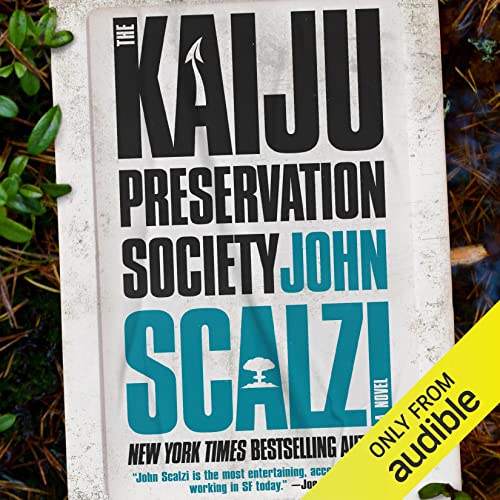
When Jamie Gray is fired right before COVID lockdowns, he has to resort to food delivery for the very company that fired him. (Note: Yes, Scalzi again here never assigns a pronoun to the MC, but since the narrator I listened to is male and it would be a pain to continue to refer to the MC by the MC’s name rather than use a pronoun, I am going to refer to Jamie Gray as “he” in my review.) Then a delivery to an old acquaintance lands Jamie a better job (because really, anything would be better) with an animal rights organization that turns out to be Jamie’s entrance into his very own sci-fi story.

Overall, this book is a fun, light sci-fi adventure. I did not know the backstory of the name, but I’m sure many others will be aware that kaiju is the general term of movie monsters like Godzilla and Mothra. The story here is that kaiju are from an alternate dimension and occasionally cross over to our dimension, and sightings led to the famous monster movies. The Kaiju Preservation Society is set up in that alternate dimension and basically studies the giant creatures while attempting to keep the two dimensions separate. Jamie is dropped into the middle of this situation and has to learn the ropes basically on the fly. I struggled to understand what the main conflict/plot was for a while, but by the time it really got going, I was mostly enjoying the story. Based only on that, I probably would have rated the book higher.

Unfortunately, Scalzi’s style and political/social leanings detracted heavily from the book for me. When I read Lock In, my first Scalzi, I noted that he tends to write conversations with little in the way of descriptions of what the characters are doing. In that book, it worked for me, at least partly because the main character was just a consciousness within a metal suit. In this book, the lack of descriptions and the overused, super basic dialog tags constantly back and forth (i.e. “I said.” “Kahurangi said.” “I said.” etc.) made the style a little too bland for me. (And by the way, kudos to Wil Wheaton for making it through the many odd names in this book.) Aside from those issues, I actually almost stopped listening to the book when, after the main character leaves behind his two homosexual roommates, he meets a character who is introduced with the “they” pronoun (which, by the way, confused me greatly about how many people were being introduced before I realized what the author was going for). It was a judgment call on my part to keep listening, but I feel that other Christians who read this review should be made aware of the concerns I had that almost led me to stop. There is also quite a bit of language, though I have come to expect that from books like this. I’m overall glad I read the book and tend to think that fans of Scalzi will generally enjoy this book as well. If you are new to his style, though, I don’t know that I’d recommend you start with this one.

Find out more about The Kaiju Preservation Society

See what I’m reading next.

If you’ve read this book, or read it in the future, feel free to let me know what you think!

Book Review: Ready Player Two

Ready Player Two
Book #2
by Ernest Cline
read by Wil Wheaton

My rating: 1 / 5
Genre: Science fiction, dystopian

Spoiler notice: The following review will contain spoilers for the previous book, Ready Player One.

As it turns out, Halliday didn’t leave just one contest behind in the Oasis when he died. He left a second one, which wouldn’t be triggered unless his heir found and decided to release a controversial, highly-advanced, game-changing technology to the world and the world then went crazy for it. And since, of course, that’s exactly what happens after the first contest is over, Oasis users are sent on another impossible quest that involves having unlikely knowledge of every single thing someone they never met loved and obsessed over. If it isn’t clear from my rating and from that synopsis I wrote, I did not like this book. To be fair, I didn’t expect to like it, and really didn’t plan to ever read it. But curiosity got the better of me.

To start with, I’ll state that I didn’t love Ready Player One. It was okay, but since I wasn’t won over by all of the 80s nostalgia, I was left with just the plot and characters, which were mediocre overall. So when the sequel was even more 80s trivia and even less plot and characters, it was destined to fail to thrill me. I think the nostalgia has to be the only reason that anyone really likes this book, since it’s otherwise poorly done. Though to be honest, I don’t even know how the pop culture references could be all that enjoyable for anyone, since they’re so shallow. I thought the same when reading RP1, but it seemed even moreso this time. It feels like Cline just really wants to showcase his pop culture knowledge in these books, except half of what we get is something that anyone with an internet connection could easily include in a story.

As for the story itself, there’s a ridiculous amount of exposition, usually dumped in huge piles, and often right when something exciting is about to happen. Seriously, when we’re told the first item for the contest has (finally) been found, we stop for a whole bunch of explanation before actually moving on to the item. And worse yet, sometimes the exposition is repeated. Cline wants so badly for us to know how certain aspects of this make-believe world within a make-believe world work that he tells us twice!

Wade, the MC, is a terrible human being masquerading as a compassionate guy who just doesn’t know how to deal with people. We went through a depressing time with him in the first book, when he pushed all of his friends away and became depressed, but at least we got a good ending out of it. But we have almost a repeat of that in this book, and it’s even more clear now that he’s simply a terrible person. I just can’t bring myself to root for him anymore. I didn’t care if he and Samantha got back together or not, and I really didn’t care about their conflicting views of how to best “save” humanity.

And then there’s the ending…I could not believe what I was hearing when I got to the last chapter. It’s astounding to me that anyone can truly think that the decisions that are made by this group of characters are a good idea. That they’re even remotely okay. That they solve anything! I guess it’s supposed to be a happy ending, but it sounds terrifying and depressing to me. I need to stop now, before the review gets any longer, but suffice it to say that I do not recommend this book to anyone, fans of 80s culture or not. If you really like John Hughes movies or Prince, you might be in heaven for 3-4 chapters of this book. For anyone else…read at your own risk.

Find out more about Ready Player Two

See what I’m reading next.

If you’ve read this book, or read it in the future, feel free to let me know what you think!