In the wake of the death of his mother, while his long-term relationship seems to be going nowhere good, Daniel writes a short, drunken letter to an unknown convict through a prison pen-pal organization. This is the beginning of his deep connection with Ruby, the inmate who he’s paired with. But when Ruby comes to find Daniel, things become too real…or maybe unreal.
If you’re looking for a dark, psychological read that will leave you feeling a little unsettled, this is it. If you’re looking for a thriller with twisty goodness…maybe not so much.
The book is fully in epistolary format, with the main character Daniel writing letters to someone named Lucy. From early in the book, I had some theories about how the story might unfold. Though things happened along the way that led me to other theories and the anticipation of one or more surprise twists near the end, it turned out that only my first ideas were correct. And there were no real twists. As I read the final pages, I felt let down.
The writing style is easy to follow, and I did at times feel invested in the story. Overall, though, there is no happiness in this book. Nothing uplifting whatsoever, not that I necessarily expect that from a psychological thriller. But it just all felt so hollow and empty. I was depressed for everyone in the book. And Daniel made such stupid decisions all throughout the book, it made it hard for me to care what happened to him in the end.
What this book really made me feel is happy to be a Christian. Grateful to have the hope that comes from knowing that God is real and that He loves me. That He is in control. It’s not that Christians are all perfect, always-happy people–far from it. But there is something nice in knowing that tragedy doesn’t have to destroy me and that I don’t have to try to fill the void in my life by myself.
A note about the story format–it’s broken into 3 long chapters, which did not bother me as it did others. There are scene breaks if you need a more definite spot to step away for a while. And at times, Daniel’s re-telling of events from years past are broken up by observations of what’s going on around him as he’s writing. This also bothered other readers, due to not being formatted well enough to be able to follow the jumping back and forth. I fear this was an issue with the ARC digital copy, which is a shame, because that shouldn’t come into play in a review. But it can, if it makes the book hard to read (I’ve been there). I read a physical release copy, and I had no issues with scene breaks or the jumping around.
Thank you to Netgalley and Serpent’s Tail for providing me a copy of this book to review.
A seemingly ragtag group of FBI agents are thrown onto a new team together, headed by Alexandra Cassidy. On her first day, a bank robbery forces her to hit the ground running. But the team is able to close the robbery case surprisingly quickly. And the next case. And the next. It is soon apparent that there is more to meet the eye, both with these different cases, and with the office’s IT guy.
On the surface, The Tech comes across like a police procedural-type story. And pretty early on, the IT guy, Mike, is shown to be somewhat of a high-tech super hero. But the further I got into the story, the more it just felt weighed down by so many things. By the point I began to realize that the cases are connected, I was struggling to keep going. I think this is mostly chalked up to a lack of depth in many areas.
I never felt much of a connection with any of the characters. In the first chapter, we’re told about each of the 5 members of Alexandra’s team, and I had a very difficult time keeping them separate in my mind throughout most of the book. That may be partly because their personalities, backgrounds (somewhat), and even their looks, are kind of just dumped on us all at once. And this continues to be the case in varying degrees with each new character introduced. I’m not given much chance to find out who they are for myself.
The interactions between the different team members were stilted as well. And all I can really say about Mike is that I was pretty sure I got what his deal was from early one…and I never liked him. He was essentially a vigilante, and there was never really any repercussions for the liberties he took.
The main thing the story has going for it is the intricacies of the plot. The author clearly mapped out his ideas in detail, and the threads can be seen tying it all together. I have a lot of respect for the work that went into the story. However, I think it needed further editing and refining. I didn’t care for the style, which might have just been personal preference, but it felt very redundant at some times and full of contradictions at other times. I don’t know how well I followed the details of the story, sticking instead to a wider view.
I’ve read a lot of self-published books recently. Though this book was published by someone other than the author, it has the feel of a self-published book. The thing is, I can give a lot more allowance to a self-published book, because those authors don’t have the resources of a publishing company behind them. But this book felt like it needed a lot more editing work. I don’t know how any paid editor lets a book get past him with two characters in close proximity being named such similar names as John and Don (I still don’t really know which of those guys was which). I personally wouldn’t be able to recommend this book to be read by others, however, please note that the book has all positive reviews besides mine (at the time of me posting this). So if it does sound interesting to you, please read the other reviews and consider checking out the book.
I received a copy of this book for free from the publisher in exchange for an honest review.
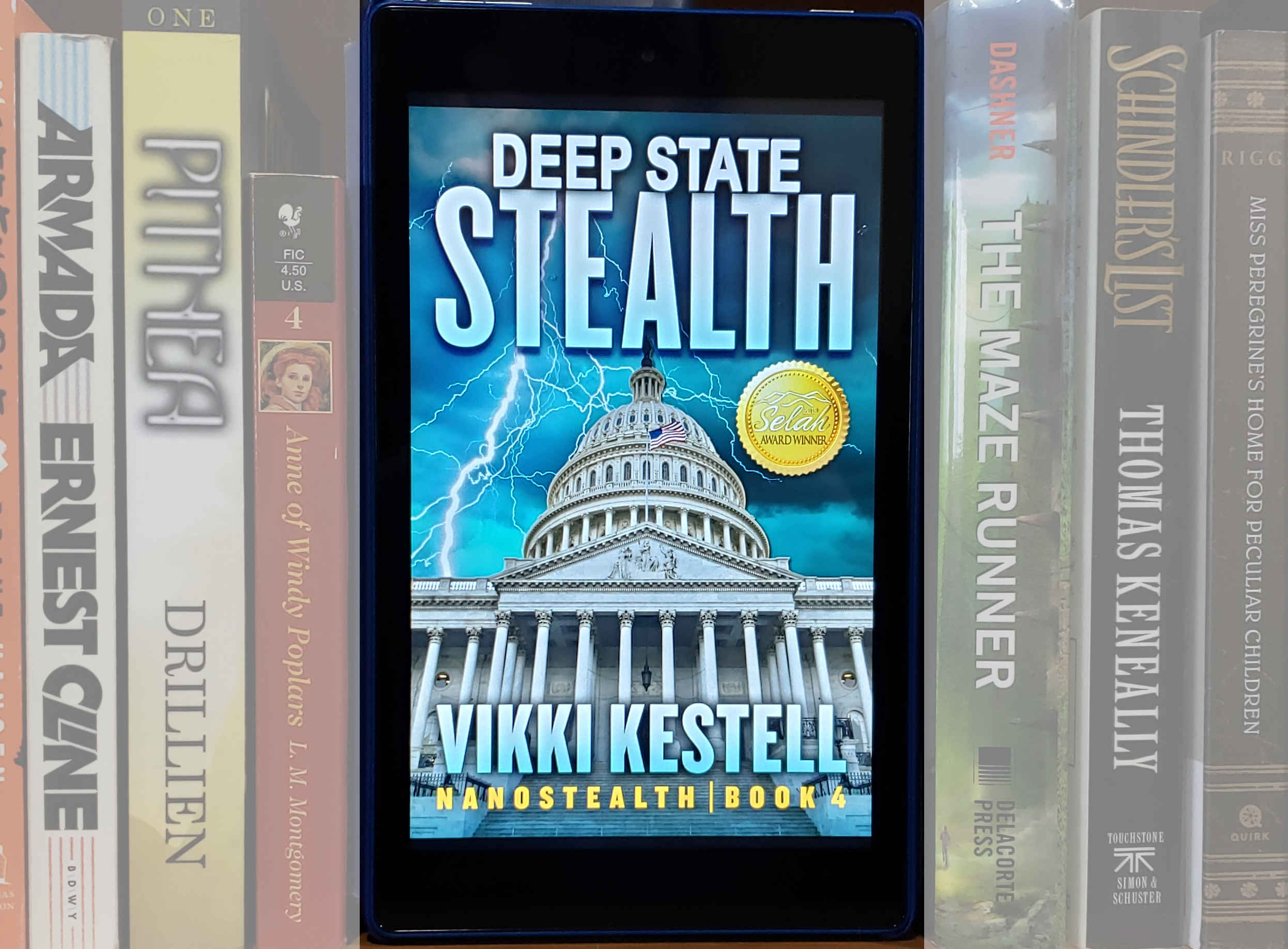
Now that Gemma (make that Jayda) and Zander are both super-powered and married, they’re all set to save the president’s life (again). Tasked with rooting out the conspiracy that did not end with the death of the vice president, Jayda will go undercover in the NSA. Will she and Zander be able to root out the corruption and get out of the espionage business?
I struggled with this book quite a bit early on. I almost gave up on it after the first few chapters. But I stuck with it, and when the storyline about the conspiracy involving the president got going, the story picked up. In the end, though, this was the weakest book in the series, in my opinion.
This book has the odd distinction of being a bit too religious for me, and yet having some things that made me uncomfortable, especially in a Christian book. I’m not against Christianity in a book by any means. But in a book of this type, it’s much better off being spread out, rather than shoved at the reader all at once, which is how the beginning of the book felt. But even while that was happening, there were discussions of and references to the newlyweds’ “nap times” that were just too much for me–both near the beginning, and later in the book too (nothing graphic, but uncomfortable). And throughout the book, there was a lot of “bleeped” cussing. I know that Christian authors have to decide how to handle real-world language in their books, and Kestell’s approach isn’t a bad one, but there was a lot of it. And my mind does fill in the missing words, so I got a point where I was irritated by the amount of cuss words the book was putting into my head.
I don’t mean to imply that the book was bad, though. It provided more resolution to the rest of the series than I expected. There was a reveal later in the book that I thought was going to turn out to be anti-climactic, but was pretty interesting. And going into this book, I was really worried about the way the 2 clouds of nanomites behaved at the end of the previous book–almost like a form of sibling rivalry, and I was happy to see that that was largely downplayed in this book. Like with the previous book, the main plot was engaging, and I really liked the way Jayda and Zander utilized the nanomites.
One more thing–like with the previous book, this one is written in mixed perspectives. Most of it is 1st-person from Jayda’s point of view, with some 3rd-person if the author wanted to show things happening with other characters. For as strange as it was in the previous book, it was even more strange in this one, as more than once, Jayda herself was referenced in one of the 3rd-person sections, and it took me out of the story, since she’s the character whose eyes we view most of the story through. The writing style in general really isn’t for me.
Looking back at the series as a whole, it has its pros and cons. The story itself was good–I really liked the premise, especially the initial accidental invisibility, and Gemma learning to work with the mites. The author’s style and insertion of religion detracted from the series overall, but I think many other Christians wouldn’t be so bothered by the things that bothered me. Be sure to check out other reviews if you’re interested, as there are many positive ones for this series.
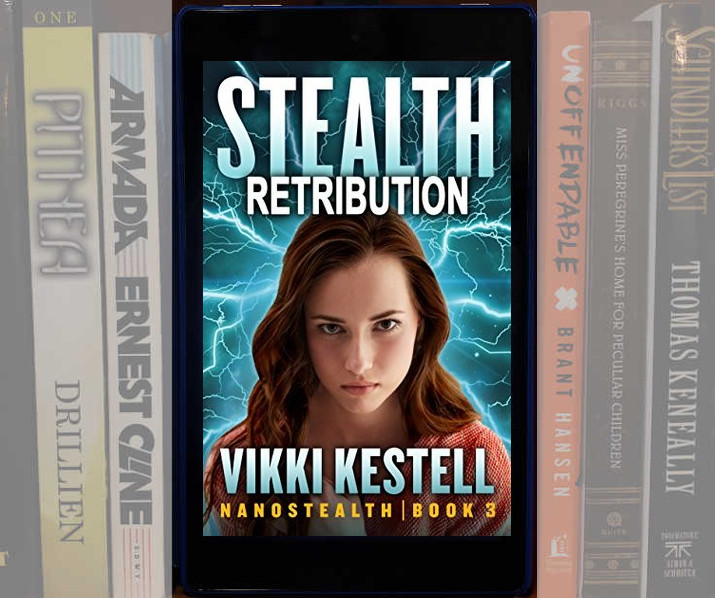
Stealth Retribution
Nanostealth #3
by Vikki Kestell
My rating: 3.5 / 5
Genre: Christian sci-fi thriller
Spoiler notice: The following review will contain some spoilers for the first 2 books in the series, Stealthy Steps and Stealth Power.
Again picking up where the previous book left off, right there in the cave where the nanomites and Gemma became Super-Gemma, she and her friends hatch a plan to start thwarting the evil military general who has been after the nanomites’ creator and, due to the mites infesting Gemma, after her too. Gemma is about to have more on her hands than escaping General Cushing, though, as a young friend of hers is in danger, and her own twin sister is in town to muck things up as well.
I enjoyed this book through most of it. I really liked the way the storyline with Cushing played out, taking Super-Gemma from Albuquerque to the White House and back. By the end of this book, I could easily compare it to a comic book super hero origin story. If my review and rating were based just on the resolution regarding Dr. Bickel and Cushing, I would have given it 4 stars, maybe more. However, things got really weird on the theology side of the story, and I felt very strange about the whole thing by the end.
I thought it a little odd at the end of Stealth Power, when Gemma became a Christian, and then the nanomites felt the presence of Jesus inside her. But I let it go, accepted it as the fiction that it is, and moved on. But by the 2nd half or so of this book, the nanomites are receiving instructions from Jesus. Surrendering their will to Jesus. And…being forgiven by Jesus? It took a lot more suspension of disbelief than I prefer to swallow all of that. Add to that the fact that the associate pastor who was once my favorite character had become simply a vehicle for faith-professing in the book, and even as a Christian, I felt very Bible-thumped (I don’t know if that works in this context, but I’m sure it’s clear what I mean). And in the end, I have no idea what the real purpose of Gemma’s twin, Genie, was in this book, other than to be another convert for Zander’s cause.
The first book was mostly in 1st-person from Gemma’s point of view, with a little 3rd-person if the author wanted to show things happening with other characters. This was explained in the fact that Gemma was keeping a journal of everything that happened after she became invisible. However, the journal aspect was sort of abandoned in book 2, and by this point, it’s more like half-1st person, half-3rd person. Which is strange and confusing. The writing style as a whole still put me off a bit, especially in the 1st-person parts. It’s incredibly casual and conversational. In the end, I think the author’s style isn’t really for me, but the story about the nanomites, the invisibility, and Gemma escaping the bad guy is unique and interesting! I only wish there hadn’t been so much else to bog it down.
The series continues on for one more book (at this time), which from the synopsis is clear is a divergence from the main story arc in the first three. I plan to read it soon, because I did come this far. At this point, I would still recommend the series to fans of Christian mysteries & thrillers and lovers of this type of sci-fi, especially since I think many others wouldn’t be so bothered by the things that bothered me. Some other reviews do mention being put off by the nanomites’ seeming religious experience, but also express that the story outside of that is good.
Spoiler notice: The following review will contain some spoilers for the first book in the series, Stealthy Steps.
Picking up immediately where the previous book left off, Gemma hides out in a safe house while planning to rescue Dr. Bickel, along with another monumental task that presents itself as the story goes on. The only trouble is…she’s still invisible. She must learn the best ways to navigate a visible world, while also learning to co-exist with the nanotechnology that she has so far fought against, if she’s going to accomplish her goals—and get her life back.
I definitely enjoyed this book more than the first. Most of the information is out there (being dumped into the first book), and we’re left with just the continuing story of Gemma and the mites (good band name, no?). The relationships that we were introduced to in the first book were continued enough to make me happy, with the addition of a new character who became one of my favorites. The writing style isn’t my favorite, but in the end, I was glad to have read this, and look forward to seeing where the story goes from here.
Gemma herself bugged me during a lot of this book. I mentioned in my review of the first book that she came across like a petulant child, and that only got worse in this one. The sections from her POV (which is most of the book) was immature, and I didn’t always enjoy it. I know there was a lot of really unpleasant stuff happening to her, but even while she was growing stronger in many ways, boy, did she whine a lot. There were also a lot of verbal tics in this book that I don’t remember from the first one—a lot of “um”s in the dialog. It only led to a further frustration with Gemma, and there’s a reason most authors don’t write dialog that realistically. It’s annoying to read.
The associate pastor, Zander, was probably my favorite character from the first book. That took a small turn for me in this book, as his character came across as simply a vehicle for preaching Christ to the other characters, and to the reader. I’m not saying there aren’t people in real life who would have talked exactly as he did, but he became a bit confrontational when talking to Gemma’s evil twin sister, and I felt it was a bit much. My favorite character in this one, then, was the new guy in this book, an FBI agent.
My favorite thing about the first book was Gemma trying to communicate with the mites, and that really expanded in this book. Even while she groused at and about them, I really liked them. Maybe that’s the under-emotional side of me, to identify more with the computer than the human. My least-favorite thing about the first book was the exposition, and Gemma’s repeating of the exposition, and there was some of that in this one, but not nearly as much. The author did, however, have a tendency to recall back to a previous conversation later on, and she would pretty much always include twice as much of the original conversation as was needed.
In the end, I think it’s really the writing style that detracts the most from this series for me so far. The characters and plot I am enjoying more than enough to make up for that though. I need to try to put less time between this one and the next one than I did the first book and this one, though, because there was little in the way of reminders to what happened before. I started out really lost! Like with Stealthy Steps, I would recommend the book to fans of Christian mysteries & thrillers and lovers of this type of sci-fi.
The Lost Causes of Bleak Creek by Rhett McLaughlin & Link Neal
My rating: 5 / 5 Genre: Thriller, horror
In 1992, the small town of Bleak Creek, NC has a reform school where children who act up are threatened to be sent. It is viewed by all of the locals as a necessary place that really works…even if 3 kids have died in freak accidents there in the last 10 years. Best friends Rex and Leif are horrified when the third member of their trio, Alicia, is sent to the school because of a catastrophe that all 3 were to blame for. They question what they might do to save Alicia, eventually teaming up with a recent film student graduate to delve into the mysteries of the school and expose its secrets.
This was a fun, easy read, with 90s references and characters that seemed all-too-real. Rex & Leif, while best friends, had issues that arose from being too close, almost like sibling rivalry. The mystery of the school developed in a way that kept my attention, and especially had me wanting to come back and keep reading after I’d hit the half-way point. And the ending, which can make or break a thriller more than most other genres, was well-executed. At times, Rex & Leif’s arguments were a little over the top, given what was going on around them when they had them, but really, as someone with 3 sisters, I know that we didn’t always take into account whether or not our petty squabbles were a good idea in the current circumstances.
While it’s labeled as a horror book, this book was not scary to me at all. I said this in another review recently, but I’m really not into horror much as a genre, in any medium (so why did I just read 2 horror books in a row?). This also means I’ve not read much horror, so I don’t honestly know how it normally works in book-form. But to me, this was suspenseful, but I wouldn’t call it horror. If it were made into a movie, I could see some visuals being pretty horrific though, so maybe that means the tone wasn’t set right in the book to make parts that could have been scary appropriately creepy.
I’ve read so many thrillers lately that promise everything up until the last 20% of the book, and then fail to deliver the right punch to drive home the thrills. I was skeptical as I neared the end of this book, but it did its job perfectly! It was just what I would have wanted it to be. Plus, a character that was a minor annoyance (intentionally) throughout the book had me laughing and cheering at the end, which was a plus!
I read this book because my nearly adult son is a big fan of Rhett & Link and Good Mythical Morning. He was interested in reading it and thought I might like to too (mostly just because he knows I’ve been getting back into reading a lot lately). So we got it from the library as soon as their hardcover copy came in. He hasn’t finished it yet (he’s never been much of a recreational reader, so he needs nudges to even remember to read it), but I can say that from the perspective of someone who has seen very little of Rhett & Link’s online presence, I’m really glad I read this book. I would recommend it for fans of thrillers and horror, understanding that it’s a very mild horror.
Heather Cole is a 40ish-year-old child psychologist with a loving husband and a quiet life. Then her life is turned upside-down by the arrival of half of a “Best Friends Forever” necklace in the mail. While the other half of that necklace is safe at her house, she knows this half was last seen on the body of her best friend who died 30 years ago…at Heather’s own hand. What follows is a tale of fear and obsession as Heather tries to find out who sent her the necklace, while having terrifying memories and dreams about her teenage days, when she and her friends tried to summon a witch.
I know that the lower I rate a book, the longer the review tends to be, so I’ll try to be more succinct in this one. Most of what I really want to say is spoilery anyway, so here goes. I really did not like the main character…couldn’t connect with her at all. I also didn’t find the mystery or the twists all that interesting or surprising, and pretty strongly disliked the ending. And the synopsis is very misleading.
The story is told in 2 timelines–the NOW is first-person POV with Heather as an adult narrator. The THEN is third-person POV, but still focuses on teenage Heather. I could not stand adult Heather. She acts like a victim of this mysterious person who is sending her little things that Heather knows were directly related to the night Becca died, but uses this as an excuse to stalk people from her past and treat pretty much everyone she interacts with terribly. By the second half of the book, I would literally groan every time the book went back to the NOW storyline, because it was just so boring. Her obsession with finding out what was going on turned her into a monster. And don’t even get me started on how terrible she became at her job, which just bugged me so much.
I also got to a point by halfway in the book where reading it made me feel kinda skeevy. Heather had a habit of picking at her cuticles when she was nervous and stressed, which of course she was during the entire book. As an author, it is important to give characters quirks, ticks, habits like this to make them seem real, but the amount that her peeling, biting, and scratching at herself enough to draw blood is shown got under my skin (pun intended).
I am surprised I haven’t seen this in any reviews yet, but during the THEN timeline, the teenage girls go into a bit too much detail about their menstrual cycle for my taste, which makes me feel especially bad for any men who read it. There’s just no need for some of what they said to be included in this book…at all.
Now about the horror aspect…I honestly can’t even tell you why I requested a book classified as horror (I told myself that it must not have been listed as horror until later, but I really can’t say if that’s true), because I am really not into horror in general. But I steeled myself for a scary read…that hardly came. The supernatural elements that the book promised were flimsy and constantly explained away by the MC. I think I came to realize at some point that the narrator was very unreliable, which just made me doubt everything that happened in the THEN parts. I also didn’t find the stories about the Red Lady scary. A bit gruesome and over-the-top, yes, but not so much scary. Near the end, the combination of reading the last 25% at night and a decently creepy scene did finally give me some chills, but that was pretty much it. I’m seriously a wimp when it comes to scary things, so that might tell you something about the level of horror in this book. I also wouldn’t really classify it as a thriller, so suspense is the best I could come up with.
In the end, a lot of this probably boils down to personal preference. So this wasn’t a good book for me, but it has plenty of 4- and 5-star reviews. The THEN parts contain some 90s nostalgia that a lot of people will probably enjoy, and the horror and thriller elements will likely hit the mark with plenty of people. So if it seems interesting to you, please be sure to check out others’ reviews for this book.
Thank you to Netgalley and Crooked Lane Books for providing me a copy of this book to review.
In a future where self-driving cars are becoming the norm, a mysterious Hacker takes control of 8 different vehicles, each with Passengers inside. These eight people are told that they will likely be dead in just over two hours. The Hacker than forces a jury of 5, alongside the entire world watching from their electronic devices, to decide which one of the eight should be saved.
I was really into this book for for the first 80%, which were parts 1 and 2. If I gave a rating just on that much of the book, it would be a solid 4 stars. Then part 3 came along, and everything just fell apart for me. The writing was good, for the most part, and some of the characters were interesting. Some were major stereotypes, but to be honest, with that many characters, it doesn’t surprise me. But the thriller aspect just died in the last 20%, even with a push to bring it back.
To be honest, the hacking done on the cars might have been wholly unrealistic, but I don’t really care. I’m blessed to be someone who can just enjoy it for what it is, because I don’t really know a lot about software, AI, or electronics in general. It was pretty clear that some of the Passengers were only in the book so that the Hacker could show how serious he was, as the number quickly dwindled from 8 to 5. Each of those 5 Passengers has their secrets, which are unveiled as the Hacker hurtles them to their doom.
While this is happening, the protagonist, a woman named Libby, is one of the 5 on the jury that is being forced to decide these people’s fate. While there were some things that she did that really bugged me, it was a good perspective to watch the events from. The very end of part 2 was a bit confusing to me, and unfortunately, in the mess that was parts 3 & 4, the book didn’t really give a satisfying reason for what happened.
Parts 3 & 4 are messy and mostly unnecessary. They felt like a tack-on, and frankly, soured the mysterious nature of the Hacker. I felt like there were too many attempted twists, and I quickly got to a point where I just didn’t believe anything, which makes it difficult to enjoy a book.
In the end, I am glad I read this book. Enough of it was enjoyable that I would recommend it for fans of sci-fi, especially people who enjoy books that show horror stories about the direction our technology is heading. Because of the many higher ratings this book has gotten, definitely check it out if you think you might enjoy it.
**Side note: One of the characters in this futuristic story mentioned that Facebook peaked in 2020. The idea of this was really funny to me.
Thank you to Netgalley and Berkley Publishing Group for providing me a copy of this book to review.
Four couples attend a dinner party as friends, but dark secrets are boiling just beneath the surface. A trust game pits husband and wife against each other, and the next day, two of the guests are dead, while the other guests are left to figure out why.
For a book that is meant to be “an addictive and twisty psychological thriller,” it didn’t provide many thrills. If the book had not started with the main character, Ted, fighting for his life, I don’t know if I would have gotten through it nearly as quickly as I did. As it was, I did want to know how it got to that point, but it was quite a chore to get there. And more than once, I got to the end of a chapter and had no real compulsion to continue immediately, like I’d expect to have in a good book, especially a good thriller.
All four of the couples came across dull and lifeless to me–not necessarily as individual people, but in their relationships. Ted and his wife probably showed the biggest spark of life, but that was likely just because he was the main character. As such, I had a difficult time connecting with anyone in the book.
After the first murder victim appeared, most of the suspense seemed to be attempted through Ted questioning things repetitively–like why the victim had died, if the person they’d suspected to be the murderer had really done it, and if “the game” was responsible.
And that brings me to one of my biggest gripes. This trust game that they played was silly at best, yet became far too pivotal in the book. Everyone but Ted basically decided that the police shouldn’t know about it, or they’d all be blamed for the death…I mean, just far too much emphasis was put on this party game. And worse yet, it turned out to be a big part of the underlying cause for everything.
In the end, the reason behind each death was weak and, frankly, boring. I had theories of twisty goodness that would be revealed at the end, but when it ended, and no exciting twists had occurred, I basically was left with my mouth hanging open, and not in a good way. No, I didn’t guess at the motive behind the killings, but that didn’t make it good. A few surprises and betrayals did come up in the second half, especially relating to Ted’s wife, but none of them delivered on the punch they set up.
For those who want to know about how clean a book is before reading–there are no sexual situations and no language whatsoever that I can recall. The violence and bloodshed does get a bit much near the end, but nothing more than I could handle (and my threshold is fairly low).
I really wanted this book to deliver on its twisty promises, but it was unimpressive. It wasn’t terrible, though, and I think there are those who will enjoy it. It just really wasn’t for me.
Thank you to Netgalley and HarperCollins UK, One More Chapter for providing me a copy of this book to review.
My rating: 3.5 / 5 Genre: Christian sci-fi thriller
I didn’t fully understand the premise of this book going into it, because the synopsis is more like a boiled-down excerpt from part of the book, with a little extra character introduction. Most of the information is there, but it’s cryptic. Here’s my synopsis though: Gemma Keyes is a young woman fresh out of college, and takes a job as a project manager at a top secret lab. She mostly organizes things and takes meeting notes, but this makes her privy to some classified information. When she hears the wrong information (not her fault), she is fired. Months later, after an accident in the same lab claimed the lives of the 2 top scientists she was working for, she’s contacted covertly by one of those scientists, Dr. Bickel (obviously not dead). She ends up being asked to help him continue his work, which he’s keeping secret from everyone at this point. This work is in nanotechnology. When the government, and in particular, a nasty military general who has no scruples about how she gets information & technology for her military, closes in on Gemma and the man she’s helping, an unexpected incident leaves her invisible. Literally. (Some people see the invisibility aspect as a spoiler, but it’s how the prologue ends, so I see it as part of the set up.)
So…now Gemma has to figure out how to live life completely invisible, which presents all sorts of problems, especially since she practically lives in a fish bowl. Half of the book is about this, as well as her concern about being discovered by the general who went after Dr. Bickel. This half of the book is entertaining and interesting. I liked the relationships Gemma developed both before and after her invisibility. My favorite thing was the ways she tried to communicate with the nanotechnology that is responsible for her uncontrollable invisibility.
The first half of the book had some interesting parts as well–especially the relationships that began and/or developed between Gemma and Dr. Bickel, Gemma and the associate pastor of her old church (more on that below), and an established relationship between Gemma and an older neighbor. However, the first half of the book was bogged down heavily by a lot of exposition and repetition.
First, there is a long and tedious description of how Gemma first got into the secret, abandoned military based where Dr. Bickel directed her to meet him. It might not have been so bad, had we not already given given those steps (most of them), but backward. Then there are the 37-8 pages of Dr. Bickel talking and explaining. Explaining how he avoided dying in the lab explosion, explaining how he got himself set up in this mountain base, and longest of all, explaining how the nanotechnology works. In detail. That most of us reading aren’t going to really follow. Some of it did prove to be important to the rest of the story, but honestly, much of it wasn’t. (At one point, after about 33 pages of explanation, Bickel says, “‘Would you like to hear more about the nanomites before you go, Gemma?'” And I literally thought, “I wish I could say no.”) Since the book is told in 1st person, and Gemma didn’t understand a lot of what he said, I have a very difficult time believing that when she wrote this account some weeks or months later, she could remember all of the science that he spouted. It could have definitely been boiled down for us, and even more so, would have then fit in with the style of narration that the rest of the book has.
Much of the information in the first half of the book would have been okay on its own, but since it was all told together in the first half, it made it difficult to keep reading. I totally understand why the prologue is a long description of the point when Dr. Bickel is discovered in his secret lab by the general, ending with Gemma finding herself invisible. It needed that action and intrigue to get people hooked. Still, if I hadn’t been recommended this book series by my mom who has recently been very anxious for me to read it so she could hear what I thought, I might have at least set it down and come back to it later. As such, once you’re past that half of the book, it does get more interesting. It’s the first book in a short series, so some of the expositiony first part can be explained as set-up to an entire series, and it does have an ending that left me wanting to know more. Still, I think setting up an entire series isn’t an excuse for so much info-dump all at once.
The associate pastor I mentioned above, named Zander, is where the Christian aspect of the book comes in, for the most part. He’s invited to visit Gemma by her older neighbor, and he is a good example of a Christian in fiction. He is generous, compassionate, flawed, and complicated. Gemma sees a lot of sides of him, some of which draw her to him, but others of which push her away. His very Christianity is the biggest obstacle to their developing relationship, though, because Gemma is quite against Christianity. He speaks the truth in love, and shows Christ’s love through his action, while still being a believable human being. I look forward to seeing how this develops in the rest of the series.
I was particularly bothered by some of Gemma’s actions in this book, and the way she excused them, but I think that was intentional. She also got angry, or at least upset, at weird things, which made her seem like sort of a petulant child to me sometimes. I don’t know if that part of her personality was intentional or not. There were a few inconsistencies that stuck out to me (like why Dr. Bickel let Gemma take pictures in his secret lab, after the intense precautions he’d asked her to take in getting there, and in their communications). Also, I feel the need to give some trigger warnings: domestic abuse, child neglect and endangerment, descriptions of or allusions to gang violence.
So to sum up, yes, the first half of the book was slow, but the rest was good enough, and I have faith that the following books will pick up the pace, that I felt the book was worthy of 3.5 stars. I would recommend the book to fans of Christian mysteries & thrillers and lovers of this type of sci-fi.