Poirot Investigates Hercule Poirot #3 by Agatha Christie read by David Suchet
My rating: 4 / 5 Genre: Classic mystery
Reading this collection of short stories after reading 3 full-length Poirot books, I really appreciated the succinctness of the mysteries here. As far as I can tell, the short stories are very uncommon in this series, though, so it’ll be back to the longer plots that I can’t help but feel run on too long after this. Though some of the stories in this collection were more enjoyable than others, overall I felt much more engaged throughout than I have so far in my readings of Poirot. Poor Hastings, though…if I were in his place, I’m sure I’d make all the same “stupid” mistakes that Poirot berates him for. If only Poirot were a bit more understanding of those who aren’t the genius he is.
I know that David Suchet, who narrated this version of the audiobook, famously portrayed Poirot in TV adaptations, though I have not seen any version of Poirot on any size screen. I will say, though, that for a good portion of these stories, his French accent for Poirot was almost too difficult to understand. Then it suddenly seemed to lighten partway through. Outside of that, though, I enjoyed listening to this audiobook.
The Regency Brides Collection by multiple authors (see details below)
My rating: 3.5 / 5 Genre: Christian historical romance, short stories
This book contains short stories from 7 different authors, taking place in England during the Regency period. My overall rating for the book is an average of my ratings for each story, shown below. Below the ratings is a brief review for each story.
“First Comes Marriage” by Amanda Barratt – 3 / 5 “Masquerade Melody” by Angela Bell – 4 / 5 “Three Little Matchmakers” by Susanne Dietze – 4 / 5 “The Gentleman Smuggler’s Lady” by Michelle Griep – 3 / 5 “When I Saw His Face” by Nancy Moser – 2 / 5 “The Highwayman’s Bargain” by MaryLu Tyndall – 3.5 / 5 “Jamie Ever After” by Erica Vetsch – 4.5 / 5
“First Comes Marriage” (3 / 5) is a marriage of convenience story with a nice forgiveness angle, plus a focus on the change in a person that comes from following God. Overall, though, it didn’t stand out, and there was a major coincident near the end of the story that bugged me a bit.
“Masquerade Melody” (4 / 5) is well-written and sweet, with a romance that isn’t as overly obvious as they often are, especially in short stories. Though I think I may not be musical enough to enjoy this much as I could have, it was one of my favorites in the book.
“Three Little Matchmakers” (4 / 5) has Sound of Music vibes to it, with a grumpy father-figure and kids that end up endearing themselves to him. The kids’ constant eavesdropping bothered me a little (like, does no one watch or discipline them?), but it ended up being kinda cute. I also really liked Henry’s arc in dealing with his temper.
“The Gentleman Smuggler’s Lady” (3 / 5) was overall fairly simple and didn’t stand out to me. The female main character had this way of trying to convince herself to pretend things weren’t as bad as they were or pretend something she wanted was really going to happen—it’s difficult to explain, but it made her seem very immature to me.
“When I Saw His Face” (2 / 5) is the story of a widow who accepts a marriage proposal mostly out of obligation, and then starts to fall in love with someone else. I did not care for her at all or the terrible way she treated both of these men, especially the fiancé, with barely any consequences. The story in the end is too easy and too predictable, and was my least favorite in the book.
“The Highwayman’s Bargain” (3.5 / 5) was maybe a bit predictable, but it ended up sweet. I was a little frustrated with how long the female main character held out before letting her better judgment prevail. And I don’t particularly care for so much deception without consequences in a Christian setting, but overall, the story wasn’t bad.
“Jamie Ever After” (4.5 / 5) was my favorite story in the series, and no surprise, since the author has recently become my favorite author of this genre of novels. Her inclusion in the collection is the main reason I read it. I liked both of the main characters as individuals and the relationship that built between them. It’s a marriage of convenience story, and though there is a contrivance in it that caused the half-star detraction in my rating, it’s overall a very sweet story that left me very happy.
In the end, though my overall rating for this collection isn’t wonderful, I liked more than I didn’t, and I think that others who like Christian romance from this time period will enjoy the book even more than I did.
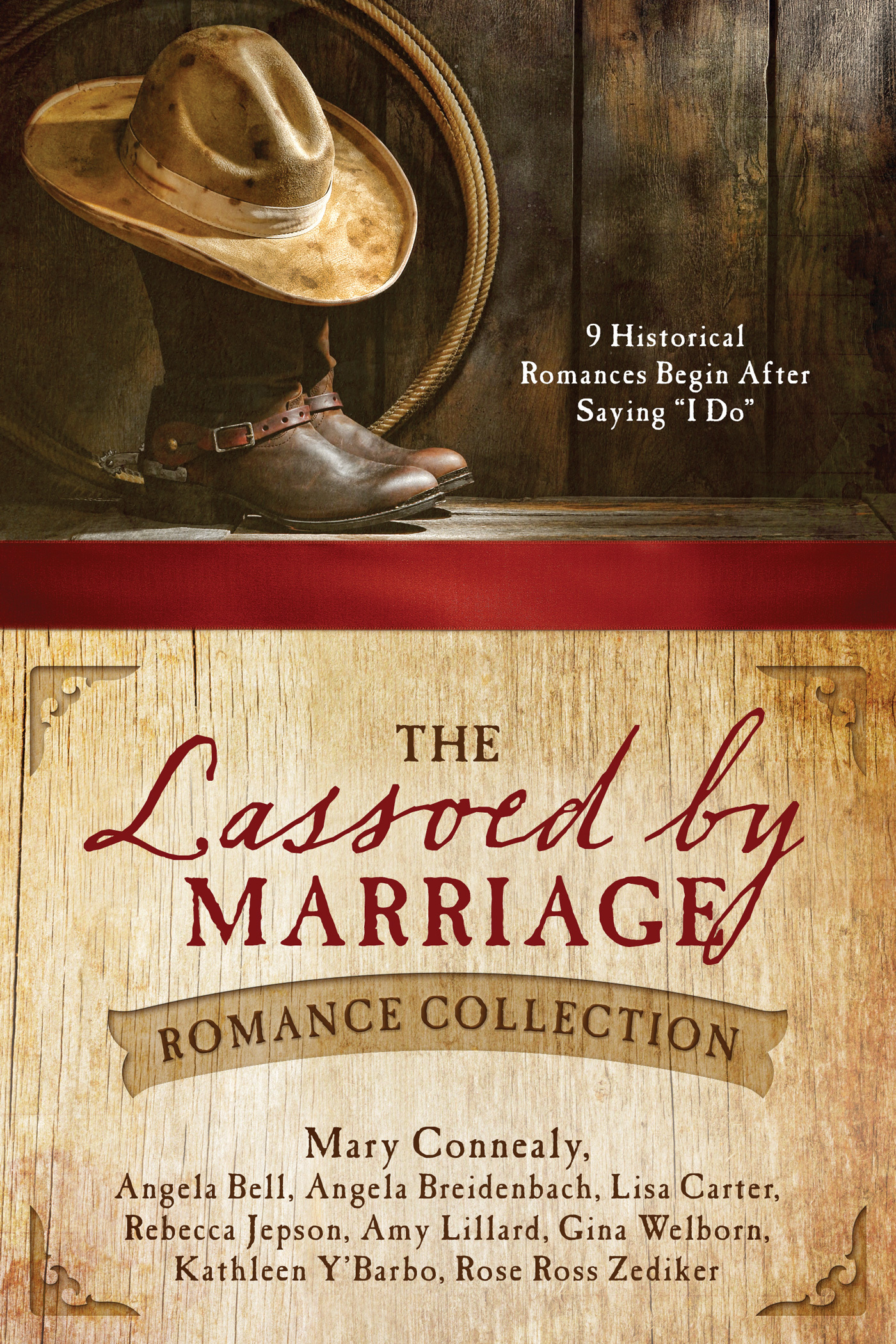
The Lassoed by Marriage Romance Collection by multiple authors (see details below)
My rating: 3.25 / 5 Genre: Christian historical romance, short stories
This book contains short stories from 9 different authors, taking place in the late 1800s, mostly in the western USA. Each story contains a marriage-of-convenience-type romance, which is my favorite kind, when done well. My overall rating for the book is an average of my ratings for each story, shown below. Below the ratings is a brief review for each story.
“Substitute Bride” by Angela Bell – 5 / 5 “Bridal Whispers” by Angela Breidenbach – 4.5 / 5 “Mule Dazed” by Lisa Carter – 2 / 5 “Sweetwater Bride” by Mary Connealy – 1 / 5 “A Highbrow Hoodwink” by Rebecca Jepson – 4 / 5 “Not So Pretty Penny” by Amy Lillard – 2.5 / 5 “All’s Fair” by Gina Welborn – 3.5 / 5 “The Colorado Coincidence” by Kathleen Y’Barbo – 3 / 5 “Railroaded into Love” by Rose Ross Zediker – 3.5 / 5
“Substitute Bride” (5 / 5) is the only story that takes place in England, diving right into a story patterned after Jacob and Leah (from the Bible). It’s short enough not to get too much into the deceit that brought Elliott and Gwen together, but if too much time had been spent dwelling on it, it might have gotten annoying. The culmination of Gwen’s self-perception and Elliott’s odd hobby was very well done and the only moment in this book that brought tears to my eyes.
“Bridal Whispers” (4.5 / 5) is full of bad assumptions and misunderstandings, but not so much to make me roll my eyes (and that’s considering I have a low tolerance for these things). In fact, they were probably completely understandable in this story of a widower marrying the cousin of his late wife. I have to say, though, that the long shadow of the first wife would have been a huge problem for me, especially when Burton took her portrait into his bedroom so it wouldn’t hang over his new wife.
“Mule Dazed” (2 / 5) contains one of the worst male leads in the book, the local sheriff forced to marry a woman he was locked in his own jail with overnight. He spends most of the story lusting after his wife, Hattie, while still meanly telling her that he can’t wait to be rid of her when the judge returns and they can annul their marriage. Then he blames her for his own rash outburst in bidding higher than necessary at a basket auction. He’s just a jerk!
“Sweetwater Bride” (1 / 5) has the one male lead that’s worse than the one in the previous story. He’s not quite so rude overall, but he hogties an isolated woman who lives alone in a secluded valley so that he can take her to his parents, because she’s afraid to leave her valley, even though he first offered to bring his parents to her. Then he kisses this girl that he knows is innocent and naive and knows nothing of men or the world in general. How creepy! On top of that, this woman who has barely seen anyone but her dad for years somehow knows that the eyes of the guy who kidnapped her are an unusual color, plus she stops talking like someone who’s been stunted socially far too quickly. Add the author’s writing style that is full of poor grammar and confusing dialogue, and it’s my least favorite in the collection.
“A Highbrow Hoodwink” (4 / 5) is nice and sweet with an overall theme of forgiveness and leaving the past behind. I wasn’t a huge fan of the plan to lie and say that Katie’s son was Henry’s, rather than his brother’s, in a Christian setting, since at no point do they regret or repent of this. But I did like the way everything ended up with this small family.
“Not So Pretty Penny” (2.5 / 5) is not bad, but not great either. The romance part wasn’t bad, but the rest of the plot was weak. Wash, the male lead, was wrongfully convicted of killing his sister, framed by the actual killer. And Wash’s plan now is to find Wash and somehow get him locked up for the crime, neat and simple, even though the man had already convinced everyone that Wash was the guilty one based on only his own testimony? There was a major unexplained coincidence in the climax, and I just do not buy this happy ending.
“All’s Fair” (3.5 / 5) is the first story in this collection that I felt like would have been better with room to expand. A quickie marriage of a man and woman on opposite sides of a family feud to keep members of both side out of prison calls for a bit more depth than this story was able to get into, and there really wasn’t much resolution. On the other hand, though the story starts with an incident that leads to strong hatred between the two MCs, and by the time the bulk of the story starts 4 years later, it’s been mostly resolved on both sides (independently of each other), so the only obstacle to this couple’s happiness is weak and feels contrived.
“The Colorado Coincidence” (3 / 5) was an overall forgettable story for me. I struggled to remember much about the story for the review. So it wasn’t bad, but since I’m not a fan of major coincidences and this story hinges on one, it wasn’t destined to be a favorite. I was at least relieved that Mack didn’t trick Gloree into marrying him by letting her believe that he was the man who’d been sent by her late husband to marry her. I also liked Gloree challenging Mack to ask God to show up.
“Railroaded into Love” by Rose Ross Zediker – (3.5 / 5) is another one where I feel like there needed to be at least a little more time to explore part of the story. I like the way that Molly took to the street urchin, and he clung to her kindness. But since Molly’s brother’s guilt or innocence was a big part of both the marriage of convenience and the rest of the plot, it didn’t get enough resolution, in my opinion. I think this feeling in more than one of these stories is due to the fact that I always prefer a romance be more in the background of a solid plot, and by necessity, the romance in stories as short as these tends to be pushed to the front.
In the end, though my overall rating for this collection isn’t great, there were a few gems in there that I’m really glad I read. The Old West setting isn’t my favorite, and I’m not a huge fan of short stories, but my husband brought the book home from the library for me, thinking I’d like it, and I always give his random book finds a try. I’m glad I did in this case, and I think that others who enjoy Christian romance from this time period will probably like more of these stories than I did.
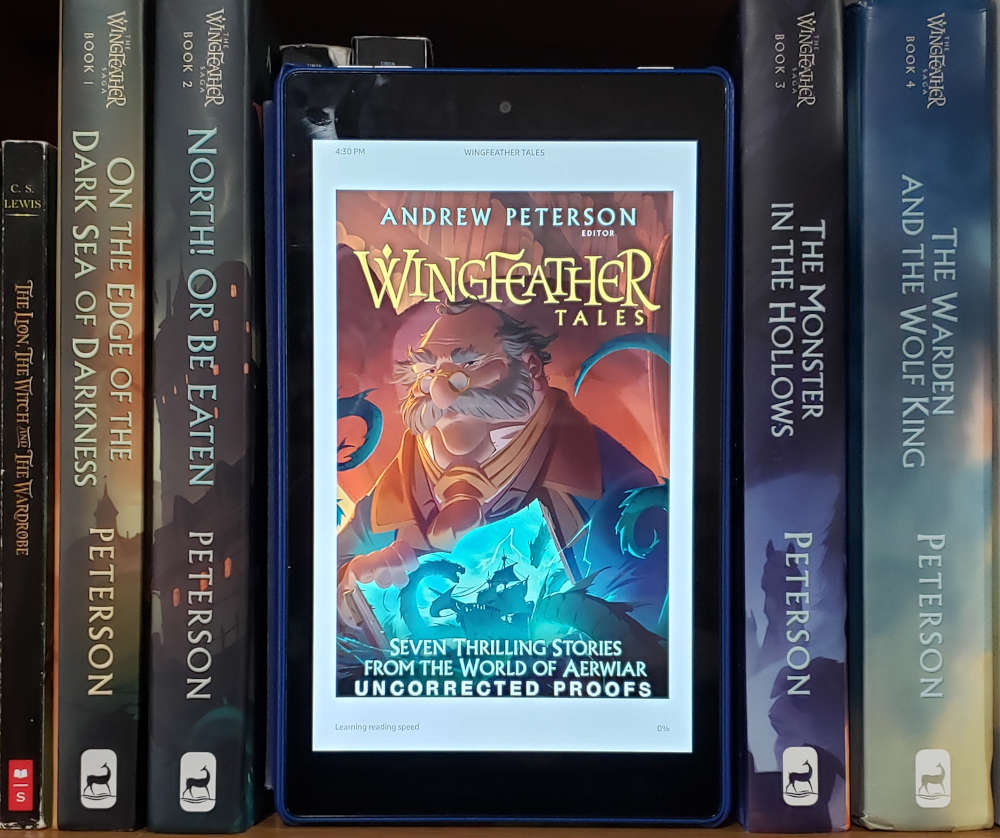
Wingfeather Tales by multiple authors (see details below)
My rating: 3.5 / 5 Genre: Children’s fantasy short stories
For me, last year will forever be known as the year of the Wingfeathers. I read the entire Wingfeather Saga for the 1st time…and the 2nd time, in a way, as the author, Andrew Peterson, read his books live, a few chapters a day, throughout the year. This book is a collection of 7 stories set in that same world, written by 6 different authors. First, let me get some basic info out of the way: Yes, you really should read this only if you’ve read the Wingfeather Saga in its entirety, which I fully recommend that you do either way. No, none of these stories is a continuation of that series in any way. Well, one sort of is, to a very small degree, but more on that in the details below. Let’s just say that it will not answer the burningest questions you’ve most likely been left with after finishing the series. Andrew Peterson has stated on more than one occasion that he would prefer to leave any answers up to the imagination of his readers, which is fair.
My overall book rating is a reflection of the average of individual ratings for each story. I did not love the stories overall as I might have hoped. However, I did go into this uncertain about how I’d enjoy them. I’m not really huge on short stories in general, but I couldn’t help but give this book a go, considering how much I loved the original series. What follows is a list of each story with its author and illustrator, my rating, and a brief (as much as possible) review for each.
“The Prince of Yorsha Doon” by Andrew Peterson(5 / 5) – This was my favorite short story in the collection, with a ragged, loner street urchin getting the chance to be something more, to do something more. It’s charming and contains a wonderful appearance by one of the bigger characters in the original series. (illustrated by Cory Godbey, Nicholas Kole, & Hein Zaayman)
“The Wooing of Sophelia Stupe” by Jennifer Trafton(3 / 5) – The story of the author of the Creaturepedia books on its own was decent, if open-ended. However, I was slowed down and tripped up by the character’s vocabulary. He had a penchant for using very large, at times ridiculous words, both real and made-up (though a lot more made-up than real, I’m pretty sure). I’m sure it’s meant to be whimsical, and that plenty of people will find the fun in it, but it’s not really my preference. (illustrated by John Hendrix)
“Willow Worlds” by N.D. Wilson(4 / 5) – I really liked seeing young Podo, and perhaps the genesis of what made him who he is in the Wingfeather books. The plot to this story, especially coupled with the story before it, paints such a vastly different fabric for this fantasy world than what was in the original books, leaving me a little surprised and confused. The story is particularly short and abrupt, but I liked the general idea of it and wish there was more on this subject. (illustrated by Joe Sutphin)
“ShadowBlade and the Florid Sword” by Andrew Peterson & Jay Myers(4 / 5) – As alluded to in the first paragraph of my review, this is the one tale in the book that is a continuation of the original series. The title tells it all, and it’s actually in comic-book format. I did like having the chance to see the two together, and wish it had been longer. Though several of the stories in this collection end abruptly and with more that could be told, I think this is the one I most want to see more of.
“From the Deeps of the Dragon King” by A.S. Peterson(2 / 5) – This story was tragic and disturbing, and while it was clearly meant to be so, my rating is not due to the theme or mood. Considering how Podo’s story and character arc went in the original series, especially at the end of North! or Be Eaten, I really think I would have preferred not seeing him at this time of his life. It almost felt like undoing everything related to this that happened in the series. Plenty of others, I’m sure, will be happy to read about Podo’s past, but it just made me sad. (illustrated by Doug TenNapel)
“The Ballad of Lanric and Rube” by Jonathan Rogers(4 / 5) – This story was short and silly, maybe a little predictable to me, but overall just fun. (illustrated by Justin Gerard)
“The Places Beyond the Maps” by Douglas Kaine McKelvey(2 / 5) – This is the kind of story that I wish I could rate higher and feel like a rube rating so low, because I’m sure it’s meant to be beautiful and poignant, but it’s just not for me. It’s the story of a man whose daughter was taken away by the Black Carriage, and all that he goes through as he tries first to get her back, then to get justice, and finally just to find some meaning and purpose after the tragedy. It is long (literally as long as all of the other stories put together, since it started at 50% in the e-book) and moves slowly most of the time. There is a lot of introspection, depression, even self-hatred–all things you might expect in the situation, but I felt like it plodded along most of the time. It didn’t help that the author has a tendency toward long, run-on sentences. Entire paragraphs, long in their own right, can be made up of just one or two sentences. It’s a style choice, I’m sure, but not one I care for.
This story is also one that actually caused squeamish me to wince as injuries and the attempt at mending such were described in fairly vivid detail at least once. The man contemplates killing himself or at least giving up on life multiple times. It’s dark, much darker than even the most serious parts of the original series. There were a few bright points for me, like the inclusion of a wonderful character from the original series and the epilogue that added a little hope after the disturbing (and just plain weird) ending. (illustrated by Aedan Peterson)
Final thoughts: I didn’t mention illustrations in the individual reviews, but I enjoyed every one of them. Andrew Peterson has a way of collecting talented people around him (not to mention his own talented children), and I can imagine the honor of having other authors and artists take part in a project like this for his books. I think, though, that some of this collection lost the charm and feel of the original series, and I especially don’t think I’d say this is as great for the age group that the first series was so well suited for. What’s most telling to me is that my daughter (10 years old), who has read/listened to the Wingfeather Saga in some format probably half a dozen times, only read about a story and a half from this collection and walked away. She’ll go back to it eventually, but clearly it didn’t draw her in like the original books. I do think that fans of the original series should read this collection, or at least some of it. I know I’ll re-read some of these stories again in the future, but I was not quite the right audience for some of them.
Thank you to Netgalley and WaterBrook & Multnomah for providing me a copy of this book to review. **Note: This book has been out since 2016, but a new hardcover edition is being released tomorrow, with a beautiful new cover and new illustrations, and the inclusion of one new tale (the comic one).


 A Journey of Words