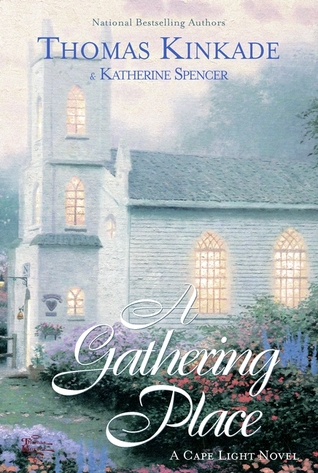
Book Review: Cape Light

Cape Light
Book #1
by Thomas Kinkade & Katherine Spencer

My rating: 3 / 5
Genre: Christian romance, drama

Cape Light is a small, very connected, and generally religious New England village. In this first book of 20 (so far), we are introduced to some of the inhabitants of the village–the mayor and her family, who are still somewhat reeling from a scandal in the past; the local diner owner who is very set in his ways and has designs on unseating the mayor in the next election; the reverend and his wife, whose joyful news is overshadowed by a wayward family member. Characters are established and at least one romance blooms, in this book that covers a summer in Cape Light.

Though there are a lot of characters to keep straight, I found that it wasn’t as difficult as I thought it would be. I had a few moments that needed clarity, but I followed it well enough. And for the first half of the book, I was interested in the lives and backstories of these people. In fact, I never stopped being interested in that. But what seriously detracted from it was the plight of the main character and her romantic entanglement.

Jessica Warwick, the mayor’s sister, has recently moved back from not-too-far-away Boston, and she intends to return as soon as she can. She’s only in town to help her ailing mother, who is starting to recover well. She has a life back in Boston, and a sort-of boyfriend. Enter Sam Morgan, whom she is immediately taken by, though she refuses to acknowledge it for a long time. But when her boyfriend conveniently gets really busy, she starts dating Sam, even while making it clear that she’s moving back to Boston at the end of the summer. What follows is a ridiculously drama-filled mess that could have easily been solved in multiple ways. I don’t know which of these two irritated me more–the woman who dated a guy in town while knowing that she wasn’t done with the previous boyfriend yet and continued a relationship with a man who was clearly falling hard for her, despite her warning about there being no future, or the man who ignored her warning about there being no future because he held out hope that he could change her mind. Actually, I can safely say it was Jessica who irritated me more, because she was a pretty terrible person in general, and it was clear that her attraction to Sam was mostly physical for a while.

While romance novels are always pretty obvious, in that the two leads are going to end up together, I prefer those that are more in the backdrop to an interesting plot. There was little in the way of plot involving Jessica and Sam that wasn’t directly related to their relationship. The situations that occurred just to make them fall in love and/or add drama to their relationship were so much more obviously contrived than I prefer. By the end, I just wanted the book to be done already, which makes me sad, because I did enjoy unraveling the lives of the others in town.

The Christianity in the book was weirdly both shallow and heavily permeating. Apparently a large amount of the village’s inhabitants go to the same church, and many of them have a strong faith. Several others are seeking, and a lot of the same advice is given by different people. The series starts with 4 not-specifically-holiday books, but apparently by book 5, it continued as a Christmas series, which is what brought it to my attention at this time of year in the first place.

The writing was a bit pedestrian, but it only bothered me at times. I am going to give the series another chance, because just about every plot arc that was started in this book was left hanging, and I really do want to see what happens. Since the main thing that bothered me about this book should take a back seat in the future, I am hopeful about continuing. With proper planning, I can be ready for the first of the Christmas books by November or December.

Find out more about Cape Light

See what I’m reading next.

If you’ve read this book, or read it in the future, feel free to let me know what you think!

Book Review: Harry Potter and the Prisoner of Azkaban

Harry Potter and the Prisoner of Azkaban
Book #3
by J.K. Rowling

My rating: 3.5 / 5
Genre: YA fantasy

Continuing with my first ever reading of the Harry Potter books, here’s #3. As a reminder, even though these books/movies have been out for a while and are really well known, I’ll still warn in advance that my reviews will likely contain spoilers.

It actually took me some time after finishing this book to decide how I felt about it. I realized that this was because it was not terribly exciting or cohesive throughout. I did find myself wanting to push to finish it, but that was as much because I wanted to find out if some of my theories were correct or not. Certain things that were going on seemed really obvious to me, and I wanted to know how they panned out.

I was not surprised to find out that Sirius Black was not evil like he was made out to be. I was, however, both surprised and disappointed to find out that Sirius Black, Harry’s dad, and a couple of other guys were the Fred & George Weasley of their time. I had not pictured Harry’s dad that way, and while I’m sure it’s not uncommon for “hooligans” to grow up and be respectable adults, it was strange to think of Harry’s dad as a bully, and to think of Snape as a victim.

Hermione’s arc was disappointing, as she was barely in this book except to anger Ron and then disappear for a while. And the reveal at the end about how she was going to so many classes at the same time was a bit unrealistic. Not because it’s time travel, but because I have a difficult time believing they’d let her time travel for school. And then later, there are some inconsistencies with the time travel that bugged me.

Harry himself was hit-or-miss for me. I know he’d done some things in the previous books that he wasn’t supposed to be doing, but when he snuck out to go to Hogsmeade in this book, it felt more outright defiant to me. I did enjoy the Quidditch scenes though, and laughed out loud at McGonagall’s reactions in the final match.

By some point in the 2nd half of the book, I realized how irritated all of the dashes in the book were making me, and to a lesser degree, ellipses. They were just so peppered throughout, for interrupted speech, faltering speech, and just…well, anything they’re normally used for. I use both of these punctuation types myself, and normally, it’s pretty innocuous. So for me to have noticed it so much, there must have been quite a lot of it.

Overall, I didn’t dislike the book, but didn’t enjoy it as much as I did the previous one. Still, I’m looking forward to seeing where the series goes from here.

Find out more about Harry Potter and the Prisoner of Azkaban

See what’s coming up.

If you’ve read this book, or read it in the future, feel free to let me know what you think!

Book Review: Anne of Green Gables

Anne of Green Gables
Book #1
by L.M. Montgomery

My rating: 5 / 5
Genre: Children’s classic, coming of age

In the first installment of the books about Anne with an e, she is brought into the home of Matthew and Marilla Cuthbert, a brother and sister who are both getting up in years. They had sent for an orphan boy to help them with the work on their property, but were sent Anne instead. She charms her way into their hearts (especially the shy, kind Matthew), and they raise her from the age of 11.

This is one of many well-known and much-loved classics that I have never read before. I have family members who really like it, so I decided that with my recent reading revolution, it was time to give it a try. I’m so glad I did, as I really enjoyed this book!

Anne has such a fiery spirit, and while I would probably be a bit frustrated to be around her much in person, I liked reading her monologues. The reactions by both of her guardians often produced a smile from me too. Though as a parent who is currently dealing with a strong-willed child who tends to melt down when she doesn’t get her way, some of scenes where Anne threw a fit made me cringe. To see Anne change as she aged 5 years in this book was wonderful and realistic, and while she lost some of her loquaciousness, she remained the same kind, generous girl at heart.

I absolutely loved Matthew, and really liked seeing Marilla’s character change throughout the book. When tragedy struck, even though I could guess what was coming, I was devastated with Anne. I am really looking forward to reading the further books in this series.

Fun fact: One of my sisters and her husband have named each of their 4 kids after characters from this book series (whether first or middle names), and it was fun to find 3 of them in this first book. Though I have since learned that one of them from this book wasn’t the actual inspiration for their son’s name, but he was named after a character with the same name in a later book in the series.

Find out more about Anne of Green Gables

See what I’m reading next.

If you’ve read this book, or read it in the future, feel free to let me know what you think!

Book Review: Harry Potter and the Chamber of Secrets

Harry Potter and the Chamber of Secrets
Book #2
by J.K. Rowling

My rating: 4 / 5
Genre: YA fantasy

Continuing with my first ever reading of the Harry Potter books, it’s time for #2. As a reminder, even though these books/movies have been out for a while and are really well known, I’ll still warn in advance that my reviews will likely contain spoilers.

After the first book that set up the fantasy world and introduced us to Hogwarts, Harry’s 2nd year at the school was more comfortable and a smoother read. The plot was clearer and the danger more real. I also didn’t notice the grammar issues like I did in the first book, so either there were less of them, or I was engrossed enough not to notice (either way is a good thing).

There was a lack of characters that were established in the first book, though, which was a little disappointing. And some of the new characters were mostly just annoying. Colin was apparently just there to point suspicion at Harry. Lockhart was annoying, but at least there was a decent payoff. When he lost his memory, he became quite amusing to me. I was a little confused by Dobby. I guess he really did do everything he did of his own accord (rather than at the behest of his master, like they originally suspected), but his reasoning for it was weak.

My husband had warned me that there would be a possible spider-related issue for me in one of the books, but he couldn’t remember which one. I have fairly severe arachnophobia, so I’m going to have to be careful when watching the movie. At least I’ll know when to look away.

I’ve noticed that I seem to be in the minority of liking this book more than the first, but what can I say? It went in almost the opposite direction of my biggest gripes of the first one. And I liked the idea behind the antagonist being a memory, and even moreso, a memory of the big villain of the books. All in all, it was a fun read, and I’m looking forward to the next.

Find out more about Harry Potter and the Chamber of Secrets

See what I’m reading next.

If you’ve read this book, or read it in the future, feel free to let me know what you think!
Book Review: Stealthy Steps

Stealthy Steps
Nanostealth
#1
by Vikki Kestell

My rating: 3.5 / 5
Genre: Christian sci-fi thriller

I didn’t fully understand the premise of this book going into it, because the synopsis is more like a boiled-down excerpt from part of the book, with a little extra character introduction. Most of the information is there, but it’s cryptic. Here’s my synopsis though: Gemma Keyes is a young woman fresh out of college, and takes a job as a project manager at a top secret lab. She mostly organizes things and takes meeting notes, but this makes her privy to some classified information. When she hears the wrong information (not her fault), she is fired. Months later, after an accident in the same lab claimed the lives of the 2 top scientists she was working for, she’s contacted covertly by one of those scientists, Dr. Bickel (obviously not dead). She ends up being asked to help him continue his work, which he’s keeping secret from everyone at this point. This work is in nanotechnology. When the government, and in particular, a nasty military general who has no scruples about how she gets information & technology for her military, closes in on Gemma and the man she’s helping, an unexpected incident leaves her invisible. Literally. (Some people see the invisibility aspect as a spoiler, but it’s how the prologue ends, so I see it as part of the set up.)

So…now Gemma has to figure out how to live life completely invisible, which presents all sorts of problems, especially since she practically lives in a fish bowl. Half of the book is about this, as well as her concern about being discovered by the general who went after Dr. Bickel. This half of the book is entertaining and interesting. I liked the relationships Gemma developed both before and after her invisibility. My favorite thing was the ways she tried to communicate with the nanotechnology that is responsible for her uncontrollable invisibility.

The first half of the book had some interesting parts as well–especially the relationships that began and/or developed between Gemma and Dr. Bickel, Gemma and the associate pastor of her old church (more on that below), and an established relationship between Gemma and an older neighbor. However, the first half of the book was bogged down heavily by a lot of exposition and repetition.

First, there is a long and tedious description of how Gemma first got into the secret, abandoned military based where Dr. Bickel directed her to meet him. It might not have been so bad, had we not already given given those steps (most of them), but backward. Then there are the 37-8 pages of Dr. Bickel talking and explaining. Explaining how he avoided dying in the lab explosion, explaining how he got himself set up in this mountain base, and longest of all, explaining how the nanotechnology works. In detail. That most of us reading aren’t going to really follow. Some of it did prove to be important to the rest of the story, but honestly, much of it wasn’t. (At one point, after about 33 pages of explanation,  Bickel says, “‘Would you like to hear more about the nanomites before you go, Gemma?'” And I literally thought, “I wish could say no.”) Since the book is told in 1st person, and Gemma didn’t understand a lot of what he said, I have a very difficult time believing that when she wrote this account some weeks or months later, she could remember all of the science that he spouted. It could have definitely been boiled down for us, and even more so, would have then fit in with the style of narration that the rest of the book has.

Much of the information in the first half of the book would have been okay on its own, but since it was all told together in the first half, it made it difficult to keep reading. I totally understand why the prologue is a long description of the point when Dr. Bickel is discovered in his secret lab by the general, ending with Gemma finding herself invisible. It needed that action and intrigue to get people hooked. Still, if I hadn’t been recommended this book series by my mom who has recently been very anxious for me to read it so she could hear what I thought, I might have at least set it down and come back to it later. As such, once you’re past that half of the book, it does get more interesting. It’s the first book in a short series, so some of the expositiony first part can be explained as set-up to an entire series, and it does have an ending that left me wanting to know more. Still, I think setting up an entire series isn’t an excuse for so much info-dump all at once.

The associate pastor I mentioned above, named Zander, is where the Christian aspect of the book comes in, for the most part. He’s invited to visit Gemma by her older neighbor, and he is a good example of a Christian in fiction. He is generous, compassionate, flawed, and complicated. Gemma sees a lot of sides of him, some of which draw her to him, but others of which push her away. His very Christianity is the biggest obstacle to their developing relationship, though, because Gemma is quite against Christianity. He speaks the truth in love, and shows Christ’s love through his action, while still being a believable human being. I look forward to seeing how this develops in the rest of the series.

I was particularly bothered by some of Gemma’s actions in this book, and the way she excused them, but I think that was intentional. She also got angry, or at least upset, at weird things, which made her seem like sort of a petulant child to me sometimes. I don’t know if that part of her personality was intentional or not. There were a few inconsistencies that stuck out to me (like why Dr. Bickel let Gemma take pictures in his secret lab, after the intense precautions he’d asked her to take in getting there, and in their communications). Also, I feel the need to give some trigger warnings: domestic abuse, child neglect and endangerment, descriptions of or allusions to gang violence.

So to sum up, yes, the first half of the book was slow, but the rest was good enough, and I have faith that the following books will pick up the pace, that I felt the book was worthy of 3.5 stars. I would recommend the book to fans of Christian mysteries & thrillers and lovers of this type of sci-fi.

Find out more about Stealthy Steps

See what I’m reading next.

If you’ve read this book, or read it in the future, feel free to let me know what you think!
Book Review: Swipe

Swipe
Book #1
by Evan Angler

My rating: 3 / 5
Genre: YA dystopian

Everyone who knows end-times Christian fiction understands the setting of this book. The world is setting up for a global government, already has a global religion, and an implanted Mark is required for buying, selling, basically for living. With this backdrop, we are introduced to Logan Langly, who has been terrified of receiving his Mark (which happens when a child turns 13) ever since his sister died when receiving hers. Around this time, a new girl, Erin, moves to town. Her father works for the government, specifically the branch that deals with trouble related to the Mark. When Erin learns that her father is basically a spy, she gets caught up in the case he came to town to work on. And that case happens to involve Logan as well.

This book was not bad, though also could have been better. From the very beginning (the prologue, even), there was a mystery set up that drove me through the story. It was a short, easy read, so that helped too.  The plots set up for both of the main characters were interesting as well, but it all kind of fell apart at the end. It took far too long to really get the answers I was looking for, and in the meantime, I was reading characters that just fell flat for me.

The two main characters are annoying and bland. There is little to no character development. My favorite was a boy who is part of a rebel group. He’s not the leader, but he’s the leader’s right-hand man. But the rest of that rebel group is so crazy that the whole rebel group aspect is just bizarre. (Two of them play a card game like War, but whoever has the highest card gets to punch the other player in the face. And it’s written like it’s completely normal. It was really weird.)

The world building is hit-or-miss. The background of how the country (and really the world) gets to where it is was well thought-out, pretty logical. The explanation of some of the current world is also interesting (though I don’t know how realistic it would be). But some of it almost comes across lazy. Many things have a prefix of “nano-“, which apparently just means it’s enhanced in some way?

It is revealed part way through the book that the rebel group has a mole at the school that the main characters go to. It comes off like it’s supposed to be a secret to the reader, but it was pretty obvious. Around the time the mole is identified, we’re also finally given some answers to why the rebel group does what it does, but the answers are unimpressive. Noble, but not nearly as interesting as I’d hoped for. And in my opinion, not presented with nearly enough evidence for at least one character to fall in line with them as easily as he does.

The ending felt a bit rushed to me, and I didn’t fully buy the way the characters acted at the end. I was also left with the question about whether or not there were meant to be romantic feelings between the main characters, and even more than that, if we were supposed to care if there were. The characters are 12 & 13, so…not really a romance I’m looking to read.

Final thoughts: the book is a set up to a 4-book series, and given the ending of this one, I’m hoping book #2 will take off quite a bit, comparatively. As I mentioned in the first paragraph, the series is said to be Christian end-times fiction, but you really wouldn’t guess it to read the first book. The only thing that hints at it is the Mark, and to a lesser degree, the possible antichrist set-up, but it’s so lightly touched on, if I couldn’t see from Goodreads that it was Christian, I would never classify it as that. Again, presumably that will come into play in the rest of the series (my son says it does–we bought these for him when they were newer, and he’s read them all). For now, it’s difficult to come up with someone to recommend this book/series to.

Find out more about Swipe

See what I’m reading next.

If you’ve read this book, or read it in the future, feel free to let me know what you think!
Book Review: Harry Potter and the Sorcerer’s Stone

Harry Potter and the Sorcerer’s Stone
Book #1
by J.K. Rowling

My rating: 3.5 / 5
Genre: YA fantasy

I have never read any Harry Potter books, nor have I watched any of the movies. The only thing I know about Harry Potter is what I’ve picked up over the years from references, movie clips, overheard discussions, etc. I am planning to go through the entire book series, and I have just finished the first one. Even though these books/movies have been out for a while and are really well known, I’ll still warn in advance that my reviews will likely contain spoilers.

I also plan to watch the movies, even though I was recently told that the movies were garbage. The same person also told me that I “just have to get through the first couple of books,” because after that, they get better (for clarification, he might come across kind of mean based on what I’m saying, but he was recommending the books, because he really likes them; he just had some caveats). However, I think he and I have a different taste in books, at least to a degree, because his brief reasoning for the later ones being better was because the first few were written for a younger audience. He said that as the characters aged, the writing was written for an older audience as well. I have always enjoyed things that are meant for teens or young adults though, even as I’ve gotten older.

With that in mind, I can honestly say that, though I saw what he was insinuating, about the book being for a young audience, it didn’t bother me much. I was a bit put off by the early chapters about Harry’s family, not just because of how terrible they were (which was obviously on purpose), but because of the way in which they were described. Definitely very silly and over-the-top. And some of that carried on throughout the book. However, I enjoyed the way the story unfolded all the same.

I appreciated the fact that, even though Harry was the main character and was obviously special in some way, he still had major limitations, which kept him from being too perfect to be real. He excelled in one main area, and I was rooting for him to do well as soon as he found that talent.

One of the things that bothered me the most was that the story seemed to just amble most of the way through the book. The main story goal was brought up now and then, but didn’t seem to take much precedence. Even when the characters spoke about it as if it were important, it didn’t feel all that important most of the time. I think that is mostly because much of this book was world-building. I have done 0 research about how this series got started, but it certainly reads as if Rowling knew it was going to be the first book in a longer series, and kept the story goal simple, so she could focus on setting up Hogwarts and the wizard world.

My other biggest issue is in the actual writing. I’m sure this is just the grammarist in me, and most people wouldn’t even notice, but the amount of commas where there should have been periods, or at least semi-colons, was really noticeable to me. I’d rather not notice those things, but I do…so it tends to take me out of the story.

One thing I’ll be interested to see as I go through these books is the way my perception of what might happen could be affected by the knowledge of the storylines that are floating around out there. People don’t worry nearly as much about avoiding spoiling something this old, and I don’t blame them. But because of clips or gifs I’ve seen from the movies, and things I’ve heard about the books, I didn’t really question the story I was being fed while reading. I have no real way of knowing if I would have had my own theories or suspicions as Harry and friends blamed Snape the entire book, but I definitely believed that he was the bad guy the entire time. Thus, I was shocked when it turned out he wasn’t.

Find out more about Harry Potter and the Sorcerer’s Stone

See what’s coming up.

If you’ve read this book, or read it in the future, feel free to let me know what you think!
Book Review: The Yellow Lantern

The Yellow Lantern
by Angie Dicken

My rating: 3.5 / 5
Genre: Historical Christian romance, crime

53097056._SX318_SY475_

In this book of historical fiction, set in New England just before the beginning of the Victorian Era, a young woman named Josephine Clayton works for a doctor to pay her father’s way out of debtor’s prison. But when Josephine becomes sick and is presumed dead, her buried body is stolen by a man working for the same doctor. The story starts with her waking up, about to be dissected, and when the doctor sees she’s still alive, he plans to dissect her anyway. To save her own life, and to keep her father out of trouble, Josephine ends up embroiled in the doctor’s schemes of body-snatching. She is planted at a cotton mill in the next town over, to spy for the body snatchers and help with the actual snatching. But when the next victim is a loved one of the cotton mill’s manager (named Braham Taylor), a man to whom Josephine has become close, the gruesome business becomes a nightmare.

This book was a decent read overall. The setting was interesting. The bigger side characters had personality. I liked the back-and-forth POV between Josephine (or as we know her through most of the book, Josie) and Braham.

I was usually really happy when it switched back to Braham for a while, which tells me I connected with his character more than with Josie. I think that’s because his troubles seemed a lot more real and understandable to me. But it’s not that Josie doesn’t have serious issues. I just think her storyline was convoluted enough that I was only vaguely aware of the danger or of her reasons for going along with the body snatching plot. Her father was in trouble with…the doctor and some creditors, but I don’t know who they were, or if I’m even right about that. Alvin (Josie’s “handler”) was bad but sort of good (which isn’t bad in itself), but was owed money, yet still chose to hold back the first body he snatched in the story? It wasn’t until near the end that enough of this network of body snatchers was sorted out enough that I was at least able to appreciate the conclusion. This was probably my biggest problem throughout the book.

For the first quarter of the book, at least, I was reminded strongly of North and South by Elizabeth Gaskell. It’s set in a cotton mill, the male lead runs the cotton mill, and the female lead is not terribly happy about coming to the town. It’s also set in a similar time period. I love North and South, so that may have helped draw me into the book at first, but it did veer off to become a vastly different story, and a good one in its own right.

The other big downside, in my opinion, is that the body snatching was really not as big a part of the plot as it seemed like it should be. I mean, it haunted Josie throughout the book, and at the end, we can see an inter-connectedness that we didn’t necessarily know was there sooner, but it was supposed to be a twist, I think, that these things were connected. So they didn’t seem to play into the body snatching plot, except that it was predictable enough that I didn’t really see much shock factor in the reveal. Or maybe it wasn’t supposed to be a surprise, and in that case, it was just kind of bland.

Overall, I did enjoy the book. The book is listed as Christian, and it holds up well in that department. The romance was sweet and clean (just how I like it), and I would recommend this book for fans of Christian romance, though probably not for fans of crime novels.

Thank you to Netgalley and Barbour Publishing, Inc. for providing me a copy of this book to review.

Find out more about The Yellow Lantern

See what I’m reading next.

If you’ve read this book, or read it in the future, feel free to let me know what you think!