Book Review: Dragon and Herdsman

Dragon and Herdsman
Dragonback #4
by Timothy Zahn

My rating: 4 / 5
Genre: YA sci-fi adventure

As Jack continues to try to help Draycos, the dragon-like symbiont that uses him for a host, track down who killed his people, the pair’s next attempt to track down information lands them in a cell. But when they’re broken out by an unlikely rescuer, Draycos is shocked and dismayed to find a primitive herd of his own race on the planet they escape to.

Though this installment of the series didn’t really further the overall plot much, the discovery of the Phookas (the primitive K’da) was an intriguing enough departure for me, considering that Draycos was supposedly the first of his kind to come to the area. Though in the end, I’m not entirely sure what Zahn was going for with these creatures or if they will come into play at all in the future, the progression from completely primitive to something more drives the story well enough. I’m definitely no fan of Alison Kayna’s now (she’s the one who rescues them early in the book), and really hope to learn more about her and soon. However, the next book looks like it will also be quite the departure, which is baffling, considering that there’s only one book left in the series after that. Fortunately, the books are fairly quick and simple reads, especially for sci-fi, because at this point, all I can do is keep going and hope that the next book has at least some answers after all. I don’t mean to imply that this book was bad, though, since I did give it 4 stars. Maybe just not as satisfying as I would hope for at this point in the series.

Find out more about Dragon and Herdsman

See what I’m reading next.

If you’ve read this book, or read it in the future, feel free to let me know what you think!

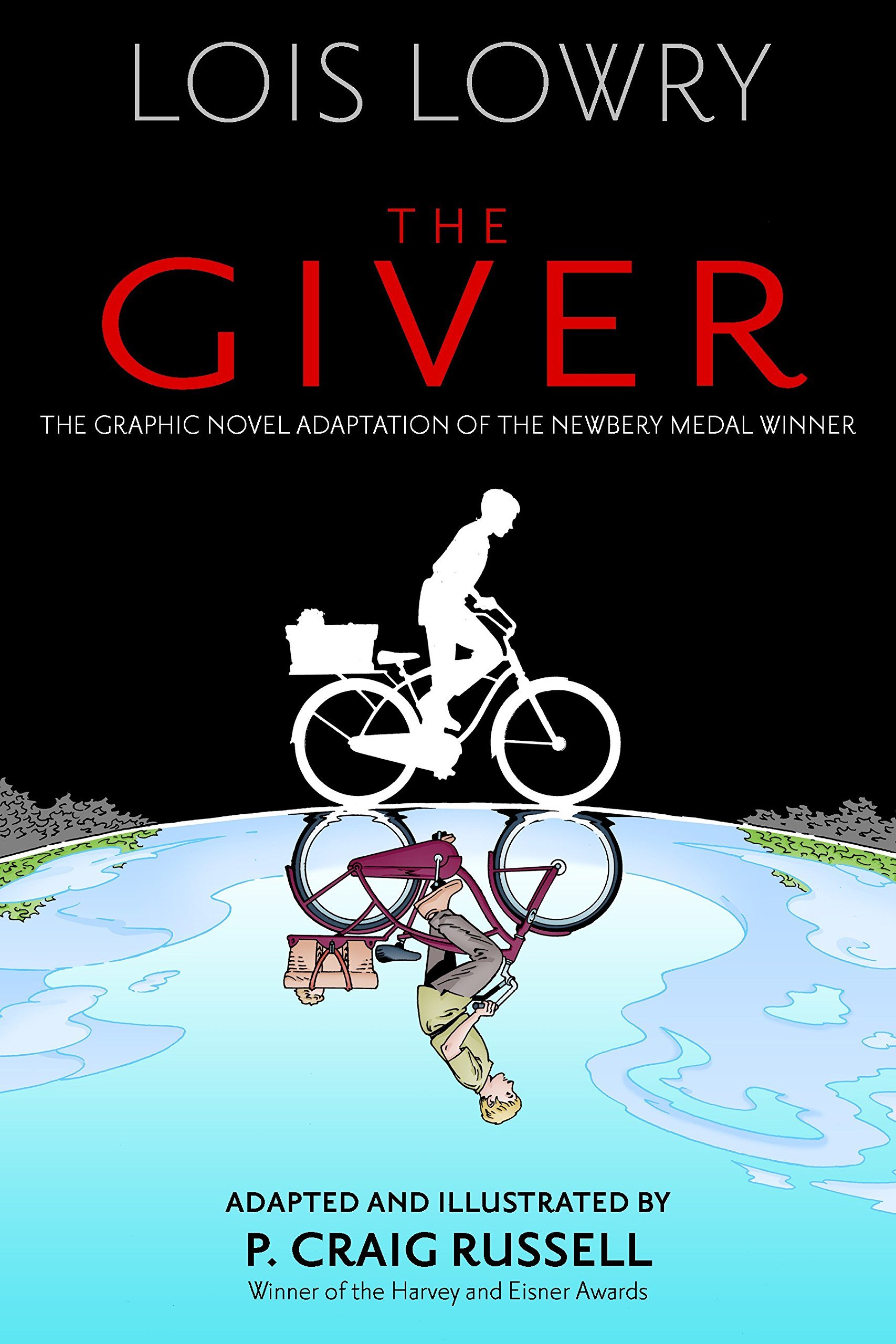
Book Review: The Giver, Graphic Novel

The Giver, Graphic Novel
The Giver series
by Lois Lowry
adapted & illustrated by P. Craig Russell

My rating: 5 / 5
Genre: Children’s dystopian, graphic novel

I read and reviewed the original book (see review here), so this review is less about the story and content than it is about the graphic novel format. My first impression when glancing through the book was that the use of pseudo black and white (it’s sort of more like blue black and white) for most of the novel was perfect for the story. The flashes of color here and there heighten the difference between Jonas’s view of the world and everyone else’s (besides the Giver). The visuals of the memories Jonas is given bring the story to life and highlight the blandness and sameness of the rest of the community. Certain graphics that I won’t specify to avoid spoilers are much more emotional than simply reading about them. Though in this format, the ending strikes me as even more ambiguous as it did the first time around, or maybe it’s just knowing the rest of the series now that makes me view the ending differently. All in all, I’d say the idea of converting The Giver to a graphic novel was a success, and I can see this being a good way to introduce the thought-provoking story to more reluctant readers.

Find out more about The Giver, Graphic Novel

See what I’m reading next.

If you’ve read this book, or read it in the future, feel free to let me know what you think!
Book Review: Masterminds

Masterminds
Book #1
by Gordon Korman

My rating: 5 / 5
Genre: YA sci-fi adventure

Serenity, New Mexico may seem like the perfect small town, but five teenagers are about to discover that there’s a lot more going on, both in their town and in the rest of the world, than they ever knew. 

This is the kind of book that is difficult to explain the premise of without giving too much away. There are five main teenagers, and each of them has their turn as the POV character. That is a lot of different perspectives to keep straight, and while so often that many doesn’t work out, Korman did a good job of keeping them all different. In fact, the story is in 1st-person from each of these perspectives, yet their voices are all unique enough to keep me from being confused (for the most part). I really enjoyed the way everything played out, though, and how the five teens got started on their investigation. While the main catalyst for the teens’ investigations comes from the main character, Eli, having bizarre symptoms when he rode his bike out of town with his friend, the other teens basically start on their own questioning and digging in other ways. When their individual quests come together, the story really picks up. The synopsis compares the book to Stranger Things, and unlike the last book I read that had that comparison, this one works.

I didn’t realize this was the start of the series until I got to the end, and while it’s not an outright cliffhanger, it definitely left me wanting more! My 13-year-old daughter read this book before me, and she and I are both excited to continue the series. We also both recommend this book for teens and even adults who enjoy suspenseful teen books.

Find out more about Masterminds

See what I’m reading next.

If you’ve read this book, or read it in the future, feel free to let me know what you think!

Book Review: The Traitor

The Traitor
Michael Vey #9
by Richard Paul Evans

My rating: 1 / 5
Genre: YA sci-fi adventure

Spoiler notice: The following review may contain some spoilers for the previous books in the series, starting with The Prisoner of Cell 25.

The Electroclan has to decide how to stop the Chasqui from destroying a town, free their friends, and deal with their friend who betrayed them.

I can’t pretend to know Evans’s motivation in opening this series back up again after a clear ending, but this book in particular made me feel like he doesn’t really care about the series anymore. The bad guy has (no surprise) turned out to be pretty much a slightly different version of Hatch. Multiple major side characters die, which might not seem like a big deal, but it’s quite different for this series. And the big kicker, to me, is that it appears that Evans completely forgot that he’d killed off an entire tribe of people way back in book #3. While, yes, the news that the Amacarra tribe had been wiped out could have been false, it has never been revealed to us that any (or apparently all) of them survived. Yet when they suddenly appear again in this book, no one is surprised, confused, happy, anything (except me). To me, that kind of huge continuity issue smacks of apathy.

Books 1-7 of this series have an overarching plot—the Electroclan trying to stop Hatch’s schemes and eventually bring down the Elgen. Whatever issues I had with those books, the desire to see the Electroclan triumph was basically what kept me going through 7 books. No matter what the real reason is that Evans continued the series after neatly wrapping it up, after only 2 books, I’ve lost my motivation to keep reading. I don’t care enough about the new bad guy, because he’s far too much like the old bad guy (plus, spoiler, he’s already stopped by the end of this 2nd book), and the new threat just doesn’t seem as globally dangerous. 

Rather than continue to complain about style issues, Evans’s weird pacing decisions, and other things that I’ve mentioned in multiple previous reviews already, I’m just going to say that this is the end for me, and be done with it. This is the last published book to date, but since it came out only 4 months ago, given what was left hanging, I assume at least one more is planned. I won’t put myself through the frustration of reading any further, though. As for recommendations, though I mildly enjoyed much of the first 7 books, I don’t know that I’d recommend this series, especially for adults. Teens are probably better able to overlook some of the shallow characterization and style issues I had with it.

Find out more about The Traitor

See what I’m reading next.

If you’ve read this book, or read it in the future, feel free to let me know what you think!

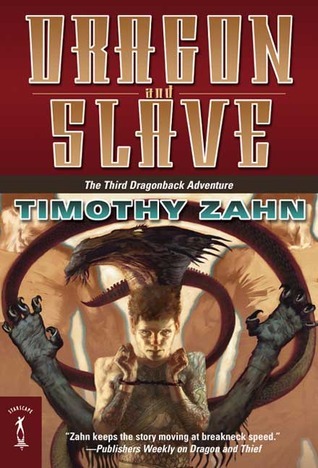
Book Review: Dragon and Slave

Dragon and Slave
Dragonback #3
by Timothy Zahn

My rating: 4 / 5
Genre: YA sci-fi adventure

In an attempt to help Draycos, the dragon-like symbiont that uses him for a host, track down who killed his people, Jack willingly sells himself to a wealthy slavemaster. Even though Draycos is a warrior brimming with power, Jack has to endure terrible conditions in order to keep his cover. But will it be worth it in the end?

Draycos and his unbending K’da warrior-poet ethics really shine in this book. Meanwhile, Uncle Virge, Jack’s spaceship’s AI based on his late uncle’s personality, is constantly trying to pull Jack the other direction—toward selfishness and greed. Jack’s inner battle to do good but also to accomplish his goal and save himself is a driving theme in these books. The intrigue and suspense, though, come from the question of who is working with K’da’s enemies to slaughter all of Draycos’s people, and that story takes a jump forward in this book. There are other questions left open, including one from the previous book, but it’s clear that this series is one long story that has to be read in succession. The books are short enough, Zahn’s writing style is easy enough to read (even for sci-fi,) and I’ve been enjoying the story so far, so I’m happy to keep going!

Find out more about Dragon and Slave

See what I’m reading next.

If you’ve read this book, or read it in the future, feel free to let me know what you think!
Book Review: The Parasite

The Parasite
Michael Vey #8
by Richard Paul Evans

My rating: 1 / 5
Genre: YA sci-fi adventure

Spoiler notice: The following review may contain some spoilers for the previous books in the series, starting with The Prisoner of Cell 25.

Even though the Elgen have been effectively defeated and scattered, other threats have come out of the ashes of Hatch’s defeat. One of them is ready to strike and catches the Electroclan off guard.

Considering the obvious ending Evans put on the previous book, not just feeling like an end to the Elgen threat but an end to the Electroclan’s fight, a return to normal life, such as it could possibly be, I don’t understand why Evans felt the need to open it back up again. In the past, when authors or movie makers have done that, it’s ended up feeling like a rinse and repeat of the original arc. I can’t say yet if that’s the case here, because this first book in the new arc was only part of a story. I will at least say that the new bad guy isn’t as over-the-top sadistic as Hatch, at least not overtly. Maybe that will come. But in a situation like this, I feel that Evans maybe should have considered shifting the focus somehow, from Michael to a different lead, maybe someone we didn’t see much of in the previous books.

Whatever may or may not work with the re-opening of the series with the same characters, though, the writing style hasn’t changed, and it’s starting to bug me even more. Maybe because the characters are in college now, but it still feels like high school. For example, there’s a reunion scene near the beginning, and it’s absolutely vital that we know who is paired up with whom (I don’t care). I’ll be happy if I never see the phrase “we man hugged” in a book ever again. Taylor apparently okayed her twin sister to kiss her boyfriend as a test or bet or something…what girl would do that? People tell each other that they sound like Ostin (the genius of the group who tends to spout facts at length) whenever they state a single fact about something, and this happens several times (and comes across pretty derogatory). And conversations are still so forced and stilted and feel like everyone is just standing around in a circle waiting for their turn to speak. Not to mention that some of these people were vehemently fighting against one another until the very end of the previous arc, and now they all act like super close friends who have fought side-by-side together through a war.

A lot of my issues with the style were present in the other books, but the plot was interesting enough that I was willing to look past it and keep going. This book, though, spent so much time on unimportant details that it didn’t have time to tell a full story. At least in previous books, while there was an overarching plot and cliffhangers, at least one smaller story goal was tied up in each book. That did not happen here. By 8 books into a series, you shouldn’t need to resort to cheap tricks like telling only half a story to get people to come back for the next book. This book does end on a cliffhanger of sorts, with a plot twist involving one of the original members of the Electroclan, but I realized something unfortunate at that point—I don’t care enough about these characters to care much about that twist. Eight books into the series with the same characters throughout, the writing style is so shallow that I just don’t care if any of them live or die. There have been a few deaths along the way, and we’re told often about how the characters feel the losses, but we’re not really given any reason to feel that loss alongside them. 

Now, after a 2-star ending to the major arc before this and a 1-star start to the next one, I had planned right up to this moment to still read the next one, mostly because I don’t like to walk away this far in. But after writing this review, I’ve realized there’s just not that much about this series that I like anymore, and my reading time is limited. Now I don’t know if I’ll read the next, but I will at least say that if you’ve read the rest of the series and are wondering if you should continue with the next arc, I wouldn’t recommend it. Especially if you are bothered by any of the things I mention above. If not and you also liked The Final Spark, then you might just enjoy this book a lot more than I did.

Find out more about The Parasite

See what I’m reading next.

If you’ve read this book, or read it in the future, feel free to let me know what you think!

Book Review: Divergent

Divergent
Book #1
by Veronica Roth

My rating: 4 / 5
Genre: YA dystopian

Set in a fairly nebulous, dystopian Chicago, the people have split into 5 factions, each prizing a different character trait as most important—selflessness, bravery, intelligence, peacefulness, and honesty. Upon turning 16, each person must choose between staying in the faction in which they were raised or choosing a different one, leaving their family behind. Beatrice Prior has a difficult decision before her, which is made all the more complicated when she discovers that she is Divergent, which means she is suited to more than one faction. But she’s told that this information is dangerous, so she keeps it to herself as long as she can. Unfortunately, it makes her stand out more than she’d like.

My first reaction to this book is that the world Roth has built doesn’t really seem realistic to me: in a a war-torn world of the past, the people picked a character trait, like aggression or duplicity, that they thought was the biggest reason for all the bad and decided to focus on being the opposite of that trait, forming five separate factions. It seems like a pretty silly way to try to avoid war, and it made me scratch my head to start the world building on this foundation. However, that is the foundation, so I figured that I just needed to accept that to be able to move on and enjoy the story for what it is. Past that sketchy start, it was a lot easier to believe that what started with good intentions could devolve to something much less good, because, well…people aren’t good. Don’t let anyone tell you different—on our own (meaning without God), we aren’t truly good. So discovering as the plot unfolds that at least one of the factions has been corrupted to be less of a pursuit of that faction’s trait and more of a pursuit of power is not surprising.

I had to go through a similar self-explanation and acceptance of the Divergent factor, which I took to be a kind of commentary on conformity and control and an “us vs. them” mindset. There were some unnecessary plot elements and a bit more focus on the physical in the relationship that builds throughout, but outside of that, I enjoyed the twists and turns along the way. The melding of different childhood factions during initiation is intriguing and some of characters are complex and well-crafted. The climax was not at all what I was expecting, and in some ways, I wish it had gone a different direction. But in the end, I’m glad I read the book and look forward to seeing where the story goes. (I also would really like to know what on earth is going on in the world outside of Chicago? Will that come up later in the series? I hope so!)

Find out more about Divergent

See what I’m reading next.

If you’ve read this book, or read it in the future, feel free to let me know what you think!

Book Review: The Final Spark

The Final Spark
Michael Vey #7
by Richard Paul Evans

My rating: 2 / 5
Genre: YA sci-fi adventure

Spoiler notice: The following review may contain some spoilers for the previous books in the series, starting with The Prisoner of Cell 25.

After Michael’s sacrifice, the rest of the Electroclan tries to go on without him. Hatch and the surviving Elgen are still a threat to the world and need to be stopped.

I was so disappointed in this book. Evans built Hatch up to be just about the most sadistic bad guy in history, which is something that’s bothered me about the series, yet I was still looking forward to the downfall of him and his people. I had my ups and downs with the series up to this point, intrigued by the plot while actually not being a fan of the writing and characters, but as I came to what was meant to be the final book in the series at the time it was written, and certainly still the wrap-up to the books-long plot, it’s not a stretch to say I was looking forward to seeing some Elgen butt being kicked by some electric teens. But that is not what I got. Instead, the electric teens are sidelined (yet again), there’s lots of military strategy filler from characters we just met in the previous book as well as some brand new characters (who are all just about as sadistic as Hatch himself), and there’s even suddenly supernatural abilities from characters that aren’t electric or teens. The two “nonels” in the Electroclan, Ostin and Jack, get a chance to bond in this book, which is probably the only good thing that came out of it.

It’s pretty safe to say that no reader is going to go into this book believing Michael to be dead (sorry if that’s a spoiler), but Evans still could have done something less predictable to bring him back than what he did. Michael is barely even in this book and only shows up to be one of the most boring, lazy tropes in writing. And murder lots of people who aren’t even Elgen, who are just following orders. And not even bat an eye or feel bad about it later. The ending was not just unsatisfying, it was completely saccharine and unrealistic, not to mention leaving us without any wrap-up for several plots and characters. I would echo comments from other reviews that I’ve read that say it seems like Evans was bored with the series by this point and just wanted to get it through it without much thought, except that 5 years after this book came out, he started the series back up! And you know what the worst part is? I know I’m going to read the newer books. I don’t know why, but I just can’t seem to help myself with this series—I know it has major flaws, and I have a hard time deciding whether or not I’d really recommend this series (it’s ridiculously brutal for the age group it’s meant for and way too angsty for adults), yet I can’t seem to help but want to see where it goes.

Find out more about The Final Spark

See what I’m reading next.

If you’ve read this book, or read it in the future, feel free to let me know what you think!

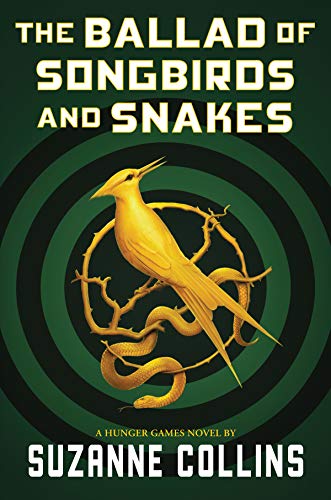
Book Review: The Ballad of Songbirds and Snakes

The Ballad of Songbirds and Snakes
The Hunger Games prequel
by Suzanne Collins

My rating: 4 / 5
Genre: YA dystopian

Spoiler notice: The following review will contain some spoilers for The Hunger Games trilogy.

This is the kind of book that is difficult to rate and review, because it is a book that is meant to be at least somewhat disturbing, as we follow a major villain’s descent into the dark. I’m not normally one who’s interested in a villain’s origin story, and it was no different with President Snow, especially after reading the part in The Mockingjay about his ever-present floral fragrance covering up his rotting mouth. It made my disgust more literal. But I decided to read this book to finish out the series; it just felt like something would be missing if I didn’t. Keep in mind, though, as you read the rest of this review, that I only read The Hunger Games trilogy for the first time pretty recently. That almost definitely makes my view of this prequel different in some ways from those who’ve known and loved the series for a long time.

Through parts 1 and 2, I was invested in the story. I think Collins did a good job giving us a somewhat sympathetic protagonist who feels trapped by circumstances. And he’s really as manipulated in some ways as Katniss is in her story. I’m not sure I ever fully understood what gives Dr. Gaul so much power, but she’s Snow’s own version of himself to Katniss in some ways. The main difference, though, is that Snow actually does begin to see things from Gaul’s point of view, which is part of the indication that he’s beginning to lose his grip on morality. This book’s Hunger Games and the lead-up to them, while being totally primitive compared to those in the main series, provide a compelling backdrop to Snow’s beginning steps toward depravity—the deception, the cheating, his first kill—things that he can rationalize at first.

Part 3 took a large turn that involved a fairly steep drop-off in action and interest for me, but the psychology of the villain’s slide was still there. And while it looks like things could actually go well for Snow, of course we know it can’t end happily, because we know who he becomes later, and it’s not this family man he envisions himself becoming. In truth, I don’t think he ever had the capacity for a normal, happy life. I’ve read several reviews that say his downturn happened suddenly at the end, but I would maintain that those people weren’t paying close enough attention during the rest of it. Snow makes many decisions that he justifies as being out of love—for his family, for his tribute—but really, the most important decisions he makes are only for himself, for family pride, to maintain his standing in society, however you want to spin it, it’s all selfishness. I do think he cares about his cousin and loved his mom. But even his cousin he puts one over on in the end for his own selfish gain. Yes, there’s a turning point at the end of the book where he makes a more deliberate choice, but I can see the rest of the book pointing right to it.

So that’s why my rating is 4 stars. And when I re-read this series in the future, which I definitely will, maybe even soon, I will probably not always finish with this book, but I will read it again at some point, I’m sure. I don’t know that I ever felt the need to know what made President Snow the monster he is in the original trilogy, but I still really appreciated this book. It’s quite polarizing, though, so if you’re wondering whether you should read it or not…that’s up to you.

Find out more about The Ballad of Songbirds and Snakes

See what I’m reading next.

If you’ve read this book, or read it in the future, feel free to let me know what you think!
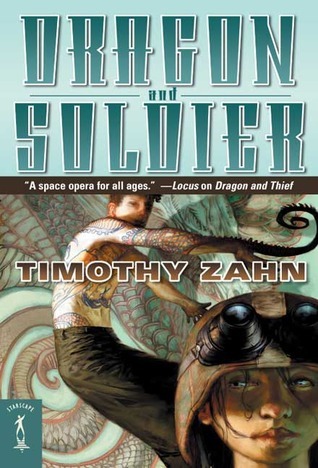
Book Review: Dragon and Soldier

Dragon and Soldier
Dragonback #2
by Timothy Zahn

My rating: 4.5 / 5
Genre: YA sci-fi adventure

In an attempt to help Draycos, the dragon-like symbiont that uses him for a host, track down who killed his people, Jack enlists as an indentured soldier for a mercenary group. After meager training, he’s placed into a perilous situation, along with other soldier children, and must stay alive while also trying to find the information Draycos needs.

The unlikely duo of the boy trying to overcome his con-artist upbringing and the noble poet-warrior of a morally superior race is one of my favorite things about this series so far. But the plot in this book, though I didn’t think I’d care much for the soldier aspect, was also intriguing. When it became evident that there was more going on than met the eye, I speculated about what might be going on. In the end, it might not have been quite as exciting as I expected, but there were a couple of revelations that still made for a great ending and left me with a desire to read more.

I appreciate Zahn’s writing style worldbuilding, maybe more so because it’s meant for teens, so it’s not too dry or serious. The overarching story set up in the first book and continuing in this one definitely makes me want to know what’s going on. I look forward to continuing this series!

Find out more about Dragon and Soldier

See what I’m reading next.

If you’ve read this book, or read it in the future, feel free to let me know what you think!