Book Review: North! or Be Eaten

North! or Be Eaten
The Wingfeather Saga
#2
by Andrew Peterson

My rating: 5 / 5
Genre: Children’s fantasy

North

Spoiler notice: The following review will contain spoilers for the first book in the series, On the Edge of the Dark Sea of Darkness.

The danger is real as the Igibys escape the clutches of the Fangs of Dang and head north toward the Ice Prairies. The Lost Jewels of Anniera begin to realize their full potential along the way, but there are a lot of obstacles to overcome. Surviving Fangs, the Stranders, and even the wilds of Skree itself, the Igiby family gets separated, and that’s when things really get bad for young Janner, the Throne Warden of Anneira. Worse yet is when he loses his little brother, the High King of Anneira, whom he is meant to protect. Surprises await around every corner in this action-packed, heart-filled fantasy!

I don’t know if I can adequately express how much I enjoyed this book. The imagination that went into the characters, the creatures, and the plot itself is vast and enviable. I was swept up in the horrors, the betrayal, and the victories right along with the characters. I was annoyed every time I had to put it down and plunged back in with voracity every chance I got.

As in the first book, the main character really is Janner, the oldest of the Igiby children, and in this book it was even more clear why that was the best choice. He grew up so much in this book, even though only a short time passed (I don’t know how much for sure…months, maybe?). Leeli really blossomed in this book as well, even though we didn’t get to see her as much. She’s courageous and has a beautiful spirit, and I love her! Tink, who is know more and more as Kalmar, has a rough time of it in this book, but boy was that ending incredible.

At times, I felt like the action didn’t slow down enough for me to catch my own breath, but looking back at it, I don’t think it was a bad thing. There were some pretty dark moments, so I wonder about the age range it’s meant for, considering that my daughter falls into the middle grade range. I don’t think it would scare her, necessarily, but I wonder if she would still be bothered by some of it, though she is on the low end of that range.

I highly recommend this book, and the series so far, for folks of all ages who enjoy clean, fun fantasy adventures. Also, you might see it labeled as Christian, and there are some references to a deity that many of the people believe in, but it is not overtly Christian. I have a feeling I’m going to love the rest of this series and want to re-read many times. There’s no way I’m waiting for the new versions of the last 2 books to come out before I read them.

Thank you to Netgalley and WaterBrook & Multnomah for providing me a copy of this book to review.
**Note: This book has been out since 2009, but a new hardcover edition will be released tomorrow, with a beautiful new cover and new illustrations inside.

Find out more about North! or Be Eaten

See what I’m reading next.

If you’ve read this book, or read it in the future, feel free to let me know what you think!
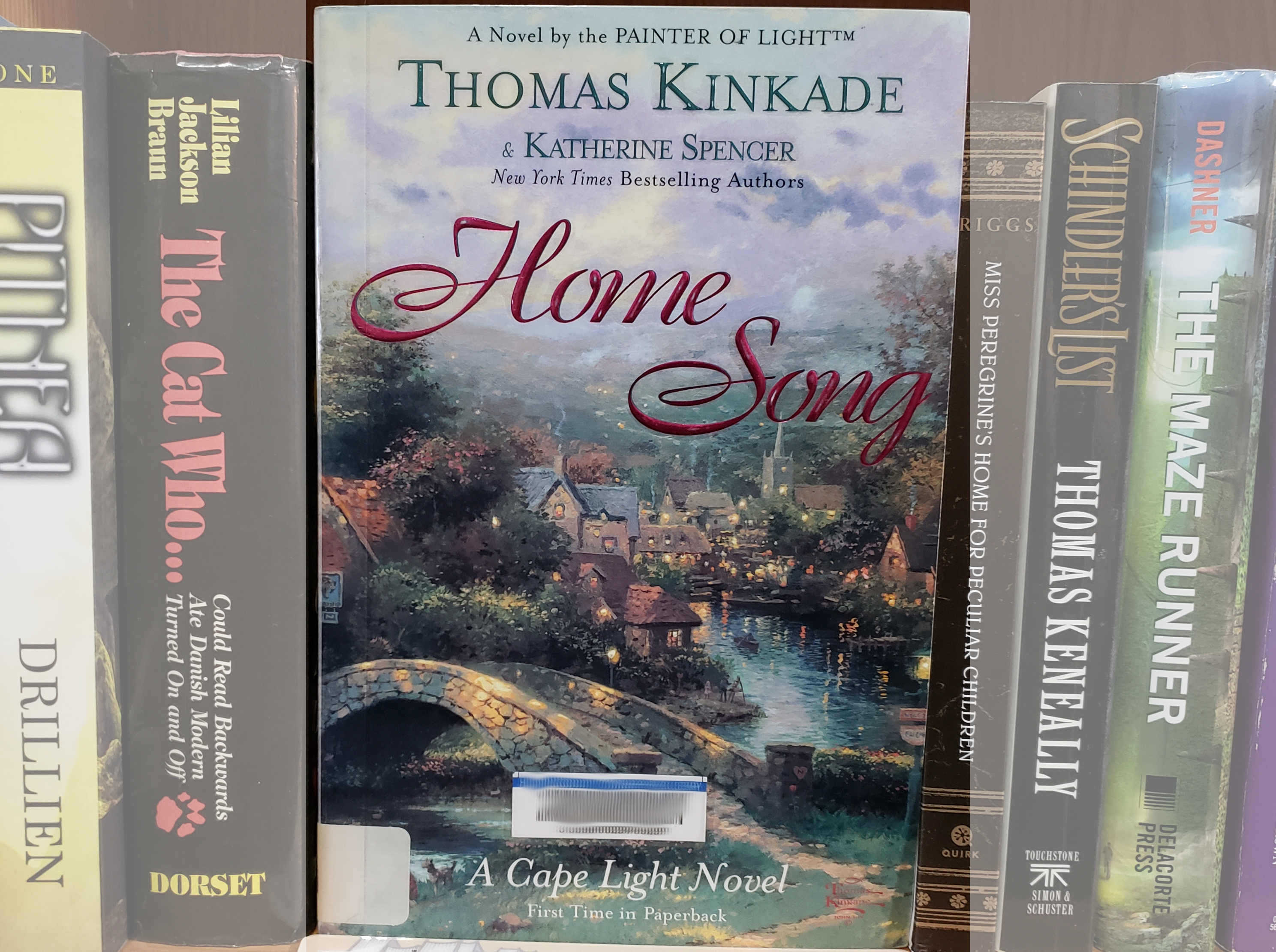
Book Review: Home Song

Finished Reading: Home Song
Cape Light
#2
by Thomas Kinkade & Katherine Spencer

My rating: 4 / 5
Genre: Christian drama

Home Song

Spoiler notice: The following review will contain some spoilers for the first book in the series, Cape Light.

Fall comes on strong in the quaint New England village, and relationships and dramas from the previous book are continued. The focus in this story is on 2 key people–Mayor Emily Warwick, who is busy with her re-election campaign, and Sara Franklin…the mayor’s long-lost daughter, who hasn’t actually told her birth mother that she’s the daughter she gave up 20+ years ago.

I gave Cape Light 3 stars, and was really happy to find this second book a huge improvement on the first. I liked the main characters so much more this time around, and the storylines were much more compelling. By the second half of the book, I was really caught up and highly anticipated seeing what would happen.

In the first book, the closest things to main characters were Jessica Warwick and Sam Morgan. Though many characters were introduced, and many story arcs were established, they were the driving force. Their romance was the story goal–the only thing that was tied up in that book. Their personalities suffered greatly because of the daunting task of setting out an entire town’s worth of characters and stories, so there wasn’t much time left to develop them or their relationship to my preference. Unfortunately, that made it all the worse that their relationship drama continued in this book. The fruition of it was good, but frankly, they both made me angry in this book. Fortunately, their parts were small.

In a similar vein, another romance that developed in this book was in some ways like a rehashing of the Jessica/Sam storyline of the previous book, wherein the woman didn’t want a relationship because she didn’t know how long she’d be in town. The big difference is that the two characters in this case had more depth. They had actual lives and their own stories to tell. I liked them so much more, and their story definitely took a different turn.

Other arcs that were set up in the first book were continued in this one in some way, or even came to fruition. Since unraveling the lives of the different people in this town was what made me care enough about the first book to want to continue the series, I was glad to see this happen. And there is still plenty more to carry my interest into the next book. I’m looking forward to the next much more than I was after finishing the first one, and now I feel safe recommending this book, and the one before it, to fans of Christian fiction, especially involving romance.

Find out more about Home Song

See what’s coming up.

If you’ve read this book, or read it in the future, feel free to let me know what you think!

Book Review: The Guernsey Literary and Potato Peel Pie Society

The Guernsey Literary and Potato Peel Pie Society
by Mary Ann Shaffer & Annie Barrows

My rating: 5 / 5
Genre: Historical fiction

GLPPPS

In the aftermath of WWII, a writer in London named Juliet receives a letter from a stranger living on the island of Guernsey in the English Channel. This begins a correspondence that expands to other members of the islander’s literary society, as Juliet wants to hear more about their society. The Guernsey Literary and Potato Peel Pie Society was formed during the German occupation of the island, and became so much more.

The book started out a little slow, but when it took off, it really took off. It’s written entirely in epistolary style, with letters and telegrams between various characters telling the story. The characters are endearing, and as the trials they went through during the war are revealed, the lasting effects are shown alongside them. The emotions are real, and I found myself swept up in them.

Early in the book, I was mostly annoyed with Juliet and her tendency to complain. It was establishing her background and life, I know, but maybe specifically because of the book’s format, since we saw everything directly from her perspective, she just seemed whiny. Around the time she got the first letter from Dawsey on the island, her character deepened enough that I didn’t dislike her so much. And then her sincere interest in the literary society and what the people on the island went through endeared her to me a lot more.

The format of the book is done well–each letter has a header stating who it was written to and from, so before you even start reading the letter, you are fully aware of that. It helps a lot, as eventually there are quite a few characters to keep straight. Some become more familiar, and others fall away, but overall, I only had a little struggle sorting through them.

Unsurprisingly, the characters are what make this book so great. I loved the way that the heart of the literary society was never even physically present in the book, once characters came together in the physical space, yet she was still a big part of the story. On the other hand, Juliet has this suitor that is pretty terrible. I don’t get why she doesn’t see how incredibly misogynistic he is, even in that somewhat different time.

This book is split into 2 parts, and by the time I got to part 2, I was completely hooked. It’s a fairly short book, and I think the epistolary format makes it particularly easy to read, because there’s not a lot of description. I read the bulk of it in a day. This is one book I am definitely going to re-read in the future. I recommend it for all fans of historical fiction, but even others, especially those who like character-driven stories.

Find out more about The Guernsey Literary and Potato Peel Pie Society

See what’s coming up.

If you’ve read this book, or read it in the future, feel free to let me know what you think!

February in Review

I read 9 books last month. I’m really surprised by that amount, especially considering that it’s a slightly shorter month. It’s only 2 books less than how many I read last August before school started and I started working a lot more. What a fun and productive month!

Here are the books I read in February:

Pawnee: The Greatest Town in America by Leslie Knope (3 / 5)
Seconds to Live by Susan Sleeman (2.5 / 5)
Harry Potter and the Goblet of Fire by J.K. Rowling (4.5 / 5)
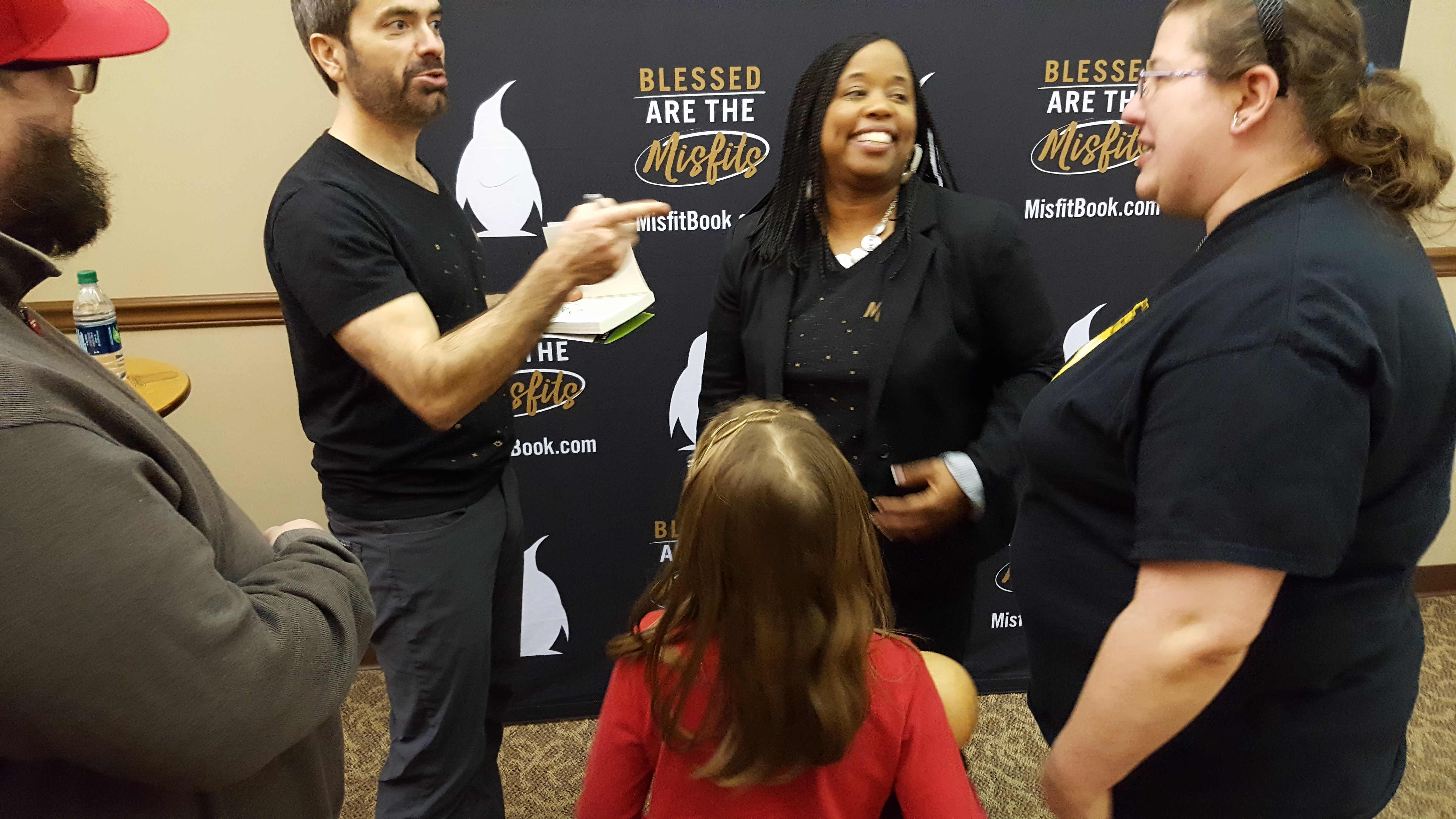
Blessed Are the Misfits by Brant Hansen (5 / 5)
This Light Between Us by Andrew Fukuda (3.5 / 5)
Heaven’s Open Book by Sheldon Peart (2.5 / 5)
Sneak by Evan Angler (4 / 5)
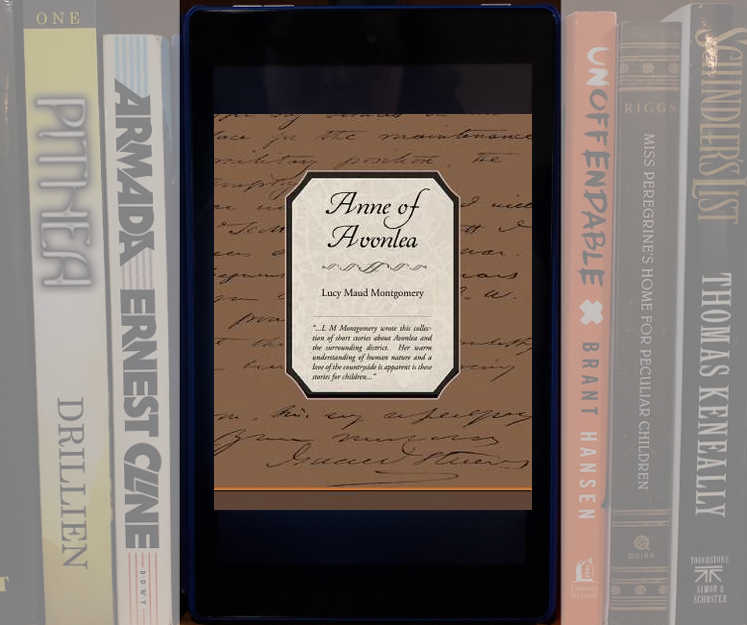
Anne of Avonlea by L.M. Montgomery (4 / 5)
The Blue Cloak by Shannon McNear (3.5 / 5)

This list includes 3 ARCs and 1 re-read. My favorite book from February was Blessed Are the Misfits. I started 0 series, continued 3 series, and finished 0 series. My ever-changing short list of to-be-reads, as well as a flag for the book I’m currently reading and an ongoing list of those I’ve read and posted about can be found here.

I’m also keeping my Goodreads page updated with a more extensive list of to-be-reads. Despite my almost too-long TBR list, I’m always looking for more to add. Feel free to offer suggestions of your favorites or just recent reads you enjoyed.

Book Review: Anne of Avonlea

Anne of Avonlea
Book #2
by L.M. Montgomery

My rating: 3.5 / 5
Genre: Children’s classic, coming of age

AoA

 No longer a child, Anne Shirley starts a new adventure as the schoolteacher in Avonlea. Fortunately (for us, not for her), she still gets into scrapes, has adventures, and meets interesting people. We follow Anne through 2 years as teacher, starting with her first terrifying day. During this time, Green Gables becomes the home for 2 young orphans, who present a whole new challenge to Marilla.

I had anticipated this book being not as wonderful as the first, considering that plenty of the charm of the first was wrapped up in Anne’s childish nature. Not only has she grown and matured, she’s also been “raised” to be more proper. Still, her spirit and imagination are there, and she meets other kindred spirits to provide some of that as well.

I did not care for the twins that Marilla took in, not just because Davy was such a handful, but also because Dora was…nothing. It seemed as if the author only gave Davy a twin so that he would have a target for his shenanigans, but she forgot to develop the sister, and thus, she became boring to the author, and likewise to the other characters. They liked Davy more because he needed them more (because he was a terror), and Dora was so good she had no imagination. So basically, if she’d acted up a little more, or made more mistakes, she’d be more interesting. Just…no.

The storyline with Miss Lavender is cute and sweet. I loved the way Paul Irving keeps saying, “You know, Teacher,” to Anne (and a few times, he said the same basic thing to someone else) to show that they were so similar in spirit. J.A. Harrison’s storyline was a little bizarre, yet came out nicely.

These books meander so, with time sprawling across the pages, and sometimes it’s hard to pinpoint the plot of a single book. But the overall plot seems to be the life of this orphan girl as she learns who she is, how to navigate life, and what she might want to do someday. I’m looking forward to reading about the next chapter of Anne’s life.

Side note: I have now purchased 5 out of 6 of the “main storyline” of this series. I didn’t really intend to, especially as I haven’t read enough yet to know if anything past the first one will be worth owning. But I have taken a lot of trips to Half Price Books over the last 3 months, and so often find one or two of these in the clearance section. It’s hard to pass it up for $1…

Find out more about Anne of Avonlea

See what’s coming up.

If you’ve read this book, or read it in the future, feel free to let me know what you think!

Book Review: The Blue Cloak

The Blue Cloak
by Shannon McNear

My rating: 3.5 / 5
Genre: Historical Christian romance, crime

Blue Cloak

In the wilds of Tennessee and Kentucky in the late 1700s, Rachel’s newly married close friend gets caught up in a nightmare. Sally’s groom and his cousin, Big and Little Harpe, become outlaws and leave a trail of destruction, dragging their family along with them. Rachel is worried for her friend, as well as for her new acquaintance Ben Langford. Ben came to the frontier to keep his cousin out of danger, but sadly discovered that Thomas was one of the Harpes’ first known victims. Now he only wants justice for his cousin, and Rachel wants to see her friend freed from her murderous husband’s grasp.

This is the third book in the True Colors series that I have read. For the first half of this book, I felt that it was a bit better than the other two (The Yellow Lantern & The Gray Chamber). The main characters were relatable, my heart broke along with Sally’s as things went from bad to worse, and the romance was sweet, if not a little weird given the backdrop.

The book was well-researched. An author’s note at the beginning even made it clear that McNear knew this was a difficult subject, and there is a real question of “how dark is too dark for Christian fiction?” I think the answer is…this. This story of the Harpes and what they did to potentially 50 men, women, and children in their time might just have proven too dark to use as a setting for a Christian romance. I’m not one who was all that put off by what was in the book, though a bit of it was definitely more disturbing than the rest, however, because the author understandably couldn’t go too in-depth in these matters, the story just came off very shallow. I think that is an indication that this bit of history just should have been passed on for this series.

However, I was planning to give this book 4 stars until just after the halfway point, when a really confusing scene happened that made me feel like an entire other scene had been deleted from the book, and the author forgot to re-write a callback to it. And then, by the end of the book, I became weary by the repetitiveness of the characters’ thoughts and prayers (that feels so bad to say, but honestly, at times it just felt like it was copied & pasted from earlier). Overall, though, the book was well-written, with just a few gripes.

So this is the part where I normally sum up my thoughts and then make recommendations for who should read the book. As I said above, the book has some more graphic spots, but overall tends to gloss over the details of the crime and depravity of the Harpes. Still, it’s not for the faint of heart, and many Christians would likewise find it too much. But if it sounds like something you’re interested in, especially if you’re a fan of Christian romance, I’d definitely say give it a try.

Thank you to Netgalley and Barbour Publishing, Inc. for providing me a copy of this book to review.

Find out more about The Blue Cloak

See what’s coming up.

If you’ve read this book, or read it in the future, feel free to let me know what you think!

Book Review: Sneak

Sneak
Swipe #2
by Evan Angler

My rating: 4 / 5
Genre: YA dystopian, Christian

Sneak

Spoiler notice: The following review will contain some spoilers for the first book in the series, Swipe.

Sneak picks up immediately after the previous story’s end, with Logan on the run and the Dust in the wind. In the aftermath, Logan and Peck, leader of the Dust, share a common goal–find Logan’s sister Lily. Five years ago, Lily supposedly died when she went to receive her Mark, but Logan has since received information that she is actually in some sort of prison. Logan and the Dust travel along the River to Beacon, the capital city, where they will try to break Lily out. Meanwhile, Logan’s friend-turned-betrayer Erin is on her own track to Beacon, which is what she thought she wanted, but now isn’t so sure.

The story really picked up in this 2nd installment, with more action and higher stakes. We get to see even more of the community that the Markless have formed across the country. And the members of the Dust weren’t nearly as annoying as in the first book. Plus, we get some fresh blood to the cause that is very promising.

Though the Dust and most of the rest of the Markless community seems to hate Logan at first, due to the extra heat he’s brought down on them all, I like him a bit more in this book. He seems a little wiser and a little less helpless. I still don’t care for Erin’s character, though, who was the other MC in the first book. She has a smaller role in this one and is so inconsistent, I don’t know if she’s just that confused or if she isn’t written very well. The character that I said was my favorite in the first book was in this one a lot less, and frankly…I don’t remember why I liked him so much in the first one. So there’s that.

The other members of the dust are given a bit more of a background, so while they don’t really come to the forefront that much, at least there’s some depth there. There’s a pseudo-love triangle in this book that seemed pretty unnecessary to me so far. But overall, the characters were more engaging in this book.

I loved the River, which had similarities to hobo signs (which I learned about from a Nancy Drew game). It was an interesting idea to include in the story, though at least one thing happened that was pretty predictable to a point. The outcome was not so predictable to me.

As I mentioned in the first book’s review, the series is actually Christian end-times fiction, which became more clear in this book. Logan finds and begins to carry around and read a Bible, which is a banned book, considering that religions other than the One World Religion are also forbidden. It’s a subtle build-up, and I’m looking forward to seeing what happens in the next book. Sadly, since reading the first one, I have become aware of the fact that this is an unfinished series, the most recent book being published in 2013. With that understanding, this might still be worth reading for those who enjoy end-times fiction.

Find out more about Sneak

See what’s coming up.

If you’ve read this book, or read it in the future, feel free to let me know what you think!

Book Review: Heaven’s Open Book

Heaven’s Open Book
by Sheldon Peart

My rating: 2.5 / 5
Genre: Christian fiction, theology

This short book is split into 2 parts. Part 1 contains 5 vignettes of life, focusing on 5 different pairs of people. In each pair, at least 1 is living some sort of Christian life. In the second half of the book, one of these characters has a vision of Heaven, where saints are able to look up their loved ones in Heaven’s Open Book, and if they did not make it to Heaven, find out what sins kept them out.

The difficulty in reviewing a book like this is that it’s difficult to sort out the different aspects and give it an honest rating that isn’t colored by anything besides the reading. As such, I have broken my thoughts about it down into 3 parts: the story itself, the theology presented within, and the writing style and editing.

Story – I get what the author is trying to do here. From the very beginning, we see a married couple where the husband is not a Christian and the wife is. But it’s clear that she is not the ideal example of a loving Christian by the way she treats her husband. As the book continues to unfold, each vignette gets longer and longer. Knowing what the second half of the book was going to be about, I made guesses as I went about who would be in Heaven and who wouldn’t. For the most part, I was right.

There were a few things that happened in the book that I thought were a little odd, but overall, the story was decently presented. I’m not going to go back and look, but my recollection is that pretty much everyone in church leadership was an adulterer, so that was a bit strange.

My biggest problem with the story came in the 2nd half. As those who made it to Heaven looked up their loved ones, they were given the options of watching videos of the actual sins that they were condemned for occurring, or in some cases, reading text about those sins. Many videos were watched of husband or wives who committed adultery. It was, frankly, uncomfortable. We’re not talking explicit scenes here, but the amount of leering and physical groping that is described is beyond unnecessary. My rating for this book is mostly based on the “Story” section of this review, and this is a huge reason for my rating.

Theology – In the first half, as I was guessing who was going to be in Heaven and who was not, characters were presented that, in real life, are the type to appear as good Christians to the casual observer, but were just going through the motions. One was even a famous, charismatic traveling speaker who drew huge crowds. It is a sad truth that many people who pass themselves off as Christians are not actually saved.

Another difficult thing in reviewing a book like this is that it could easily force me to set up my beliefs as correct over the author’s. That is not my intention here, but it’s impossible to not allow a difference of beliefs to color my thinking in some way. In the second half of the book, I disagreed with a lot of the theology presented. I’m not going to list it all, because also I don’t want it to appear that I rated the book lower due to not having the same views of God and the Bible. I will at least say, though, because it’s already mentioned above, that I really hope people in Heaven aren’t going to be watching videos of their loved ones sinning, especially not the types of videos I described above.

Writing Style & Editing – When I read a self-published book like this one, it is my intention not to let things that a professional editor would help with affect my view too much. I’m not saying that there is no burden of responsibility here, but it’s harder for self-published authors. However, I’m going to skip mentioning any proofreading or line-editing issues here and focus on one area that made the book harder to read for me: the style.

I came to realize some time during the 2nd vignette that the book was set in Jamaica. Maybe I should have assumed that already, based on the fact that the author lives in Jamaica. However, at first, I simply thought there were a lot of grammar issues in the dialog. Even after I understood the setting, it was difficult for me to read, as a lot of the dialog is what I can only assume is specific to the way people in Jamaica talk. I’m not trying to say that everything has to be written for Americans, but as an American audience, it was difficult to read. And I’m not sure if the fact that almost everyone used “Bro” or “Sis” as a title for almost everyone else is a Jamaican thing or just a church culture thing that the author is used to, but it was also very distracting for me.

In the end, I can tell I was not the correct audience for this book. The author seems to have found the right audience, as the reviews on the common places I check (Goodreads & Amazon) are all favorable. But for me, there are definitely some cultural and theological differences that made this a difficult book for me to read and enjoy.

Find out more about Heaven’s Open Book

See what I’m reading next.

If you’ve read this book, or read it in the future, feel free to let me know what you think!

Book Review: Blessed Are the Misfits

Blessed Are the Misfits
by Brant Hansen

My rating: 5 / 5
Genre: Christian living

Blessed

Maybe you’re an extrovert. Maybe you go to church and totally fit in, never wonder if you don’t belong, never feel like others must be closer to God than you are. Radio show host Brant Hansen wrote this book for the rest of us. If you don’t understand modern church culture, feel like you must be missing something because you don’t feel the emotions others feel, maybe you’re not a good enough Christian, this book might just help. For the introverts, the outcasts, the spiritually numb, the misfits–this book might just change your life.

I knew from Brant’s radio show & podcast that he knows exactly what its like to feel out of touch with Christian church culture. In the book, he shows even more that he has every reason to feel disenfranchised and skeptical about even the existence of God. And yet, that is exactly what has led him to believe and trust in God. He shares some stories from his life, some of which had me laughing so much! (Seriously, the flute & folding chair incident never gets old, even though I’m sure it must have been terrible for him in the moment.)

One of my favorite things that he talks about in the book is the concept of “together, yet apart” in regards to our relationship with God. There’s so much about the Bible that we don’t really get because we don’t understand the culture back then, the people it was initially addressed to, or even the geography. Brant explains the betrothal period for Jewish couples, and equates that to us and God, and it can put your entire life into a whole new perspective!

More than just making me feel better knowing that I’m not alone in feeling like a misfit in church culture (and even in non-church culture), some of what Brant has to say really opened my eyes to my responsibility. For example, as an Aspie (someone who has Asperger’s syndrome), Brant has much more cause to stay away from people than I do–more reason to not fit in, not understand. And yet, he explains how he has to make a conscious effort to interact. To love people. I’ve never really bothered to do that. There’s also a whole section about bumping up against someone and seeing what kind of “fruit” falls off them, which can show you who they really are, not who they claim to be. I know that the responses I produce in moments like that are not always positive. I want my fruit to be loving, generous, and kind.

There’s so much more than I can go into in my review, but trust me, if any of this makes any kind of sense to you, make sure you read this book. He speaks simply and honestly, makes some really good points, and uses the Bible to back it all up. I recommend this book for all Christians, because even if you don’t feel like a misfit, it might help you to understand those around you who do. And even if you’re not a Christian or just don’t think the book will be for you, I suggest you check out The Brant & Sherri Oddcast.

Side note: My paperback is actually signed by Brant. My family went to a book event with both him and Producer Sherri. I asked him to sign as Tostare (Latin for toast).

Find out more about Blessed Are the Misfits

See what I’m reading next.

If you’ve read this book, or read it in the future, feel free to let me know what you think!

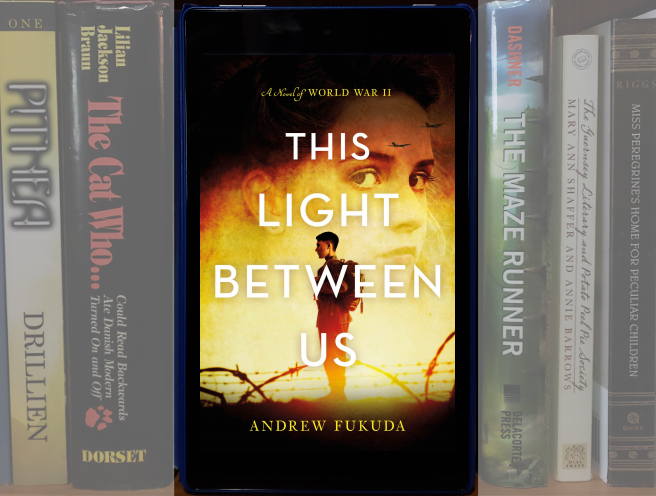
Book Review: This Light Between Us

Finished Reading: This Light Between Us
by Andrew Fukuda

My rating: 3.5 / 5
Genre: YA historical fiction

This Light

As a Japanese American during WWII, teenage Alex Maki’s life begins to deteriorate until his family is sent to a detainment camp. Up to and during this time, he is pen pals with a Jewish girl in France, who is seeing the growing persecution of Jews around her. This friendship is his one bright spot in an otherwise scary, unpleasant time. They share their hopes, dreams, fears, and ideas about acceptance vs. revolt through their many letters back and forth. As the war rages on, both of their lives change in ways they can’t imagine, and their strong friendship might not be enough to keep hope alive.

This book was incredible in some ways, and problematic in others. I really liked the history that was presented in this book, as well as the relationships. However, I had a difficult time with the style of writing and with the pacing.

I’ll start with what I liked, which is plenty. I loved the juxtaposition of the two teenage pen pals, who most readers will understand going in are being set up for intensely difficult times ahead. While I have seen and read many books about the Jewish side of this, the Japanese American side was a fresh topic for me. It’s easy to see the Nazis as evil because of what they did, but it’s also easy to forget that America put their own citizens into camps (though not heinous as the Nazi camps, as is clearly recognized in this book).

There was a pivotal scene not far from the end that I was curious enough about to look up and found that it was historically accurate, which was really neat to me. And the author’s notes at the end said it was one of 2 sources of inspiration for this book! Overall, I appreciated the history in this book.

I think my favorite parts of the book were the letters between Alex and his pen pal Charley. I would have been okay if more of the story had been told through those letters. I also liked the way a few other relationships developed throughout the story, particularly those between Alex and his brother Frank, and Alex and Mutt. Thinking of these, though, make me realize how light the book is on deep characters. Overall, those 4 are the only characters with any real depth, and none of them are particularly deep, besides maybe Alex and his brother.

This might be largely related to one of my biggest dislikes with the book. The story, which is presented as a personal narrative, has some strange inconsistencies in writing style. It fluctuates often between 3rd person limited and 3rd person omniscient (especially in the last third), which can at times make me feel like I have mental whiplash. Some of these sections easily could have been shown from the limited POV of Alex, rather than the broad POV of everyone involved. The story is also written in present tense, which, to me, is a strange choice for the omniscient POV. This caused the book to not flow as well as it could have.

Similarly, during the omniscient sections, there’s a lot of telling, instead of showing. I’m really not a big stickler for the “show, don’t tell” adage, but even I have my limits. I also would have preferred some translation for the French in some parts. This is a small gripe, because it didn’t come up often, and most of the time I could guess what was being said from context. But during a pivotal scene near the end, I had to use Google to translate some phrases to make sure I knew what was being said, and I’d rather not have to leave the book in a moment like that. (There was also something said in German that the reader is led to believe was some kind of German curse, and it’s not translated or even hinted at otherwise. I know enough German to know it was not a German curse, and was really quite emotional.)

So, overall, I did enjoy the book. It wasn’t a favorite, but I also think that most of what bothered me was more personal preference than normal. I think most people will not be bothered by the writing style, especially. It is listed as YA, but I’m not sure how much it works for that crowd. Though I will say that the dialog at times is pretty immature, so that might work out well (it’s also a little too modern, in my opinion, but I’m no expert). If you’re a fan of historical fiction, especially related to WWII, you will probably like it.

Thank you to Netgalley and Tor Teen for providing me a copy of this book to review.

Find out more about This Light Between Us

See what’s coming up.

If you’ve read this book, or read it in the future, feel free to let me know what you think!