Book Review: The Sea Before Us

The Sea Before Us
Sunrise at Normandy #1
by Sarah Sundin

My rating: 4 / 5
Genre: Historical Christian romance

Sea Before

Wyatt Paxton is a lieutenant in the US Navy. Dorothy Fairfax is a first officer in the Women’s Royal Naval Service. Both of these divisions of the US and UK military are working closely together to plan the invasion of Normandy in June of 1944, which is when Wyatt and Dorothy meet. Dorothy’s job is to piece together thousands of holiday pictures of the beaches of France so that Wyatt can make informed decisions for the invasion. Though Wyatt is drawn to Dorothy, she has her eyes set on another man…who has his eyes set on several other women. Both have to find a way to keep romantic entanglements, as well as other family drama, from distracting them from the ultimate goal—winning the war.

What I liked about this book is that it was not just about the romance. Wyatt and Dorothy both had a lot of other things going on in their lives, and that’s besides the looming invasion. In fact, the romance plot line is what detracted the most, or at least a particular aspect of it, as I’ll explain a bit further below. Overall, though, the book was engaging, enjoyable to read, and clearly well-researched.

The book begins by showing an incident in Wyatt’s past that haunts him throughout the book. It was especially interesting to me, because I’ve already read book #3 in this series and knew of the event, and now got to see it happen. Wyatt himself is a great character—great guy with a lot of depth, and I had an easy time imagining his Texas drawl, because his dialog was well-written. Feeling guilty about his part in the incident that happened before he joined the Navy, Wyatt sees himself as a prodigal son, leaning on God to get him through this tough time, and sharing his faith with Dorothy.

Dorothy has a lot more going on in her story, but I liked her less. She is a good daughter, and not necessarily mean to Wyatt (for the most part). But frankly, it takes her way too long to see Eaton, her crush, for what he really is. There were times I was sure she was on the turning point, but she just keeps pushing Wyatt aside in her mind and crushing on Eaton. And why is she so set on this? Because of what I felt was the weakest part of the book—her mother once told her that she regretted marrying her father, because he was boring, and she needed excitement. Her mother said that Dorothy was just like her, and warned her to marry someone exciting like Eaton. Why she wrote Wyatt off as “boring” so very quickly, I’m not sure, but she sticks by that assessment for far too long.

Other than a further contrivance later in the book, the rest of it was great. The book follows Wyatt into the invasion, from his position on a naval ship, and though a lot of the terminology was lost on me, I was caught up in it. There were several scenes in the last quarter of the book that made me so happy. In the end, I definitely recommend this book to all who enjoy Christian romance and Christian historical novels.

Find out more about The Sea Before Us

See what I’m reading next.

If you’ve read this book, or read it in the future, feel free to let me know what you think!
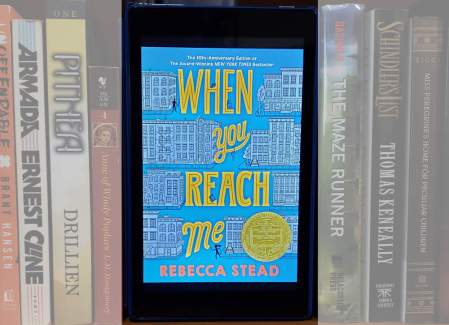
Book Review: When You Reach Me

When You Reach Me
by Rebecca Stead

My rating: 5 / 5
Genre: Middle grade mystery, sci-fi

When You Reach Me

When she got the first note, Miranda was able to convince herself it was just trash–it wasn’t necessarily meant for her and didn’t mean anything. The second one couldn’t so easily be dismissed. Then she begins to unravel a mystery that involves her once-best friend, the crazy man on the corner, and a break-in where nothing was stolen. Can Miranda put the pieces together in time to prevent a death?

I am so glad I decided to see what this book is all about. Though it’s for a younger audience, it intrigued me when I saw it on a fellow blogger’s Top Ten Tuesday list a few weeks back. It was such a great read! I liked the book’s feel of living in a big city in the 70s, which was based on the author’s own childhood. The mystery was seriously engaging, and even the chapter titles were wonderfully themed!

The chapters are mostly short, some as short as 2 pages (on my Kindle, so probably less in a book format), which kept the story moving, even when a lot of the earlier chapters covered backstory that brought the reader up to date on the “present time.” Also, the main character’s mom is practicing to be on the game show The $20,000 Pyramid, and most of the chapter titles are themed around that (ex. “Things That Burn”), which is also explained well enough in the story that younger readers, who wouldn’t know the show at all, will understand it too.

I had my theories about who wrote the notes, going back and forth between 2 people before deciding on one. When the big reveal happened, though I suspected most of what was revealed, it still left my breathless for a moment. It was so well done!

I will say that I think Sal was maybe a bit more mature in his thoughts and decisions about friendship than makes much sense for a boy his age, but other than that, I loved everything about this book. I highly recommend it for anyone who enjoys a good mystery, with some time travel thrown in. It is middle grade fiction, but I don’t think it the younger audience makes the story any less readable for adults.

Find out more about When You Reach Me

See what I’m reading next.

If you’ve read this book, or read it in the future, feel free to let me know what you think!
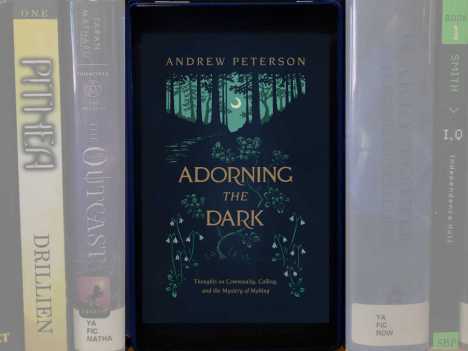
Book Review: Adorning the Dark

Adorning the Dark
by Andrew Peterson

My rating: 4 / 5
Genre: Memoir, Christian living

AtD

Singer, songwriter, and author Andrew Peterson shares his insight on creating in this book. He uses personal experience as well as wisdom from other songwriters and authors to discuss the process of writing songs, the ups and downs of the business, and using one’s creative abilities to tell a story.

I’ll start my review by saying that I was not the main target audience for this book. While Peterson does do his best to expand beyond songwriting into fiction-writing and other kinds of art, the heavy focus is on the musical realm (and poetry to a lesser degree). I’m a fiction writer, but have no experience with or even much of an understanding of writing songs. Plus, he referred to songs and books by various songwriters and authors a lot and talked about them as if the reader should know them as well as he did. I’m not nearly as well read as him, and I am definitely not as immersed in music culture, nor do I listen to as wide a range of music as he. As such, I do think that quite a bit of the book was lost on me.

Another way this book did not resonate with me is that I came to realize by maybe halfway through the book that my personality, and the way I see the world around me, is vastly different from his. He sees beauty in everything, but I’ve never been all that sentimental. So that was another chunk of the book that fell flat for me.

However, that does not mean that I did not find plenty of gems in the book, things that work for any kind of creating. For example: “If you wait until the conditions are perfect, you’ll never write a thing.” Or: “The songs won’t write themselves, and neither will the books, the recipes, the blueprints, or the gardens.” Even with the difference that Peterson describes between songwriting (which can also apply to poetry to a degree) and writing fiction, the clear point is that you have to get through the bad to find the good.

He also addresses the different between “Christian art” and art from a Christian perspective, which I really appreciated. As an author, I’ve struggled in the past with thinking that I should only be using the gift God gave me to write specifically Christian fiction. However, I no longer think that’s true. Instead, I can write stories with a Christian worldview, which will most likely be acceptable to most Christians, and will even be acceptable to many non-Christians who just want something good to read. And in approaching the art that way, perhaps it would allow the artist to actually reach more for Christ.

There were a few things about which I disagreed with the author, but even in those I think it mostly comes down to a difference in mindset or preference. I did agree with the idea that calling some people “creatives” excludes many people who really are more creative than they think. Just because “art” isn’t the end result, pretty much everyone creates in their own way–that can come out as critical thinking or problem solving, or so many other things that don’t seem as creative. In the end, I’m very glad I read this book, as it gave me some interesting insight into a singer whose music goes back as far as my marriage, and plenty of solid advice on writing, some of which I needed to hear even today. I recommend this book for Christians who are interesting in creating, no matter the form it takes.

Thank you to Netgalley and B&H Publishing Group for providing me a copy of this book to review.

Find out more about Adorning the Dark

See what I’m reading next.

If you’ve read this book, or read it in the future, feel free to let me know what you think!

Book Review: Harry Potter and the Deathly Hallows

Harry Potter and the Deathly Hallows
Book #7
by J.K. Rowling

My rating: 4 / 5
Genre: YA fantasy

HP 7

Continuing with my first ever reading of the Harry Potter books, I’ve just finished the final book. As a reminder, my reviews will likely contain spoilers, as I’m not too worried about avoiding that, with as long as these have been out, and as well known as they are.

This is the hardest review yet, for me. I was so caught up in the book by the last half that I was excited to give it 5 stars. But then I thought back over the entire thing, and looked at the notes I’d written earlier on, and realized that there were some disappointing things that really were worth an entire star detraction. Rather than try to organize my thoughts in a way that flows well, I’m going to do bullet points for this review.

What I liked/loved

  • Dudley’s appreciation of Harry, which is touching, yet not overdone or out of character for him
  • 7 Harrys
  • Luna in general, but esp that she could see through Harry’s disguise at the wedding
  • Godric Hollow’s wizards’ monument to the Potters and the graffiti on the sign
  • Ron’s chance to save the day
  • The fruition of the DA was better than I could have hoped for
  • Harry getting to see his parents again, and 3 out of 4 of the Marauders (Sirius was one of my favorites before he died, after all)
  • Neville’s triumph
  • The final defeat of Voldemort, of course, and the knowledge that these people are finally free from his destruction
  • I felt the epilogue was pointless at first, but after a few days to let it rest, I appreciate being able to see how the characters moved on, that Hogwarts was restored, and that Neville was a teacher there

What I disliked

  • The middle really dragged with all of the moving around to camp, and a few little things happened that really didn’t advance the plot much, if at all
  • The Deathly Hallows seemed so out of place, like a tack-on to another otherwise solid-feeling plot, and ended up barely having any point (despite me liking Harry’s use of the stone, as I mentioned above)
    • It’s really hard for me to buy that the invisibility cloak is infallible…except where it needed to not be for the plots of past books (especially since, from my recollections, none of the times I can think of that someone did, or seemed to, see through it were necessary to the plot)
  • Lupin’s and Tonks’s deaths should really have been “on-screen.” I know everyone loves Dobby, but I think they were at least as important to the series and should have been given a bigger send-off.
  • The Battle of Hogwarts and most of the climaxes and falling action that occurred between them were exciting, except for one thing–there was just so much talking during all of it! After the battle we get pages of exposition about Snape, then an entire chapter of Dumbledore explaining things to Harry (some of which we already know or could easily have deduced from previous information). Then there’s rising action to the final stand-off with Voldemort…during which they talk…a lot. I wish Rowling had figured out a way to include more of this much sooner than during/between the epic battle and final stand-off.

Overall, I did like the book a LOT more than I didn’t, and probably a lot more than it looks like here. But it generally takes more words to explain a problem I had than to share the things I liked. I do think the book was longer than it needed to be, and wonder if that was on purpose–the previous books had gotten so long, Rowling and/or the publishers felt she couldn’t go back at this point. I don’t know. But as this is the final book in the series, I can say now that I do understand why it is so loved. I am already looking forward to starting back at the first book some day and reading through the series again with an understanding of how things play out, to find those things that I missed the first time around.

Find out more about Harry Potter and the Deathly Hallows

See what I’m reading next.

If you’ve read this book, or read it in the future, feel free to let me know what you think!

Book Review: Harry Potter and the Half-Blood Prince

Harry Potter and the Half-Blood Prince
Book #6
by J.K. Rowling

My rating: 4 / 5
Genre: YA fantasy

HP 6

Continuing with my first ever reading of the Harry Potter books, here’s #6. As a reminder, even though these books/movies have been out for a while and are really well known, I’ll still warn in advance that my reviews will likely contain spoilers.

Well…I don’t even know where to start with my review of this book. Normally, I take a few notes while reading–just things I want to make sure I remember when I’m writing the review–things I really liked or things I didn’t like. I didn’t write any notes for half of this book, because I was just so caught up in the ride. So suffice it to say: I liked it.

I enjoyed seeing Harry as team captain, really liked the luck potion fake-out, and even liked that the Gryffindor team was able to win without Harry (because of the common Harry-is-best-at-everything complaint some people have with this series). The romance with Ginny was expected, but I think that’s only because of spoilers I’ve seen over the last few years. Harry suddenly being jealous of her relationship with Dean and daydreaming about her being with him, with no indication that he liked her that way before, was actually pretty abrupt. I’m curious, though I’ll never know, about how I would have felt if I hadn’t been anticipating it, because it came out of left field in this book.

The formula throughout this series of Harry suspecting something and not being able to get anyone (except maybe his friends, but not even them this time) to believe him is getting a little tiring. It’s even worse if he turns out to have been correct about everything, so it leaves little mystery for us.

The ending was a bit unpleasant, not just because of the obvious, but because of the realization of how very different the next book is going to be. After 6 books that covered a year of school (with more and more shown of the summer each year), knowing we won’t be going back to Hogwarts was as sad for me as it was for the characters. I also felt really let-down by the explanation of the Half-Blood Prince, which was fairly anticlimactic.

The one biggest issue I had was not a fault of the book’s. Back when this book first came out, my husband showed me the video of some guy driving by a bookstore yelling, “Snape kills Dumbledore!” at a crowd of people waiting in line to buy the new book, or walking way after buying it. Even though my memory isn’t what it used to be, this has stayed in my mind for 14 years, even when I never had any plans to read the book. So it’s also tainted my thoughts, expectations, and theories as I’ve read the entire series. Because of that, and who Snape has been shown to be up until and through this book, I did truly expect there to be more to it than there was when it actually happened. But there wasn’t.

In my reading and book blogging over the last 10 months, I am making sure to continue with series at a decent pace, but have never read 2 books from one series back-to-back. However, when I finished this book, I just knew I had to keep going. So I’ve already started on book #7. That’s probably as much of a testament to how much this series has sucked me in as anything. In a similar fashion to how a lot of questions and mysteries are tied up at the end of each HP book, I’m expecting a lot of tying-up of things left a mystery (or misunderstood, etc.) throughout the rest of the series, at the end of Deathly Hallows.

Find out more about Harry Potter and the Half-Blood Prince

See what I’m reading next.

If you’ve read this book, or read it in the future, feel free to let me know what you think!

Book Review: Anne of the Island

Anne of the Island
Book #3
by L.M. Montgomery

My rating: 4 / 5
Genre: Children’s/YA classic, coming of age

Anne 3

See my review for book #1, Anne of Green Gables.

This book takes us through 4 years of college with Anne and her school and housemates. She makes new friends, experiences loss, runs from love, and finds comfort at home. Relationships form and blossom, and life continues on all around her.

There’s a lot to love about this book. The characters are written with the same heart as the previous books, and even Marilla has an outwardly loving moment. Davy is not as terrible as he was in the previous book, though Dora is still basically nothing. I will say that there has become a kind of repetition among the characters. Many newly introduced characters seem a lot like those that were larger in previous books. Phil, for example, is a lot like Ruby (and wow with what happened there). Even Patty’s Place has some similarities to Echo Lodge. However, the charm is still there.

There are some things that happen in this book that seem like a cliche, but I can forgive that, because this book was written before they became such cliches. Anne has started to become a little too perfect and loved by all, but it seems kind of natural, rather than forced. There are quite a few romances going on in this book, which I personally enjoyed quite a bit. 

Because of how quickly these books speed through time, I echo Anne’s sentiment that it’s sad people have to grow up. Characters come and go so much, it’s hard to get attached to any of them. Still, there are a few permanents, and at the end of this book, because of the writing and dialog style I was so immersed in by then, the word “sweetheart” seemed like a whole new word when it was used. I’m a little less excited about continuing the series than I was up to this point, but I’m still looking forward to seeing what happens to Anne next.

Find out more about Anne of the Island

See what I’m reading next.

If you’ve read this book, or read it in the future, feel free to let me know what you think!

Book Review: The Wounded Spirit

The Wounded Spirit
by Frank Peretti

My rating: 5 / 5
Genre: Christian non-fiction

I bought the book used without a dust jacket, so this was the best I could do for a picture.

Peretti shares with us the difficulty he went through growing up with a medical condition that caused a deformity requiring many surgeries over his first handful of years. Fighting against infections and dealing with the condition left his body unable to develop as it should, and he went through school years smaller than the rest of his classmates. This led to years of persecution by his peers, and Peretti who was left feeling like those in authority had failed him, forcing him into the situation where he was bullied regularly, unable to do much of anything about it.

I read this entire book in one afternoon, and I won’t pretend that it left me feeling happy. I went through a range of emotions while reading, which was mostly pity and sadness, but included elation when Peretti described a turning point for him, which simply took a teacher caring enough to ask if things were okay.

More than just an autobiography about this part of Peretti’s life, he discusses the failure of teachers and other authority figures to keep kids from going through the same type of thing. The mindset that “we all went through it, you can too” or “it’s just part of life” is a big part of what he addresses, saying that it’s not nearly enough reason to turn a blind eye. That kids (and even adults) who are bullied suffer long-term effects that can cause problems in future relationships, and can lead to the bullied later becoming the bully. There have been a lot more anti-bullying programs started in the 20 years since this was written, but it does still happen.

He even puts out a challenge for those who see themselves as the victims to examine their lives for times when they might have been the bully. Even just laughing along when friends or peers are making fun of someone makes us guilty. It’s a hard thing to think about, but it really made a difference for me.

This book gave me a whole new insight into and appreciation for my favorite author and his lovable nature, joviality, brilliance, insight, and heart for God. It also puts my own life into perspective. I recommend this book for…everyone, really.

Find out more about The Wounded Spirit

See what’s coming up.

If you’ve read this book, or read it in the future, feel free to let me know what you think!
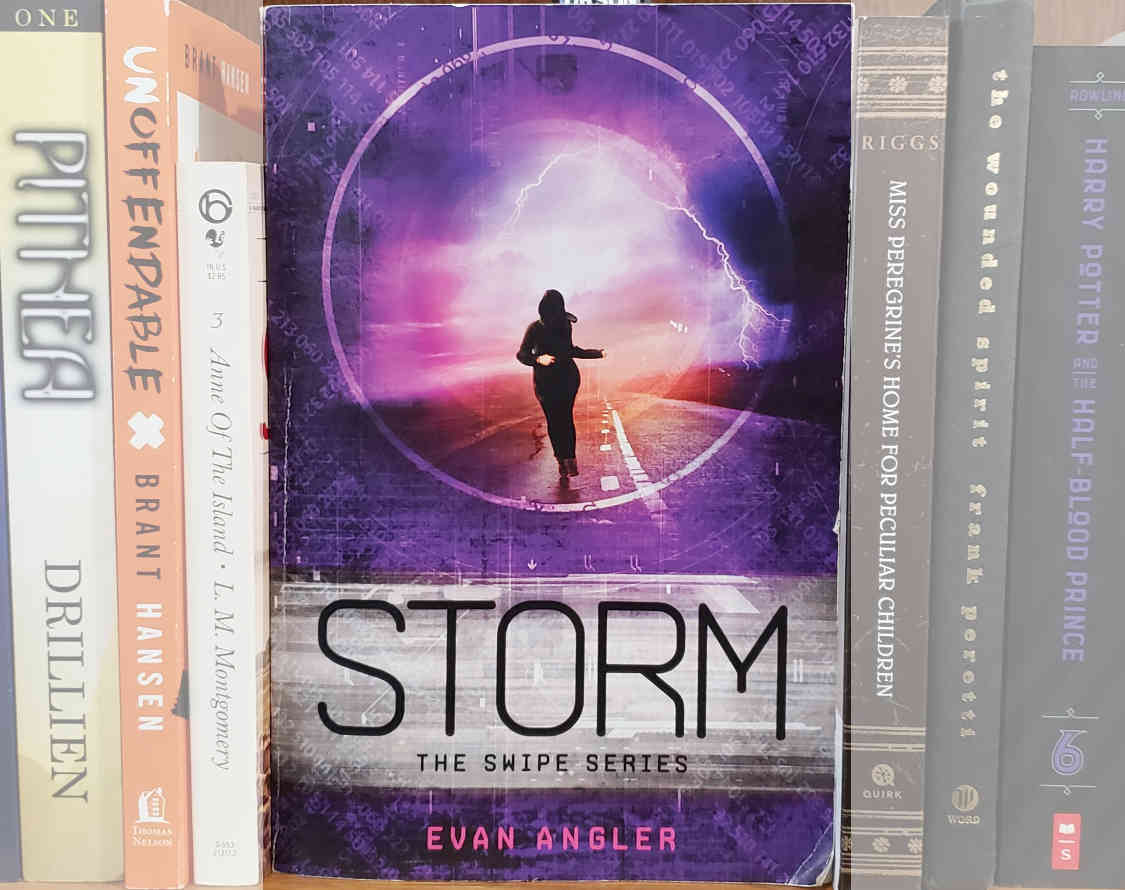
Book Review: Storm

Storm
Swipe #3
by Evan Angler

My rating: 4 / 5
Genre: YA dystopian, Christian

Spoiler notice: The following review will contain some spoilers for the previous books in the series, Swipe and Sneak.

Unwitting leaders of a revolution for those who refused to pledge loyalty to the future global leader, Logan and the rest of the Dust are being pulled in multiple directions. While Logan, Peck, Erin, and Hailey head west to try to save Erin’s life and stop an epidemic, the rest of the Dust have a mission in the capital city of Beacon–continue to protest the leader’s minions while searching for their lost friend. Then Logan’s sister Lily brings him a new mission, as a brewing storm is about to be unleashed.

The continuing saga of Logan and the Dust ramps up in this book. The Dust continue to gain new members and allies, both Markless and Marked. The ending feels like a huge leap off the side of a cliff, but overall, the book was engaging.

In the first book, I really disliked both Tyler and Eddie. I know they’re kids, so of course their immaturity would be expected. But it’s taken to such an extreme, it just bugs me. I like both of them so much more in this book, even though they’re still goofy and immature. It’s like it has a purpose now.

There were a few oddball things that happened in the book, like horses showing up out of nowhere when two of the characters were traveling via the River, or a teenager being walked to the scene of his parents’ death, even to the point of them showing him their dead bodies. I just don’t know why the sheriff would do that.

By the end of this book, I had come to realize that Evan Angler is a pen name, considering that it turns out he’s actually a character in the book. I truly don’t understand why the author chose this plot device, though, as so far, it doesn’t add much to the book. I think that perhaps this could have been more fully utilized by having a narrator that was more connected to the reader throughout the series. I’ll be curious to see if this is expanded on in the next book though.

This story has really come into its own by this book. It’s uncommon, at least in my experience, for Christian end-times fiction to come in from this angle, as there’s very little in the way of Christianity even still now. One character did express his faith a bit more in this book and then left on some kind of pilgrimage, which I’m sure will come into play more in the next book. It did become clear in this book that the rapture had happened in the past though, which I’d been curious about. I’m not too optimistic about the next book, given reviews I’ve read, but I’m going in with an open mind, because I’ve disagreed with reviews plenty of times before. At this point, I’d still recommend this book to those who enjoy end-times fiction and YA books.

Find out more about Storm

See what I’m reading next.

If you’ve read this book, or read it in the future, feel free to let me know what you think!

Book Review: The Outcast

The Outcast
Summoner
Trilogy prequel
by Taran Matharu

My rating: 3.5 / 5
Genre: YA fantasy

Outcast

Spoiler notice: The following review may contain some spoilers for the books in the trilogy, The Novice, The Inquisition, and The Battlemage.

In a land where only children of noble birth have the ability to summon demons, Arcturus, an orphan and stable boy, accidentally becomes the first common summoner. He is drawn into a political battle that threatens his life and the lives of those noble-born students he is studying alongside. He’ll have to choose between his fellow commoners or his fellow summoners.

On its own, this book was intriguing and exciting with good world-building and some engaging characters. However, as a prequel, it had some issues–namely too much repetition from the original trilogy and too many characters in common.

The first third or so was especially had a lot of similarities to the first book in the series. A commoner unintentionally summons a demon, is whisked away to Vocans, the summoner school, and is snubbed by some, but not all, of the nobles while being far friendlier with the servants and “lower” races than most other humans. Even some of the early explanations of how spells work felt repetitious.

Prince Harold in particular I really liked in this book. And Captain Lovett as a teenager was quite the fun and rambunctious character too. However, while it was kinda neat to see characters in this book that were in the trilogy, or were parents of characters in the trilogy, when all of these characters who we know are alive years later are put into peril, there’s no question of whether they will survive or not. Though I will say that, for me, this didn’t mean there was no suspense. There was still some danger, but it wasn’t as exciting as it could have been.

As for Arcturus himself, who is very similar in personality to Fletcher from the trilogy, when I was reading through the trilogy, I really liked Arcturus. And when I saw there was a prequel about him, I expected there to be a lot more of him in the last half of the trilogy than there ended up being. In the end, perhaps he wasn’t the best choice for the subject of a full-length prequel novel. Yes, he was the first common summoner, which was mentioned in the trilogy but made for a decent story on its own. But from what I understand, Matharu had already written a shorter story of his origin, and then later turned that into the full novel. But the story wasn’t far enough removed, and the time it took place wasn’t long enough before the trilogy, for this to work all that well as a prequel.

I wonder if it might actually work better if this book were to be read before the trilogy. I can’t guarantee that there wouldn’t be some world-building that was lacking in the prequel, because the reader is expected to know the world already, but I didn’t really think that was the case. Whether or not someone who has read the trilogy absolutely needs to read the prequel before calling this series complete, I would say…it’s a toss-up.

Find out more about The Outcast

See what I’m reading next.

If you’ve read this book, or read it in the future, feel free to let me know what you think!

Book Review: Star of Persia

Star of Persia
by Jill Eileen Smith

My rating: 4 / 5
Genre: Biblical fiction

Esther

When the queen of Persia refuses an unreasonable demand of King Xerxes, she is banished. Jewish girl Esther, known as Hadassah for her first fifteen years, is one of many unmarried women who are brought to the palace to contend to be Xerxes’s next wife. Made queen in place of Vashti, Esther and her adopted father Mordecai have to navigate palace politics and eventually, it’s up to Esther to save all of her people from extermination.

Though the Biblical account of Esther is commonly known by most who would read this book, I liked the way the author brought it to life. The struggles that those would have faced due to the politics, culture, and religions of that day were not glossed over. It’s common, and even somewhat necessary, for the author to take creative license in some areas, as not all details are ever known in a Biblical account, and while I didn’t necessarily agree with everything the author chose to do, I don’t think any of it detracted from the story.

I loved the way that Mordecai, who had chosen to stay in Susa when the Jews were allowed to return to Jerusalem, struggled with his decision to keep his heritage a secret. We all know that even the most prominent figures in the Bible (besides God himself) were flawed humans, some more than others, and that is clear with the two main Jews in this book as well. I also think that the way Xerxes was portrayed was realistic, considering that he does often consult others, even his servants, in the Biblical account, so his character in this book was fleshed out from that perspective, and I loved it.

As I mentioned above, I disagree with one main point the author decided on. It is not immediately evident who King Ahasuerus is in the Biblical account, due to language differences, I believe. He seems to be most commonly accepted to be Xerxes. However, Xerxes has only 1 verified wife–Amestris. I did not do nearly as much research as Smith must have for this book, but I see more evidence that Amestris is another name for Vashti, or even possibly for Esther herself. So having a rival wife that is actually directly or indirectly behind much of the shady things that happen in the account seemed unnecessary to me. However, it did provide more intrigue for the fictional version, and while I would have chosen a different route, I respect her decision and am not saying whatsoever that the book was any worse for it.

I would say the writing itself was what mainly detracted from the story for me. I personally think there was at least one POV too many. The story was told from the following perspectives: Esther, Mordecai, Xerxes, Vashti, Haman, and Amestris. If I’m missing one, I wouldn’t be surprised. But I think we could have done without getting to know Vashti, considering what her parts set up aren’t resolved. And she’s just a shadow of the true heroine anyway. There are also a couple of things that happen with Haman that confused me, like him grumbling about his wife and her back-talk, when the entire rest of the book, she seemed nothing but supportive to me, giving him advice that he followed. He even called her wise at one point. Then suddenly, he’s about ready to punish her if she opens her mouth again. I don’t know what was going on there.

Overall, I enjoyed this book a lot. I am one who tends to read romance (not just romance in the traditional sense) into certain accounts in the Bible as I’m reading, and it’s nice to see it come alive in this way. I will likely re-read this someday, but first, I plan to check out Smith’s take on Ruth, which is my favorite book in the Bible. As for Esther’s story, though, I highly recommend it to fans of Biblical fiction.

Thank you to Netgalley and Revell for providing me a copy of this book to review.

Find out more about Star of Persia: Esther’s Story

See what I’m reading next.

If you’ve read this book, or read it in the future, feel free to let me know what you think!