Book Review: The Cat Who Saw Red

The Cat Who Saw Red
Book #4
by Lilian Jackson Braun

My rating: 5 / 5
Genre: Cozy mystery

Former crime reporter Jim Qwilleran starts a new diet just before he’s made the newspaper’s first ever gourmet reporter. In typical Qwill fashion, he immerses himself in the culture by moving into a boarding house where the owner is a gourmet chef and requires all boarders to have some sort of connection to food. Part of the reason for moving there (okay, maybe most of the reason) is that Qwill’s old flame lives there, and when she disappears, he starts to question if foul play is involved. Still, she’s always been flighty, as Qwill knows well enough. Then a houseboy vanishes, and Qwill kicks his investigation into high gear.

My experience with this book is probably a bit tainted by the fact that I’ve read it before, many years ago. It’s actually one I remember most from whichever ones of this series I read when I was younger. So that being said, I really liked the story and the mystery, even though I was pretty sure I knew what was going on the entire time. Because even with that past experience, I couldn’t quite decide for sure if my theory was correct or not. In the end, the mystery was interesting and maybe even a bit more sensational than normal for this series.

I always enjoy the antics that the cats get up to, and this book was no exception for me. Qwill even has a bit of a scare involving them, and it’s very touching to see his reaction. One particular side character amused me quite a bit too, even down to a comical description of the car that he drives. I only wish there would have been more of him. Overall, this was an entertaining read that I do believe beat out the previous to be my favorite in the series so far. I would recommend this book for fans of the classic whodunit & cozy mystery genres.

Find out more about The Cat Who Saw Red

See what I’m reading next.

If you’ve read this book, or read it in the future, feel free to let me know what you think!

Book Review: The Orchard House

The Orchard House
by Heidi Chiavaroli

My rating: 3.5 / 5
Genre: Christian drama

After a difficult childhood, Taylor is adopted by her best friend’s parents. But sisterhood is not all it’s cracked up to be, and Taylor ends up leaving home at 21 with the determination to never see her family again. However, when informed 18 years later that her adopted mother is going through treatment for cancer, she returns home. But what starts as a brief visit turns into something more as old wounds are re-opened and this make-shift family struggles to make sense of present struggles. That’s when Taylor and her sister stumble across a story that captivates them and helps distract from real life. In the 1860s, the death of a soldier sparked a friendship between the soldier’s sister, Johanna, and Little Women author Louisa May Alcott. This friendship, and the life and marriage of Johanna, were hidden away for 150 years, to be discovered by Taylor and Victoria just when the story could most affect their lives.

I spent the first half of this book uncertain about a lot of it. Two different storylines had to be established–both the past and the present–and the present one covered several years in a few chapters. Even when the story slowed down and started unfolding in the present day, I struggled to get into it. Taylor’s adolescence had turned her into a confused, broken woman, and she essentially second-guessed her decisions, thoughts, emotions, and reactions every step of the way. And I questioned often what the past storyline had to do with the present one. It was a slow build, to be sure. It did pick up in the second half, but for a while, all I could think about was how terrible each of the characters seemed to be, in one way or the other.

The main thing that I really liked about the story was the way the Christian message was presented. While some reviewers found it “too religious,” I spent at least half the book wondering how on earth this had been labeled as Christian. But the slow build I mentioned earlier can also be applied to the way the main characters learned to first believe in and then trust in Someone bigger than themselves. Though in the end, I felt the “conversions” and overall Christian message were a little light, I still liked the way they shaped up.

There were some things in the book that confused me, and I re-read some passages more than once trying to understand. As an example, Louisa was said to have 2 sisters, but over the course of time 3 were mentioned–Anna, Nan, and Amy. However, Anna and Nan were the same person, and while the author did seem to realize we needed that explanation (I certainly did), it didn’t come until after the sister was referred to by both names at least once. There are other things that confused me too, but fortunately there was less of this in the second half too.

I think that people who love Louisa May Alcott’s books, or at least have read one or more of them, might enjoy this book. Though Louisa herself is only a small part of the story, her books and lasting effect on future fans are prevalent themes. I’ll admit to having a different view of a particular aspect of Little Women than the author (or at least than the main character), but as fiction, it’s certainly open to interpretation. If you’re looking for a light Christian read, this is not it. It’s full of drama and covers some dark topics such as abandonment, abuse (both physical and emotional), and betrayal. If you like time-split novels and stories about finding “home” or families trying to piece themselves back together, you might enjoy this book.

Thank you to Netgalley and Tyndale House Publishers, Inc. for providing me a copy of this book to review.

Find out more about The Orchard House

See what I’m reading next.

If you’ve read this book, or read it in the future, feel free to let me know what you think!

January in Review

I read 12 books last month, which is on the high side for me. Though I do think my monthly numbers should be a little higher overall from here on, since I’ve started listening to a few audiobooks a month. I’m glad I managed to figure out how to make use of idle time and which types of books work best for me in audio format!

Here are the books I read in January:

Maus by Art Spiegelman (5 / 5)
The Return of the King by J.R.R. Tolkien (4 / 5)
A Noble Masquerade by Kristi Ann Hunter (3 / 5)
The Thousand-Dollar Tan Line by Rob Thomas & Jennifer Graham (4.5 / 5)
The Haunting at Bonaventure Circus by Jaime Jo Wright (2 / 5)
Poppy Redfern and the Midnight Murders by Tessa Arlen (5 / 5)
Anne of Ingleside by L.M. Montgomery (4 / 5)
The Warden and the Wolf King by Andrew Peterson (5 / 5)
There I Go Again by William Daniels (5 / 5)
Mr. Lemoncello’s Library Olympics by Chris Grabenstein (4 / 5)
When Twilight Breaks by Sarah Sundin (4 / 5)
Little Women by Louisa May Alcott (5 / 5)

This list includes 2 ARCs and 2 re-reads. My favorite book from January was There I Go Again. I finished 2 series, continued 2 series, and started 3 (short) series. My ever-changing short list of to-be-reads, as well as a flag for the book I’m currently reading and an ongoing list of those I’ve read and posted about can be found here.

*One of the re-reads involved listening to the author read a few chapters of his book every night live on Facebook/YouTube to beat the quarantine blues. I count it the same as listening to an audiobook.

I’m also keeping my Goodreads page updated with a more extensive list of to-be-reads. Despite my almost too-long TBR list, I’m always looking for more to add. Feel free to offer suggestions of your favorites or just recent reads you enjoyed.

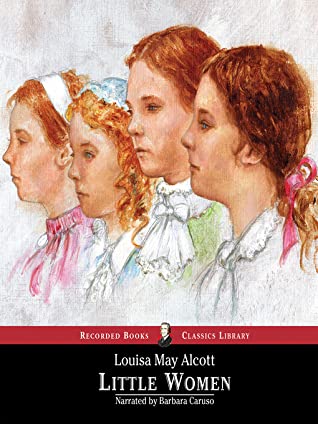
Book Review: Little Women

Little Women
by Louisa May Alcott
read by Barbara Caruso

My rating: 5 / 5
Genre: Classic children’s/YA coming of age

This is another classic that I had never read before, but have seen a movie or other adaptation of more than once in the past. In this case, I’ve only seen the 1994 movie with Winona Ryder as Jo, though I have seen it more than once over the years. I also did read the Great Illustrated Classic adaptation with my daughter just over a year ago, but this was my first time reading the full, unabridged version, technically listening to the audiobook. Be aware, there will be spoilers in this review, so read on at your own risk.

One of the things that struck me the most about the full story is how much these sisters thrive in their environment. This is a time period where women are oppressed and kept in their place, and while at some times this makes tomboy Jo unhappy, she doesn’t have to completely rebel in order to make some inroads and even do what she wants to do. In fact, most of what gets in her way as a writer is her own ideas, plans, hopes, dreams, failings, and attempts to be a better person. In modern times, we if we want to write historical fiction where women aren’t just stuck in a box, they are often wild and outrageous (but at least they manage to meet that one man who’s okay with the woman who refuses to wear a dress or attend any formal functions). I think that’s one of the biggest things I love about Jo.

I also really like the fact that most of the way through the story, the March sisters are striving to better themselves. They are quite poor, but vow to be happy with what they have and avoid grumbling, even as they allow themselves hopes for the future in which they find wealth in one way or the other (different for each girl). And though I speak generally, Beth is usually perfectly content with what she has. Speaking of Beth, how well did I relate to that quiet, shy girl. Even too scared to go to the neighbor’s house who’d extended an open invitation so she could exercise her talent on his piano…that would definitely be me.

I loved the references made to Pilgrim’s Progress in the first half of the book, which plays a lot into what I mentioned above, about the sisters trying to be happy with what they have and be good “pilgrims.” I’ve never read Pilgrim’s Progress, though I’ve always thought I should (tried once, but I’m really not good at sticking with books that are hard to read), and now I wish I had. The reference back to the pilgrims and the game the sisters played when they were younger, shortly before Beth’s death, made the tragedy of her death all the more emotional to me.

On probably the most disputed point of this book, though I never lamented over the fact that Jo rebuffed Laurie, it did always seem strange to me that he ended up marrying little Amy. However, after reading this book, I think Louisa May Alcott did a fine job setting up the ways the various romances went. I could certainly see that Jo had no romantic feelings for Laurie and had good reason to think that they wouldn’t have a very pleasant marriage. And when Amy was still young, a connection grew between her and Laurie that paved the way for their love later. Jo’s feelings for Professor Bhaer came very naturally, and it was easy to see why she fell in love with this mature man of integrity and morals.

Before I wrap up, I want to say a few words about Barbara Caruso, the narrator of the audiobook I listened to. I haven’t listened to many audiobooks and can really only listen to certain types of books that way, since my mind tends to miss details if I’m not careful. Also, like many others I’m sure, the narrator can really make or break my enjoyment, and I’ve discovered that I’m really picky about it. Which is why I’m really glad that this is the narrator I listened to for this book, because she did a fantastic job! I really liked how she brought the characters to life and even managed to have slight differences between the sisters. Her reading of foreign words or sentences (French and German) and accents for characters like the German Bhaer are incredible. I will definitely look for her when I listen to other books that she has narrated.

Find out more about Little Women

See what I’m reading next.

If you’ve read this book, or read it in the future, feel free to let me know what you think!

Book Review: Mr. Lemoncello’s Library Olympics

Mr. Lemoncello’s Library Olympics
Mr. Lemoncello’s Library book #2
by Chris Grabenstein

My rating: 4 / 5
Genre: Children’s adventure, mystery

Spoiler notice: The following review will contain some spoilers for the first book in the series, Escape from Mr. Lemoncello’s Library.

After their big win in Mr. Lemoncello’s escape game, Team Keeley is challenged by basically every kid in the country. They all want their chance at stardom (starring in commercials for Mr. Lemoncello games) and are unhappy that the contest was so localized. So Mr. Lemoncello grants them their wish, because hey, that means he gets to create more games! The top teams in each region of the country are chosen and invited to Ohio to compete for full college scholarships–against Kyle’s team. The only problem is that Kyle isn’t so sure he’s up to the challenge this time.

After the pure fun I had with the first book, I knew this wouldn’t be able to be quite the same. For one thing, it’s not so much with the escape room aspect anymore. There are puzzles involved in the games, but it’s not nearly the same as it was in the first book. However, it’s still a fun read, and even has a bit of mystery. So while I didn’t quite enjoy it as much as I did the first book in the series, it was still good.

For all the similarities to Willy Wonka in the first book, this had even more. Including a particular bit that I guessed at from early on, comparing a character to a role in Roald Dahl’s book. Even still, though, the book did keep me guessing a bit as I waited to see if I was right. And unlike the “justice” in Wonka’s world, it’s nice to see some of the “bad” kids have a change of heart by the end of this book.

In my review of the first book, I mentioned that it was unrealistic how much knowledge some of these kids have–Kyle is about the only one who doesn’t come across like he lives and breathes books and studying. That was much more noticeable this time. Still overall, it’s a good book, fun for kids, and I continue to recommend it for kids around 8-12 and for parents, especially those who like games.

Find out more about Mr. Lemoncello’s Library Olympics

See what I’m reading next.

If you’ve read this book, or read it in the future, feel free to let me know what you think!

Book Review: When Twilight Breaks

When Twilight Breaks
by Sarah Sundin

My rating: 4 / 5
Genre: Christian historical romance

Americans living in Germany in the late 1930s had front-row seats as the country sped toward war. Evelyn Brand is a foreign war correspondent living in Munich, her hands tied as a woman in a man’s world. Or maybe there’s more than just her gender causing her boss to edit her stories to death. Peter Lang is a graduate student working on his dissertation and teaching American students how to speak the German language more fluently. He sees the benefits of the current German regime, as he values the order it brings to a country once chaotic and destitute. But he soon learns the price that this order demands.

I really wanted to give this book 5 stars while I was reading it. For the story alone, it’s worth 5–the characters are engaging, the romance well-done, and the suspense is pulse-pounding. I sped through the book compared to my normal speed, wanting to see what the outcome would be. And the ending did not disappoint, wrapping up all storylines satisfactorily. But I had a few issues while reading it, and I felt they were worth a point detraction and that others should know about some of them.

The book made me a little uncomfortable or caused me to blush a few times in the second half with descriptions of physical or visual contact between the main characters. Nothing graphic by normal standards, really just skirting the line of what I am okay with in a Christian book, but I think there are some who would prefer to be aware of this in advance. The romance was overall well done and while certainly a big part of the story, not so in-your-face like most with the tag of romance. I liked it, but it was just a little descriptive here and there.

There were a few issues with perspective–in a book like this that has established the alternating perspectives between two characters, only changing when there is a scene or chapter break, a couple of times the perspective changed from one to the other mid-scene, which was jarring. Also, characters were speaking German, while we were reading it in English, yet the author continually sprinkled German phrases into the dialog. They were never more than I could understand from my years of German in high school and a little in college (except a few times that were also basically translated for us), but they were unnecessary given the context. Maybe they were just supposed to remind us that the characters were speaking German without having to constantly state it in the narration, but I personally would have preferred the simple reminder now and then.

Back to the positives, because I so loved the characters and story, I found Peter’s starting viewpoint about the Nazi regime enlightening, as it shows how it’s possible for intelligent, moral people to be pulled in by a bad ideology. His history, both personal and as it relates to Germany, as well as his position in the country at this time, allow him to see the positives…at least for a while. I also loved some of the side characters, the way the Americans’ lives overlapped with the Germans’, and the fact that the bad guys weren’t only the Germans.

All in all, I thoroughly enjoyed this book. Even with the few issues that I noted, I kept coming back to it in the last half, unable to put it down more than necessary. I’d previously read the Sunrise at Normandy trilogy by Sarah Sundin and loved it, so I’d say Sundin is effectively on my instant-read list. I definitely recommend this book to anyone who likes historical fiction from this time period in the Christian romance genre.

Thank you to Netgalley and Revell for providing me a copy of this book to review.

Find out more about When Twilight Breaks

See what I’m reading next.

If you’ve read this book, or read it in the future, feel free to let me know what you think!

Book Review: Anne of Ingleside

Anne of Ingleside
Book #6
by L.M. Montgomery

My rating: 4 / 5
Genre: Children’s/YA classic

See my review for book #1, Anne of Green Gables.

After watching Anne grow up and become a wife and mother, this book chronicles several years of motherhood, with an eventual six children. Like many of the other books in this series, there’s not exactly a single plot to the book, more a series of vignettes about the children’s antics and some of Anne’s own activities. Some of her children are a lot like her, fanciful and whimsical, and in some ways, it was like seeing Anne as a child again.

It was interesting, and I’m not entirely sure how realistic, that so many of her children’s scrapes led them to be outside on their own at night. I really felt for some of them, considering the ways they tended to let their imaginations run away with them. I can remember being a kid and not fully understanding what was going on, and that leading me to be scared, unhappy, sad, etc. when I probably didn’t need to be.

I did not care at all for Aunt Mary Maria, which I’m sure was intentional, but when she had the audacity to tell one of the kids, as they were about to leave home for 2 weeks, that if he was naughty, a man would grab him up in a big, black bag, I couldn’t believe it! And this after scoffing at one of the other kids for still believing in Santa, which is such hypocrisy. I don’t care what generation you’re from, you wouldn’t get away with scaring my kids like that.

I liked seeing some of the characters back from previous books, and overall, I didn’t mind that Anne had grown up so much. It wasn’t my favorite of the sequels (that honor goes to the previous, Anne’s House of Dreams), but I still liked it a lot. It’s the last book in the series proper, and I may someday read the final two books, but for now, I think I’ll stop here. When I re-read Anne of Green Gables in the future, I may skip past the next few and only re-read books 5 & 6. I’m just not a huge fan of the rest.

Find out more about Anne of Ingleside

See what I’m reading next.

If you’ve read this book, or read it in the future, feel free to let me know what you think!

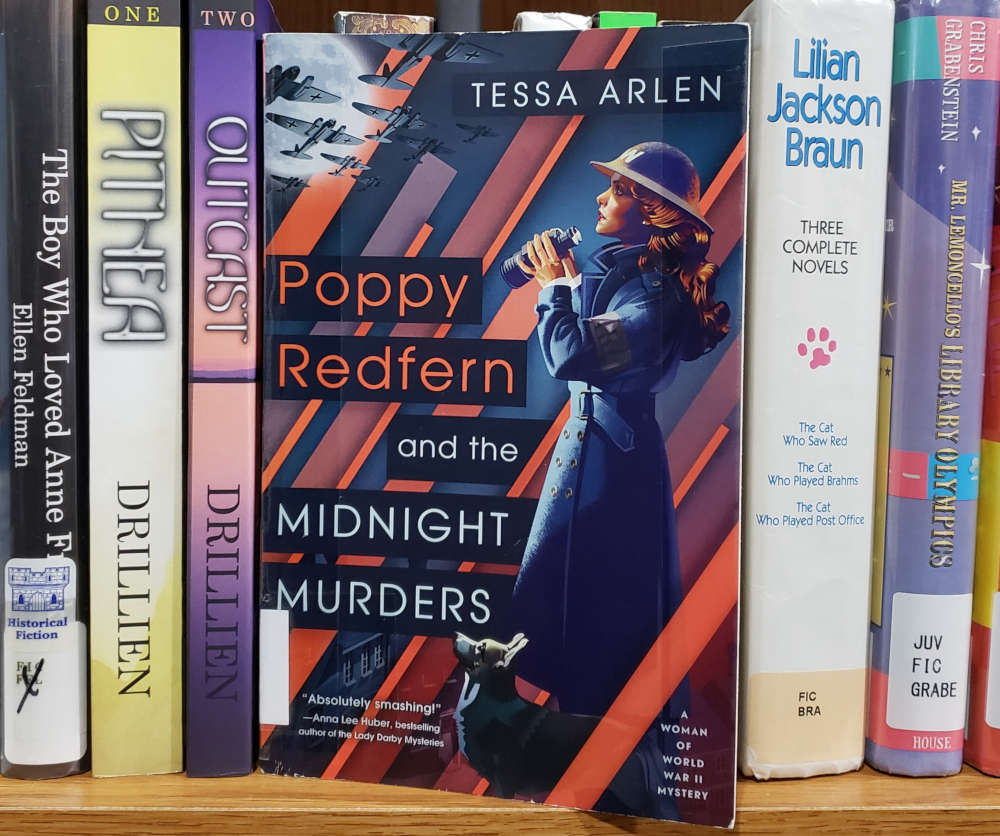
Book Review: Poppy Redfern and the Midnight Murders

Poppy Redfern and the Midnight Murders
A Woman of WWII Mystery #1
by Tessa Arlen

My rating: 5 / 5
Genre: Historical cozy mystery

Newly trained Air Raid Warden Poppy Redfern takes up her post in the small English village of Little Buffenden, where an American Air Force airfield is about to open. The airfield could make this otherwise quiet hamlet a target for an air raid, but the Germans aren’t the only danger to Little Buffenden; trouble is much closer to home when two women are murdered only days apart. When suspicion is cast upon the Americans at the airfield, distrust for the “friendly invaders” surges in Little Buffenden. Poppy begins to investigate while continuing her duties as warden and trying not to end up as the next victim.

This book was all sorts of great! The descriptions made the story come to life, and though there were quite a few characters from the village and neighboring airfield involved, the author did a great job of helping me keep them all straight as I got used to them. Poppy had a wonderful mixture of spunk, loyalty, compassion, and intelligence, with a little quirk thrown in (it’s not that strange to have the main character of the novel you’re writing pop into your head with observations or admonitions now and then…or so I’ve heard).

I really liked the feel of this small town in 1942 England, where they’ve been at war for much longer than their American allies, not to mention more directly affected. The things the Air Force men take for granted, like having sugar and beef readily available, were luxuries to the locals. The attempts made by Poppy and her grandparents to help their fellow villagers see the Americans in a different light showed the great wisdom of this family. And though there are some bumps along the way that were a little frustrating, the American pilot that works with Poppy, Griff, was one of my favorite characters. Also, I’m not a dog person and don’t normally care much about dogs in fiction, but Bess was pretty great.

I would classify this as a cozy mystery–it has all of the earmarks. I had guessed who the murderer was much earlier than I normally do, but I wasn’t quite certain, and the reveal was still done really well. However, the book does probably have a little more description of violence and disturbing images than you’d normally find in a classic cozy mystery. That’s not to say that it’s very much–it didn’t bother me at all, and I don’t have a very high tolerance for some of that kind of thing–but enough that I thought it was worth mentioning if I’m classifying it as “cozy.” All in all, I thoroughly enjoyed the experience this book provided and would recommend you give it a try if either of the genres interest you. There’s a second book in the series so far, which I’m looking forward to reading.

Find out more about Poppy Redfern and the Midnight Murders

See what I’m reading next.

If you’ve read this book, or read it in the future, feel free to let me know what you think!

Book Review: The Thousand-Dollar Tan Line

The Thousand-Dollar Tan Line
Veronica Mars #1
by Rob Thomas & Jennifer Graham
read by Kristen Bell

My rating: 4 / 5
Genre: Mystery

Picking up soon after the Veronica Mars movie, which in turn is set about 10 years after the same-name television show, we have a brand new, stand-alone mystery. During Spring Break in Neptune, two young women go missing from the same house, on different nights. Veronica is hired to look for them, but she doesn’t expect to be confronted with a face from the past. With the help of some old friends, Veronica is determined to find the missing women. But will she be too late?

As one who has seen the show several times, this is just about everything I’d want from a book continuation. The only real downside is that a book can’t span as long of a time as an episodic show does, and so the mystery, characters involved, and side plots can’t be developed like they were in the show, which is what made each larger mystery (i.e. each season) have such a big punch at the end. However, the rest of what I love about the show is here–Veronica’s wit and sass, Keith’s very existence, a twisty plot with a dangerous conclusion, and a whole cast of friends and frenemies to help or hinder Veronica.

For Veronica Mars fans, I would say this is definitely worth a read. And I highly recommend the audiobook, as it is narrated by Kristen Bell herself, which notches the whole thing up to as close to a life-action show/movie as you can get, especially considering that the show is narrated by Veronica along the way too (though this is in 3rd-person, a minor detail). And Kristen Bell does a spectacular job with the voices of her once-co-workers. For one who has seen the show a lot, it’s so easy to hear Wallace, Keith, Mac, even Cliff coming out of the “pages.”

If you haven’t watched any Veronica Mars but are interested in this book, I would first ask why you’re not just starting with the show. But as for whether or not you’d enjoy this book or if you’d be lost, it’s hard to say from my perspective. Things that happened in the movie months before that affect the book are explained well enough, I think, but that also means the movie is spoiled in some parts. I do think that some of the larger characters are represented well enough for a newbie to get a feel for them, but smaller ones, like Weevil, definitely shine more if you already know them. That’s not a fault with the book, though, because he’s simply a smaller character in this story. So if you’re interested at all, I’d recommend the show first (the first 3 seasons), then the movie, then this book and its follow-up, which I haven’t read yet but will. And then maybe the 4th season…maybe.

Find out more about The Thousand-Dollar Tan Line

See what I’m reading next.

If you’ve read this book, or read it in the future, feel free to let me know what you think!

Book Review: The Haunting at Bonaventure Circus

The Haunting at Bonaventure Circus
by Jaime Jo Wright

My rating: 2 / 5
Genre: Historical suspense

Pippa, 1928 – Daughter of circus workers, abandoned and raised by the owner’s family, Pippa is now considered “circus royalty,” above the grit and grime of the circus, yet still feels like she belongs down in the community. Pippa has felt a presence nearby all of her life, watching her, protecting her, calling to her. When The Watchman, as she calls him, begins to step out of the shadows, Pippa will have to decide who to trust.
Chandler, present day – Niece of the new owner of the old circus train depot, Chandler is tasked with determining if the building is a candidate for renovation or if it should simply be demolished.
When the ghosts of the circus’s dark and foreboding past threaten Chandler in the present, she finds herself digging into the story of a serial killer who preyed on the circus in the past. But even in the present day, there’s a very real danger that leads Chandler to be uncertain of who she can turn to.

I had a very difficult time reviewing this book. The idea of an old-fashioned circus as the setting/backdrop, solving a bit of a mystery in the past that connects to the present, it all sounded really intriguing. And though the title certainly doesn’t scream Christian fiction, it’s billed as such. However, there is so much about this book that I struggled with, and in the end, I just don’t understand how it was released like this. I’m going to try to sort out my thoughts in sections below, to at least attempt to keep this review coherent.

Story – The past storyline on its own was decent, if a little muddled. The question of who The Watchman was and what he wanted from Pippa definitely kept me going throughout the book. There was not nearly as much exploration of circus life as I expected, as much of the story takes place in Pippa’s family’s house or in the elephant house, where Pippa is helping to care for an injured baby elephant. But that story on its own was pretty good, from beginning to end.

However, I found the present-day storyline completely pointless. I thought that, as the reader, some of the answers of the past mystery wouldn’t be revealed there in the past, but would come to light when discoveries were made almost 100 years later. I was wrong. It was basically an entire story in itself, with the past storyline a somewhat unnecessary background. And I didn’t like the present-day storyline at all. Seriously, Chandler just needed to put surveillance cameras in the buildings and that would’ve solved an awful lot of her trouble.

Characters – There’s an interesting dynamic between the two main characters. Chandler is fiercely independent, and Pippa is fiercely subordinate to all of the men in her life, even the one in the shadows, obeying his every secretive whim. And this is something the book did mostly well with, as both of these women found their way to a more neutral stance, allowing themselves to breathe a bit and have a bit more freedom. Overall, though, Chandler just drove me crazy. She had some issues that weren’t necessarily unrealistic, but man was she hard to like. In some ways, I felt like the only reason the author included her part of the story at all was so that she could create Chandler, who was perhaps a reflection of the author herself.

One glaring coincidence that I’m surprised more people aren’t bothered by is that both storylines have practically the exact same male romantic interest. They were both large, well-muscled, gruff, brooding men with long hair/beard, and even had the same basic goal driving them. Their names were even similar (Jake & Hank). The author even set up a really easy explanation for this coincidence, but then quickly shoved it aside and let it be just that–pure coincidence.

Writing – I don’t know who edited this book, but it needed a little more work. There were some strange inconsistencies here and there. For example, right from the first chapter, I got the feeling that Pippa was already accepted within the circus and its workers. It mentioned her dear friends in the circus, even listed them by name. Then we proceed through the story to find that most of these people she barely knows. Barely has met. Some of them barely acknowledge her or don’t like her (she’s “above” them, after all). If this was simply meant to show us that Pippa is delusional, imagining these people as her friends because she’s lonely, that never came across to me. Instead, I found myself wondering if the story was written out of order.

Additionally, Linda Pike is said to have disappeared when she was 12. Then later it says she went missing at 18. And I noticed an observation that Pippa made about Jake regarding how good he looked smoking a cigar that was then repeated, almost word-for-word, a few chapters later. There are others, and these aren’t tiny typos, but fairly noticeable mistakes, so many that it took me out of the story quite a bit.

Genre – Now for the thing that bothered me the most throughout the book. It’s listed as Christian fiction, and I’m not sure who decided that was a good idea. I get that for Christian authors, it can be difficult to find a good middle ground sometimes. You don’t necessarily always want to write a book where there’s a solid Christian message, but if you include any Christian talk, it’s deemed too religious to be secular. But wow, the characters were so incredibly confused about their own faith that it could easily leave a reader confused too. I think that if you’re going to write a book where there’s a hint that ghosts and hauntings might be real, and call it Christian, you should definitely come down on one side or the other about whether or not it was a real haunting. At least that way Christians who read the book can agree or disagree. But the “supernatural” events in the present day were really never explained, more just “hand-waved” away at the end. I was left feeling incredibly unsettled (not because it spooked me, but because it was so unpleasant), and I don’t think I’ll read another book by this author.

I don’t read only Christian books, and I don’t necessarily expect every book by a Christian author or in the Christian genre to have a solid Christian lesson or message. But to call it Christian and have one of your main characters this confused over what the Bible even says about what’s going on, or whether or not she should let a psychic contact the spirit world on her behalf, because maybe the psychic was sent by God and Chandler was wasting the opportunity because of a Sunday school lesson (wow!)…to me, this is not a good message anyone should be reading.

Thank you to Netgalley and Bethany House for providing me a copy of this book to review.

Find out more about The Haunting at Bonaventure Circus

See what I’m reading next.

If you’ve read this book, or read it in the future, feel free to let me know what you think!