Book Review: The End of the Magi

The End of the Magi
by Patrick W. Carr

My rating: 4 / 5
Genre: Biblical historical fiction

Myrad is the adopted son of a Hebrew magi in ancient Persia. After having a dream of a star in the sky that didn’t move throughout the night, Myrad is brought into the order of the magi, just in time for a massacre. Barely escaping, Myrad now must outrun his pursuers while also attempting to discover the meaning of his dreams about the star and the prophecy of the Hebrews Messiah that his father taught him about.

With Christmas looming, I loved the idea of reading a book about the advent of Christ from the perspective of the magi that visited Him not long after his birth. This book really hit the spot, easing me into the season. With great characters and some fun relationships, following the star with Myrad was an adventure that highlighted some important Biblical truths.

Myrad himself is a decent protagonist, young and inexperienced, learning everything around him along with us. He has a clubfoot, which gets in his way quite often. Walagash is now one of my favorite characters ever. And the relationships between Myrad and Walagash, Roshan, and Aban are enjoyable to watch develop along the way.

One of the main reasons for 4 stars, instead of 5, is that there was a lot of politics in the book, which is the main thing that caused the story to drag in parts. It does make sense, given the state of the empires in that region at the time. But it wasn’t terribly interesting to read the characters discussing it.

(Warning: the following paragraph contains spoilers.) What I loved most about the book, though, was that it went past the birth of Christ to the real root of Christianity–His death and resurrection. We see the rift form between those Hebrews who believe that Jesus is the Messiah and those who don’t, because he didn’t conquer the Romans like they thought he should (or because he died and they left before his resurrection). And when the magi who stayed in Jerusalem even after the resurrection because they felt there was more for them there got exactly what they were looking for, they left changed.

For me in particular, the book really drove home the importance of trusting that God’s way is the best way, even when we can’t see what He’s doing. It’s a reminder that He can and does use anyone He chooses for his plans, even those people who think that they are worthless–even those people who don’t follow Him. We can only do our part and accept His will in our lives, and in this, we can have peace in stressful times. This has been really important for me lately.

While this book could easily be pigeon-holed as a Christmas book, it is so much more than that. I recommend it for all fans of Biblical fiction. In truth, I think it should be read by anyone who enjoys historical fiction or quest-driven stories, because the message contained within is important and should be heard by everyone.

Thank you to Netgalley and Bethany House for providing me a copy of this book to review.

Find out more about The End of the Magi

See what I’m reading next.

If you’ve read this book, or read it in the future, feel free to let me know what you think!

Book Review: The Dead Girls Club

The Dead Girls Club
by Damien Angelica Walters

My rating: 2 / 5
Genre: Suspense, horror

Heather Cole is a 40ish-year-old child psychologist with a loving husband and a quiet life. Then her life is turned upside-down by the arrival of half of a “Best Friends Forever” necklace in the mail. While the other half of that necklace is safe at her house, she knows this half was last seen on the body of her best friend who died 30 years ago…at Heather’s own hand. What follows is a tale of fear and obsession as Heather tries to find out who sent her the necklace, while having terrifying memories and dreams about her teenage days, when she and her friends tried to summon a witch.

I know that the lower I rate a book, the longer the review tends to be, so I’ll try to be more succinct in this one. Most of what I really want to say is spoilery anyway, so here goes. I really did not like the main character…couldn’t connect with her at all. I also didn’t find the mystery or the twists all that interesting or surprising, and pretty strongly disliked the ending. And the synopsis is very misleading.

The story is told in 2 timelines–the NOW is first-person POV with Heather as an adult narrator. The THEN is third-person POV, but still focuses on teenage Heather. I could not stand adult Heather. She acts like a victim of this mysterious person who is sending her little things that Heather knows were directly related to the night Becca died, but uses this as an excuse to stalk people from her past and treat pretty much everyone she interacts with terribly. By the second half of the book, I would literally groan every time the book went back to the NOW storyline, because it was just so boring. Her obsession with finding out what was going on turned her into a monster. And don’t even get me started on how terrible she became at her job, which just bugged me so much.

I also got to a point by halfway in the book where reading it made me feel kinda skeevy. Heather had a habit of picking at her cuticles when she was nervous and stressed, which of course she was during the entire book. As an author, it is important to give characters quirks, ticks, habits like this to make them seem real, but the amount that her peeling, biting, and scratching at herself enough to draw blood is shown got under my skin (pun intended).

I am surprised I haven’t seen this in any reviews yet, but during the THEN timeline, the teenage girls go into a bit too much detail about their menstrual cycle for my taste, which makes me feel especially bad for any men who read it. There’s just no need for some of what they said to be included in this book…at all.

Now about the horror aspect…I honestly can’t even tell you why I requested a book classified as horror (I told myself that it must not have been listed as horror until later, but I really can’t say if that’s true), because I am really not into horror in general. But I steeled myself for a scary read…that hardly came. The supernatural elements that the book promised were flimsy and constantly explained away by the MC. I think I came to realize at some point that the narrator was very unreliable, which just made me doubt everything that happened in the THEN parts. I also didn’t find the stories about the Red Lady scary. A bit gruesome and over-the-top, yes, but not so much scary. Near the end, the combination of reading the last 25% at night and a decently creepy scene did finally give me some chills, but that was pretty much it. I’m seriously a wimp when it comes to scary things, so that might tell you something about the level of horror in this book. I also wouldn’t really classify it as a thriller, so suspense is the best I could come up with.

In the end, a lot of this probably boils down to personal preference. So this wasn’t a good book for me, but it has plenty of 4- and 5-star reviews. The THEN parts contain some 90s nostalgia that a lot of people will probably enjoy, and the horror and thriller elements will likely hit the mark with plenty of people. So if it seems interesting to you, please be sure to check out others’ reviews for this book.

Thank you to Netgalley and Crooked Lane Books for providing me a copy of this book to review.  

Find out more about The Dead Girls Club
Publication date: December 10, 2019

See what I’m reading next.

If you’ve read this book, or read it in the future, feel free to let me know what you think!

Book Review: The Passengers

The Passengers
by John Marrs

My rating: 3 / 5
Genre: Sci-fi thriller

In a future where self-driving cars are becoming the norm, a mysterious Hacker takes control of 8 different vehicles, each with Passengers inside. These eight people are told that they will likely be dead in just over two hours. The Hacker than forces a jury of 5, alongside the entire world watching from their electronic devices, to decide which one of the eight should be saved.

I was really into this book for for the first 80%, which were parts 1 and 2. If I gave a rating just on that much of the book, it would be a solid 4 stars. Then part 3 came along, and everything just fell apart for me. The writing was good, for the most part, and some of the characters were interesting. Some were major stereotypes, but to be honest, with that many characters, it doesn’t surprise me. But the thriller aspect just died in the last 20%, even with a push to bring it back.

To be honest, the hacking done on the cars might have been wholly unrealistic, but I don’t really care. I’m blessed to be someone who can just enjoy it for what it is, because I don’t really know a lot about software, AI, or electronics in general. It was pretty clear that some of the Passengers were only in the book so that the Hacker could show how serious he was, as the number quickly dwindled from 8 to 5. Each of those 5 Passengers has their secrets, which are unveiled as the Hacker hurtles them to their doom.

While this is happening, the protagonist, a woman named Libby, is one of the 5 on the jury that is being forced to decide these people’s fate. While there were some things that she did that really bugged me, it was a good perspective to watch the events from. The very end of part 2 was a bit confusing to me, and unfortunately, in the mess that was parts 3 & 4, the book didn’t really give a satisfying reason for what happened.

Parts 3 & 4 are messy and mostly unnecessary. They felt like a tack-on, and frankly, soured the mysterious nature of the Hacker. I felt like there were too many attempted twists, and I quickly got to a point where I just didn’t believe anything, which makes it difficult to enjoy a book.

In the end, I am glad I read this book. Enough of it was enjoyable that I would recommend it for fans of sci-fi, especially people who enjoy books that show horror stories about the direction our technology is heading. Because of the many higher ratings this book has gotten, definitely check it out if you think you might enjoy it.

**Side note: One of the characters in this futuristic story mentioned that Facebook peaked in 2020. The idea of this was really funny to me.

Thank you to Netgalley and Berkley Publishing Group for providing me a copy of this book to review.  

Find out more about The Passengers

See what I’m reading next.

If you’ve read this book, or read it in the future, feel free to let me know what you think!

Book Review: The Dinner Party

The Dinner Party
by R.J. Parker

My rating: 2 / 5
Genre: Thriller

Four couples attend a dinner party as friends, but dark secrets are boiling just beneath the surface. A trust game pits husband and wife against each other, and the next day, two of the guests are dead, while the other guests are left to figure out why.

For a book that is meant to be “an addictive and twisty psychological thriller,” it didn’t provide many thrills. If the book had not started with the main character, Ted, fighting for his life, I don’t know if I would have gotten through it nearly as quickly as I did. As it was, I did want to know how it got to that point, but it was quite a chore to get there. And more than once, I got to the end of a chapter and had no real compulsion to continue immediately, like I’d expect to have in a good book, especially a good thriller.

All four of the couples came across dull and lifeless to me–not necessarily as individual people, but in their relationships. Ted and his wife probably showed the biggest spark of life, but that was likely just because he was the main character. As such, I had a difficult time connecting with anyone in the book.

After the first murder victim appeared, most of the suspense seemed to be attempted through Ted questioning things repetitively–like why the victim had died, if the person they’d suspected to be the murderer had really done it, and if “the game” was responsible.

And that brings me to one of my biggest gripes. This trust game that they played was silly at best, yet became far too pivotal in the book. Everyone but Ted basically decided that the police shouldn’t know about it, or they’d all be blamed for the death…I mean, just far too much emphasis was put on this party game. And worse yet, it turned out to be a big part of the underlying cause for everything.

In the end, the reason behind each death was weak and, frankly, boring. I had theories of twisty goodness that would be revealed at the end, but when it ended, and no exciting twists had occurred, I basically was left with my mouth hanging open, and not in a good way. No, I didn’t guess at the motive behind the killings, but that didn’t make it good. A few surprises and betrayals did come up in the second half, especially relating to Ted’s wife, but none of them delivered on the punch they set up.

For those who want to know about how clean a book is before reading–there are no sexual situations and no language whatsoever that I can recall. The violence and bloodshed does get a bit much near the end, but nothing more than I could handle (and my threshold is fairly low).

I really wanted this book to deliver on its twisty promises, but it was unimpressive. It wasn’t terrible, though, and I think there are those who will enjoy it. It just really wasn’t for me.

Thank you to Netgalley and HarperCollins UK, One More Chapter for providing me a copy of this book to review.  

Find out more about The Dinner Party

See what’s coming up.

If you’ve read this book, or read it in the future, feel free to let me know what you think!
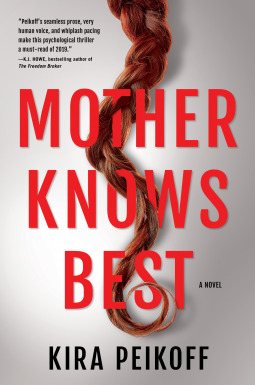
Book Review: Mother Knows Best

Mother Knows Best
by Kira Peikoff

My rating: 3 / 5
Genre: Drama, suspense

Eleven-year-old Abigail has a semi-normal life, except that her parents (especially her mom) are reclusive, she has absolutely no extended family, and she’s not allowed to have a smartphone or social media like her friends. She discovers through a DNA mapping site that she actually has a lot of distant relatives and even tries connecting with one, which she thinks will make her parents happy. It has the opposite effect. This sends her mom into an emotional tailspin, and before long, her life begins to unravel. Then she finds out that her parents are not who they claim to be, everything they’ve been hiding from is revealed, and it turns out that the danger is very real.

I had my ups and downs with this book, and wasn’t sure what to rate it, even while writing this review. The writing was clear and concise, and even the science presented in the book wasn’t difficult to follow. There were some specific moments in the last third of the book that I anticipated and enjoyed when they came to fruition. And there were a few small twists that I wasn’t fully expecting. Outside of that, though, the book was a bit of a miss for me.

I think a lot of what didn’t work for me about this book was personal preference, so keep that in mind as I continue. For starters, the book is told in 1st person, present-tense, which I thought was a strange choice, considering the POV changes, and that during the first half of the book, more than half of the story was showing what led up to the present time where the books starts. We see the story from 3 perspectives: Abigail, her mom Claire, and the antagonist Jillian, the threat from the past. The two time periods shown in the book are “present” time–Abigail is 11 and living with her mom and dad– and the past–the year or so before Abigail was born, right up until the point that she was born. It would have made a lot more sense to me if the book was at least past-tense during the past parts. And I don’t understand the reasoning behind 1st person if you want to head-hop as much as this book does. The only good thing I can say about it is that at least each time the perspective changes, it’s clearly labeled. But there were still times that, even with this, I would forget who the current “I” was and get confused.

My biggest disappointment was that I was unable to connect with any of the characters. I’m definitely a character reader and writer. An interesting, well-executed plot is important, but I am character-driven. I think the main character was meant to be Claire, but the story was told from Abigail’s perspective about as often, and I just couldn’t get into the right frame of mind to see things even a little bit from Claire’s perspective. Her single biggest driving point is the loss of her first son, due to a terrible genetic disorder, and her strong desire to have another child that is healthy, but her inability to do so, because of her genes. I have never experienced loss to this degree, and I’m not a terribly sentimental person, so I don’t think I would react remotely the same way as her if I did. Don’t get me wrong–I have 2 kids and I love them and would be devastated if either of them died! And perhaps I’d then discover that I would be the same as her. But in my current life, it’s difficult for me to connect with her reaction to her loss, and the fact that it drives literally everything she does. Also, she’s pretty terrible to her husband (Ethan), even calling him corrupt because of his ethical ideas about the genetic manipulation discussed in the story.

Abigail’s parts were generally my least favorite. For one thing, she didn’t come across as 11, but closer to 13 or more. Especially for someone who has been as sheltered as she has, she seems to understand and question a lot more than I’d expect. I get why she was written to be as curious and deceptive as she was, and without it, there would basically be no story, but again, my personal preference here, I didn’t like how she acted.

The antagonist is basically a big loon. I mean, Claire has some mental issues, but hers are understandable and addressed. Jillian is just delusional and psychotic, and I don’t know if that was on purpose, or if that was just how she had to come across in order to give the story suspense. Whichever the case, by the end, I just rolled my eyes at how stupid she had been.

For those who want to know about how clean a book is before reading–there are some sexual situations that are more detailed than I prefer, and a bit heavy on the language side (the f-word is used more than anything else, I’m pretty sure).

I don’t regret having read this book. It wasn’t terrible, it just didn’t hook me. Also, it is meant to be suspenseful, but I think that element is terribly done. The synopsis on Amazon, Goodreads, etc. gives away too much and I think the plot should have been structured differently to create more suspense. Too much of the backstory is told too soon, and the entire thing is just too predictable. I would recommend this book for those who enjoy drama and obsessive characters, but not for lovers of suspense novels.

Extra notes: If you prefer to read the book with a little more mystery going in, I suggest not looking for more information on this book before reading it. It really might have changed my opinion. Also, I thought this book was a bit sci-fi at first, then I did a little research. I found it interesting that the topic of this book has really happened, or at least is being seriously experimented with.

I received a complimentary copy of this book through Netgalley. Opinions expressed in this review are completely my own. 

Find out more about Mother Knows Best

See what I’m reading next.

If you’ve read this book, or read it in the future, feel free to let me know what you think!

Book Review: Smoke Screen

Smoke Screen
by Terri Blackstock

My rating: 4 / 5
Genre: Christian suspense, romance

Brenna and Nate were high school sweethearts, a relationship that ended in heartache when Nate’s father was convicted of killing Brenna’s father. Soon after, Nate left town amid accusations that he’d burned down the local church. Fast forward almost 15 years, and Nate returns to town an injured hero, and Brenna is fighting a bitter custody battle for her two children. Nate’s father has been released from prison, but most people still believe he is guilty, including Nate. While Nate tries to reconnect with his father and Brenna tries to fight her own demons while also fighting her ex-husband, Nate and Brenna realize that their flame is still burning.

This book gave me all the feels…I got angry, I smiled, and I shed some tears. Nate was incredible, Brenna was all too real, and their relationships with God were presented in a very real, positive way. I am very glad that I read this book.

The book is listed on Netgalley as a mystery/thriller, but it really isn’t either of those. It’s more drama & suspense, with a heavy romance. Yes, the mystery of who killed Brenna’s father, as well as who burned down the local church, are addressed in the book, but they are some of the smallest plot threads, at least until near the end. One of the biggest arcs is Brenna’s battle with her horrid ex-husband. That was the part that had me angry. I won’t pretend that things like this can’t happen in real life, but the way it all went down was just…so aggravating. And because of this situation, Brenna was struggling with alcoholism, which was a heavy element in the book as well. But it was difficult to blame her, considering how she was being steamrolled into not being able to take care of her children properly.

The relationship between Nate and Brenna was one of the sweetest romances I’ve read in a long time. It was not about the physical, but purely about the emotional & historical connection between them. That Nate was able to look past the effects of her currently terrible circumstances to see the real woman, and gave her a lifeline when she needed one the most, while allowing her to build her own strength, rather than relying purely on him, all makes him one of my favorite male romantic protagonists ever.

The book was told in first-person perspective, but switched back and forth between Nate’s and Brenna’s points of view, which I found a little disorienting. Each time we switch, or even just when there’s a new chapter, we are clearly told who’s perspective we’re in, but I still had a difficult time with it. And I’m not sure there was really a good enough reason to do it this way.

I think that one of my biggest issues was with the predictability and contrivances that I noticed. One of the things that happened near the end I basically assumed had to happen, though weirdly, even when it did happen, it turned out to not be for the reason I thought it was necessary. And a few events were a little too coincidental, happening purely to make sure the plot went where it was supposed to.

Overall, I really enjoyed this book. I was surprised by how quick and easy of a read it was, and would recommend it to all fans of Christian drama, suspense, and romance.

I received a complimentary copy of this book. Opinions expressed in this review are completely my own. 

Find out more about Smoke Screen
Publication date: November 5, 2019

See what I’m reading next.

If you’ve read this book, or read it in the future, feel free to let me know what you think!

Book Review: Cilka’s Journey

Cilka’s Journey
by Heather Morris


My rating: 4 / 5
Genre: Historical fiction

From a Nazi death camp to a Siberian gulag, we follow Cilka Klein, who was charged with spying for the enemy and conspiring, due to her role of senior officers’ mistress and death block leader in Auschwitz II-Birkenau. In the Russian prison camp, she faces 15 years of conditions not much better than they were in Auschwitz, plus the addition of frigid weather nearly year-round. She manages to stand apart yet again, but this time mostly because she shows herself to be a quick learner, which makes her valuable at the prison hospital.

This book is a sequel to The Tattooist of Auschwitz, but only in that Cilka is introduced in that first book, and some of the characters from the first book are brought up again in this one. I do recommend reading The Tattooist of Auschwitz first, for a more full experience, but you wouldn’t lose a lot if you didn’t. Click here to see my review of The Tattooist of Auschwitz.

I liked Cilka’s Journey a bit more than its predecessor, and I think that is because of the writing. I didn’t find it quite as stilted as in the first book. The subject matter is nearly as dark, especially since there are flashbacks to Cilka’s time at Birkenau, but we also get to see glimpses of her life before she went to the camp.

Cilka was very compassionate, even to her own detriment many times. I appreciated the way that her heart ached when a friend was hurt (physically or otherwise), or when a rift came between her and someone she cared about. She even managed to find a way to understand and forgive those who persecuted her, by acknowledging that they were simply trying to survive this place like she was. She may have been a bit on the Mary Sue side, somehow being the best at everything she did, but it wasn’t glaring.

There were a few events and situations that seemed unnecessary, or that were maybe only there to show again how wonderful Cilka was. I know that this book was even more fictionalized than The Tattooist of Auschwitz, with no first-hand account to draw from, so I did at times wonder how realistic certain things were.

In the end, it was a good read, and I would definitely recommend it to readers of historical fiction, especially of the WWII era.

Now if you’ll excuse me, I have to find something much lighter to read, especially since the book I had originally planned to read next (Priceless by Joel & Luke Smallbone) also involves sexual abuse, and between these 2 books, I’ve had enough of that for a while.

Thank you to Netgalley and St. Martin’s Press for providing me a copy of this book to review. 

Find out more about Cilka’s Journey
Publication date: October 1, 2019

See what I’m reading next.

If you’ve read this book, or read it in the future, feel free to let me know what you think!

Top Ten Tuesday: Books On My Fall 2019 TBR

It’s time for another Top Ten list from That Artsy Reader Girl. This one was easy for me because I had the next 9 books I’m going to read planned, and was easily able to add a 10th. I recently went a little crazy requesting ARCs from Netgalley, so I’m trying to get caught up (I don’t know how others do it without letting the pile of ARCs awaiting reviews drive them mad). But I wanted to space out the ARCs with other books from my TBR, so in the below list, every other book is an ARC. This list should take me through most of the fall (I’ll probably slow down in November because of NaNoWriMo), and I suppose they’re not necessarily fall-oriented…I don’t usually think in those terms when it comes to reading (except I probably will at Christmas time).

So without further ado…the ones near the end of the list may change as I get closer to them, but I think the order will be mostly this:

1. Priceless by Joel & Luke Smallbone
2. Smoke Screen by Terry Blackstock
3. Harry Potter and the Chamber of Secrets by J.K. Rowling
4. The Passengers by John Marrs
5. The Battlemage by Taran Matharu
6. Mother Knows Best by Kira Peikoff
7. The Martian by Andy Weir
8. Claiming T-Mo by Eugen Bacon
(Not technically an ARC, I won it in a Goodreads giveaway, and have gotten a couple of emails requesting that I review it soon.)
9. Anne of Green Gables by L.M. Montgomery
10. On the Edge of the Dark Sea of Darkness by Andrew Peterson
(This book was released in 2008, but was re-released in hardcover with new illustrations, so is still an ARC.)

Have you read any of these? What do you plan to read over the next few months?

Book Review: Synapse

Synapse
by Steven James


My rating: 3.5 / 5
Genre: Christian sci-fi

Set at a time in the future when robots (or Artificials) have been taught to not only think for themselves, but to have emotions, and even the option of pain, there is still a lot that is unknown about how similar robots are to humans. Do they have souls? Can they believe in and worship God? Kestrel Hathaway doesn’t know, and neither does her Artificial, Jordan. Amidst their discussions of these concepts, Kestrel is pulled into a plot to put an end to the advances in AI by people known as Purists. Working with federal agent Nick Vernon, Kestrel and Jordan do their part to help prevent a deadly attack.

This book was an interesting mash-up of theology exploration and sci-fi elements. For much of the book, Kestrel is simply trying to cope with a fresh tragedy, while being slowly dragged into a deadly cat-and-mouse game between federal agents and terrorists. Jordan was probably my favorite character, as he tried to figure out what hope there was for him, especially in eternity. And there were some twists near the end that I enjoyed. But overall, the book was mostly just okay.

The very beginning of the book shows Kestrel delivering a stillborn baby (that she didn’t know was stillborn). It’s told in 2nd-person perspective, so it’s describing the events as if they happened to you. I think this is important to know for those who have gone through this or something similar. She is a pastor, and spends most of the rest of the book idly questioning her faith in God. I say idly, because it’s as if she’d forget her questions now and then, and have to remind herself she was still uncertain about if God existed, or he was actually all-powerful, or if he cared about her. She also carries some PTSD from a tragedy 9 years old, and I was surprised by the way some of that played out as well. But I suppose PTSD is not a consistent syndrome (meaning it’s not the same from person to person, and probably difficult to pin down and define). I would say that maybe the way she does respond shows her strength, but I didn’t really get that characteristic from her otherwise.

I believe Jordan’s role in the book was to parallel humanity’s question of an afterlife. How can we ever know for sure if Heaven exists, if no one who has been there can return to tell us about it? Artificials are told that there is a manufactured afterlife where their consciousnesses will go when they “die.” Jordan’s mother “died,” and he is desperate to know if she’s in the afterlife. Where this parallel falls apart, though, is that Artificials are guaranteed this afterlife by a fallible man, while humans who follow Christ are guaranteed their afterlife by an infallible God. Some of the discussions that arise between Jordan and Kestrel about afterlife and the ability to believe in and worship God are interesting though. Except for the times that Kestrel is just mean to Jordan about his inhumanness.

As for the twists near the end, they did mostly catch me off guard. But there was a weird thing that happened that got my heart pumping about a possible twist coming, but instead, it turned out not to be true. It was a huge letdown, and I can think of a few ways that some dialog could have been written to avoid this letdown. I had some questions that were left unanswered–about Jordan’s mom, about some of the Purists’ involvements and questionable actions, and some other things that came out during the climax, but are never given any kind of explanation.

I think the sci-fi plot were simply a vehicle for the theology discussed in the book, which is why the plot was fairly weak. And for me, at least, some of the theology was weak too. Kestrel’s brother, an atheist, asks her some very good questions about God, and her replies are the type I often see from the token “religious character” in TV or movies. She does go deeper than the stereotype sometimes, but I still found myself wishing for more. And very likely, this can all be chalked up to the author and me having different views on some theological aspects, which will certainly happen. I just found myself very sad about Kestrel’s brother’s view of God, and wished her responses had been more fulfilling.

One more thing that adds to my lower rating, which I almost forgot, was the way the story was told. As I mentioned above, it starts out in 2nd person (“you”), then switches to 1st person out of the blue (“I”), but is only 1st person when the perspective is on Kestrel. When it’s on a plethora of other characters, it’s 3rd person. And to make it even more confusing, when the perspective is on Jordan, it’s 3rd person and present tense, when it’s past tense the rest of the time. There’s a reason jumping POVs, tenses, and even character perspectives is meant to be kept simple, and while it’s not completely impossible to try something different…it was just confusing in this case, and made the reading disjointed.

In the end, I would recommend this book for those who are interested in the exploration of how humans approach God and the afterlife, and what it means to have a “soul,” and understand that there is some sci-fi around that. I don’t think I’d recommend this for readers of sci-fi, unless they are willing to wade through the theology.

I received a complimentary copy of this book. Opinions expressed in this review are completely my own.

Find out more about Synapse
Publication date: October 8, 2019

See what I’m reading next.

If you’ve read this book, or read it in the future, feel free to let me know what you think!

Book Review: Fatal Strike

Fatal Strike
by DiAnn Mills

My rating: 4 / 5
Genre: Christian suspense, romance

A pair of FBI agents partner up to investigate a string of murders involving law enforcement officials. They have never worked together before, and but fall into a professional rhythm to work the case. What ensues is a police-procedural-type story involving a gang that kills with rattlesnake venom, a mother desperately trying to protect her son, missing persons, faith, trust, and a few interesting turns thrown in.

I read this book in 2 days, and really enjoyed it. The main characters, Leah & Jon, were smart, compassionate, and professional. They both had back stories that provided depth without being overly emo and cliched. And both had phobias that they were determined to overcome, and that they had the chance to face in the book.

I liked the way the case unfolded, with some developments that kept me guessing. I did figure out who the kingpin was, but wasn’t bothered by figuring it out in advance. In fact, I remember thinking that if didn’t go that way, I was going to question some of the author’s choices. There were a couple of smaller elements that were presented that seemed to be left hanging, but they didn’t bother me too much. I also had a very difficult time following the action in the climax, and didn’t understand why some of the things happened.

Some of the dialog seemed kind of stilted, especially between the main characters. Most of the time I couldn’t really tell who was talking, because they were so similar to each other. I’m not sure that’s a fault in the characterization, because it was clear from the beginning that they WERE similar, so maybe it was an issue with dialog tags and narration as much as anything. I also did not care for the kingpin’s dialog near the end of the book. It made him seem a lot less intelligent and dastardly than I think he was supposed to be.

The romance is a slow-burn, which is my favorite type. The characters are completely respectful of each other and of their situation (partners working a case), and the romance that develops between them is understated, almost to a point of coming from out of left field, but I prefer a little bit of a leap to the in-your-face type of romances.

And finally, the Christian aspect is well-presented. Most of the faith that is presented in the book comes from a priest who is involved in the investigation. He is wise and insightful, and even clearly shown to be a human with some flaws, but kind and devoted. Through this influence, as well as some others, both of the main characters individually begin to examine their belief in God and what it might mean for them. I even appreciated the way that the too-familiar question of why a loving God would allow bad things to happen to good people is addressed.

Overall, I enjoyed this fast-paced read and would recommend it to all fans of suspense or crime dramas, with a little faith thrown in.

Thank you to Netgalley and Tyndale House Publishers for providing me a copy of this book to review.

Find out more about Fatal Strike

See what I’m reading next.

If you’ve read this book, or read it in the future, feel free to let me know what you think!