Book Review: I Can Only Imagine

I Can Only Imagine
by Bart Millard
Read by the author

My rating: 5 / 5
Genre: Memoir
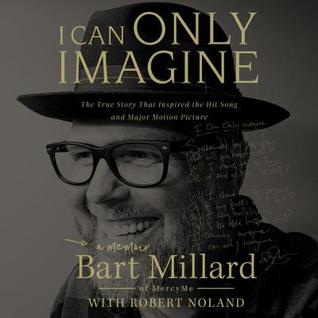
Singer and songwriter Bart Millard, lead singer of the band MercyMe, shares the full story of the band’s best-known song, “I Can Only Imagine.” Though this story was shared with the world through the movie by the same name, as Millard explains at the beginning of the book, a movie has time constraints that a book does not; thus, the book is able to go into more detail about Millard’s relationship with his abusive dad and his dad’s transformation shortly before his death.

You know how a song can be so popular, played so often, that you almost start to not care about it, even though you thought it was a great song when you first heard it. I won’t pretend I enjoy “I Can Only Imagine” as much now as I did when it was first released in 2001. But reading this book definitely puts the song in a whole new light. Though it sounds like Bart Millard has told the story about his abusive-turned-repentant dad many times over those years, I don’t recall ever hearing it, and I haven’t seen the movie. And wow, it is quite the heartbreaking story. From the physical and mental abuse to the (worse in some ways) checking out of his dad later, Bart Millard has every reason to be traumatized. And to know that it has continued to affect him in more recent years, even while playing music to large crowds, of which, at various times, I’ve been a part, only adds to the sadness.

I am incredibly grateful for so much of the music that Bart Millard has written and that the band has recorded, and I think it’s important for “fans” to keep in mind that these are real people with real problems. They often seem like they have it all together, like they have all the answers, to the degree where even when they’re standing on the stage telling us that they’ve had some rough times, we imagine those rough times to be over, because otherwise, how could they be standing there in front of us leading us in worship? We assume that whatever problems they have can’t be as bad as our own, and maybe by the time they get to writing a book like this, they’ve got it all sorted out. But most likely, Bart Millard will continue to struggle with PTSD and the feelings of inadequacy that his dad instilled in him, while thanking God that he had some good times with him before it was too late.

I listened to the audiobook, because I wanted to hear the words in the author’s own voice. I’m incredibly glad I listened to the book, and though I’ll probably never quite think of MercyMe songs the same way again, I don’t think that’s a bad thing.

Find out more about I Can Only Imagine and MercyMe

See what I’m reading next.

If you’ve read this book, or read it in the future, feel free to let me know what you think!

Daily Writing Check-in: April 28, 2019

Words/Time:  28 minutes of freewriting

I knew it would be difficult to find time to write this weekend. Yesterday, I managed to carve out some time in the afternoon, which was good, because I didn’t get home from a concert until around midnight.

Today, after being up super early and getting home only a couple of hours before my family we going to see Avengers: Endgame, by the time we got home from that, I was so tired, I could barely keep my eyes open. Still, I knew I had 150 minutes of writing work left to finish Camp NaNoWriMo before the end of the month, so I decided anything I could get done was better than nothing.

It seemed like a good time for freewriting, rather than trying to focus on the outline I’ve been working on, so I went back to an old word list I wrote down in my failed attempt at a bullet journal 1 1/2 years ago. I picked a word from the list and wrote 356 words. And even better, it’s not too vague, confusing, or spoiler-y to be used as a Monday Moment, an attempt at a weekly feature on my blog that has been incredibly sporadic over the last 5 months. But come Monday, there will be a Monday Moment!

A Monday Moment: The Play

At the beginning of this year, I made a new goal for myself to do a little writing practice every day. I already try to do some form of writing work each day, hence my daily check-ins. But most of that is revision, and I want to write a little too.

Every Monday, I’m going to choose one bit of writing practice from the previous week and post it here. If I haven’t done any writing practice all week, I’ll have to make sure I do some on Sunday or Monday to have something to post. So there’s an extra little push there too.

I won’t revise any of this, except for a spell-check. They’ll probably rarely be longer than 500 words. The prompt, if I used one and if I choose to include it, will be at the bottom. And I can’t even call them all stories, because there’s not always a beginning and end. Sometimes it’s just writing.


Judy tried not to look at her daughter too often during the play, but she couldn’t help herself. She’d seen the play before and remembered all too well the emotions she’d experienced throughout. Natalie was old enough to understand what was going on—the overt and subtle themes, consequences to actions, and feelings that went along with it all.

She worried that glancing over as often as she did would disrupt Natalie’s concentration on the story, but every time she looked, the girl was so entranced that she didn’t notice Judy’s eyes on her.

As the story ramped up to the climax, tears sprang to Judy’s eyes. She knew what was coming, and she was already reacting to what hadn’t happened yet. Natalie was yet unaffected, but Judy couldn’t wait for that one moment.

As the climax unfolded, Judy felt Natalie’s hand grip her arm. She looked over and saw Natalie sitting forward in her seat. She was still staring straight ahead, but had reached out to her mom for some comfort. Judy placed her other hand over her daughter’s and turned her face back to the stage. Her eyes darted between the actors on the stage and Natalie’s face.

Her own heart nearly broke when she saw tears reflecting the stage lights. Natalie was barely breathing, she was so caught up. When Natalie shook her head slowly and then closed her eyes, Judy wondered if she’d done the right thing. Maybe Natalie was too young after all. The girl seemed to realize even before Judy had that it was over. It was too late. The hero’s life done—there was no way around his necessary sacrifice. And it was painful to watch.

Though she’d planned to keep an eye on Natalie’s reaction out of the corner of her eye, that moment that Judy had been waiting for—THE moment, the triumph, the hero saved—had all of her attention. She was swept away like it was her first time. At least until she felt Natalie’s grip tighten even more. Blinking past her own tears, Judy looked at her daughter. Natalie’s cheeks glistened in the dim light, and mother joined her daughter in weeping for the hero.

As the final moments of the story played out, Judy knew she’d made the right choice. She wouldn’t point out later that she’d been right when she insisted Natalie come with her, even though it wasn’t as exciting as a movie or television show. She wouldn’t explain to Natalie what a deus ex machina was, or the history behind it. She wouldn’t ask her to identify themes and symbolism in the play. She would just ask for Natalie’s thoughts and then ask if she’d like to go to another play with her mom someday.


“Like a hero who takes the stage when we’re on the edge of our seats saying it’s too late…”
-MercyMe, “Flawless”

Daily Writing Check-in: January 16, 2016

Words/Time:  620 words of writing practice with an idea inspired by a song I heard a few times on the radio today while my husband and I were on our way to and from the theater to watch the new Star Wars movie. The song was “Flawless” by MercyMe, and there’s one line in it that has struck me since I first heard the song. Today was not the first day that it influenced my writing.