Book Review: Eye of the Storm

Eye of the Storm
by Ryan Stevenson

My rating: 4 / 5
Genre: Memoir, Christianity

AtD

Singer and songwriter Ryan Stevenson shares the story behind his hit song “Eye of the Storm.” Years of struggling in his personal life and his musical life led to doubt and depression. Stevenson had to learn to fully rely on God, to allow Him to be in charge of his dreams and ambitions, but it wasn’t a quick realization, a “flash of inspiration” that fixed everything at once. It took time and some very dark moments, which Ryan lays bare for us in this book.

It’s never easy to read about the difficulties of someone else’s life, and Stevenson had a lot of them. From watching his mom die of cancer, to his wife having a miscarriage of twins, and to Stevenson’s own bad choices that nearly ruined his life. Through all of this, Stevenson had a love for Jesus, though I’m not clear on where his faith really stood. Still, there’s inspiration to be found in the pages of this book.

I appreciate the humble and vulnerable way that Stevenson wrote about his history. He found some success throughout his life, but suffered many setbacks. And he never holds back from taking the blame for his own mistakes. His wrong choices, mingled with things that were out of his control, caused some of the problems he had. Yet, along with the understanding that he should, and could, trust God in everything, he also came to learn that his mistakes did not have to define him. That, as long as he allowed it to happen, God could wipe them away and he could move on from who he used to be.

Though I have not had nearly the hardships in my life that he had, I gleaned plenty of insight from Stevenson’s story. In particular, it was a reminder when I really needed it to continue to do plug away at my writing, which feels stalled at the time of my writing this review. But rather than waiting for a big, obvious lit-up path (which I didn’t even consciously realize I was doing until now), I should be faithful to the work as I know to do it. God may or may not open doors for me, but waiting around for something to happen feels more like giving up than trusting God to use my abilities as he sees fit.

One thing I want to mention for anyone who may read this book–I think it’s important to be clear that not everyone hears that “still small voice” quite so clearly as Stevenson did so many times in his life. If we assume that God will lead us in this way, and we never feel an obvious nudging of the spirit, we may feel like God has abandoned us in the way Stevenson felt at times during his life. Even if we never experience a monologue from God, a whisper in the wind, we can still follow God faithfully, and he can use us in ways we’d never expect. I don’t want to discount Stevenson’s account of how God spoke to him, but it is not the only way, and for those of us who do not have those experiences, we should not feel less important to the kingdom.

With that in mind, I do recommend this book for Christians who could use some inspiration in trusting God in the storms, or for those who enjoy Ryan Stevenson’s music.

Thank you to Netgalley and Harvest House Publishers for providing me a copy of this book to review.

Find out more about Eye of the Storm

See what I’m reading next.

If you’ve read this book, or read it in the future, feel free to let me know what you think!
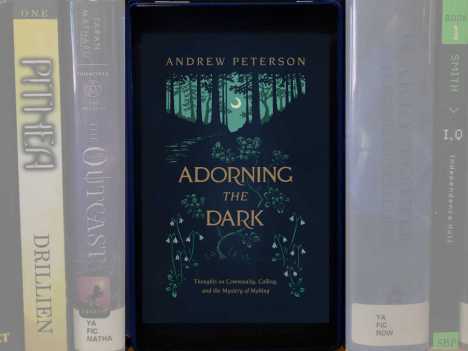
Book Review: Adorning the Dark

Adorning the Dark
by Andrew Peterson

My rating: 4 / 5
Genre: Memoir, Christian living

AtD

Singer, songwriter, and author Andrew Peterson shares his insight on creating in this book. He uses personal experience as well as wisdom from other songwriters and authors to discuss the process of writing songs, the ups and downs of the business, and using one’s creative abilities to tell a story.

I’ll start my review by saying that I was not the main target audience for this book. While Peterson does do his best to expand beyond songwriting into fiction-writing and other kinds of art, the heavy focus is on the musical realm (and poetry to a lesser degree). I’m a fiction writer, but have no experience with or even much of an understanding of writing songs. Plus, he referred to songs and books by various songwriters and authors a lot and talked about them as if the reader should know them as well as he did. I’m not nearly as well read as him, and I am definitely not as immersed in music culture, nor do I listen to as wide a range of music as he. As such, I do think that quite a bit of the book was lost on me.

Another way this book did not resonate with me is that I came to realize by maybe halfway through the book that my personality, and the way I see the world around me, is vastly different from his. He sees beauty in everything, but I’ve never been all that sentimental. So that was another chunk of the book that fell flat for me.

However, that does not mean that I did not find plenty of gems in the book, things that work for any kind of creating. For example: “If you wait until the conditions are perfect, you’ll never write a thing.” Or: “The songs won’t write themselves, and neither will the books, the recipes, the blueprints, or the gardens.” Even with the difference that Peterson describes between songwriting (which can also apply to poetry to a degree) and writing fiction, the clear point is that you have to get through the bad to find the good.

He also addresses the different between “Christian art” and art from a Christian perspective, which I really appreciated. As an author, I’ve struggled in the past with thinking that I should only be using the gift God gave me to write specifically Christian fiction. However, I no longer think that’s true. Instead, I can write stories with a Christian worldview, which will most likely be acceptable to most Christians, and will even be acceptable to many non-Christians who just want something good to read. And in approaching the art that way, perhaps it would allow the artist to actually reach more for Christ.

There were a few things about which I disagreed with the author, but even in those I think it mostly comes down to a difference in mindset or preference. I did agree with the idea that calling some people “creatives” excludes many people who really are more creative than they think. Just because “art” isn’t the end result, pretty much everyone creates in their own way–that can come out as critical thinking or problem solving, or so many other things that don’t seem as creative. In the end, I’m very glad I read this book, as it gave me some interesting insight into a singer whose music goes back as far as my marriage, and plenty of solid advice on writing, some of which I needed to hear even today. I recommend this book for Christians who are interesting in creating, no matter the form it takes.

Thank you to Netgalley and B&H Publishing Group for providing me a copy of this book to review.

Find out more about Adorning the Dark

See what I’m reading next.

If you’ve read this book, or read it in the future, feel free to let me know what you think!