The Worst
by Mark Binder
My rating: 2.5 / 5
Genre: Middle grade fiction
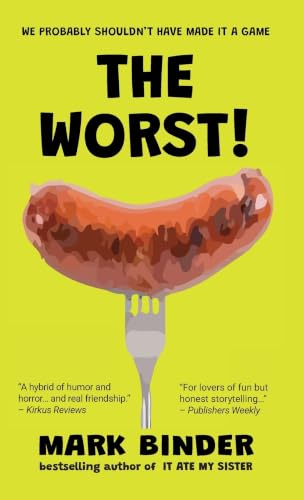
This series of vignettes about life in middle school in the 90s follows a group of 7 friends who refer to themselves as “Team Bomb Shelter,” because they hang out in a basement bomb shelter at the house of one of the friends. Starting in the summer before eighth grade and going all the way to the end of school, the book actually ends with a novella about a school shooting. If that sounds like a strange combination to you, it felt that way to me, as well. Before the vignettes start, the protagonist/first-person narrator (whose name I don’t recall ever being told) tells us that the school year ended with a school shooting. But first, he takes us back almost a year and tells us mostly fun, whimsical, completely unrelated stories about normal life for him and his friends. The stories range from outlandish to realistic, fun to serious. One story involves the protagonist developing a super-fast but also super-minor attraction to a new kid, whose gender he doesn’t know, so that makes him question what he’s always assumed about himself. The author seems to remember the 90s differently than I do, because he indicates that “crises of identity” were common back then, and I sure don’t remember that whole thing being even a fraction of what it is today.
Regarding the school shooting novella in particular, I think authors need to be really careful about how they handle something that is still a subject of such terror today. It’s strange to me that this story was put after a series of mostly light, jovial vignettes. I wouldn’t go as far as saying that Binder treated the subject lightly, but I do have a difficult time believing that any eighth-graders would have acted the way the kids in this book do. This makes it seem more like a story written specifically so the kids can be the heroes, and it just seems strange for a school shooting story to be written that way. I’m not sure if I can adequately explain what I mean, so I’ll leave it at that. I also didn’t particularly enjoy the way the author slips from a first-person narrative, even one where it’s clear the narrator is looking back on his childhood at a much later time and giving minute-by-minute details of the event, only to interrupt himself with a chapter from the shooter’s POV or an explanation of what they learned from the police report after the incident. It was jarring.
The first half of the book, the vignettes, could be enjoyable for the right reader—either adults who enjoy nostalgic views of the time they grew up or possibly middle schoolers now who like to read about what life was like before cell phones (which we’re reminded of many times during this book). The novella in the second half is a very serious subject matter, but some may enjoy that as well. This wasn’t a stand-out read for me, but if you’re interested, please check out other reviews at the link below.
Find out more about The Worst
If you’ve read this book, or read it in the future, feel free to let me know what you think!

