Book Review: The Faithful Spy

The Faithful Spy
by John Hendrix

My rating: 5 / 5
Genre: Middle grade nonfiction, graphic novel

I read this book after my 13-year-old daughter, who read it for book club at the library. It’s an impressive mixture of information about Bonhoeffer, who was part of the conspiracy to stop Hitler before and during WWII, and a concise picture of how Hitler came to power in Germany and then went on to conquer lands around it. Bonhoeffer’s struggle to accept what was happening in Germany and then figure out how he should act in response is well presented, and I can really appreciate his (and others’) difficulty trying to reconcile his faith and God’s commands with wanting to do what he/they can to stop Hitler’s reign of terror. It presents the reader with the question of what he/she would do in the same situation.

Hendrix does a great job of presenting all of this in a way that is easy to follow, not just because of the artwork, but because of the clear, simple wording he uses. My daughter isn’t exactly a history buff, and frankly, neither am I, but we were both caught up in the book. I gained a lot of insight into the history around WWII, things that I either never knew or forgot from my school days. The artwork is stunning and poignant, with symbolism here and there like Hitler as a wolf or the Nazi party as rats invading the “cellar” of the German government. A few of the images are a little dark, not that the subject matter doesn’t lend itself to that, but it’s something to keep in mind for younger readers. While I’d recommend pre-reading for parents of younger kids or those prone to be sensitive, I highly recommend this book for teens and even adults.

Find out more about The Faithful Spy

See what I’m reading next.

If you’ve read this book, or read it in the future, feel free to let me know what you think!
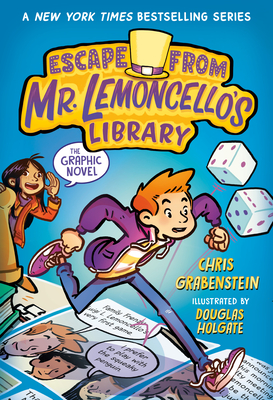
Book Review: Escape from Mr. Lemoncello’s Library, the Graphic Novel

Escape from Mr. Lemoncello’s Library, the Graphic Novel
Mr. Lemoncello’s Library series
by Chris Grabenstein
illustrated by Douglas Holgate

My rating: 5 / 5
Genre: Children’s adventure, graphic novel

Game-lover Kyle Keeley is desperate to win a spot in the overnight sleepover at the new, state-of-the-art local library. The library was designed by his hero, Mr. Lemoncello, who created pretty much every board game and video game Kyle loves. When the overnighter turns into a lock-in (literally), Kyle and his fellow 12-year-olds have to figure out how to escape.

I read and reviewed the original book (see review here), so this review is less about the story and content than it is about the graphic novel format. I was so excited to see that there was going to be a graphic novel of this book, because if there was ever a book (and series) that was crying for a graphic novel to be made for it, it’s the Mr. Lemoncello’s Library books. The amazing library and all of its high-tech features are just too big for the imagination (not that I’m saying the author didn’t do well describing it all in the original novel). Plus, puzzles that the kids need to solve are often shown in the book, and they fit in much better in a graphic novel. The characters are distinctly different, which helps when you’re talking about an original 12 kids that get pared down along the way, and Mr. Lemoncello himself really came to life for me in this format.

On top of all of that, there is a 11-clue rebus puzzle hidden throughout the first 46 pages of the book, which, knowing about in advance, forced me to pay close attention to the background while I read. In the end, I had to go back and look really hard for one I’d missed (and throw out one that turned out to not be a clue). Maybe I’m too old to send my answer and be in the running for the prize, but as a puzzle-lover, it was a lot of fun to work it out after I’d finished the book.

I don’t know if the rest of the series will follow this graphic novel, but I do know that I sincerely hope that Mr. Grabenstein will continue the main series, since the last book definitely set up more to come. As for this book, though, I think that fans of the series will enjoy this new format, but I’d imagine that the idea for it is more to encourage kids who don’t care to read regular books to pick up this illustrated version and enjoy the story. Since I had already read the original book, I can’t say for sure how the story will come across to a newcomer, but I think it would be a fun read for 8-12-year-olds!

Thank you to Netgalley and Random House Children’s Books for providing me a copy of this book to review.

Find out more about Escape from Mr. Lemoncello’s Library, the Graphic Novel

See what I’m reading next.

If you’ve read this book, or read it in the future, feel free to let me know what you think!

Book Review: Maus II

Maus II
Book #2
by Art Spiegelman

My rating: 5 / 5
Genre: Historical non-fiction graphic novel

The 1st volume of the story of Polish Jew Vladek Spiegelman took him right up to the gates of Auschwitz. In this second volume, Vladek and his wife survive the horrors of two of the deadliest camps the Nazis ran, but at what cost? As seen in their lives after the war, as well as in the life and psyche of their son, coming out alive at the end of the Holocaust was just the first battle (though granted, a very, very difficult battle).

The previous book was rough enough in some ways, but this one is like a gut punch. The images portrayed of Vladek and those around him, the death and torture, can be difficult to handle. Add to that the depression that Art Spiegelman himself goes through as he works on putting his father’s story on paper, and it is not a book to be taken lightly. Amidst the terror, I am still fascinated to read about Vladek’s ingenuity, the tricks he used to stay alive. Sometimes it was pure luck, but often it was intelligence and quick thinking.

The emotions were heavy when the separated Vladek and Anja manage to even simply hear word that each other is alive. That hit me hard, thinking about my husband and me being in a similar situation. When I finished the book, I was left with a feeling of heaviness that was hard to shake. There’s just no way to be able to imagine a fraction of what those involved in the Holocaust went through, living easy lives as we are. I think it’s important for us to never forget what humanity is capable of, lest we begin to believe something like this could never happen again. I would recommend this to be read by anyone interested in this part of history, even if you don’t normally read graphic novels. I don’t either, but these books have captivated me for years.

Find out more about Maus II

See what I’m reading next.

If you’ve read this book, or read it in the future, feel free to let me know what you think!

Book Review: Maus

Maus
Book #1
by Art Spiegelman

My rating: 5 / 5
Genre: Historical non-fiction graphic novel

The story of Polish Jew Vladek Spiegelman, as told to his son, is not an easy one. In this 1st volume of 2, we’re shown in images what Vladek’s life was in the time leading up to and in the early days of the Nazis’ suppression of Jews in Poland. In tandem, Art shows his research process with his father, as he tries to interview him about his past and get along with him at the same time. The 1st volume takes Vladek right up to the gates of Auschwitz, and takes Art to the brink of despair with his tormented father.

The horrific things that happened during the time leading up to the Holocaust (and some of the beginning) is difficult enough to read about, but to see it in this format can make it even more difficult. Spiegelman doesn’t pull any punches in his father’s account or his own. It’s a depressing story, yet I’ve always appreciated reading about the amazing ingenuity of survivors of the Holocaust. Even while we see the depths of human depravity, we also see a shining light as those who are basically safe (the Germans may not have been rounding up the average Polish citizen, but they weren’t exactly making life easy on them either) risk their own safety to help those who are being persecuted.

I’ve always been fascinated by stories like this, preferring real accounts to fictional ones, and it’s difficult not to imagine myself in that situation. While the characters in this book are depicted as animals, in a way, this adds another layer to the realism while also making it a little more palatable (though just a little). I would recommend this to be read by anyone interested in this part of history, even if you don’t normally read graphic novels. I don’t either, but this book, and it’s follow-up, have captivated me for years.

Find out more about Maus

See what I’m reading next.

If you’ve read this book, or read it in the future, feel free to let me know what you think!