Mr. Lemoncello and the Titanium Ticket Mr. Lemoncello’s Library book #5 by Chris Grabenstein
My rating: 5 / 5 Genre: Children’s adventure
Mr. Lemoncello’s game-making factory is in Hudson Hills, NY, and recently a new, top-secret building was added to the grounds. Now it’s time for another game, for the first time taking place outside of Ohio, with competitors from Hudson Hills. The playing field is inside that new building, and the prize is a titanium ticket, one of multiple that will eventually be awarded. But the real prize, what the ticket gives its holder a chance at, is the biggest one yet!
Each book after the first in this series got a little less exciting for me. A little less interesting, a little less fresh. In this fifth book, all of the excitement from the first one came rushing back. It’s different and fun again. Not that some of the formula the series has developed isn’t there, but it feels new again. It helps a lot that we step away from the Ohio kids and meet some brand new ones. Kyle makes an appearance, but he’s just a side character. And the new MC, Simon, is different in a lot of ways.
There are several things that happen in the story that caused me to mentally cheer. I so wish I could expand on that at all, but I’ll just say that there were some great moments. I love the friendship that’s formed in the story and the way that whole thing turns out. And I really love how Simon’s personal story came to fruition.
The titanium ticket angle was a little predictable, and it’s a little frustrating to have another Charles Chiltington-type character, though this new one (Jack) is different in many ways too. I suppose some of that might just be the genre and intended age group. But those very minor issues aren’t even worth a partial-point detraction for me, and I am happy to highly recommend this book to kids around 8-12 years old, as well as others who are interested in this type of book. While I did feel the last few books in the series weren’t quite as good, I would suggest reading it all up to this point. And based on the ending, it’s clear that this series isn’t over yet.
I read 9 books last month, which I’m pretty happy with. Somewhere in the middle of the month I slowed way down on reading, partly due to the book I was reading dragging a lot. The 3 audiobooks I read last month definitely kept me going when my normal reading faltered
This list includes 2 ARCs and 1 re-read. My favorite book from March was Wives and Daughters. I finished (or caught up on) 4* series and started 1 series. My ever-changing short list of to-be-reads, as well as a flag for the book I’m currently reading and an ongoing list of those I’ve read and posted about can be found here.
*This includes 1 series that I did not reach the end of but decided not to continue reading, after being 2 books into the series.
I’m also keeping my Goodreads page updated with a more extensive list of to-be-reads. Despite my almost too-long TBR list, I’m always looking for more to add. Feel free to offer suggestions of your favorites or just recent reads you enjoyed.
My rating: 4.5 / 5 Genre: Christian historical romance
When her fiance Rich succumbed to injuries sustained near the end of the war between France and her home country of England, Lady Sophia Haverly did not not expect to ever fall in love and marry someone else. Instead, she would continue to care for her elderly almost-mother-in-law, who developed a strong desire to return to the seaside, where she’d grown up. She finds assistance in this endeavor in the form of Captain Charles Wyvern, close friend of her late fiance, who tells her that Rich died saving his life, leaving him indebted to helping Sophia however he can. The captain, while desperate to head back out to sea, has his own reason for going to the coast–his uncle has just died, and he’s inherited the estate and title of earl. When he finds that the estate is in bad shape, not to mention the three young girls he’s inherited as wards, he seeks help from the young woman to whom he owes a great debt.
The third book in the series stands as tall as the first two. I loved how the captain was so out of his element on land, while Sophia equally did not take to the sea very well. The three girls, aged between 5 and 16, added a layer of life to the story that all worked together so well. Sophia, not much older than the eldest girl herself, found herself in the role of mothering the kids simply because she fell in love with them so quickly. And her relationship with her late fiance’s mother-in-law, Mamie, as well as Mamie’s relationship with the three wards, made this book about so much more than the main romance.
In fact, my biggest frustration with the book was the repetitiveness that came with Sophia starting to let herself move on from her loss. She kept sort of chastising herself for holding another man in high esteem and possibly wanting more from that, always ending with a question of whether that was how it should be or not. This may be completely realistic, but the repetition wore on me just a bit. That’s pretty much where the half point rating detraction came from. On the other hand, 5-year-old Betsy’s attachment to the captain’s hat is wonderful!
Here at the end of the series, my favorite character overall has been Marcus Haverly. He also played the most significant role throughout, being the male lead in the 2nd book, while also having decent roles in the first and third. I love that his alter ego gets to play a role in all three books, too, and wish Erica Vetsch would somehow write a little more about him (maybe a short story in which Sophia and Charles learn of his former occupation?).
While I found parts of this story predictable, and one particular part far too convenient, I loved it overall. It’s a great ending to a great series, which I highly recommend to fans of Christian romance, historical or otherwise, and fans of Regency romance. And if you do plan to read these books, or already have, make sure you also look into the book Joy to the World, a collection of 3 novella-length Christmas stories. Vetsch’s contribution to that book takes place directly after this third book in the series and ties up the story of a character that has been involved in the series.
I received a free review copy from the publisher in exchange for my honest unedited feedback.
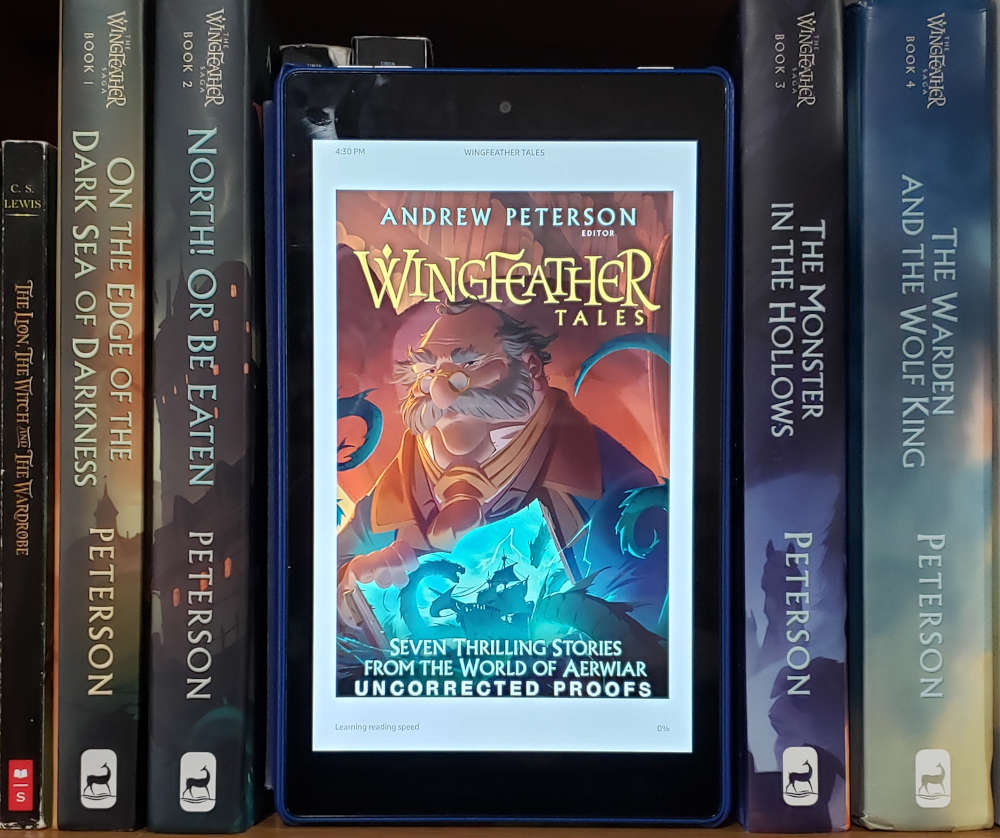
Wingfeather Tales by multiple authors (see details below)
My rating: 3.5 / 5 Genre: Children’s fantasy short stories
For me, last year will forever be known as the year of the Wingfeathers. I read the entire Wingfeather Saga for the 1st time…and the 2nd time, in a way, as the author, Andrew Peterson, read his books live, a few chapters a day, throughout the year. This book is a collection of 7 stories set in that same world, written by 6 different authors. First, let me get some basic info out of the way: Yes, you really should read this only if you’ve read the Wingfeather Saga in its entirety, which I fully recommend that you do either way. No, none of these stories is a continuation of that series in any way. Well, one sort of is, to a very small degree, but more on that in the details below. Let’s just say that it will not answer the burningest questions you’ve most likely been left with after finishing the series. Andrew Peterson has stated on more than one occasion that he would prefer to leave any answers up to the imagination of his readers, which is fair.
My overall book rating is a reflection of the average of individual ratings for each story. I did not love the stories overall as I might have hoped. However, I did go into this uncertain about how I’d enjoy them. I’m not really huge on short stories in general, but I couldn’t help but give this book a go, considering how much I loved the original series. What follows is a list of each story with its author and illustrator, my rating, and a brief (as much as possible) review for each.
“The Prince of Yorsha Doon” by Andrew Peterson(5 / 5) – This was my favorite short story in the collection, with a ragged, loner street urchin getting the chance to be something more, to do something more. It’s charming and contains a wonderful appearance by one of the bigger characters in the original series. (illustrated by Cory Godbey, Nicholas Kole, & Hein Zaayman)
“The Wooing of Sophelia Stupe” by Jennifer Trafton(3 / 5) – The story of the author of the Creaturepedia books on its own was decent, if open-ended. However, I was slowed down and tripped up by the character’s vocabulary. He had a penchant for using very large, at times ridiculous words, both real and made-up (though a lot more made-up than real, I’m pretty sure). I’m sure it’s meant to be whimsical, and that plenty of people will find the fun in it, but it’s not really my preference. (illustrated by John Hendrix)
“Willow Worlds” by N.D. Wilson(4 / 5) – I really liked seeing young Podo, and perhaps the genesis of what made him who he is in the Wingfeather books. The plot to this story, especially coupled with the story before it, paints such a vastly different fabric for this fantasy world than what was in the original books, leaving me a little surprised and confused. The story is particularly short and abrupt, but I liked the general idea of it and wish there was more on this subject. (illustrated by Joe Sutphin)
“ShadowBlade and the Florid Sword” by Andrew Peterson & Jay Myers(4 / 5) – As alluded to in the first paragraph of my review, this is the one tale in the book that is a continuation of the original series. The title tells it all, and it’s actually in comic-book format. I did like having the chance to see the two together, and wish it had been longer. Though several of the stories in this collection end abruptly and with more that could be told, I think this is the one I most want to see more of.
“From the Deeps of the Dragon King” by A.S. Peterson(2 / 5) – This story was tragic and disturbing, and while it was clearly meant to be so, my rating is not due to the theme or mood. Considering how Podo’s story and character arc went in the original series, especially at the end of North! or Be Eaten, I really think I would have preferred not seeing him at this time of his life. It almost felt like undoing everything related to this that happened in the series. Plenty of others, I’m sure, will be happy to read about Podo’s past, but it just made me sad. (illustrated by Doug TenNapel)
“The Ballad of Lanric and Rube” by Jonathan Rogers(4 / 5) – This story was short and silly, maybe a little predictable to me, but overall just fun. (illustrated by Justin Gerard)
“The Places Beyond the Maps” by Douglas Kaine McKelvey(2 / 5) – This is the kind of story that I wish I could rate higher and feel like a rube rating so low, because I’m sure it’s meant to be beautiful and poignant, but it’s just not for me. It’s the story of a man whose daughter was taken away by the Black Carriage, and all that he goes through as he tries first to get her back, then to get justice, and finally just to find some meaning and purpose after the tragedy. It is long (literally as long as all of the other stories put together, since it started at 50% in the e-book) and moves slowly most of the time. There is a lot of introspection, depression, even self-hatred–all things you might expect in the situation, but I felt like it plodded along most of the time. It didn’t help that the author has a tendency toward long, run-on sentences. Entire paragraphs, long in their own right, can be made up of just one or two sentences. It’s a style choice, I’m sure, but not one I care for.
This story is also one that actually caused squeamish me to wince as injuries and the attempt at mending such were described in fairly vivid detail at least once. The man contemplates killing himself or at least giving up on life multiple times. It’s dark, much darker than even the most serious parts of the original series. There were a few bright points for me, like the inclusion of a wonderful character from the original series and the epilogue that added a little hope after the disturbing (and just plain weird) ending. (illustrated by Aedan Peterson)
Final thoughts: I didn’t mention illustrations in the individual reviews, but I enjoyed every one of them. Andrew Peterson has a way of collecting talented people around him (not to mention his own talented children), and I can imagine the honor of having other authors and artists take part in a project like this for his books. I think, though, that some of this collection lost the charm and feel of the original series, and I especially don’t think I’d say this is as great for the age group that the first series was so well suited for. What’s most telling to me is that my daughter (10 years old), who has read/listened to the Wingfeather Saga in some format probably half a dozen times, only read about a story and a half from this collection and walked away. She’ll go back to it eventually, but clearly it didn’t draw her in like the original books. I do think that fans of the original series should read this collection, or at least some of it. I know I’ll re-read some of these stories again in the future, but I was not quite the right audience for some of them.
Thank you to Netgalley and WaterBrook & Multnomah for providing me a copy of this book to review. **Note: This book has been out since 2016, but a new hardcover edition is being released tomorrow, with a beautiful new cover and new illustrations, and the inclusion of one new tale (the comic one).
The Lion, the Witch and the Wardrobe The Chronicles of Narnia #1 (original order) by C.S. Lewis
My rating: 4 / 5 Genre: Children’s classic fantasy
This is my first foray into The Chronicles of Narnia. I’ve seen the movies (or at least some of them), but only once when they first came out, and don’t remember much past the first one. So overall, this will all be very new for me. This is yet another book I wish I’d read when I was younger; I have a feeling I would have liked it more as a kid. Overall, I did enjoy it, but it was a lot shorter and shallower than I would have expected it to be. Be aware, there will likely be spoilers ahead.
I can appreciate the parallel to Christ in Aslan, though I went into the story expecting the entire thing to be an allegory, just from things I’ve heard. So some things really confused me, like Father Christmas showing up and giving everyone gifts. Or the kids needing to fight against the witch and her army, weakening her before Aslan could then defeat her. However, I’m understanding more that the entire book (and series) was not necessarily meant to be an allegory, even while one can certainly draw a Christ-like parallel in Aslan’s actions in this book. That does change my perspective on it after the fact.
Now to Edmund…oh, Edmund…he’s a bit of a brat, even before he betrays his siblings, but I kinda get it. He’s a middle child and struggling to find a place under his big brother. I’m in the same position in my family of 4 kids and definitely remembering struggling sometimes to feel special (though I have all sisters, we did not always get along at all). Of course it seems as though he went too far, though we’re supposed to understand he was under some sort of enchantment. His mental reasoning, though, as he prepared to betray his siblings, sounded less like enthrallment and more like sibling rivalry to me. In the end, though, I did like how the entire thing turned out.
As soon as I finished this book, I recommended it to my 10-year-old daughter. I can see similarities in it to books that she has already read and enjoyed, so I think she’ll love it. I’m looking forward to hearing her thoughts; it’s always fun when we both read and enjoy the same books and then get to talk about them, and I see that being a possibility with this series.
Jo & Laurie by Margaret Stohl & Melissa de la Cruz
My rating: 3.5 / 5 Genre: Romantic retelling, YA historical fiction
If you’ve ever read Little Women and wondered what could have been between Jo and Laurie, if the author had allowed it, this book might be for you (or even if you haven’t). It’s a bit meta and can be difficult to fully understand, but the authors are not so much rewriting the second half of Little Women as they are imagining that the book that we know was itself written by another fictional Jo March (and it was, within the context of the book), and that the second half (originally published as a sequel novel titled Good Wives) was more of a departure from her real life than the first half was.
I’d say the primary audience for this book is those who really wish Jo and Laurie had ended up together. However, I think there’s still a place for the rest of us to read it, out of curiosity if nothing else. Or for die-hard fans of Little Women who want to revisit that world in a way. (Though those seem to be the strongest opponents to this retelling.) As for myself, I only really read this book to see if it’s something I’m okay with my 10-year-old daughter reading. We read the Great Illustrated Classic version of Little Women together just over a year ago, and the little romantic that she is, she was quite unhappy that Jo and Laurie both married other people. I’ve since read the original book, and personally have no problems with the way the whole thing worked out.
My rating on this book, however, is wholly unrelated to the re-imagining of fictional-author Jo’s life and love, but based on the book itself. I think the authors did a pretty good job with the historical fiction feel to the book, and even with making it feel similar to the source material (though understand I’ve only read it once, so I’m not exactly an expert). However, to me, it seemed repetitive and a bit slow through most of it. Jo rehashed her confusion about how she felt about Laurie so many times. And for being a feminist and bucking against the way women are treated in her time, Jo doesn’t have the slightest problem seeing a woman she doesn’t care for only as a pair of bosoms. That really bugged me.
In the end, I did like the culmination of the romance, which itself was fairly unromantic most of the time (though even that is true to who Jo is). I think that Laurie himself reflects the reaction a lot of readers would have, especially those that I mentioned above, who read Little Women and really wished Jo and Laurie had married each other. The book is listed as young adult, though I do think it’s good for readers of all ages.
Mr. Lemoncello’s All-Star Breakout Game Mr. Lemoncello’s Library book #4 by Chris Grabenstein
My rating: 3.5 / 5 Genre: Children’s adventure
If Kyle Keeley and his team thought the previous Lemoncello game was big, they haven’t seen anything yet. The next competition Kyle’s hero has dreamed up will be broadcast live on national television! And the winners will get to choose one from their team to be the host of a new kids’ game show, while the rest of the team are the first contestants. It’s game on as Kyle is up against his nemesis Charles Chiltington and some other competitors that will be tough to beat.
These books are beginning to become a bit formulaic, which is probably not good for this type of book. Kyle almost can’t compete for some reason, and then he can. Kyle/his team stops normal game play to solve some side mystery/issue. Spoiler:Kyle/his team wins almost by default because all or most of the other kids/teams were disqualified or gave up or joined Kyle’s team. Considering how much I loved the first book, I want to continue enjoying this series. But it’s starting to become repetitive and just silly. I did like the game, putting the kids into their own fictional stories in a way like holodecks work in Star Trek shows. Who of us hasn’t wanted to be able to do that? I still miss the more escape room, puzzle-y nature of the first book, though. There was a tiny bit of that again here, with 5 locks to open per team, but the puzzles, riddles, etc. that gave the codes were a lot lighter this time around.
I really appreciated that the game forced the kids (or at least Kyle) to see the “bad guy” in a new light. I only wish a little more had come from that. The thing that bugged me the most as I read this book was the dialog. I don’t know if this is new to this book, or if I simply didn’t notice it before, but all of the kids seem to talk the same way, in a particular format that I began to find grating. I won’t take the time to explain what I mean, because it seems really petty, but it happened enough that it started to bring the rest of the story down for me. And seriously…the TV-star kids were just over-the-top silly and ridiculous in their shticks.
I wonder if maybe they wouldn’t feel so formulaic if I wasn’t reading through them so quickly. It’s hard to know. I also want to stress that this book is meant for kids around 8-12 years old, and the things that bother me may well not be noticeable to them. My 10-year-old daughter loved this book as much as the previous ones, and I think that’s important to remember.
I read 11 books last month, which was only 1 less than last month, but the total page count was about 1/3 of what I read last month. Apparently I read a lot more short books this month!
This list includes 2 ARCs and 2 re-reads. My favorite book from February was The Hiding Place. I finished 0 series, continued 3 series, and started 1 series. My ever-changing short list of to-be-reads, as well as a flag for the book I’m currently reading and an ongoing list of those I’ve read and posted about can be found here.
I’m also keeping my Goodreads page updated with a more extensive list of to-be-reads. Despite my almost too-long TBR list, I’m always looking for more to add. Feel free to offer suggestions of your favorites or just recent reads you enjoyed.
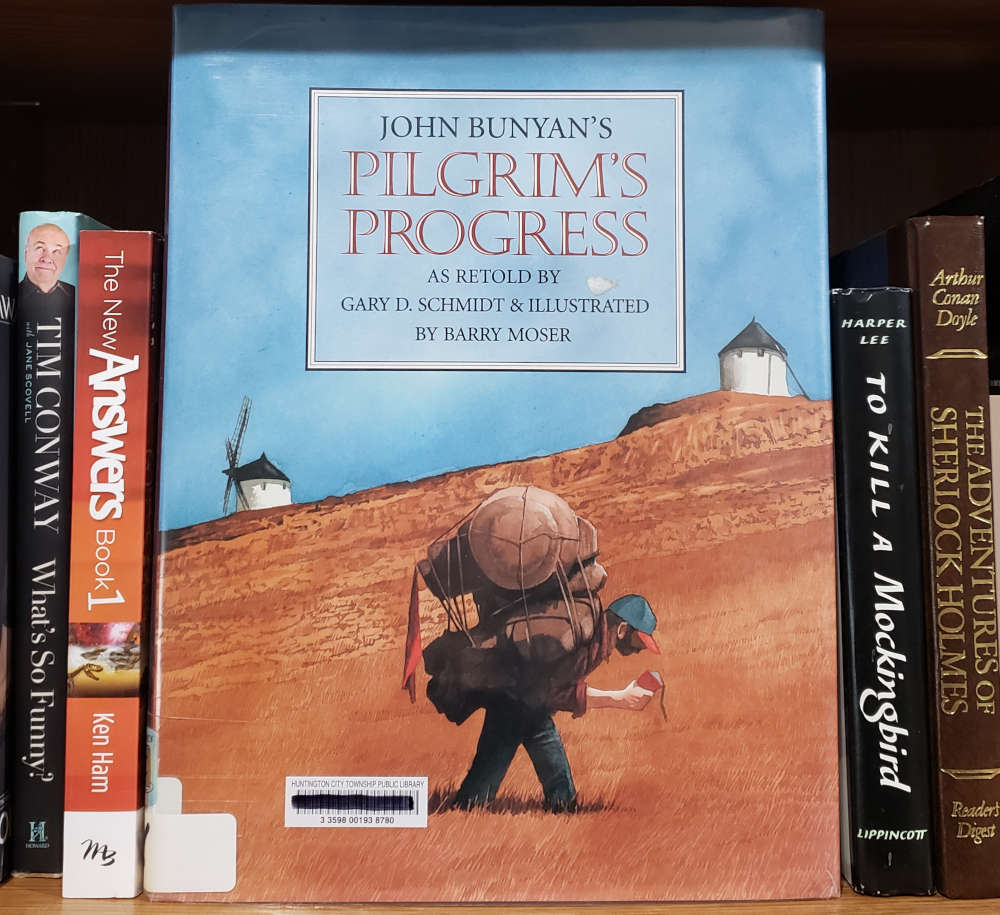
John Bunyan’s Pilgrim’s Progress as retold by Gary D. Schmidt
My rating: 2 / 5 Genre: Christian allegory
I have long felt that I should read The Pilgrim’s Progress by John Bunyan. I even started to once, but only made it a page before putting it down. So when I found this retelling, putting the story into contemporary language, I knew it was my chance to at least see what the book was all about. So understand going into my review that this is in no way a comparison of this retelling to the original. And my comments are specific to this version, because I can’t say what might be different from the original. With that being said, I do think that some of what I didn’t like about this story would extend back to the original source.
After I finished reading this, as I tried to analyze what I’d read and did some research to understand others’ views on the allegory, I flashed right back to high school. After reading The Great Gatsby, I wrote that I didn’t understand why my teacher would have us read a book that so glorified the drinking and partying in the book. She wrote back about her disappointment that I thought she’d promote those things, and that perhaps I didn’t really understand the book. That it’s the type of book one might have to read multiple times to grasp. That’s kind of how I feel about this book.
My first apparent misunderstanding is that it seemed to me that Christian had to essentially earn his salvation. He struggled with his burden on the way to the cross, after coming to an understanding that he had this burden and needed external help to release it. Others say that he was actually saved when entering through the gate that started this journey, and releasing his burden at the cross was simply an illustration about how we don’t often let go of our guilt upon salvation and have to still come to that understanding that Jesus wants to relieve us of that guilt. However, it was at the cross, after losing his burden, that Christian was handed the Roll, which seemed to be needed in order to enter the Celestial City. I took this as a symbol of his salvation, but then, when he was audacious enough to rest a little too long, he lost the Roll and later had to go back and look for it.
I won’t go into any other details, but for whatever this book might mean to some people, at least the people who “get it,” to me it looks like a book that could send the wrong message to new Christians or curious unbelievers, especially those who, like me, aren’t so great at understanding allegory. From start to finish, it makes me feel like a Christian walk is nothing but trial and tribulation. Constant struggling to stay on the right path, to stay good. Yes, some of that is true to a degree, because it can feel like a constant struggle to avoid temptation to sin, but where’s the other side? Why do we not see much of the joy and peace that can come, in this life, from following Christ? For that matter, why is God so completely absent until Christian reaches the Celestial City? If I were to write an allegory about a Christian journey, it would include God interacting with the pilgrim in a much more tangible way (or at all…).
I seem to be pretty hit-or-miss in my enjoyment of much-loved older books and classics, and this is another for my pile of misses. I’m glad I read it, though. Originally I thought it might end up being a stepping stone to going on and reading the original. I’ve decided to leave it right here, at this simplified version, and just be one of the few who’ve never read the original.
Jase is a new youth minister at a small church in an even smaller town in Kansas. Recently moved from San Antonio after his fiancee died, he’s struggling with anger and doubt in his Christian walk. Kenzie is ten years removed from her Amish heritage, leaving the community when she learned how the grace of Christ could free her from the rules and regulations of her family’s religion. She’s been thinking more and more about her family, though, and the darkness they’re still lost in. Lori is a young woman who was emotionally and verbally abused by her father as a teenager. She uses food as a coping mechanism when she feels lonely or inadequate, despite knowing that it’s pointless and wishing she could stop. Jase, Kenzie, and Lori are each searching for answers from God, and when Jase moves to Kansas, he’s welcomed into the friendship that Kenzi and Lori already have. With each other’s help, the three just might find their answers.
Through the first half of this book, I didn’t really understand what it was meant to be about. Part of that is because the official synopsis is atrociously inaccurate and misleading. But it’s also because it really took a while for things to get going. And actually, in the end, it turns out the book really was about what I saw in that first half– these characters each struggling with their doubts, uncertainties, and questions about God and their faith. There were parts of the story that I liked, that I thought came together well in the end, and parts that fell flat for me, or that I questioned why they were included. Overall, it was a decent read, but not a stand-out for me.
The storyline I related to the most was Lori’s over-indulging in times of extreme emotion, good or bad. I haven’t had an abusive past like hers, but over-indulgence is an issue I have struggled with in the past, though not to the degree that she does it. I really liked the way Kenzie’s story shaped up too, after wondering what it had to do with anything for a while near the beginning. Jase’s storyline is the one that I was least connected to, partly because I’ve not experienced loss like that, but also partly because the decisions he made really bugged me. There is a 4th perspective in this story too, which I felt was wholly unnecessary. I couldn’t help but compare it to the previous book I read by this author, which also included 4 perspectives. But where it worked in that one, it just seemed pointless in this one. I’m not sure what the pastor’s perspective added, nor did I feel like it was particularly resolved.
If there was one cohesive lesson this story seemed to bring out, it was the benefit of allowing others to share your burdens. Each of these four people was originally struggling alone and seemed to only see a turning point when they opened up to a fellow Christian about their trouble. Actually, that’s not really true for one of them (I won’t say who), but perhaps it’s just that I wished he/she had let others help him/her along the way. And on a related note, Kenzie really drove me crazy at some points. How can you say “God will provide” and then refuse all of God’s ways of providing? If a really specific incident hadn’t happened, she absolutely would have stayed in the same place, spinning her wheels, still waiting and hoping for God’s providence. (You ever heard the one about the guy sitting on the roof of his flooded house, refusing to get in the boat or helicopter because he knew God would save him? Yeah, she’s kind of like that.)
So in the end, this is not a book I would choose to read again. However, I think that my issues with it will likely not be shared by most others. If you are looking for a Christian book where romance isn’t the main plot and where the author ties multiple storylines together into one story where God’s hand can be seen, this might be a good book for you.
Thank you to Netgalley and WaterBrook & Multnomah for providing me a copy of this book to review.





 A Journey of Words