Book Review: Fool Moon

Fool Moon
The Dresden Files #2
by Jim Butcher
read by James Marsters

My rating: 3 / 5
Genre: Paranormal mystery

Harry Dresden is the only professional wizard available for hire in Chicago and is sometimes called on by the police to help solve crimes where magic is involved. So when a series of murders that happen around the full moon show other signs of involving werewolves, Harry is on the case. But will it prove to be too much for him to handle?

I was not as big a fan of this second book as I was the first in the series. I’ve read that the series gets better after you get into it (though how far into it varies widely), but while this one started off similarly enough to the first, it did not have as much of interest to me. It wasn’t so much a mystery as it was police procedural, and even after the case was basically solved, there was a lot of book left, which turned out to be mostly fighting. It doesn’t help that I usually find werewolves boring in any iteration. I did appreciate that there were various types of werewolves, but since I was listening to the audiobook and couldn’t easily go back to remind myself of which was which, it mostly confused me.

I’m finding some formula in the series that I really hope Butcher steers away from soon enough—like how Murphy keeps believing Dresden to be a bad guy (not that he helps the situation by not telling her the full truth, but she can’t manage to be understanding of how his hands are tied) or how Harry just gets beat up…so…much. Still, I enjoyed some humorous moments and lines, and there was a bit of a twist at the end involving one of the werewolves. Overall, the book just felt like it dragged on, but I’m still looking forward to continuing the series. I can’t pretend that I’d recommend this book in general, but it shouldn’t be enough to dissuade anyone from trying the series, especially if you’re a fan of mystery and detective noir novels, and enjoy or at least can tolerate the addition of supernatural elements (and the content warning below). In particular, if you like to listen to audiobooks, I recommend the narration by James Marsters.

One final note, something that was worse in this book than in the previous—there is quite a bit of sexual content. After my husband finished the audiobook, he commented on how, with the couple of female werewolves, every time they were in a scene, whether they were fully clothed or not (one of them was naked in at least 75% of her human-form page time), the narrator felt the need to remind us that they had certain female parts. And he was right…they were referenced often. I really hope this doesn’t remain at this level. There’s also some language, but not actually as much as I anticipated. And there’s certainly some violence, much more than the previous book (werewolves are beasts). My tolerance on things like these is fairly low, especially compared to the average reader, and while I do plan to continue, I really hope the level of sexual content, at least, doesn’t stay this high.

Find out more about Fool Moon

See what I’m reading next.

If you’ve read this book, or read it in the future, feel free to let me know what you think!

Book Review: The Magician’s Nephew

The Magician’s Nephew
The Chronicles of Narnia #6 (original order)
by C.S. Lewis

My rating: 3.5 / 5
Genre: Children’s classic fantasy

While I appreciate the origins of Narnia shown in this book, it’s my least favorite of the series. I think part of that is my own fault, as I’m still watching for the theological parallels to God, and this one threw me off a lot. I wonder if I’m just not the right kind of person to read this and see it the way others do. To me, at least, as a parallel to God creating the universe, it fell flat in many ways. Maybe that’s because God did it perfectly, and anything besides that just seems like a poor comparison. Of course, from a fiction (and fantasy) standpoint, just having it done the same way as God did it would be kinda weird. But even seeing it more as an allegory than a parallel (which is probably more how it’s meant anyway), I just didn’t enjoy it as much as I did others in the series. Taking it as its own story with no connection to the Bible, it felt a little disjointed.

This series is one of those that I feel like I’m never going to enjoy like so many others do. I didn’t read them as a kid, so that might make some difference. Still, I sometimes think I just don’t have enough sense of wonder or whimsy to make these books more enjoyable. Not that I haven’t enjoyed any of the series by any means, but I don’t know that I’ll ever re-read it. On the other hand, it’s possible that reading the series again some time in the future might give me a different insight into it, and this book in particular.

Find out more about The Magician’s Nephew

See what I’m reading next.

If you’ve read this book, or read it in the future, feel free to let me know what you think!

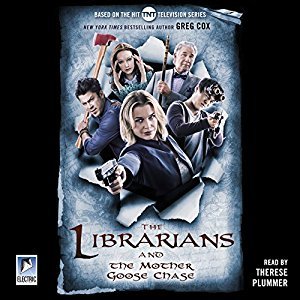
Book Review: The Librarians and the Mother Goose Chase

The Librarians and the Mother Goose Chase
The Librarians #2
by Greg Cox
read by Therese Plummer

My rating: 4 / 5
Genre: Fantasy adventure

When the Mother Goose Treaty of 1918 appears to have been broken, nursery rhymes come to life, and they’re anything but whimsical. The Librarians and their guardian are sent in different directions to investigate these nursery rhymes, while Flynn Carson is nowhere to be found.

Let me start by saying again, as I did for the previous book in the series, that I love The Librarians. I think the show is better than it has any right to be, and a large part of that is due to the great casting. The movies were good as well, but I think the show really took the overall story world to a new level. I’m glad to be able to read these books, though it’s frustrating to me that they’re so vague about where they fit in the series. This one seems to take place after season 3, but while there are plenty of references to Prospero (and a spoiler for the end of season 2) and definitely to Dulaque (from season 1), there aren’t any references to Apep from season 3. Plus, a major development for Cassandra that took place at the end of season 3 definitely doesn’t come into play in this book, so it seems it can’t have happened. Maybe it’s just supposed to be vague, but I would have preferred to be able to read it at the right time while watching the show. And while the book does attempt to give some basic understanding of the overall setting and backstory of the Library and the Librarians, I think this book is best read by someone who has seen at least the TV show. Knowledge of the movies may not be necessary.

Now to the story itself. Overall it was decent. I didn’t mind the Librarians being separated as much as others did, partly because they still each had a counterpart of sorts to work with. I thought some of the story was weak, for example the nursery rhyme connection to the man in Florida was a major stretch, and for a while, I kept expecting someone to say they were wrong about which nursery rhyme they’d associated it with. The stakes were as high as they get, and there was a bit of a twist that I only figured out a moment before Baird did. In the end, there things I liked more about it than the previous book, and things I like less about it. This book had all the campy fun of the show, and I like that the characters’ personalities come through on the page like they do on the small screen. I still don’t care for the narrator’s breathy tendencies, and if I do re-read this series in the future, I’ll probably skip the audiobooks. Still, I’m enjoying this extension of the show.

Fact check: Jenkins explains that “Mother Goose” is more of a title, passed down through generations, the bearer of which is meant to guard the spells that end up being written down and distributed as nursery rhymes. Elizabeth Goose was her generation’s Mother Goose, and a real-life person, however her maiden name was Elizabeth Foster, and she married the Goose name, so it’s weird she was coincidentally that generation’s Mother Goose (and that this isn’t brought up in the book). Also, Jenkins says that “tourists in Boston flock to what’s claimed to be the grave of the ‘real’ Mother Goose, blithely unaware that she was actually only one in a long line of Mother Gooses, carrying on an ancient tradition.” But the grave in Boston that has become a tourist attraction is actually the grave of MARY Goose, unrelated to the woman whose rhymes prompted the publishing. Mary Goose was actually the first, late wife of Elizabeth’s husband.

Find out more about The Librarians and the Mother Goose Chase

See what I’m reading next.

If you’ve read this book, or read it in the future, feel free to let me know what you think!

Book Review: Storm Front

Storm Front
The Dresden Files #1
by Jim Butcher
read by James Marsters

My rating: 4 / 5
Genre: Paranormal mystery

Harry Dresden is the only professional wizard available for hire in Chicago and is sometimes called on by the police to help solve crimes where magic is involved. He also takes other cases, and when he’s asked to track down a missing person while also working on a murder case for the local PD, Harry is relieved that he might just be able to pay his rent this month. However, tracking down someone who kills with magic, which is not just illegal but also forbidden in the magical realm, requires more than a little investigating. And the missing person’s case turns out to be more involved than he’d thought or hoped, too. Suddenly, Harry has a lot more to be worried about than whether or not he’ll be evicted.

I am so glad I finally decided to give this book series a chance. I enjoyed so much about it and was interested from start to finish. The author drops the reader right into the middle of this magical world, which feels very real, due to the way Butcher mostly explains some of the magical mechanics almost off-handedly, rather than as a big info dump. It almost felt like I’d jumped into the middle of an ongoing series, even though this is book #1, but not in a bad way that made me feel like I was struggling to understand. I did have some confusion early on, but not enough to lessen my enjoyment.

The mystery/detective side of the story was interesting in its own right, but add in the vampires, fairies, and demons, and it was more of a thrill ride. I also really appreciated the wit throughout the story, which I picked up on in the first few chapters. And I have a feeling that Bob could become a favorite of mine.

I knew what I was getting into, as far as content goes, but for anyone who doesn’t really know—there is quite a bit of sexual content, though nothing gratuitous. Even when Dresden spends a decent stretch of time naked, the reader isn’t reminded of it constantly, and in fact, I forgot a few times that he was naked. There’s also some language, but not actually as much as I anticipated. And there’s certainly some violence, but again, it’s not gratuitous. All of these content issues together aren’t enough to discourage me from continuing the series (and my tolerance is fairly low, especially compared to the average reader).

I listened to the audiobook narrated by James Marsters, which I’ll admit went a long way to pushing me to finally start this series. I highly recommend the book in general, and his narration specifically. If you’re a fan of mystery and detective noir novels, and enjoy or at least can tolerate the addition of supernatural elements (and the content warning I gave), you should give this book a read.

Find out more about Storm Front

See what I’m reading next.

If you’ve read this book, or read it in the future, feel free to let me know what you think!

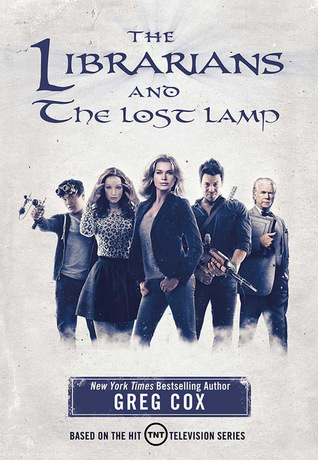
Book Review: The Librarians and The Lost Lamp

The Librarians and The Lost Lamp
The Librarians #1
by Greg Cox
read by Therese Plummer

My rating: 4 / 5
Genre: Fantasy adventure

In 2006, Flynn Carsen, the lone librarian, is sent to keep Aladdin’s fabled lamp from falling into the hands of The Forty, a criminal organization that has been searching for the lamp for centuries. Using Scheherazade’s The Arabian Nights as a guide, Flynn must outwit the thieves. In 2016, the new team of Librarians heads to Las Vegas to find out why a man winning the lottery is cause for concern. And they might just run into an artifact from Flynn’s past.

Let me first state that I love The Librarians. I think the show is better than it has any right to be, and a large part of that is due to the great casting. The movies were good as well, but I think the show really took the overall story world to a new level. Though I haven’t been able to find definitive proof of where in the show this book takes place, I’m calling it between seasons 2 and 3. And while the book does attempt to give some basic understanding of the overall setting and backstory of the Library and the Librarians, I think this book is best read by someone who has seen at least the TV show. Considering that half of the book takes place while Flynn was the sole librarian, a knowledge of both the movies and the show might be best.

I liked that we kinda got some of both—solo Flynn and the dynamic of the group. The movies with Flynn tend to be more epic, big-budget adventure, with him trying to track down some kind of relic that could be a huge problem in the wrong hands, and his side of the story in this book is just like that. The TV show episodes, at least the filler/MOTW (monster of the week) episodes, involve more mystery as the team has to first track down who and what is causing the problem and then figure out how to stop it. Their side of the book continues that trend.

At its best, The Librarians is campy fun, and at its worst, it’s illogical hand-waviness. This book had all of that, and I commend the author for doing a pretty good job capturing the characters pretty well. I know not everyone agrees on that, but I literally just finished watching season 3 of the show before reading this book, and I never felt like any of the characters acted all that out-of-character. And that’s considering that I listened to the audiobook, and the narrator definitely did not sound like any of the main characters (especially Stone). In fact, her tendency to be breathy during the non-dialog text and make every character sound like they were gasping at the end of every line could have ruined the story for me. But I was caught up in it enough that I was able to ignore it most of the time, and I’ll even give the audiobook another chance as I continue the series.

Find out more about The Librarians and The Lost Lamp

See what I’m reading next.

If you’ve read this book, or read it in the future, feel free to let me know what you think!
Book Review: The Horse and His Boy

The Horse and His Boy
The Chronicles of Narnia #5 (original order)
by C.S. Lewis

My rating: 4.5 / 5
Genre: Children’s classic fantasy

The first (and, as far as I can tell, only) book in the series where the main characters are not from our world, this story shows some interesting insight into Narnia and the countries nearby. Bree’s perspective, as a talking horse living amongst non-talking horses, provides some great contrast, and I could imagine how difficult it would be for both him and Shasta to find some kind of understanding. And Hwin, though she’s portrayed as demure and submissive, still speaks her mind when the occasion warrants it.

For me, though, the highlight of the book is Aslan’s contributions, both obvious and subtle (which is still sort of obvious, to be honest), culminating in a conversation near the end of the book. For those who see a parallel between Aslan and God, it’s a reminder that God is working in ways that we can’t see and may never be aware of (as much as I’d like to sit down with Him and learn how His hand was at work after a long, difficult week). I’m not sure how I feel about Aslan’s treatment of Aravis, but overall, this was a fun read.

Find out more about The Horse and His Boy

See what I’m reading next.

If you’ve read this book, or read it in the future, feel free to let me know what you think!

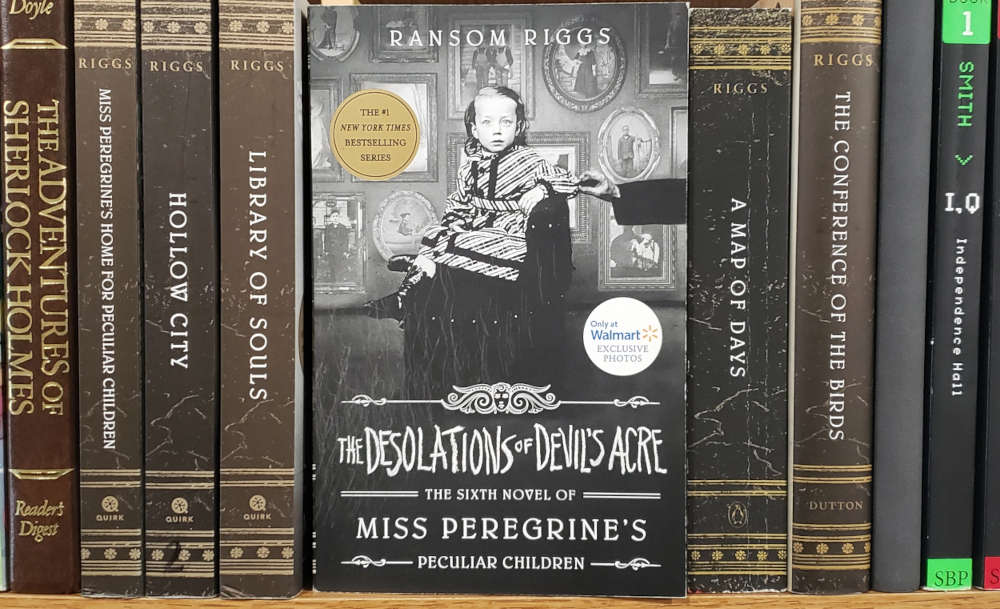
Book Review: The Desolations of Devil’s Acre

The Desolations of Devil’s Acre
Miss Peregrine’s Peculiar Children #6
by Ransom Riggs

My rating: 2 / 5
Genre: YA fantasy

With a larger-than-life villain creating larger-than-life henchmen and a prophecy to fulfill, Miss Peregrine’s wards will need to use every tool at their disposal to keep peculiardom from being enslaved.

What started as a unique, interesting idea has devolved into a repetitive, boring mess. There are characters and relationships I just couldn’t care less about (though that has been an issue for me from the beginning). There is more than one deliberate mislead that just made me feel lied to by the time I’d finished the book. Riggs basically mangles his own foundational lore in this book. And in the end, it all just felt like a watered-down rinse and repeat of the first trilogy’s end.

I wouldn’t necessarily say that Riggs should have stopped after the first trilogy, because he’d already created an interesting world that has a lot of possibilities. However, he definitely should have put more distance between the two trilogies, whether that meant evolving Jacob’s abilities in some way, having a different main character (because, let’s face it, with Jacob’s peculiarity, there’s only so much variety in what he can help fight against), or maybe even finding an entirely different group of peculiars to focus on. I now own every book in the series, buying them along the way, but wish I’d have read the last few before deciding to purchase them. I prefer to only own books that I plan to re-read someday, and while I may go back through the first trilogy, I would know to stop there in the future. For anyone else reading this series, certainly keep going if you’ve enjoyed it so far; plenty of others liked the this book more than I did anyway.

Find out more about The Desolations of Devil’s Acre

See what I’m reading next.

If you’ve read this book, or read it in the future, feel free to let me know what you think!
Book Review: The Silver Chair

The Silver Chair
The Chronicles of Narnia #4 (original order)
by C.S. Lewis

My rating: 5 / 5
Genre: Children’s classic fantasy

Not only is this the first book without any Pevensies, but it sure does delve into new depths (pun intended). Jill and Eustace are an interesting combination of characters—they’re the first to go to Narnia who aren’t related to each other in any way, not that being unrelated kept them from bickering. While parts of the story were quite predictable, I still enjoyed the way it played out.

Puddleglum, though, now he’s my kind of character. He expects the worst, yet never gives up. He has 100% faith in and devotion to Aslan, and I absolutely love his words and actions when facing the evil witch of this story. I really appreciate the way C.S. Lewis brings out truths about following God in the midst of these fantastical stories.

Find out more about The Silver Chair

See what I’m reading next.

If you’ve read this book, or read it in the future, feel free to let me know what you think!

Book Review: The Conference of the Birds

The Conference of the Birds
Miss Peregrine’s Peculiar Children #5
by Ransom Riggs

My rating: 3 / 5
Genre: YA fantasy

Spoiler notice: The following review will contain some spoilers for the previous books in the series.

Find V. Keep Noor safe. Avoid war between American peculiar clans. Of course, Jacob can’t do all of this alone, so it’s a good thing his friends are willing to overlook his stupidity and bring him back into the fold. But then the prophecy rears its ugly head, almost literally, and Jacob may not have what it takes to save the future of peculiardom.

This was my least favorite book of the series so far, though the story itself was good overall, about as good as the rest, to me. But I feel like either Ransom Riggs is getting more lazy or I’m just noticing it more. The most glaringly obvious is Noor. I was never a fan of Emma and Jacob’s relationship, so I don’t care that Jacob has a new romantic interest. However, Noor herself, and the development of their relationship, is like a rinse and repeat of Emma. Riggs seems to have no imagination for major female characters, especially those of the love-interest variety. And in this book, Jacob remarks that his relationship with Emma was “chaste,” to which I respond, “Compared to what?!” This is quite a ret-con of the earlier books, during which Jacob and Emma were definitely fairly physical. I really don’t understand the author’s thoughts in all of this.

This is not the only example, though, as a prophecy that was written in many different languages and cobbled together into English just happens to rhyme in English (and this happens again later with a shorter text). A loop that is locked just happens to let 2 people in, but keep all others out (nothing nefarious or planned, simply no explanation given). And the climax seems like it should be impossible (not saying more to avoid spoilers), but no explanation is given to make it more believable.

I think Riggs has done something decent here with this series, though I do wonder if he should have stopped at the first trilogy. Or perhaps made the second trilogy more of a removal from the first. A lot of people don’t really care for the villain in this 2nd half, and while it doesn’t really bother me, I get the frustration. I don’t know if he plans to continue with more books or not, but even though this book was less fun for me, I’m still looking forward to reading the culmination of this 3-book arc, and possibly of the entire series.

Find out more about The Conference of the Birds

See what I’m reading next.

If you’ve read this book, or read it in the future, feel free to let me know what you think!
Book Review: A Map of Days

A Map of Days
Miss Peregrine’s Peculiar Children #4
by Ransom Riggs

My rating: 4 / 5
Genre: YA fantasy

Spoiler notice: The following review will contain some spoilers for the previous books in the series.

After their victory over the wights and hollows, Jacob and Miss Peregrine’s peculiar children are disappointed in the assignments they’re given in the Devil’s Acre as part of the reconstruction process. Jacob, in particular, really wants to follow in his hollow-fighting grandfather’s footsteps, so he does whatever he can to make that happen. But peculiardom in America is vastly different from what he and the others are used to in Europe, and there’s a whole new menace to defend against.

It was really nice to see these “kids” who have been through so much have a chance at a little rest. Certainly not as much as they want or deserve, but the book started out more leisurely than the 2 before it. The explanation for why America’s peculiar community is so much wilder than Europe’s makes complete sense, and I loved the overall change of scenery from the first 3 books. I’m also perfectly okay with Jacob and Emma’s relationship cooling off, considering that it always weirded me out anyway.

This book was a lot longer than the previous 3, but it didn’t feel all that long. I don’t remember at any point thinking that something could have easily been cut out. It’s the set up to another 3-book arc in the series and unsurprisingly ends with a cliffhanger. I wasn’t sure how much I’d like continuing on in this series, but I’m excited to see what comes next!

Find out more about A Map of Days

See what I’m reading next.

If you’ve read this book, or read it in the future, feel free to let me know what you think!