Book Review: The Maze Cutter

The Maze Cutter
Book #1
by James Dashner

My rating: 2 / 5
Genre: YA dystopian

Spoiler notice: The following review will contain spoilers for the series that precedes it: The Maze Runner series.

Seven decades after the events at the end of The Death Cure, the final book in the previous series, the lives of the descendants of those who were sent to an island to live in peace and safety are disrupted. A ship appears bearing a woman who insists that some of them need to come back to the mainland with her. Meanwhile, the 3 parts of a mysterious authority group called the Godhead are at odds with each other.

I don’t think I’ve ever finished a book and felt like I was given so little info as I did at the end of this book. Things happened, but ultimately, nothing happened. It was a 250-page set-up for whatever is going to come later, but all that happened here is that we’re given little tiny bits of info that don’t really amount to a whole picture of anything. People are taken by one faction, then another, then another, and in the end, I have no idea who is with who and who is good or bad.

I don’t actually remember a lot about the end of the main series, but I remember that I felt like James Dashner had gone off the rails. The first book was good, but things just went all sorts of weird directions after that. This is basically a continuation of that. I decided to give this continuation series a try because of how much I liked The Maze Runner (the first book, not the entire series) and hoped maybe we could get back to those somewhat simpler roots. That is definitely not what we have here. One good thing, though, is that this first book makes it pretty clear that Dashner has plotted the entire continuation trilogy from the get-go, which is not at all what I feel like happened with the first trilogy. It seemed like he wrote the first one, was pleased it went well, and then just pantsed the rest of the trilogy. This feels like the opposite so far, but the first book doesn’t seem to have its own story goal that gets resolved, at least nothing I can pick out, which explains why I felt like nothing really happened.

I’m going to continue this series, but only because I jumped the gun and requested an ARC of the 3rd book in the trilogy. Since it’s one long story, I can’t exactly just skip the middle book. I do hope it gets better, but at this point, I wouldn’t really recommend the book to anyone, whether you’ve read the original trilogy or not. (On the other hand, if you enjoyed the first trilogy, that probably means that what bothered me about it doesn’t bother you, so there’s a decent possibility that you’ll enjoy this book more than me.)

Find out more about The Maze Cutter

See what I’m reading next.

If you’ve read this book, or read it in the future, feel free to let me know what you think!
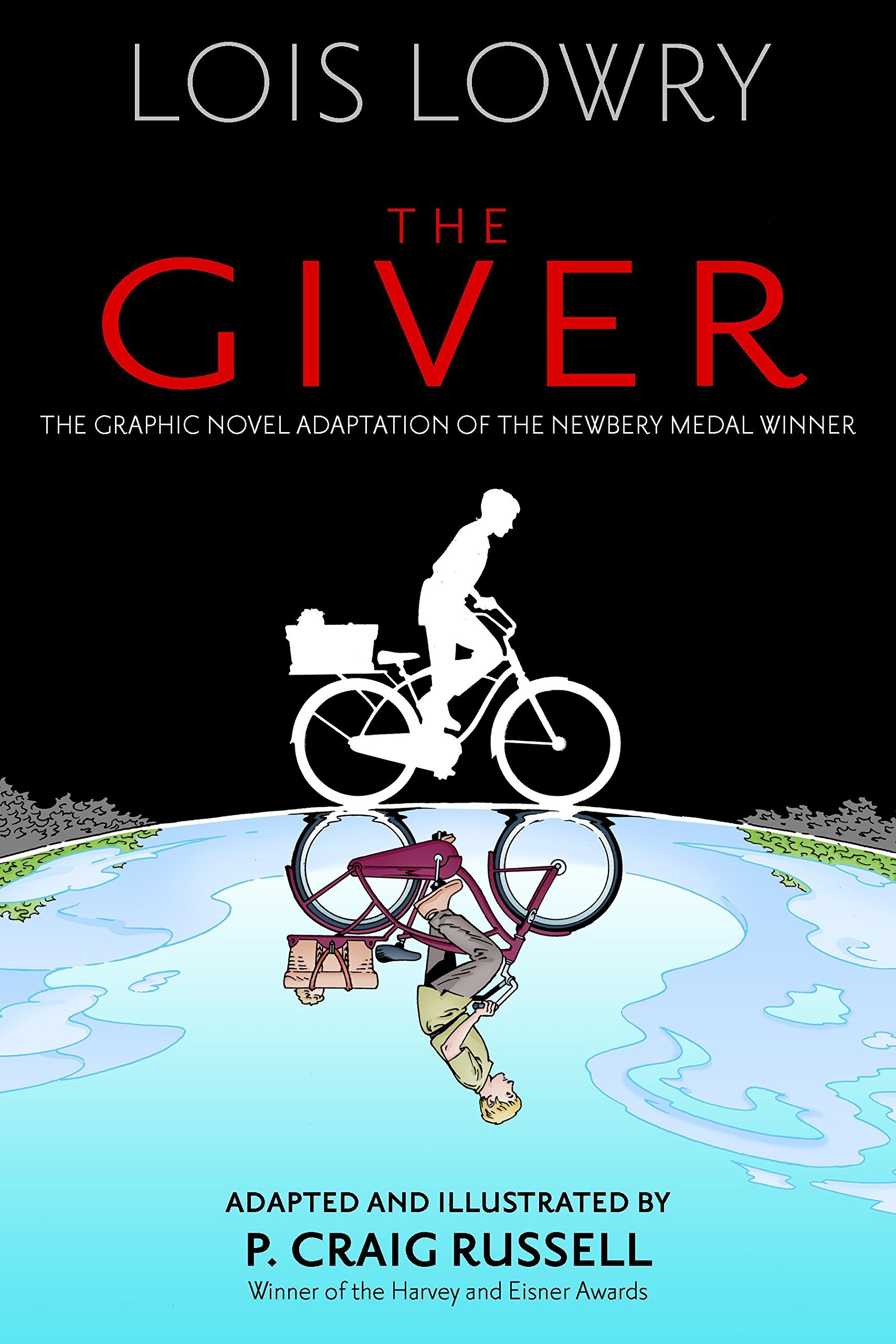
Book Review: The Giver, Graphic Novel

The Giver, Graphic Novel
The Giver series
by Lois Lowry
adapted & illustrated by P. Craig Russell

My rating: 5 / 5
Genre: Children’s dystopian, graphic novel

I read and reviewed the original book (see review here), so this review is less about the story and content than it is about the graphic novel format. My first impression when glancing through the book was that the use of pseudo black and white (it’s sort of more like blue black and white) for most of the novel was perfect for the story. The flashes of color here and there heighten the difference between Jonas’s view of the world and everyone else’s (besides the Giver). The visuals of the memories Jonas is given bring the story to life and highlight the blandness and sameness of the rest of the community. Certain graphics that I won’t specify to avoid spoilers are much more emotional than simply reading about them. Though in this format, the ending strikes me as even more ambiguous as it did the first time around, or maybe it’s just knowing the rest of the series now that makes me view the ending differently. All in all, I’d say the idea of converting The Giver to a graphic novel was a success, and I can see this being a good way to introduce the thought-provoking story to more reluctant readers.

Find out more about The Giver, Graphic Novel

See what I’m reading next.

If you’ve read this book, or read it in the future, feel free to let me know what you think!

Book Review: Divergent

Divergent
Book #1
by Veronica Roth

My rating: 4 / 5
Genre: YA dystopian

Set in a fairly nebulous, dystopian Chicago, the people have split into 5 factions, each prizing a different character trait as most important—selflessness, bravery, intelligence, peacefulness, and honesty. Upon turning 16, each person must choose between staying in the faction in which they were raised or choosing a different one, leaving their family behind. Beatrice Prior has a difficult decision before her, which is made all the more complicated when she discovers that she is Divergent, which means she is suited to more than one faction. But she’s told that this information is dangerous, so she keeps it to herself as long as she can. Unfortunately, it makes her stand out more than she’d like.

My first reaction to this book is that the world Roth has built doesn’t really seem realistic to me: in a a war-torn world of the past, the people picked a character trait, like aggression or duplicity, that they thought was the biggest reason for all the bad and decided to focus on being the opposite of that trait, forming five separate factions. It seems like a pretty silly way to try to avoid war, and it made me scratch my head to start the world building on this foundation. However, that is the foundation, so I figured that I just needed to accept that to be able to move on and enjoy the story for what it is. Past that sketchy start, it was a lot easier to believe that what started with good intentions could devolve to something much less good, because, well…people aren’t good. Don’t let anyone tell you different—on our own (meaning without God), we aren’t truly good. So discovering as the plot unfolds that at least one of the factions has been corrupted to be less of a pursuit of that faction’s trait and more of a pursuit of power is not surprising.

I had to go through a similar self-explanation and acceptance of the Divergent factor, which I took to be a kind of commentary on conformity and control and an “us vs. them” mindset. There were some unnecessary plot elements and a bit more focus on the physical in the relationship that builds throughout, but outside of that, I enjoyed the twists and turns along the way. The melding of different childhood factions during initiation is intriguing and some of characters are complex and well-crafted. The climax was not at all what I was expecting, and in some ways, I wish it had gone a different direction. But in the end, I’m glad I read the book and look forward to seeing where the story goes. (I also would really like to know what on earth is going on in the world outside of Chicago? Will that come up later in the series? I hope so!)

Find out more about Divergent

See what I’m reading next.

If you’ve read this book, or read it in the future, feel free to let me know what you think!
Book Review: The Ballad of Songbirds and Snakes

The Ballad of Songbirds and Snakes
The Hunger Games prequel
by Suzanne Collins

My rating: 4 / 5
Genre: YA dystopian

Spoiler notice: The following review will contain some spoilers for The Hunger Games trilogy.

This is the kind of book that is difficult to rate and review, because it is a book that is meant to be at least somewhat disturbing, as we follow a major villain’s descent into the dark. I’m not normally one who’s interested in a villain’s origin story, and it was no different with President Snow, especially after reading the part in The Mockingjay about his ever-present floral fragrance covering up his rotting mouth. It made my disgust more literal. But I decided to read this book to finish out the series; it just felt like something would be missing if I didn’t. Keep in mind, though, as you read the rest of this review, that I only read The Hunger Games trilogy for the first time pretty recently. That almost definitely makes my view of this prequel different in some ways from those who’ve known and loved the series for a long time.

Through parts 1 and 2, I was invested in the story. I think Collins did a good job giving us a somewhat sympathetic protagonist who feels trapped by circumstances. And he’s really as manipulated in some ways as Katniss is in her story. I’m not sure I ever fully understood what gives Dr. Gaul so much power, but she’s Snow’s own version of himself to Katniss in some ways. The main difference, though, is that Snow actually does begin to see things from Gaul’s point of view, which is part of the indication that he’s beginning to lose his grip on morality. This book’s Hunger Games and the lead-up to them, while being totally primitive compared to those in the main series, provide a compelling backdrop to Snow’s beginning steps toward depravity—the deception, the cheating, his first kill—things that he can rationalize at first.

Part 3 took a large turn that involved a fairly steep drop-off in action and interest for me, but the psychology of the villain’s slide was still there. And while it looks like things could actually go well for Snow, of course we know it can’t end happily, because we know who he becomes later, and it’s not this family man he envisions himself becoming. In truth, I don’t think he ever had the capacity for a normal, happy life. I’ve read several reviews that say his downturn happened suddenly at the end, but I would maintain that those people weren’t paying close enough attention during the rest of it. Snow makes many decisions that he justifies as being out of love—for his family, for his tribute—but really, the most important decisions he makes are only for himself, for family pride, to maintain his standing in society, however you want to spin it, it’s all selfishness. I do think he cares about his cousin and loved his mom. But even his cousin he puts one over on in the end for his own selfish gain. Yes, there’s a turning point at the end of the book where he makes a more deliberate choice, but I can see the rest of the book pointing right to it.

So that’s why my rating is 4 stars. And when I re-read this series in the future, which I definitely will, maybe even soon, I will probably not always finish with this book, but I will read it again at some point, I’m sure. I don’t know that I ever felt the need to know what made President Snow the monster he is in the original trilogy, but I still really appreciated this book. It’s quite polarizing, though, so if you’re wondering whether you should read it or not…that’s up to you.

Find out more about The Ballad of Songbirds and Snakes

See what I’m reading next.

If you’ve read this book, or read it in the future, feel free to let me know what you think!
Book Review: Mockingjay

Mockingjay
The Hunger Games #3
by Suzanne Collins

My rating: 4 / 5
Genre: YA dystopian

If I were rating this book by just the story, I’d give it 5 stars like I did the previous books in the series. But the gratuitous violence and death that I feared when I started reading the first book came in full force in this book. Much more death and much grislier deaths than necessary were spread throughout the latter portions of this book, but especially in part 3. And the pods, though of course they had already been in the first two books, but to a much smaller degree, reminded me a lot of the bizarre methods of attack in The Maze Runner series—over the top and completely unnecessary.

The story itself, including the ending, though, I liked. I can understand why some people didn’t, but I totally got it. I always knew this wasn’t going to end in rainbows and sunshine for Katniss after all the horrors she’d been through and the terrible things she’d been forced to do. Her PTSD would have to be more extreme than anything most of us can imagine, which is exactly what I saw in her in those last chapters. Add to that the fact that she still wasn’t really free, and it’s really no wonder she had no real fight left in her. I was still hooked, reading it as often as I could come back to it, which has not been as common for me in recent months, so that must say something.

I still think it’s funny that I was adamant I’d never read this series, yet I ended up loving it. I haven’t watched the movies yet…I suppose I will try to get to that soon. I am already looking forward to reading the series again though.

Find out more about Mockingjay

See what I’m reading next.

If you’ve read this book, or read it in the future, feel free to let me know what you think!

Book Review: Catching Fire

Catching Fire
The Hunger Games #2
by Suzanne Collins

My rating: 5 / 5
Genre: YA dystopian

I did not know where this was going to go at all. At times, it seemed like not much was happening, which is a huge difference from the action in the first book. I don’t need all that action, though, and especially the violence, and the tension surrounding the aftermath of Katniss’s actions in the games was enough to keep me going. In case we forgot how much control the Capitol has, we’re reminded in the way Katniss is controlled through threats to her loved ones. 

This series so far has a different kind of a take on a love triangle. Katniss doesn’t even really have much in the way of control over her own love life, and it brings home the reasons she had for not ever wanting to have a family. Even that decision will be out of her hands, if President Snow has anything to say about it. He’s not happy, but I did not expect the way he would take it out on her. When the story takes its sudden turn, I worried it would be too reminiscent of the first book, but I found it pretty darn fresh.

For someone who never, ever planned to read this series, it’s amazing how much I’ve enjoyed it. This book took turns I never expected and left me really wanting to know what’s going to happen! Now it’s all the more important to me to avoid spoilers for a book & movie series that’s been around for long enough for people to not care about spoilers. 

Find out more about Catching Fire

See what I’m reading next.

If you’ve read this book, or read it in the future, feel free to let me know what you think!

Book Review: The Prophet of Yonwood

The Diamond of Darkhold
Book of Ember #3
by Jeanne DuPrau

My rating: 1 / 5
Genre: Children’s dystopian

Some decades before the city of Ember is built, before the Crisis that moved the first inhabitants of Ember underground, a woman in the town of Yonwood has a fiery vision. But her comatose-like mind might hold the secret to keeping Yonwood safe from that catastrophic future.

I don’t really see a lot of point to this book. It’s a prequel to the first two books in the city, but it’s barely connected. And even the elements within this book were fairly disconnected from each other. There’s the main character, Nickie, and her aunt, who are visitors to Yonwood, and their disagreement about selling the house they’re there to clean out and possibly sell. The actual Prophet storyline, which barely comes across as the main storyline. Grover and his plight to make it to camp in Arizona. The kooky man who is interested in the heavens and is the only who who successfully defies the Prophet’s lackeys. There is just too much going on, and even by the halfway point, I had no idea what the purpose of the book really was.

As the Prophet’s main interpreter begins to get more and more ridiculous with her rules, I quickly began to realize that this is just another attempt on the author’s part to teach readers something she feels is important. But unlike a more universally accepted truth in the 2nd book (“War is bad”), this one is a lot more controversial. The book turns into basically an indictment on religion, seeming to imply that religions are largely fabricated by their followers. It actually reminds me most of the Pharisees who, by Jesus’ time, had imposed so many of their own rules, they had lost the core message. On top of all of that, the author attempts a tug at the heartstrings that is likely far more successful for dog lovers. I’m more of a dog tolerater (I know that’s not a word). I can acknowledge that what happens is ridiculous (stupid, really), but definitely didn’t get as emotionally invested as others might. In the end, I really wish DuPrau had kept this series more in line with the first book. The second wasn’t bad, but the first and fourth were my favorite, and I really just wish for more like them. If you are considering reading this series, I recommend it, but feel free to skip this third book.

Find out more about The Diamond of Darkhold

See what I’m reading next.

If you’ve read this book, or read it in the future, feel free to let me know what you think!

Book Review: The Hunger Games

The Hunger Games
Book #1
by Suzanne Collins

My rating: 5 / 5
Genre: YA dystopian

I didn’t want to read this book. I never planned to and was content with knowing nothing more about it than the basic premise. (I’ve never seen any of the movies either.) The main reason I stayed away is due to an aversion to heavy violence and death, and of course a book that involves a couple dozen teenagers being forced to kill each other is going to have plenty of that. I finally decided to read it after my son (who has seen the movies, but not read the books) tried to tell me that I might not be giving it a fair assessment, and of course, he was absolutely correct. And I did struggle still early on in the book, considering walking away because I was dreading what was to come. But I stuck it out, and boy, did I not expect to like it this much.

I appreciate the simple writing style—no pretension, no unnecessary words—and that made it easy for me to keep going when I didn’t want to face what was to come (yes, I am as much of a wimp as it sounds). And as the story unfolded, I realized I was empathizing with the tributes so much that my own pulse sped up in certain moments, during action or even just anticipating what was to come. And yet, in the end, I can say that the “violence for the sake of violence” that I anticipated from the book wasn’t there. Instead, we only see what Katniss sees, which is only what’s necessary to advance the plot or show her character.

The characterization and plot are a huge high point for me. Katniss’s attitude and motivation are consistent, and I really felt for Peeta throughout the book. Even the characters that it would be easy to hate end up being well-rounded and sympathetic. I wasn’t thrilled with the love triangle being set up, but at least it was a fairly minor aspect, as was the “romance” in general. While I can’t pretend to appreciate the world Collins has set up in this book, I do like that the book drew me in and made me want badly to see this system dismantled. I have unintentionally managed to avoid much in the way of spoilers for the rest of this series (or maybe I heard plenty of spoilers but just didn’t know what they meant at the time and don’t remember them now), so I am going forward with no idea what to expect, but with hopes for what I’d like to see firmly intact. All I can really say for recommendation, since I’m sure most people who are going to read this have already done so, is that if you’re like me and don’t want to read it because of reasons I mentioned, I suggest you reconsider.

Find out more about The Hunger Games

See what I’m reading next.

If you’ve read this book, or read it in the future, feel free to let me know what you think!

Book Review: The Diamond of Darkhold

The Diamond of Darkhold
Book of Ember #4
by Jeanne DuPrau

My rating: 4.5 / 5
Genre: Children’s dystopian

Spoiler notice: The following review will contain some spoilers for the first book in the series, The City of Ember.

The people of Sparks are suffering through winter without enough food for everyone and with many sicknesses and injuries. When Doon discovers a book that seems to hold a secret for the people of Ember, he and Lina make a plan to uncover that secret and hopefully help their town.

After liking the first book and being a little disappointed with the second, I enjoyed this one, which I felt brought back the adventure and intrigue of the first book. It helped me to realize that one of the things missing from the 2nd book is Lina and Doon working together, rather than both having their own quests. I also liked the return to Ember, even though much had changed, and how things played out there. The secret of the diamond was underwhelming at first, but as I came to understand it better, I appreciated it more.

The ending was a little strange to me, partly because it leaps forward and then backward at least once, and I had to reread some spots to make sure I wasn’t confused. And the reference to the third book in the series, which I skipped in favor of the next book in sequence (the third book is a prequel) was weird and made me less inclined to even read the third one (though I still will). However, the ending only detracted a little, hence the half point down from 5 in my rating. Overall, it was a satisfying conclusion to a series that I’m glad I read.

Find out more about The Diamond of Darkhold

See what I’m reading next.

If you’ve read this book, or read it in the future, feel free to let me know what you think!

Book Review: Son

Son
The Giver series #4
by Lois Lowry

My rating: 3 / 5
Genre: Children’s dystopian, fantasy

As a teenage Birthmother, Claire produces her first child of the three that are expected of her. But there are complications, and she is unceremoniously ejected from the job she’d been assigned. She begins to long for her son and will stop at nothing to find him again after he is taken from the community by Jonas, the recently appointed Receiver.

Well…what a strange, uncertain journey it has been through this series. In some ways, it seems like Son decently ties up the three books that come before it. In other ways, it seems like Lowry had no idea where she was going and took a rambling route to the end. I tend to assume that Lowry wrote The Giver without intending any follow-up. Then, considering how many years passed between each successive sequel that came out, I wonder if she had an ultimate plan in mind for this series, or if she just wrote each book as it came to her and tried to build on the previous. It would make more sense to me if the latter were true. Either way, though, I do appreciate being able to see more of the escapees from the first book. On the other hand, the existence of innate magical powers in quite a few people, in a series that started more as sci-fi than fantasy, is rather confusing.

I felt there were some weak areas in the book, even outside of the broader questions of simply what on earth is going on in this world. For example, I have a difficult time believing that Einar could really memorize so well the climb up the cliff that he had done only once, and an even more difficult time believing that the path up had not changed since the years before that Einar climbed it (plants should have grown, rocks might have crumbled, etc.). For that matter, since Claire’s reason for not leaving the seaside town by boat was her fear of the water, what was Einar’s? Why would he not just sail away, rather than attempt such a long, arduous, dangerous climb?

While I appreciate the storylines that Lowry does tie up in this book, I really wonder if we would have been better off left with The Giver as a standalone novel. On the other hand, many people like the series overall. It seems like the kind of thing you either love or hate. Though I’m personally in the middle somewhere, so maybe not. My final recommendation, though, is to read The Giver, if you haven’t already, and maybe just leave it at that, unless you’re really curious.

Find out more about Son

See what I’m reading next.

If you’ve read this book, or read it in the future, feel free to let me know what you think!