Daily Writing Check-in: January 9, 2019

Words/Time: 34 minutes doing some early revision of “Pursuit of Power.”

I read through more of the story, making broad changes and taking notes for other issues that need addressed (though so far there have been no notes to take). Today I got through 46 pages of 435, which puts me on pace to have this done in just over a week.

I should say, it’s not that there are no bigger changes to make (I mean, I still have some items on a list that I decided should wait until after I get this “good enough” to be read by a friend who has been itching to read it), but nothing besides some huge questions I have about leaving in entire sections of the story. I’m putting that off for later too. My friend won’t mind reading sections that might get cut later.

I am very glad for a daily challenge that isn’t impossible to reach, and keeps me moving forward, even at a slow pace. I’m just happy to get some work in these days.

DailyTime-30min-DebbieOhi-200

Daily Writing Check-in: January 1, 2019

Words/Time: 42 minutes doing some early revision of “Pursuit of Power.”

I completed 4 items in my list of things to revise again, which made me happy! Though I added yet another item to the bottom of the list. It seems like it’s never going to end, and this is just the early revision.

goal tracker Dec 2018

I am starting a new goal tracker on the NaNoWriMo website for January. December went so well that I have decided to up my daily goal to an average of a half hour a day. I’m not sure this is necessary, because I also know that if I start to fall behind, I won’t push myself to catch back up. That goes against the nature of this daily writing challenge. And during December, I definitely didn’t have to push myself to reach the daily goal more than a very small amount. But I’m doing it anyway, just in case it helps.

DailyTime-30min-DebbieOhi-200

Tips for NaNoWriMo, Part 5

crest-bda7b7a6e1b57bb9fb8ce9772b8faafb
In 2015, I wrote a series of posts about NaNoWriMo, covering things like tips for prep time, help in the actual prep work, tips for November, and even some of my favorite writing tools.

Earlier this month, I picked out some of my favorite NaNoPrep tips and boiled them down into a single post, and then I promised a post with tips about the actual writing. However, this time, I don’t want to re-hash my old tips, since I do actually have a few more to add to the list.

I will at least list the headers from 2 posts with tips about how to survive–and thrive–during NaNoWriMo, and suggest that if you want to read the details about any of them, you click the links that will take you to the two posts in which I first gave these tips:

Post 1
Break up the words.
Write in sprints.
Reward yourself.
Stay hydrated.
Back up your work.
Limit your time on the forums (and other online activities).
Don’t expect too much.

Post 2
DO NOT EDIT. (I can never stress this one enough)
Don’t go back and read.
Use placeholder words.
Take notes of things to fix later.
Stop in the middle of a scene.
Don’t be afraid to go off-script.
Dirty tricks to pad your word count (are not always a good idea).

Now to add a few more to those:

1. Don’t stop at 1667.
Sometimes my tips are a little hypocritical, but hear me out. If you reach the daily goal (1667 if you’re going the traditional route), but you still have some time left during whatever writing time you’ve carved out for yourself, don’t stop. Keep going until you have to make supper, go to bed, go to work, or whatever your end cap is. Those extra words will most likely be needed later in the month, and even if they’re not, hitting 50k early can be a lot of fun! Or who knows, maybe you’ll end up writing more than 50k this month!

In a similar vein, if you do write extra one day, don’t let that cause you to stop short the next day. I try to take each day as its own word count. No matter what my total is, I try to write 1667 each day (unless I’m behind, then I try to write more). Again, if you can build up a buffer, it will very likely come in handy later.

2. Plan your writing days & daily word counts.
Your daily goal does not have to be 1667 words. You don’t have to write every single day. Yes, that’s part of the benefit–using NaNo to build a daily writing habit. But for some people, despite all of the “rules” out there stating to write every day (yes, I have a series with that title, but I definitely don’t call it a rule, and…I definitely can’t always do that myself), it’s just not an option. So before November starts, figure out what days you don’t think you’ll be able to write. Are Saturdays always full of family time? Does a full work week always leave you drained, so you know you won’t write on Fridays? Do you want to try to write more on weekends, and less during the week?

Whatever your days off need to be, or even your overall pattern of writing, do the math and alter your daily word count. Print out a calendar and have those daily goals where you can see them. Make the month work for you.

3. Don’t panic if you get behind.
If you get off-track, don’t panic and think that means you have to write double for a few days to catch up. Figure out how many total words you have left, and divide that out by how many days there are left. That will up your daily amount by a little every day, rather than a lot for a few days. (If you keep your word count updated on the NaNo site, it will do this math for you.)

4. Check your official word count.
You can update your word count on the NaNo site by typing the number into the field at the top of the page. I would suggest that every so often, you actually go ahead and check your official word count. I do this at the end of every day, because if I’m 100 words lower than I’d thought, I want to know as soon as possible. The reason for this is that different word processors count words differently, and the NaNo site counts them differently than some of those word processors. By the end of the month, you could be even up to a thousand or more words off, and if you’re just barely getting to 50k, you don’t want to suddenly find out at 11:50 pm on Nov. 30 that you’re 1000 words shy. So just copy & paste your whole novel into the field that comes up when you click on “Check my official word count” under the “update” button.

5. Find helpful ways to procrastinate.
Is there such a thing? My favorite example is the NaNoMusical. Created by WETangent in 2012, it is a brilliant 6-part video series with themes and situations familiar to any Wrimo. The music is catchy and fun, and…well, you should watch it. Watch the first episode, and if you enjoy it, use the rest of the episodes as rewards for a certain amount of words written.

By the end, you'll either want to punch Rick or love him to pieces!

“It’s November 1st, thousands of people madly writing….I hope you’re up for crazy, ’cause NaNoWriMo has begun!”

There are many other helpful ways to procrastinate though. Go for a walk, read something pointless, take a nap (because odds are you could use the sleep)…you probably have your own ideas. The point is something that is light-hearted and gets your mind off of that novel that might be stressing you out.

6. Don’t give up.
That is probably the most important thing I can tell you. Whether you’re writing for fun, a creative outlet, to relieve stress, or to have a finished project to do more with, NaNoWriMo is a wonderful event and can be a lot of fun. It doesn’t have to be stressful, but I know it can be to some. The stakes aren’t exactly high, and losing is not the end of the world. You shouldn’t dread your writing time, or worry about how badly your writing is going.

If you find your story is going a completely different route than you’d expect, just follow it and see what happens. Maybe a side character is becoming more interesting to you. Give them all the time they need. Your main story will still be there later. If your words are lagging so badly, you don’t see how you could get back on track, make a new track! Set a personal goal of less words, or plan to keep going after November (though frankly, that is easier said than done). Come back in April or July for Camp NaNoWriMo.  Just don’t quit.

I had more new tips than I thought! And there are more out there floating around on the internet! In fact, here’s one just on NaNo Etiquette! The most important tip, though, is that when November 1st comes…just write.

We’re in the last week of NaNoPrep now, and this pretty much sums up how I’m feeling:

Jen

If you don’t know about NaNoToons, you’re missing out!

What about you? Are you ready for November 1st? Are you new to NaNoWriMo, or do you have tips of your own you can share?

Tips for NaNoPrep

crest-bda7b7a6e1b57bb9fb8ce9772b8faafb
In 2015, I wrote a series of posts about NaNoWriMo, covering things like tips for prep time, tips for November, help in the actual prep work, and even some of my favorite writing tools.

The problem now is that, though those things are all still helpful and relevant, there’s not a lot to add to them. I have picked up a few extra tips since then, sure, but those things I wrote about 2 years ago are still some of the most helpful advice I could give.

I could just reblog those posts throughout the month, but I don’t like that idea. Instead, I’m going to pick some of my favorite tips and share them in a few, boiled-down posts, while also suggesting that anyone who is interested in learning more visit the page where I’ve listed all of those posts from 2015.

1. Start writing now.
Take the next 2 1/2 weeks to learn what works best for you, so that by November, you know how to make the most of your writing time. Do you require absolute silence? If yes, when can you find that? Is your ideal time late at night when others are asleep? During your lunch break? First thing in the morning?

It doesn’t have to be the amount of time you will need to write 1667 words each day in November, but find maybe 15-20 minutes when you can sit down and write. For planners, work on the plot, characters, outline, or whatever you’re doing. For pantsers who are doing absolutely no planning before November 1, you can still make time every day to free write in anticipation of daily writing in November. In fact, free writing can be a great use of your time whether you’re a planner, a pantser, or somewhere in between.

Try to write every day, which is a good habit to have even outside of NaNo, but also keep in mind that if you can’t get to it one day, it’s not the end of the world. Just remember that if you’re like most of us, the longer you let yourself stay away, the less likely it is that you’ll keep the habit you’ve developed.

2. Find your space.
In a similar vein as figuring what when you work best, it can also be good to know in advance where and how you work best. Do you need a comfy spot? Maybe you work better at a desk or table with a straight-backed chair.  Where can you go to have the solitude you need? Or do you prefer some noise? Give coffitivity.com a try for a steady coffee shop background noise available anywhere you happen to be. Sometimes a little noise is good, but too much (people in the room, or even music with lyrics) can be bad.

Use your planning time to try out different locations and environments and see what works best. Do some work with pen/pencil and paper and some with a computer. Do you enjoy the tactile feel of writing by hand? Do you prefer the speed that typing can provide? This is the time to find out!

3. Gather your NaNo necessities.
Whether this includes consumables, physical tools, or making sure your laptop is set up and ready to use, make sure you know what you want to have handy for NaNoWriMo now, and procure as much of it as you can. When November starts, you don’t want to find yourself lacking.

4. Involve other senses.
I touched on sound above, so we’ll start there. Some people create a playlist for every story. I’ve read about people who will find music that matches the theme of their story, make a playlist from it (even if just on YouTube), and listen to it all month. Then, when November is over and they want to go back later and either finish the novel or revise it, they can listen to that music again, and it will put them right back in the mood.

Whatever your taste in music is, an alternative to creating an audio scene for your story is creating an olfactory scene. Scent memory is said to be very powerful. Go to the store and smell all the candles or all the scented wax (if you have or are willing to buy the wax melter to go with it). Think of your story, what it’s about, where it’s set, who the main character(s) is/are. Is it a romance? Maybe something flowery or sensual. Is it set in a tropical location? Something with coconut or tropical fruit, perhaps. There are outdoor scents if your story involves a lot of forest or other outdoor scenes. Not every story lends itself easily to a scent, but pick something that smells right and have it burning/melting near you while you write all month. Then later, you may just be able to immerse yourself back into the book by activating that scent again.

Check out this post for some NaNo-related music, comic strips, and even a musical!

5. The midnight sprint.
NaNoWriMo begins at midnight on November 1. That falls in the middle of the week this year, but if you’re the kind who stays up late, or can make an exception for one night, you can start writing right at midnight and get some words under your belt before going to bed. It’s purely a mental trick, getting a jump start on the day’s word count, but many people love to do the midnight sprint.

When November looms closer, I will post tips about the writing itself, and how to survive–and even thrive–during NaNoWriMo. If you’re don’t want to wait, by all means, here’s the link again to the series of posts I made 2 years ago, from which I’ll probably be stealing some those tips.

What about you? How are you preparing for NaNoWriMo? If you’ve done this all before, do you have any tips on how to get ready?

A New Day

I’ve been ready to write this post for about a week now. It’s the first one in almost a year and a half, so I knew it had to be epic, witty, or at least insightful. But I don’t want to write that post. I do want to address it, but in simple words. Though knowing myself as I do, it still may not be short.

At the beginning of last year, I submitted my first novel to publishers, after spending several years creating it. Without knowing if that first novel would be worth publishing, I tried to move on to revising my second novel. Then, I got a job. It was a part-time weekend job at first, working as a game master at an escape room company, but quickly became more than that, with sporadic hours. These two things together pulled me away from my regular writing work, which I’d been fairly consistent with for a few years (minus short hiatuses now and then).

In August last year, I changed to full-time with my job and became a manager. That only solidified my lack of time and mental energy to do any writing. I remember hoping that November, which would bring NaNoWriMo, would help me jump-start back into my writing.

Some time during all of this, I got a couple of rejection letters for my novel, but I was so caught up in how life was going at the time, I barely registered them.

Then in September, my dad had a heart attack and subsequent 6-bypass surgery. He’s doing well now, but was very close to death for about a week (not to be too dramatic). As NaNo approached, I decided to rebel a bit and write about the time he was in the hospital, both because he had a strong desire to know what had happened, and because I thought it might be cathartic for me.

I had a difficult time with the writing, and didn’t even get all of the events written, but I did finish NaNoWriMo. Unfortunately, because of my full-time job and the nature of my writing, NaNo did not help me return to my writing.

Fast forward almost a year, and I am now working 20 hours a week (approximately) at the same job, now as Director of Operations. The anniversary of my dad’s heart attack was last month, and he and my mom brought up the writing I said I was doing for NaNoWriMo last year. My dad has been trying to remember everything that happened during his 3-week hospital stay, and hopes that what I had written down would help.

It was still in “NaNo-form,” though, which means typos, things marked for deletion, and generally just hard to read. So I started going back through it, trying to put it in some semblance of a readable form, reading it along the way myself. While doing that, I started going back to other things I’ve written.

Over the course of the 3 weeks, I’ve read through just about everything I’ve written in the last 10 years, from the 2 complete novels, to partially drafted novels, to writing practice, drabbles, ideas, and even some of the fanfiction I wrote early on. I’m starting to have the itch to get back into it, and in some ways, I feel like I’ve just popped my head out of the cave I’ve been hunkered in for the last 17 months.

Going forward, I am going to work on writing as often as I can. I’m not going to pretend that I will be able to do writing work every day like I used to strive for. But even for the last week or so, I’ve already been writing out an outline for a story I’m not sure I want to write, but can’t avoid thinking about, so needed to at least get it down. That passion for just getting the words out is something I really miss, and I want to embrace it.

I think one of the things that disappoints me most about my time in the cave is that I barely remember participating in NaNoWriMo last year. I didn’t blog about it at all; I barely even finished. I enjoy going back later and reading through certain blog posts, remembering my writing journey, but 2016 NaNoWriMo is just a blank spot in my mind. I will be more deliberate this year.

My job, even at 20 hours a week, is still sporadic in the time those hours are put in. As Director of Operations, I am “on” from 9am until 11pm, 6 days a week, meaning that any time someone needs something from me, I’m generally expected to be available and respond. If I want to spend uninterrupted time with my family, I often have to schedule it.

I do enjoy my job. I design, implement, and modify escape rooms and get to be part of many other creative endeavors that our company is always working on. But I know that one of the reasons I do so well at that job is because, in my heart, I am a writer! 

i am a writer

This is from NaNoToons 2015. I don’t even remember last year’s NaNoToons…

For the approaching NaNoWriMo, I want to get back to traditional roots and write a new work of fiction. To do that, I have to sort through ideas I already have, see if any of them are ready to be expanded to a full outline, or decide to start something from scratch. Today begins NaNo prep season (I’m not sure how official that is, but October 1st always feels like the beginning of NaNo prep time to me). I am all in.

Loading Witty Title…

Wow, this place is dusty. I mean, really dusty. Layers of dirt and cobwebs everywhere. It’s not the first time I’ve taken an unintended break from my writing, letting it fall to the side for more than a month, but I think this is the longest gap I’ve had in posts since starting this blog. Previous breaks from writing were at least peppered with good intentions of trying to return, a day here or there where I’d post, and then still fall back into the break.

But it has been almost 2 full months since I posted even an attempt at keeping up with my writing. Which is because I haven’t attempted to keep up with my writing since February 17th. Looking back through my blog, it was even before that that I really started into this slump. It’s interesting to me, at least, to see the progression. It went something like this:

I finished revising my first novel, “Pithea,” to the point of even being able to send it off to a few publishing companies.

I dove right into revising my second novel, the first draft of which had already been written.

I got a new job on the weekends, which largely affected the rest of the week enough to make finding time and energy to write more difficult.

I hit an early roadblock in revising my second novel, and more time and thinking was required to push past it.

My new job started to ask more of me than I expected, including working during the week for a few weeks, thus exhausting me more and making things more strained at home.

I made a conscious decision to put off revising for a few weeks, dropped my daily writing habit, and let myself be lazy in the evenings (my normal writing time) instead of pushing myself to sit at my desk and get some writing work done.

It’s important to note that I am one who in the past has insisted that even people who lead busy lives should be able to find time to write. And I’m not saying now that it’s not true, but I definitely have more perspective on that now. It only took one change to my life and normal routine to throw me off enough to just give up on writing for a while. It took me two months to get to where I am right now, which is starting to feel a strong enough desire to get back to my writing that I’m willing to put aside the lazy evenings for more structured ones again.

It may take a few weeks to be back to where I was for 9 months before this break, writing almost every day. I don’t know when I’ll have time or ideas for another Write Every Day post. It may even take me a few wasted evenings of going back over what I was last doing in my work before I’m able to make any real progress. But the important thing is that I’m finally feeling up to it again.

Something else that bothers me about this break I took is that I fell away from all things writing and blogging. I haven’t read posts by others that I normally keep up with, and I know there’s no way I can find time to go back through 2 months worth of posts (not that I follow all that many blogs regularly).  I’m going to scan through my WP reader and try to hit the highlights, but I don’t want to take so much time reading that it hurts my attempt to start writing again.

I do want to say that I appreciate those of you who contacted me during the last few months to check in or ask if everything was okay. I’m sorry I didn’t respond at the time. I didn’t mean to be rude or anti-social, I just couldn’t get my head into the right space to think about any of this. Hopefully that makes at least some sense.

Thanks for reading my rambling. I hope things get back to normal around here soon. I miss my story world, and even the blogging world I’d created.

Dream Every Day: Story Cubes

 dream plan write

I used to think that if I ran out of spontaneous story ideas (those that came to mind on their own, and were not sought after in any way), it would be the worst thing in the world. There have been gaps in my writing that came from not being able to go forward on my current work, but not having new ideas that interested me much, and so I simply did nothing for months at a time. Though I love NaNoWriMo, I’ve skipped several years since my first time participating in 2007, because I didn’t know what to write.

I used to think that not having an idea readily available would mean I’d have to sit and stare at a wall, racking my brain for anything that could be a story. It’s not a pleasant concept, which is obviously why I chose to do nothing instead. Most of you, I’m sure, know how ridiculous that is. I regret this attitude, and those lost NaNo chances. In the last few years, I’ve finally come to see that not having a story to write may not be so terrifying. There are all sorts of tools and exercises that we can use to find ideas. Writing prompts, plot generators, and many other things can lead to an idea.

The one I’m looking at today is called Rory’s Story Cubes. It’s a set of dice that is billed as a game–two or more people rolling the dice and using the images that come up to create a story. There are several variations of game play, including one where several people roll the dice, one at a time, in turn, and add to a group story as they go.

007

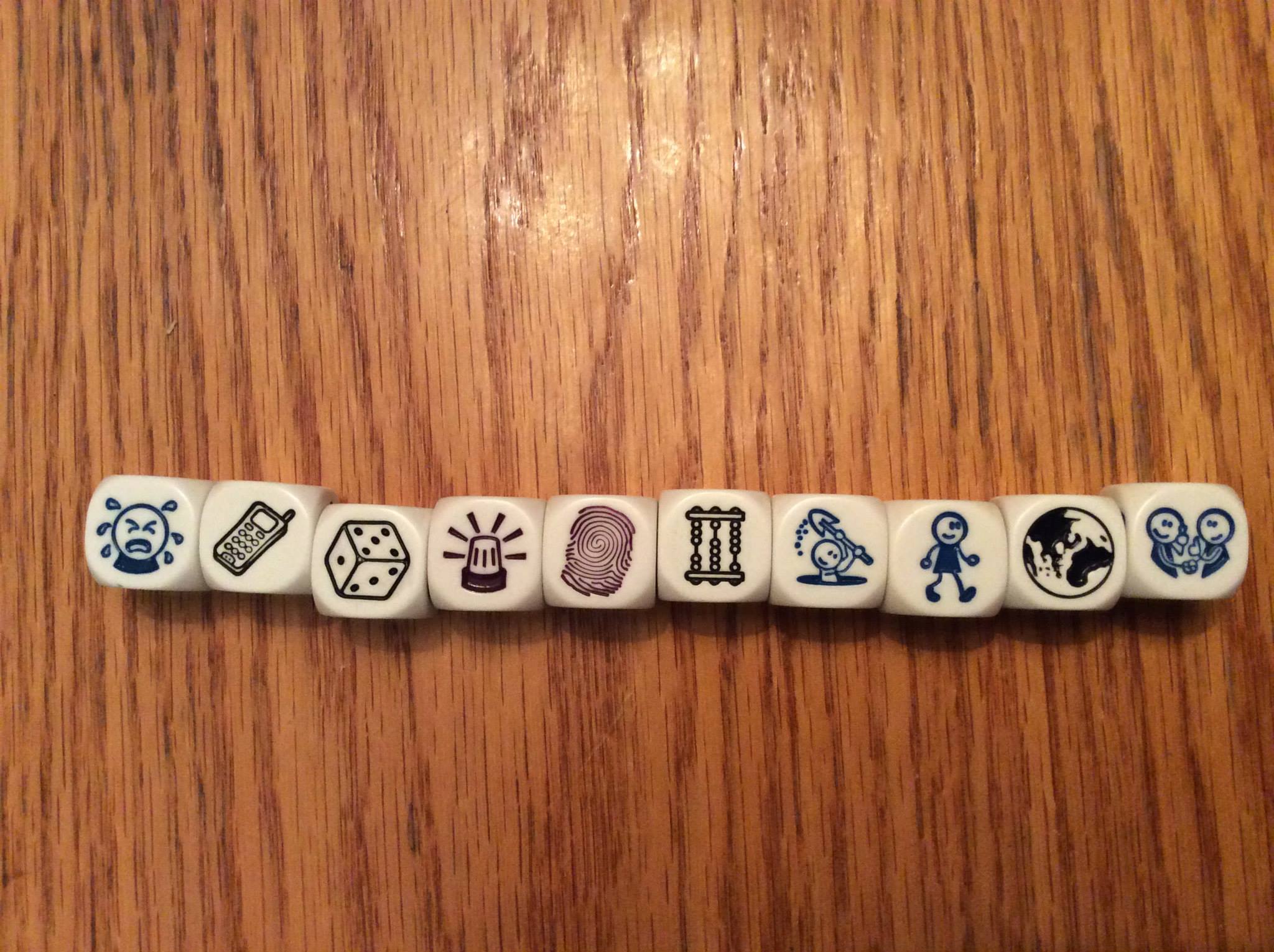
These cubes prompted a story about old flames, murder, and the mafia.

story cubes2

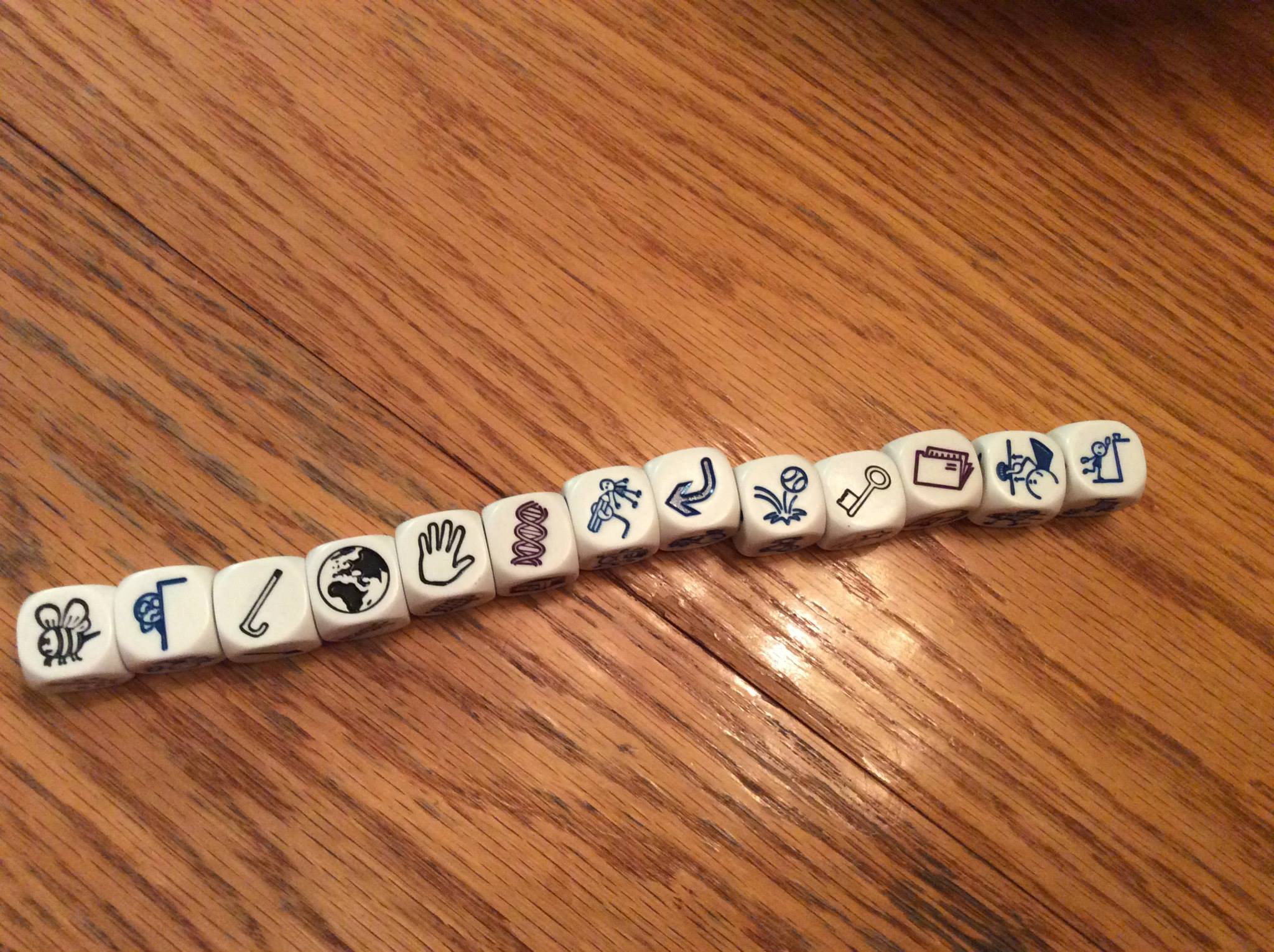
This chain of dice turned out to be about awards, thieves, and Greek detectives.

I’ve played with the cubes in groups a few times, and it’s fun to see what we come up with. When we first got the dice, my husband thought they may be useful for me as a writer, though I didn’t think it was likely. I believe one of the first things I said was that I didn’t know if the themes of the dice would really fit into my story world.

I’m still learning how prompts, seeds, and other tools can be beneficial to writing practice. I tend to think that if I’m not generating new ideas for my current project, it’s a waste of time. I have failed to understand that even the most innocuous writing practice can lead you to a new character, plot device, bit of dialog, or even just a feeling you want to explore.

So when I went on my writer’s retreat, I took the cubes and tried out using them alone. The method I chose was simply to mix all the dice together (we have 4 sets), choose one without looking, and roll it. Then I wrote a line or two based on the image. I proceeded to do this until i felt I had reached an adequate ending. That took 21 out of the 30 dice.

I enjoyed writing something completely unrelated to the world I’ve been so immersed in lately. Something with no importance whatsoever. I enjoyed it so much that I feel it would help keep my mind fresh for my writing if I were to do free writing practice more often. Most days, though, I barely have time to do my normal work, let alone finding extra time for that. Maybe when I can devote more of my life to writing (i.e. when my kids are older).

006

This one involved aliens and their bodily functions.

story cubes1

Here we have the tale of an elderly beekeeper; it turned into a government conspiracy with DNA-manipulated animals and giant graphite men.

One thing about using the story cubes that I’ve noticed and want to mention is that I have to be willing to let whatever comes from using them be completely ridiculous. Often, the dice will lead in some sort of impossible direction, and the stories end up being supernatural or dream-like in some way. One of these days I should try the method of rolling several dice at once and looking at them together to find a way to piece them together into a story, rather than going one at a time and not knowing what might come next.

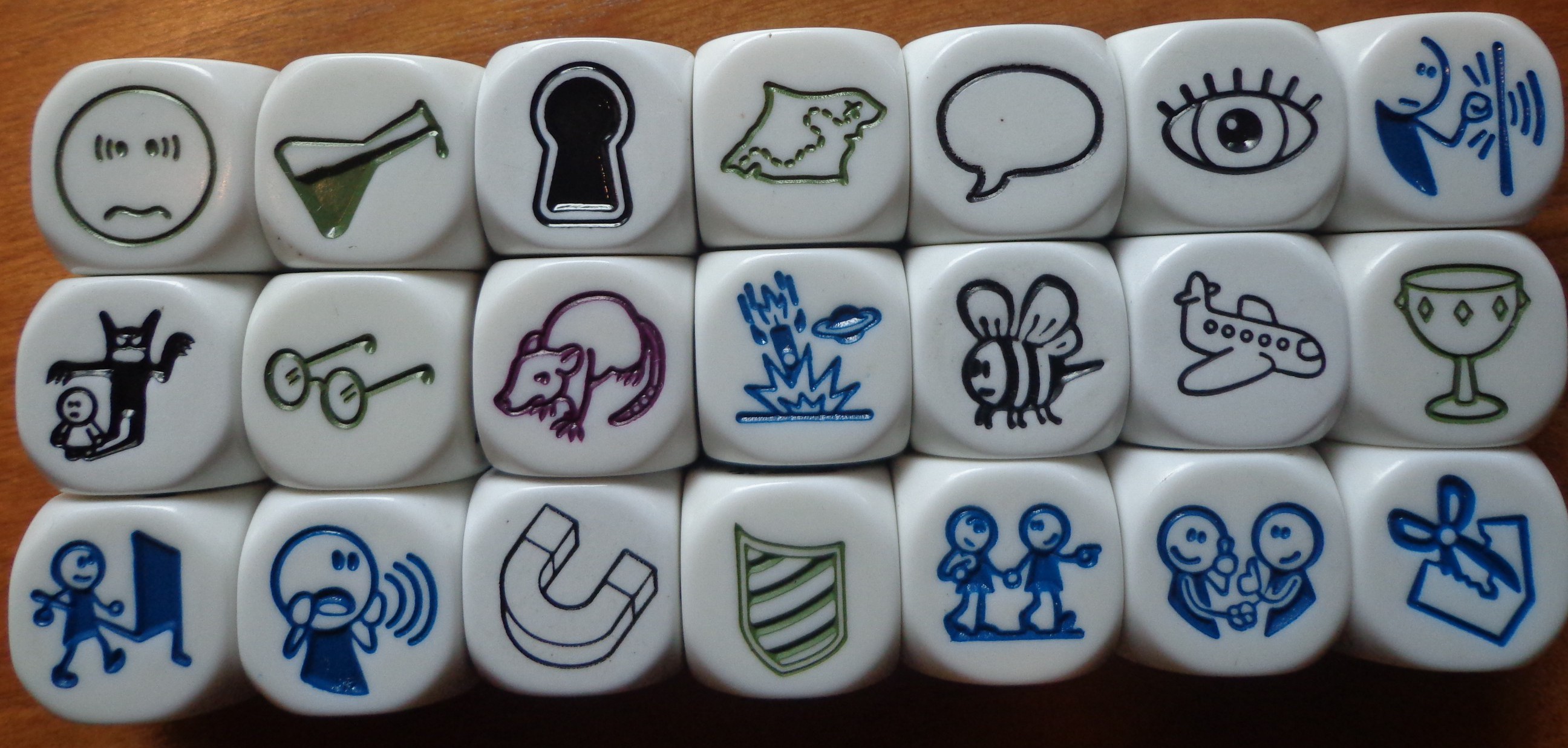
Dream for yourself: You don’t have to have a set of story cubes to be able to give them a try. I have included 4 pictures above of chains of the cubes that you could use for your own writing practice. Use the dice in order or mixed up; look at the chains as a whole, or only one die at a time. See what comes to mind. Below, I have shared the picture of the dice I rolled during my writer’s retreat. Feel free to write your own story from any or all of the cubes below, and then share it with me somehow. If you want to read what I came up with, you can find that here. (Note: If you’re thinking about writing your own, don’t read mine yet!) It would be fun to compare what other people come up with.

108

What are your thoughts on story prompts and other such tools? How do you fit free writing/writing practice into your day?

Write Every Day: Writer’s Retreat

dream plan write

I haven’t posted a daily progress update in over a week. My family took a 5-day trip to Toronto starting last Thursday, and returning Monday. I have spent the rest of this week recovering, and also purposely avoiding my writing. When we got back, I was tired and unfocused and gave into the laziness.

I think I may have needed a little rest after Camp NaNo, though I know that’s not in the spirit of writing every day at all.  Still, I knew my chance to dive back in would be coming soon.

My in-laws have a trailer set up at a local campground, which they’ve visited now and then throughout the summer. Several weeks ago, while thinking about our family spending a weekend out there, I realized something. That could be a great place for a quiet weekend away from all of the distractions of home. The initial idea wasn’t necessarily for it to be full of writing, rather simply time alone, after a chaotic summer.

School is about to start, and I homeschool my kids. I have a son who is starting 8th grade and a daughter who is about to start a more structured daily routine for kindergarten. And this summer hasn’t really been the most relaxing “time off” any kind of teacher might hope to get. Hence the weekend getaway. My husband is the one who mentioned the idea of making it a writing weekend.

So I am leaving this evening, with food that won’t need much preparation, my laptop, every notebook I think I may need, printouts of two different stories, and no real chance at having internet (the wi-fi is terrible there, I’m told). I am bringing some DVDs to watch for a break now and then and plan to get out and take a walk when I need to stretch my legs. I’ll likely stay up until I’m too tired to think, sleep until (most likely) noises from neighbors wake me up, and keep going.

Come Sunday evening, I may have a very different post to share about the realities of my writer’s retreat, but for now, I have grand plans to get all sorts of work done, and to recharge before school starts up again.

Have any of you out there ever had a sort of writer’s retreat? A day, weekend, or even more away from normal life, during which you focused on writing?

Plan Every Day: Those With Whom We Spend Most of Our Time

dream plan write

Character creation is an important part of developing a story. It’s one of the key elements of fiction, right up there with plot and setting. A unique character can make a stale plot seem new again. Alternatively, an overused character type can drag down a brilliant plot. So what do we do? We plan. We carefully craft our characters before we start to write. Sometimes, before we even start to outline.

(Obviously not all characters are planned in advance–you’re not always able to plan for everything that may come up as you’re writing. And maybe pantsers don’t have any characters figured out before they start. Is that a thing? I don’t even know. If so, though, at some point, I would think they’d have to slow down and flesh out the characters that came as they wrote.)

For me, character creation can sometimes go hand-in-hand with the outlining. As I’m weaving the plot, the characters are being defined by what the story needs. Sometimes, an idea for a character is sharp in my head before I’ve even figure out what may ever happen to that character.

In my early writing, I wasn’t great at making various characters have their own distinctness. That doesn’t mean there were 5 of the same person, but with different names and genders, wandering around interacting and moving the plot forward. Rather, I seemed to have a general nice, friendly type of character and a general crabby, anti-social type of character. I noticed that a lot of my side characters almost mirrored the main character.

In the time since then, I’ve been more careful to give each character their own sense of being. It has been an important part of my current revision of “Pithea” to flesh out side characters who are actual people in my head, but don’t get a lot of “screen time,” so to speak. Just because they have small parts doesn’t mean they shouldn’t be as much themselves as I can make them in those parts.

There can be a question, though, of how to really craft your character into a real person. Character sheets are an obvious answer, and you can find different forms of those all over the place. I’ve tried that before, but I’ve realized I don’t care for them. For a while, I thought that if I couldn’t answer a question like, “What is your character’s philosophy on death?” it was because my characters weren’t deep enough. Obviously I needed to answer that to have a really good character. But the truth is, no matter how I answered, it felt silly. It felt forced. It just didn’t work for me. (Character sheets or profiles can be a great tool if it works for you. I’d never discourage anyone from doing it. I may even try it again someday. Maybe I just need the right template.)

To get to know my characters, give them their own voice, or discover why they are who they are, my favorite method is just writing. Write a scene unrelated to the plot, centered around the character in question, maybe even from the point-of-view of that character, even if the main story isn’t. Writing prompts can come in handy for something like this, if an idea doesn’t readily present itself. But the general idea is to write out a scene and let that character shine in their uniqueness, and it gives you a better feel for that character.

As I’ve been working on “Pithea” with my sisters, one of them defended a character that was meant to be disliked by other characters and readers alike. My sister said, “He’s tactless, but everything he says makes sense. Why does everyone else always jump on him? They’re all really mean to him.” I was shocked and confused. He was a bully! Rude! Horrible! But as I read through his parts in the story, I realized that she was right. He wasn’t the nicest guy, but the other characters reacted to the man I saw in my head, not the one on the page.

So I spent some time getting to know him. I started with the personality I wanted him to have and asked what in his life could have led him to be that way. Then I wrote out important points about his early life. Over the course of a couple days, I did some writing practice from his perspective. None of this would ever make it into the story, but it was important to me. I shared it with my editing-partner sisters so that they could understand how I saw him. Then I changed some of his parts in the story, based on the deeper understanding I have of him now.

One more thing–while I don’t fill out a pre-made character sheet, I do make sure to write down traits or other important notes about my characters that I realize along the way.

Plan for yourself: Think about any characters you may have that you feel are not very well developed. Or that you feel have confusing motivations. Consider why they are in the story in the first place, and what specific personality or outlook on life their role would require of them. Then go backwards from there and think through why that personality might develop in them. Does he look down on women because he had three older sisters who treated him harshly? Did she become a nurse because when she was younger, she remembered how her sick grandfather’s nurse had brightened his stay in the hospital?

Spend some time getting to know them. Fill out a character sheet if you like and haven’t already, but go further than that. Write more with them than you might plan to for your story. Write as them. How would they describe themselves? How do they see the world? What do they think of the main character? Put them into a conversation with someone else, about something important or just what to have for dinner. How do they talk, react, or move during the conversation?

Make sure to write down anything you learn about your character during this time, somewhere that you can easily refer back to it.

How do you get to know your characters? Do you have a character sheet template that you use for every one? Do you ever struggle to avoid copy+paste characters, or do you excel at creating unique individuals? How many times do the words “character” or “characters” appear in this post?

Dream Every Day: Fanfiction That Isn’t

dream plan write

Full disclosure: I used to write fanfiction. A lot. All for one MMORPG called Ragnarok Online, which my husband and I played for around a year. It was where my love for writing fiction resparked, after having dimmed during high school. I’m never sure what’s going to happen when I say I write fanfiction. Plenty of people have no real opinion. Some say they have written or currently are writing fanfiction as well. And some scoff, laugh, roll eyes, or quietly assume the worst about what that means. There are many misconceptions about fanfiction, but that’s not what this post is about.

This post is also not about convincing you to write fanfiction—at least, not precisely.

One of the biggest benefits of fanfiction is that some of the work is already done for you. Characters are already in play, relationships built (or at least started), sometimes a plot is left dangling that you can pick up and run with. At the very least, in the case of a mostly story-less, character-less world like was in the game I wrote for, a setting has already been established—a whole world built, with mechanics in place that I didn’t have to create myself.

Don’t get me wrong; I’m not saying fanfic writers are lazy, but let’s face it—it’s easier to start writing when some of the work has been done. And that’s where I’m going with this post.

As writers, we are often reflections of what we take in. My dad is a blacksmith, and so is my main character’s dad. I have a character that I created long ago who is jovial, always enthusiastic, outgoing, and sometimes annoying; in recent years I actually met someone in real life who reminds me of that character, so now when I write that character, I keep this other person in mind as a guide.

Errol

Now when I write Aeldrim’s dialog, I think to myself, “What would Errol say?”

The same can be said for books we read, movies or television we watch, or even music we listen to.

A major character in my story “Outcast” was partially inspired by Nathaniel Hawthorne’s The Scarlet Letter, mostly in that I decided to give her a physical mark that reminded people of her mistake.

I have grand plans for a dramatic scene in a story that I never finished when I was writing fanfiction (but will likely pick back up someday and finish in my new story world) that was heavily inspired by a song called “Letters From War” by Mark Schultz.

And the entire premise of a short story I wrote years back was drawn upon the question, “What if the girl had to save the guy?” which I asked myself after watching a movie with my sisters. (For years now I’ve been certain it was the movie Last Holiday that led me to that, but after rewatching the climax to that movie, I don’t see how it could have been. So now I’m not sure what the movie was.)

As a whole, writers get ideas and inspiration from everyday life all the time, so none of this is special. Most writers that I talk to seem to always be neck-deep in ideas that they have to choose between when deciding what to work on next. This advice is more about what you can do if you’re looking for new material. A fresh idea, a different direction to take your plot, or a new character to introduce.

In the book Now Write! Science Fiction, Fantasy and Horror, there is an article about taking an existing story and simply adding a different element to it. Examples were moving the story to space, adding dragons, setting it in an alternate dimension, or adding time travel. The idea is not to literally rewrite the same story with the same exact plot with that one added element, but to use that as a starting point. Once you start plotting and/or writing, you make it your own. By the time you’re done, it will most likely look very different from the original.

And that is really where I’m going with this post. Take a cue from fanfic writers and let other stories around you inspire you. What you liked or didn’t like about them, what you’d change or how you think it would have continued.

Dream for yourself: For the rest of this post, understand that “story” can refer to any work of fiction in any medium—print, big or small screen (even a single episode out of a series), or audio.

Think of a story you really liked, but just didn’t like the ending. Or wish a character had been given a different side-plot. How would you have done it differently? What would have been better?

Or think of a story you absolutely hated. Starting with the same premise and same characters (or different characters, if they were part of what made the story so horrible), rewrite it so it’s better.

What character do you really despise? I don’t mean the kind that are meant to be hated, but one that fell flat for you. The character who grated on your nerves. Who was meant to be a comic relief but was just stupid. Or maybe one who was indeed an antagonist, but the villain factor was taken too far. Even a protagonist who you just didn’t sympathize with and couldn’t care less if they lived or died. What would you have done differently? How would you have made that character better for the story?

Yes, this is what some fanfiction writers do. But it doesn’t have to turn into literal fanfiction. If you do not purposely hold yourself to the world the original story is set in, you can make it your own. Or simply use these questions to spark an entirely different idea.

So how about you? Are you now or have you ever been a fanfic writer? Have you noticed real life or fictional stories seeping their way into your writing?