Daily Writing Check-in: October 11, 2017

Words/Time: Just over an hour working on NaNoPrep

I have officially settled on what to write for NaNoWriMo this year. I posted the mood board for it yesterday, but I still have a lot of the discovery phase to work through before I’m ready for November. I have never thought much in depth about this story idea.

After finally looking into what this “Beautiful Books” thing is that I’ve seen so many times, I realized learning what it was couldn’t have come at a more perfect time. For those who don’t know, you can find out here.

I answered the questions as a way of learning more about this story, and about the main character, and boy did it help (that’s what I did for my hour of work today). I will post more about that tomorrow though. Yesterday, I mentioned that, along with the mood board, I created a cover for my novel. I don’t normally do that. Only once before in my 7 previous years of participating in NaNoWriMo have I made a cover, and it was just a close-up picture of a forge.

I always assumed covers had to be complicated and fancy, but I got smarter. Here is the NaNoCover for my 2017 NaNoNovel, “Vin.”

Vin cover.png


For anyone out there who is participating in NaNoWriMo, feel free to check out my series of tips and tricks for the month, and also to add me as a writing buddy! (Let me know you came from here, and I’ll add you back!)

Daily Writing Check-in: October 10, 2017

Words/Time: 104 words written and 1 hour, 27 minutes worked

I finished the little bit of writing about a possible primary character for a possible NaNoNovel, because I didn’t want to leave it hanging.

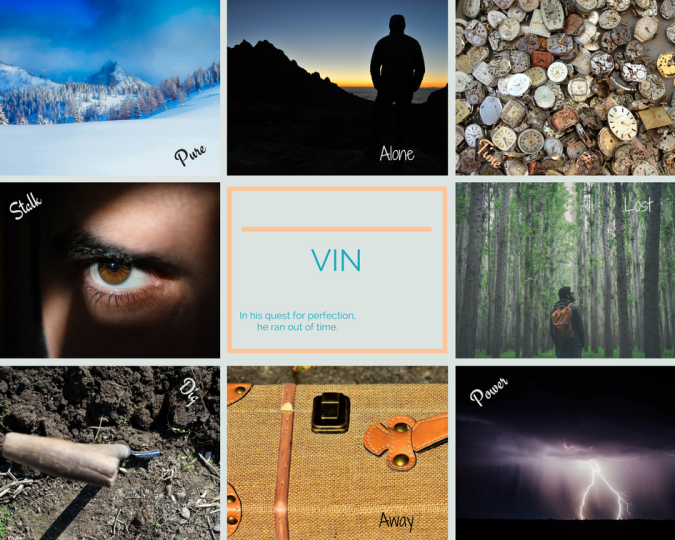
Then I decided to try my hand at making a mood board of sorts. I’ve never done anything like this before, outside of designing the icon for my story blog and, in a similar vein, the working cover for “Pithea.” I am not much for visual arts overall. But I thought it would help to solidify this story as what I wanted to write for NaNo, and it did. So I spent almost an hour and a half finding pictures, and then building this fancy layout. I also created a cover for the NaNo site, which I’ll post more about tomorrow. Again, I’m not much of a visual creator, so keep that in mind. It’s more about the themes, moods, and actions this board brings about:

Vin moodboard


For anyone out there who is participating in NaNoWriMo, feel free to check out my series of tips and tricks for the month, and also to add me as a writing buddy! (Let me know you came from here, and I’ll add you back!)

Daily Writing Check-in: October 9, 2017

Words/Time: 78 words written.

And no amount of NaNoPrep, and I’m not even bothered by it. It puts me below par in my goal for this month, but it just wasn’t going to happen tonight. This is my first time trying to get back to a writing habit for a year and a half, and the family situation and bedtime rituals are different than they were that long ago. My biggest obstacle from now on is going to be just getting to my writing time. However, since I’m a night owl, I will probably do some prep work after midnight, and count it for tomorrow. Maybe that’s how my whole NaNo will go too.

Last night I had a sudden idea about what I might write for NaNo, and it’s not one of the options I laid out for myself a few days ago. But it might just be what I need to write next, so my writing today was while I was waiting for a work meeting to start, as I decided to delve into the mind of one of the primary characters of that story. (So I guess it was a little bit of prep work! It’s going on the goal tracker!)


For anyone out there who is participating in NaNoWriMo, feel free to check out my series of tips and tricks for the month, and also to add me as a writing buddy! (Let me know you came from here, and I’ll add you back!)

NaNo After November

Did anyone else see this?

goal trackers

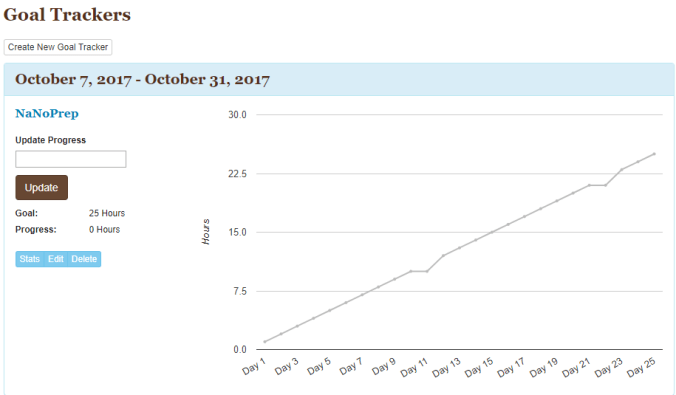
There is a feature on the NaNoWriMo website where you can track writing goals any time you want! According to my NaNoMail, this was announced this year in May, but I don’t always read all of the mail they send outside of November, even less so when I’m living in a cave.

You pick a start date and a stop date (up to a 100-day range), and set your own goal, which can be a word count, or an amount of hours worked. Then when you click create, this is what you have:

goal trackers 2I have seen many ways that writers try to keep track of their progress toward a goal, from Excel spreadsheets to filling in a calendar (well, maybe not that many ways…mostly just a lot of variations of spreadsheets). I used Final Deadline after NaNo in 2013 to set myself a goal for finishing the novel I started that month, and I know that without a tangible goal, I would not have finished my very first novel draft 3 months after NaNo ended.

Just like NaNoWriMo doesn’t work for everyone, continuing to track goals and fill in a chart during non-NaNo months might not be something even every Wrimo will want to do.

But for the rest of us, this is a really helpful addition to the NaNo website. I’ve already created a project to help me keep moving on my NaNoPrep this month. Since I started with it a few days ago, I haven’t felt any lack of motivation, but it could definitely still happen. (Though so far the fear of not being ready at all when November 1st comes is keeping me going.)

Besides, I always love watching the graph climb higher during NaNo…it appeals to some specific part of my brain. So I’ve set a goal that will average out to 1 hour of prep work per day for the rest of the month, and we’ll see how this goes.

(I don’t know why my graph has those flat spots. That is the “par” line, and twice it keeps the same amount of hours for 2 straight days, then jumps 2 hours for the next day. I don’t know if it’s a glitch or something they built in that I just don’t know about.)

What do you think about this feature? Do you plan to make use of it or give it a pass?


Tools for NaNoWriMo: Write or Die

crest-bda7b7a6e1b57bb9fb8ce9772b8faafbUpdate: In the time since I made this post, Write or Die has moved on to a 3rd version. The original version that I described in this post doesn’t exist anymore. It still works generally the same way, with even a few more options, but I personally don’t use it anymore, because I don’t like it as much. Now I just write on my Neo (great for avoiding distractions) and set a timer on my phone.

I came across Write or Die for the first time a few years ago. I believe my region’s ML posted it in a list of other tools for writers. I was hooked as soon as I tried it out.

The idea behind Write or Die is that an immediate consequence for not writing is more effective than a far-off reward for writing. The biggest benefit for me is that using Write or Die helps me avoid distractions while I’m writing.

There is a downloadable software that you can buy, or you can use the web app. I’ve only ever used the web app, not because I don’t think it’d be worth buying, but because my family’s budget hasn’t afforded me the ability to buy the software yet. For that matter, I prefer the older web version to Write or Die 2. The older version is what I’ll be using to explain the tool further.

writeordieThe above is what you see when you go to the link for the web app (now obsolete). There are four choices to make: word goal, time goal, consequences, and grace period. The first two are self-explanatory. You choose how long you want to write–sprint for 10-20 minutes, go for hours, etc. I usually set my word count goal higher than my average for the time I’m choosing, so I don’t quit early. (Edit: I recently discovered that if you leave the word goal at 0, the program won’t let you quit until you reach the time limit. So if you’re wanting to time your sprint, and just get as many words as you get, that’s the way to go.)

Once you start typing, if you stop to think about what to write next, you will start to incur the consequences. There are four modes for consequences: gentle, where a box pops up to remind you to keep writing if you stop for a while; normal, where some sort of obnoxious noise plays if you stop writing for a while; and kamikaze, where your words begin to be deleted if you stop writing for a while. (I’ll let you figure out the electric shock setting for yourself.)

After a few seconds of inactivity, the screen will begin to turn red in increasing shades. The amount of time you can pause in your writing before your chosen consequence kicks in is determined by the grace period you choose.

There is a pause button in the top, right corner. If you push it, a dialog box pops up and gives you as much time as you need to stop writing with no consequences (though sometimes when you unpause, the consequence is going off, so you just need to type something quickly to make it stop). You get one pause per session, so use it wisely. I save them for when my time is interrupted by a family member, or when I spill my water on my lap. I try very hard not to pause it just to think of the next thing I want to write.

When your time is up or your word count is reached, make sure you copy and paste your words to a file in a word processing program. Write or Die does not save your work. There will be a reminder before you leave the page, so it’s not something you should be extremely worried about, unless you tend to have bad luck with this sort of thing.

I love Write or Die when I’m writing on my own, or especially for word wars. The time set by fellow Wrimos can be set in the app, and I can see my time going down and words going up. I use this during almost all of NaNo, only writing without it when I have to write in a notebook for some reason, when I’m warming up for word wars, or when I am just so into what I’m writing, nothing could possibly distract me anyway.

The newer version has its merits, but I like the old version, I’m used to it, and it suits what I need it for well enough to not need to mess with the new one. If you have any interest in using Write or Die for your writing, during NaNo or any time of the year, you can play around with the features, and both versions, and figure out what works best for you, or if it works for you at all.

Tools for NaNoWriMo: Coffitivity

crest-bda7b7a6e1b57bb9fb8ce9772b8faafb

When I was in high school, I remember realizing that to be able to concentrate on my homework, I needed complete silence. Though I tried to convince my mom (and myself) that I could study in front of the TV, she never bought it, and really, neither did I.

Fast forward to now, and things have changed a little. What I’d like to do is listen to music while I’m writing, plotting, or revising, but that’s usually a bad idea. The only time it really works is when I’m doing something that doesn’t require as much focus, like transferring edits I made on my hard copy into the computer (which, frankly, barely counts as writing work anyway, but it has to be done now and then).

The lyrics are the main reason music is a problem for me. I start singing along, even in my head, and I lose what I’m doing. Music without lyrics would work–I know people who like to write to sound tracks from epic movies about adventure and magic. I don’t listen to that kind of music normally, so it would really just take too long trying to track down a playlist that I like or fits the mood of my story.

So I stay away from music most of the time, but I don’t like absolute silence either.

That’s why I use Coffitivity. I just found out about this website sometime earlier this year, but I use it almost every time I sit down to do any kind of writing work.  It’s basically just the sound of a coffee house or diner. On a loop. There are three options (or more, if you want to pay), though I honestly don’t see how any one is better than the others.

This doesn’t work as well for people who write with the internet turned off to avoid distractions, but for the rest of us, it could be a crucial part of our writing environment. If you’re not sure if you need silence, noise, music, or something else, try it out now, during NaNoPrep season while you plan your novel.

Tools for NaNoWriMo: Aeon Timeline

crest-bda7b7a6e1b57bb9fb8ce9772b8faafb

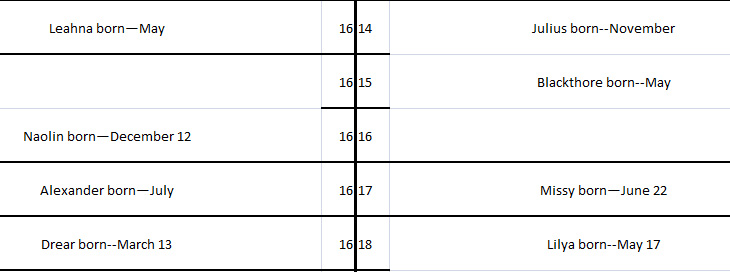
Years ago, when I was writing fanfiction, I struggled to create a timeline for my large group of stories that stretched across many years and contained a lot of the same characters. I started on paper, and eventually tried to make something with Excel. I did end up with a format that I have since used for other writing, but it was still a pain to use and especially to make edits.

timeline

It gets really messy when the events of the story pick up.

A few years ago, at the end of NaNoWriMo, I noticed amongst the winner goodies a discount for a program called Aeon Timeline. I downloaded the free trial and spent a few days putting several stories worth of information into it. I discovered very quickly that it was exactly what I needed.

There are many settings you can play with, including having the timeline stretch out over thousands of years, or one single day. If you choose the latter, the timeline will show much more detail than with the former. I’ve read that a user can create their own calendar system in the program too, which would be useful for fantasy writers, though I haven’t used the feature myself.

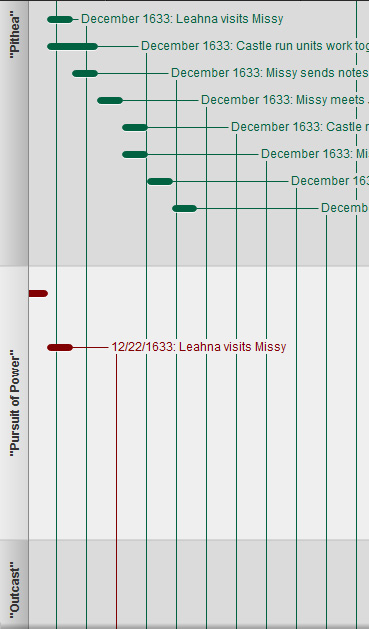
You can have individual sections for different stories, different story arcs, or whatever else you may need. You can also toggle those individual arcs on or off to your liking.

Aeon arcs

“Arcs” are shown along the left.

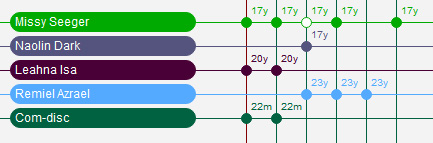
And one of my favorite things about the program is that you can add in all of your characters and attach them to the entries. If you set up a birth date, it will even tell you how old the character is at the time of that entry. The feature is called “Entities,” because it pertains to more than just characters too. I used it to remind myself of when a particular device (listed in the picture below as “com-disc”) was introduced into my story world, because I was having a hard time remembering when it was available to be used by characters.

Aeon entities

The lines go up to entries. The dots indicate that the character was a participant in that event (the one that’s not colored in indicates “observer” rather than “participant”).

Not every story needs a timeline. Sometimes events only happen over the course of a few days. The story I’m planning for NaNo this year will cover 9 days. I still plan to make a timeline for it as I plan this month. Even if in the end it turns out to be unnecessary, I know I’d rather have it anyway.

Though I’ve been mocked (all in fun, I assure you) for how meticulous I am with my timeline, it is crucial for keeping track of things for my group of stories that include “Pithea,” “Pursuit of Power,” “Outcast,” and other plans that will take place before, after, and during the others. There is so much to keep straight–character’s ages, how long ago a certain event happened, how long a certain event lasted, etc. So whether your writing is as complicated as mine or not, if you’ve ever felt the need for a timeline for your stories, Aeon Timeline is worth checking out.

How about you? Have you ever used Aeon Timeline before? Do you have a program you use for keeping track of a timeline?

Outlining for NaNoWriMo

crest-bda7b7a6e1b57bb9fb8ce9772b8faafbIf you’re just coming across this now, at the beginning of October, there’s still plenty of time to plan a story from scratch. Here is a list of posts I’ve made about NaNo, which includes starting with story seeds and beginning to develop a plot. I’m not finished with that series of posts, as I wanted to give people time to work on the various steps. Personally, I’m still in the “take a nugget of a plot and see what you can flesh out of it” stage myself. However, I think this is a good time to talk about outlining, in case anyone is ready for that step.

The Great Debate

This isn’t a new topic. Even I have discussed the debate between panters and planners more than once before. I’ve been doing a lot of reading about others’ NaNo prep on WordPress in the last month, and have come to a few conclusions about pantsing and planning: Most pantsers actually do some planning, but not enough to consider themselves planners. Most planners leave room to pants along the way, but still find that they need to have a certain amount of stuff planned in advance.

So basically, there are extreme panters–all they know at the beginning of NaNo is a basic idea like, “It’s set on Mars and involves werewolves.” Or more of a plot point like, “Everywhere she goes, Sarah hears voices. She thinks she’s schizophrenic until the things the voices say start coming true.” With no more than that basic idea, they start writing on November 1st and just let the words flow out of them.

There are extreme planners–they have a 10,000-word outline, detailed character sheets for everyone down to the MC’s hairdresser, and a notebook full of notes about the world they’ve built.

Most of us fall somewhere in between these extremes–plan a little and wing most of it, or plan a lot but still let the story change itself. And I’ve noticed that many panters think that having an outline before starting to write the story means you’re locked into what is in that outline.

The Case for Outlining

Let me just say right now that most planners do give themselves room to follow the story or characters in unexpected directions. Sometimes, I write 2/3 of an outline, then start writing, knowing that I’ll veer off the outline before I get to the end anyway. Or I’ll change the outline to suit the new direction, or throw it out completely. Not too long ago I took a little offense at a blogger who implied that pantsing was creative, and writing from an outline wasn’t. Don’t take my tone to be too severe here, but I’d just like to state that writing fiction is creating, no matter what way you go about it. Simply because I do more of my creating before I start the actual writing by no means makes it less creative.

And let me just put this out there–the more you plan before you write, the more intricate your story can be. You can weave subplots together, work in foreshadowing more easily, and find plot holes before you’ve written them into the story. Outlining doesn’t make your story perfect, but I do believe it adds more potential for depth.

One more reason that I find planning to be important is that if I don’t write down ideas as I have them, and get them into place in the story, I will simply forget them. Even for this post, when I was falling asleep last night, I had an idea for a random plot point for the example up above. I really liked it, even if it was just an illustration. By this evening, I’d forgotten it completely.

Types of Outlines

1.) Perhaps the first thing that comes to most people’s minds when they hear the word “outline” is the formal outline. You know the kind–with the roman numerals and indentation and such. outlineThey provide some scene organization and truly, if this works for you, great! Though they always made writing research projects easier, I still disliked making these in school. And a few years ago, I tried to make one for my NaNo project anyway. About 1/4 of the way through the outline, I decided it was more difficult than it was worth and switched to my normal way of outlining.

outline2.) My outlines usually look like this. Actually, they’re normally handwritten, but this one I typed was easier to share. I simply write plot point after plot point, events as I want them to happen. Sometimes a single line in the outline is so broad that it takes several pages to write that plot point. Sometimes the story flows quickly through several pages of outline. The important thing is that I’m getting down, in order, what I want the story to look like. And sometimes the details don’t require much extra thought during the writing (which, by the way, can be really helpful during NaNo…less slowing down to think of what else should happen means I get the words out faster). But sometimes the outline only tells me that “MC grows up after the important thing happens at the beginning of the story,” and I end up spending several thousand words making up things that happened to him while he was growing up.

3.) I recently learned about worksheets and templates for outlining. I knew of them for characters, so it makes sense that they’d exist for outlining too. If you think you’d benefit from having a template, you may try doing a web search for one that works for you. From what I can tell, there are those that give you lines to fill in an introduction, several plot points with supporting material, a climax, and a conclusion. Or there are some that show the image of a story (sort of like a mountain) and tell you to fill in the points along the way. If you’re new to fiction writing or even just new to outlining, perhaps the structure would help.

4.) Another way of outlining or plotting I have heard of, but never tried, is making a plot board. Some sort of board on which you place individual cards, post-its, whatever, each one of which is a different plot point or detail. You can color code it (which to my thinking would come in handy to show different subplots), see it all at a glance, and move points around as you need to. Something like this can probably be done on different mediums, and there are probably online that you can find better information on this than I can provide.

I personally plan to try outlining in Scrivener this year. I still have the free trial, though it won’t last all through November. But I’m still testing out different aspects of the program to decide if it’s worth buying. Since you can create a new scene for each outline point and then write directly into the scene space, thus organizing your story as you write, it seems like a nice tool…I’m just not sure how it will work for me in practice.

During October

Wherever you may be in your NaNo prep, I strongly advise that you start gearing up for NaNo now (if you haven’t already been). It’s not that it’s impossible to dive right in on Nov. 1 and win, but there are certainly ways to make it easier. As I’ve mentioned before, making writing part of every day now will make needing to do that in November easier. Even if you only spend 15 minutes per day free writing or working on novel planning, you can start building the habit now.

Are you gearing up for NaNo too? Do you have a different style of outlining?

Tips for NaNoWriMo, Part 2

crest-bda7b7a6e1b57bb9fb8ce9772b8faafb

Happy October! For those of us who are planning to participate in NaNoWriMo, October should be a very important month. (And I see by the WordPress Reader under the tag of NaNoWriMo that I am not alone in this thinking. Seriously, for the last month, I’ve been obsessively reading every post on WordPress that has been tagged as such, and it really exploded today!) There is a lot to prepare in advance, and I don’t just mean the story. Let’s face it, planning a story is only part of what one should to do prepare for NaNo.

Today, I’m going to share some more tips for what you could do throughout this month to make sure you’re ready to write on November 1st.

A few weeks ago, I shared some ideas for these pre-NaNo months that could help anyone who was planning to participate get ready. All of those tips still work for this month too. Honestly, if you’re new to NaNoWriMo especially, I suggest you learn what works for you now, because you’re not going to want to spend your first few days of writing trying to figure out where the best place is to write, or when you can get to it, or other things like that.

1. Consumables
NaNoWriMo is not the time for sleep. Caffeine can be a crucial ingredient for the month, so make sure you’re stocked up on your favorite poison. I don’t care for coffee, so I usually drink cappuccino (the kind from a powder). I drink iced tea, even in cold months, but it’s normally decaf. Last year someone suggested switching to regular tea for November, so I may try that too. But for my birthday this year, I got a Keurig machine. Strange for someone who doesn’t like coffee, I know, but since I discovered that I rather enjoy flavored coffees, I’ve gone kind of crazy for it. So I have a lot of that stocked up for November.

More than beverages, though, many people find that they want to snack more during NaNoWriMo. I know not everyone is as self-indulgent as I, so if you’re more health conscious, you may want to skip the chocolate. Personally, though, I have plans to go to some stores on November 1 in the afternoon and buy up a bunch of post-Halloween-sale candy. Chips are also a staple for some, or any other snack-type foods you like.

2. Writing Tools
This may seem kind of obvious, but there are plenty of things that you may assume you’d remember, or you’d have available, but won’t be able to find when the time comes. Make sure you have any notebooks you may need, pens or pencils, binders, planners, whatever physical items you use for writing. Put them all in one place and even contained in a transportable bag, box, etc. if your location for writing tends to change (either within the house or to coffee shops, library, or friend’s house). I would advise that even if you are a true computer writer and don’t use pen/paper for any stage of writing that you still carry a notebook and pen or pencil with you during November. It’s a good back up in case anything goes wrong with electronic devices, and this is not a time to risk that.

In the virtual sense, make sure you know what programs or apps you want to use and have them on any computers or devices you may use. If you’ve heard a lot about a program but haven’t tried it yet (like Scrivener or Evernote), download it now and play around with it before November. During NaNoWriMo is no time to be trying to learn a new software. I have some more virtual tools that I use for writing that I’ll share during the rest of this month too.

3. Writing Buddies
I’ve mentioned before that now is the time to be finding your home region on the NaNoWriMo website. More than that, this is a good time to start scheduling your month for local events, if you can make it to those. I won’t say that it’s a necessity to attend, as I would be a hypocrite if I did. I’ve never been to a write-in, just the last few years’ kick-off parties. Write-ins are usually 45 minutes away, and I’m a stay-at-home, homeschooling mom, so it’s hard to get away. This year, though, my local library, which is about 5 minutes away, is going to have weekly write-ins, so I’m working out plans to at least go to the first one and see how it goes.

Whether you go to in-person events or not, it can be nice to connect with others in your area, even if only online. Introduce yourself in the forums, see if there is an online chat you can join in on, and just be part of the community. It’s easy to get overwhelmed with the community if you let yourself, which is why I mostly stick to my region’s forums, and don’t venture much into the main forums.

Something else to be thinking about now is how you might best go about doing some word wars once November starts. (Word wars are where you and at least one other person agree on a set amount of time, usually 10-15 minutes, start writing at the same time, and compare your word count at the end.) Last year I was part of my first word wars, and let me tell you, they are very motivating. They were all virtual, taking place over Skype in a group some people from my region created. Almost every day there were word wars going on in the evening, and most of the Wrimos who were there regularly finished NaNo at least a week early, citing word wars as the reason why.

If you know people in person who are also doing NaNo, they’d be the obvious choice for word war competitors. However, you can usually find someone to go head-to-head with in your region, at write-ins esp, or if all else fails, there’s a forum for that: http://nanowrimo.org/forums/word-wars-prompts-sprints

4. Involve Other Senses
So number 1 kind of covered taste, but that’s not really what I mean. I’ve mentioned in a previous post about how the time leading up to November is a great time to discover what kind of writing atmosphere you need (if you don’t already know). Do you require absolute silence? Some kind of white noise? Music? The last one is what I’m referring to right now.

Some people create a playlist for every story. I’ve read about people who will find music that matches the theme of their story, make a playlist from it (even if just on YouTube), and listen to it all month. Then, when November is over and they want to go back later and either finish the novel or revise it, they can listen to that music again, and it will put them right back in the mood. I’ve never done this, I think because music doesn’t work that way in my head. Or maybe it’s because I’m too lazy to spend time tracking down what music would fit my novel (though this year, I may just have the perfect music, given the subject matter).

One year, I did spend the whole month going back and forth between these two playlists: D&E NaNo songs, NaNoMusical songs

Whatever your taste in music is, an alternative to creating an audio scene for your story is creating an olfactory scene. Scent memory is said to be very powerful. Go to the store and smell all the candles or all the scented wax (if you have or are willing to buy the wax melter to go with it). Think of your story, what it’s about, where it’s set, who the main character(s) is/are. Is it a romance? Maybe something flowery or sensual. Is it set in a tropical location? Something with coconut or tropical fruit, perhaps. There are outdoor scents if your story involves a lot of forest or other outdoor scenes. Not every story lends itself easily to a scent, but pick something that smells right and have it burning/melting near you while you write all month. Then later, you may just be able to immerse yourself back into the book by activating that scent again.

5. To Sprint or Not To Sprint
NaNoWriMo begins at midnight on November 1. This year, that falls on Saturday night/Sunday morning. If you’re the kind who stays up late, or can make an exception for one night, you can start writing right at midnight and get some words under your belt before going to bed. It’s purely a mental trick, getting a jump start on the day’s word count, but many people love to do the midnight sprint.


If you read my first Tips post, hopefully you have been getting used to how you like to write–what format you prefer, what items you’ll need, what kind of writing environment you desire. If not, there is still time to do that. The best advice I can give is to start writing every day right now. Whether that writing is pre-writing for your NaNoNovel (brainstorming, outlining, character creation) or just free writing to get in the habit, it’s a great idea to warm up before November starts, and not jump in cold.

Are you considering NaNoWriMo? Give me a shout if you’re participating, and share what you do in October to get ready. Feel free to add me as a buddy on the site, though let me know you came from here somehow.

My NaNoWriMo

crest-bda7b7a6e1b57bb9fb8ce9772b8faafb
I am going to do something a little different with this post than I normally do. Not that talking about my writing is all that different, but I’ve never done so to this extent. As I prepare for NaNoWriMo and do my best to help others prepare, I have been purposely vague on my own history. I try not to spend too much time talking about my own writing, because that’s not the point of these NaNo prep posts.

I do post daily about the writing work I’ve done for the day, because this blog was originally intended to keep myself accountable. I’ve since expanded it into a place to share writing tips, but I still post at the end of every day in which writing work of some kind happened, to check in. However, they’re usually short posts with not much detail (or a bit of detail with no context).

Today, I am going to share my personal NaNo history. If you don’t really care about my personal NaNo history, I won’t be offended if you simply don’t read on. (I probably won’t even know.)
nanowinner07I first heard about NaNoWriMo on a forum for Ragnarok Online fanfiction. The moderator mentioned it, and I ran to go check it out. I decided immediately to join, even though it was already October. At the time, I had written a good amount of fanfiction for the aforementioned game, and was stalled on the 5th (and last) in a series of novella-length stories. I also had a brand new fic I wanted to work on, but needed to finish the other first. NaNoWriMo gave me a brand new motivation to push past the blocks. I was so excited, I didn’t even want to wait until November. So I started on October 21st and wrote for 30 days. I finished the book I’d been stuck on in short order and spent most of the month writing “Outcast.”

There was no region near me, so I was stuck in the “Indiana: Elsewhere” category, and most of the people were from way north or south of me. There was no real hope for much social interaction, but that didn’t bother me. I’m pretty terrified of people anyway.

I ended the month with 50,288 words, and though “Outcast” wasn’t finished, I did finish it within the next year. It’s still one of my favorite stories ever, and I can’t wait until it gets its turn at being re-set in the world of Pithea.

“Outcast” is a story about sin and redemption, losing everything to gain much more, and the nature of true friendship. More information about the story can be found here.

I skipped 2008. Though I agonized over my decision all month (or at least the first few weeks, until I decided it would be too late to start anyway), I’m pretty sure this was the point when I was starting to transition away from writing fanfiction, but couldn’t really move on from those stories.
nano_09_blk_participant_100x100_1.png In 2009, though, I was raring to go again. I had worked for several months on building a world in which I could set my fanfics–original, but still accommodating the stories I’d already written. With that new world in mind, I wrote “Pursuit of Magic.”

I’m pretty sure I was still in the Indiana: Elsewhere region, though I think I may have been a little involved in the region of a town not far from me too.

I wrote 22 words over the goal, finishing one day early. This time, I did actually write the end of the story. However, I had a lot of gaps in the last third of the story. A lot of areas that I hadn’t fleshed out and didn’t want to slow down to decide what should happen. Still, I had a final scene that I really loved, so that was something.

In 2010 and 2011, a combination of not having much inspiration in the fiction area and having a young child, while also homeschooling an older one, gave me enough reason to sit NaNo out. I wish now that I’d at least tried those years, as well as 2008. I didn’t really know back then how to generate ideas, so without any readily available, I truly didn’t think I could do NaNo.

2012-participantFollowing on the heels of two years off, 2012 was a rough one. The world I had started creating back in 2009 hadn’t worked out, and I’d officially decided that my fanfictions–the characters, plots, and future ideas–needed to be laid to rest. It was difficult, but I did have an idea for a new story. It wasn’t much of an idea, but I went with it. I don’t even remember if I had an outline, but I know the plot I had in mind didn’t extend very far. And during the month, I kept playing with the setting and changing things.

Fort Wayne, a city near me, had gotten its own region in (I think) 2010, so I had a region closer to home to join. I considered going to some events, but in the end, I was still too shy. I did join in on discussions on my region’s forum though.

It was messy, but I ended the month with 51,288 words, crossing the finish line on the 27th. I had barely any semblance of a story, and certainly not a full novel. I haven’t touched that story since then, as I’m quite sure I was forcing the idea anyway. If anything good came of that month’s writing, it was the understanding that I really need to plan more before November.

The best part about 2012 was that on the main NaNo website, there was a link to NaNoToons, a daily webcomic that runs during November (sometimes starting partway through October). And the day before November started, the guy who made the webcomic posted a link to the first episode of a musical he and some others had made about NaNoWriMo. By the end of the month, I was hooked on Debs & Errol and involved in a whole new world of geekiness, and the rest is history.
2013 NaNo Participant FB ProfileIn 2013, NaNoWriMo took on a new excitement for me. I had hit on a new idea for a story world that would work for my fanfictions. Instead of trying to simply alter the game world they’d been created in to make it original, yet similar, I realized it would be better to build a new world from the ground up. I started with one basic element around which I, along with my husband, have crafted the world that I use now. I spent a lot of the year figuring out how things would work, and how to fix problems in my existing stories to make the basic plots still work in the vastly different world.

From my fanfiction days, I had a core group of 5 stories (the series I mentioned back during the 2007 section). Most of the other plans I had, and many of the characters, stemmed from that series. So it was the first thing that needed to be converted to this new world. Originally, I really thought I’d just be able to go through and edit it to fit and to be one novel instead of 5 shorter stories.

Somewhere along the way, I realized how ridiculous that notion was. Not only was there too much that needed changing, but I had grown so much as a writer in the 6ish years since I’d written them. It was much smarter to rewrite completely. So I picked out what I wanted to keep and started plotting a new story. I boiled five 20k-30k word stories into one story in 4 parts. And then I proceeded to have the best November I’d had so far, writing what has since been titled “Pithea.”

I went to my first local event in 2013–the kickoff party. My husband went with me, and I got to meet some of the other Wrimos from my area. I kept thinking I’d get to a write-in, but it’s hard to get out alone with kids and a husband who works full time. Going to the kickoff was a huge step for me anyway.

I hit 50k words on Nov 14 that year, and ended the month with 90,228 words total. I chalked the amazing numbers up to having a lot planned for the story. I’d been working with these characters for almost 10 years, after all, and the story itself was a rewrite. The story wasn’t finished, but I wrote the rest over the next few months. In February 2014, I finished my first ever novel draft.

“Pithea” is the story of two teenagers who find their places in life while growing up in a world filled with Power and Madness. More information about the story can be found here.

2014-Participant-Facebook-ProfileThis brings us to last year. I went into November with a well-developed outline. I was writing a story that runs somewhat parallel to “Pithea,” with some characters and even a few scenes that coincide. I planned out 2014’s novel earlier in the year, while revising “Pithea,” so I knew for sure what the characters were up to when they showed up in “Pithea.”

Also, my 2014 novel was a rewrite of my 2009 novel. However, it was set in a different world from the one I’d tried to craft in 2009. Some basic mechanics were different enough that a lot of the plot had to be gutted and rebuilt. So though it’s a rewrite of very broad plot points, it was a vastly different story. Even the final scene from 2009 ended up needing rewritten, thus losing the big moment that I’d loved. By the end of the month, I had a finished draft of “Pursuit of Power.”

There was so much different about last year. I went to the kick-off party again, with my whole family. I joined a Skype group with other people from my region, where we proceeded to have word wars most of the month (my first word wars). I blogged about my progress every day, which was kind of fun–recapping the day’s story progress and how I’d fit the writing time into my day.

I broke my single-day word count record (which was probably in the area of 6000) with 10,516 words on the 15th. I also tried a challenge set forth on the forums to write 3k in 1 hour. I wrote a little over 3000, but I didn’t enjoy the experience. I crossed the 50k mark on November 12. At the end of the month, I weighed in with 107,234 words. 2014 is the first year I ever finished NaNo with a completed manuscript. Unlike its predecessor, “Pursuit of Power” was truly finished, without huge gaps of story that I’d have to fill in later.

“Pursuit of Power” follows Alexander Surett, who is messing with forces he doesn’t understand in an attempt to find the truth behind his father’s death. More information about the story can be found here.
Print

I always say I learn something new every year during NaNoWriMo. Some of it is about what to do, some about what not do to. I’m looking forward to seeing what I’ll learn this year, though I suspect a lot of that is already happening right now, with the series of blog posts I’ve been making about preparing for NaNo, and my own work to that effect.

There’s no reason to think that the virtual strangers who stop by my blog care to read so much about my past experiences with NaNoWriMo. Maybe it will provide some insight, excitement, or simply entertainment for someone though.

What is your history with NaNoWriMo? Do you love it or hate it? Feel free to share your own thoughts on the matter.