Book Review: Things We Couldn’t Say

Things We Couldn’t Say
by Diet Eman with James Schaap

My rating: 5 / 5
Genre: Memoir

Diet Eman, along with her fiance Hein Siestma, watched as the Nazi’s occupied their country, started imposing rules and restrictions, and then began to persecute the Jewish people living there. What started as quiet, minor resistance turned into a movement, with Hein and his brother leading their own group. Both Diet and Hein were arrested and spent time in prison, and then concentration camps. Fifty years later, Diet tells her story in Things We Couldn’t Say.

This is the third book I’ve read now that centers on Dutch resisters during WWII and the Holocaust. I was fascinated to hear about the citizens’ reactions to the occupation and the royal family fleeing in advance of the invasion, followed eventually by the realization that the royal family’s decision hadn’t necessarily been as cowardly as first thought. Diet also talks about why it was so natural for people in her country to resist, as she explains how stubborn the Dutch tend to be, easily forming splinter churches if there’s a difference of opinion.

In 2015, upon receiving the Faith and Freedom Award from the Acton Institute, Diet Eman said, “…you think it’s something special. But when your country is taken—and Hitler had said he would respect our neutrality, and then he marches in and he starts killing all of the Jews—and we had so very many Jewish people in our country. So, you would have done the same there, when you had friends who were Jewish and they were in danger.” However, from this book, it’s clear that not everyone would do the same thing. Even as Diet tried to find people who would help her early in her work, she was disappointed in her Christian friends who valued their own safety over that of others.

Diet was in the same prison, and then later, the same concentration camp, as Corrie & Betsie ten Boom, and though she didn’t meet them at the time, her observances of these fellow Dutchwomen of faith only strengthen my admiration of the ten Boom family (their story can be found in The Hiding Place). It’s inspiring to read how Diet’s faith grew during the toughest times and how she continued with her resistance work even after suffering very difficult things. I highly recommend this book to anyone interested in true WWII resistance or Holocaust accounts, especially those from a Christian worldview.

Find out more about Things We Couldn’t Say and Diet Eman

See what I’m reading next.

If you’ve read this book, or read it in the future, feel free to let me know what you think!

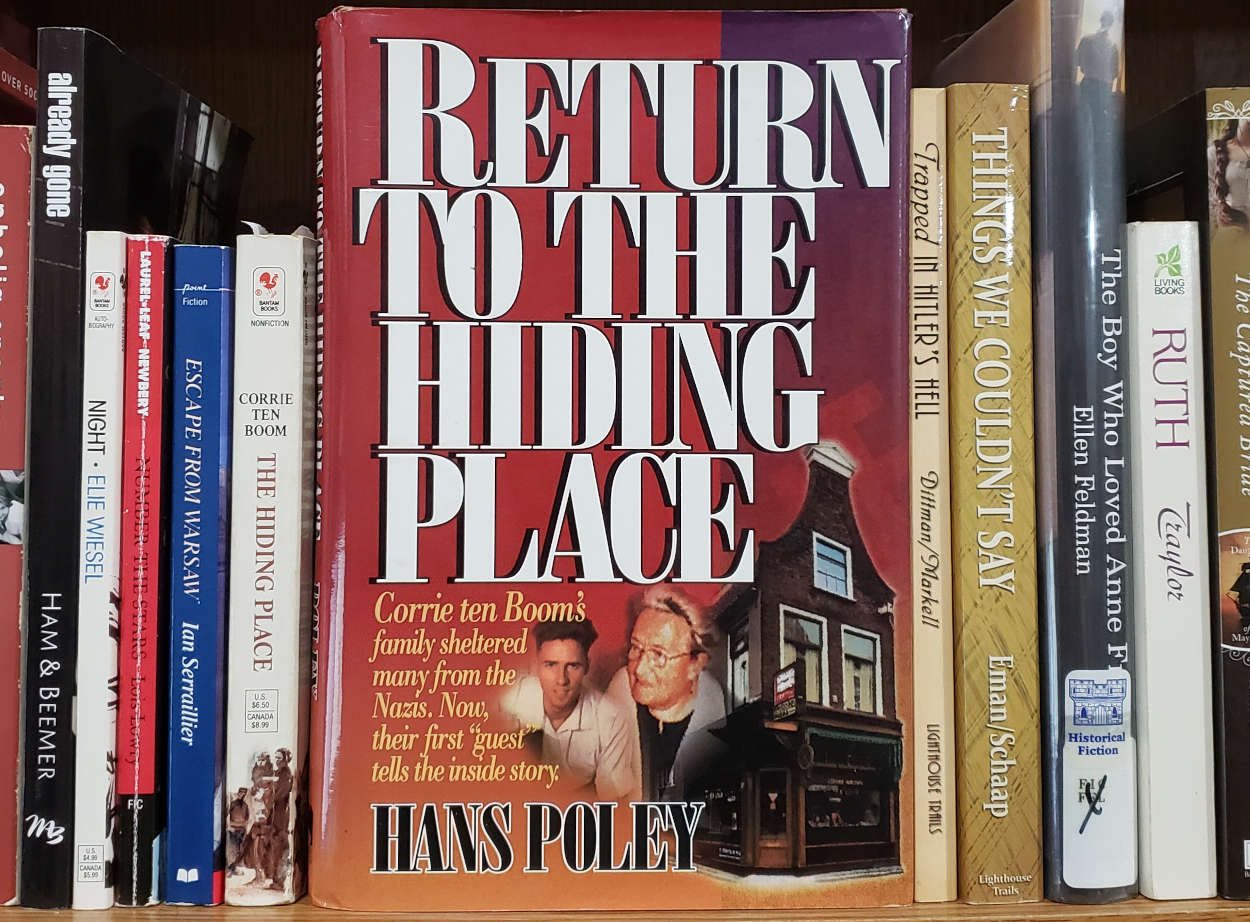
Book Review: Return to the Hiding Place

Return to the Hiding Place
by Hans Poley

My rating: 5 / 5
Genre: Memoir

During the time of Nazi persecution, a Christian Dutch family called the ten Booms welcome into their home various people who were hiding from the Nazis, both Jewish and not. 18-year-old Hans Poley was the first guest, hiding to avoid being sent to Germany to do hard labor in replacement of Germans who’d been sent to fight. Here he tells the story of his time at the ten Booms’ house and his own arrest that took him to a prison, then a concentration camp.

Having read The Hiding Place earlier this year, it was really interesting to see the Beje and the ten Boom family from the perspective of one of their “guests.” Not only does Hans Poley echo Corrie ten Boom’s assertions about the incredible faith of her father and sister, he shows Corrie herself as more open and giving than she portrayed herself in some areas. For example, when her room was chosen as the location for the secret room in her book, she tried to protest it. According to Poley, however, she “readily agreed.” I think we’d all be surprised to find out how others view us, compared to how we view ourselves, and in this case, Corrie ten Boom may have been a little hard on herself. Another small thing I noticed that didn’t match up between the books is that both authors claim to be the one who gave Eusi, one of the most prominent long-term Jewish guests, his fake name, and I wonder if this, and any other possible discrepancy, is simply due to faulty memories.

Yet again I was struck by how incredibly selfless this family was, giving up their own comfort and safety to help so many others. And Casper ten Boom, Corrie’s father, is even more inspirational to me after reading this. He repeatedly expressed a desire to help the Jewish people as if it weren’t even a choice to make. If you’ve read The Hiding Place, you should consider reading this too. Overall, though, I recommend it to anyone interested in true Holocaust accounts, especially those from a Christian worldview.

Find out more about Return to the Hiding Place

See what I’m reading next.

If you’ve read this book, or read it in the future, feel free to let me know what you think!

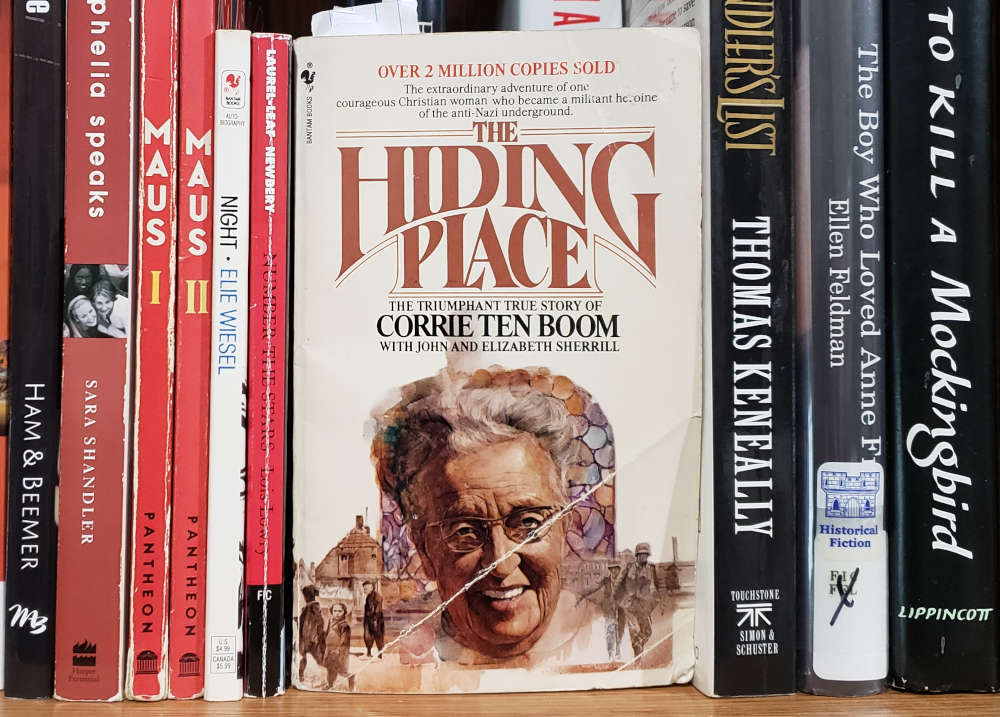
Book Review: The Hiding Place

The Hiding Place
by Corrie ten Boom with John & Elizabeth Sherrill

My rating: 5 / 5
Genre: Memoir

At 50 years old, Corrie ten Boom lived a simple life with her older sister, both of them unmarried, and their elderly father in a small house in Holland. When the Nazis invaded and occupied their country, Corrie quickly saw the need around her as Jews began to be shipped out. The ten Boom house and watchmaker shop became part of the Dutch Underground, helping those who were persecuted find a safe place, even to the point of building a small hiding place in their own house. In this book, Corrie shares much of her life before the occupation, including the faith that led her and her family to help those in needs, culminating in the arrest and imprisonment of many members of her family, and later to her time in a concentration camp alongside her sister Betsie.

This book is incredible in so many ways. It’s inspirational, and not only because of what the ten Booms did to help others. It’s the reason behind their desire to help, the way that it really wasn’t even a question about whether or not they would help, and the way that they affected everyone around them, even in the darkest of places. The strong faith in God that Corrie’s parents had, exhibited, and passed on to their children shows through every page of this book. Corrie herself struggled the most in this area, constantly learning from her other family members and being surprised by their heart for the oppressors. Yet she never questioned whether or not she should help the Jews around her at the risk of her own well-being.

Not many Holocaust-related accounts that I have read are from a Christian perspective, and I really appreciated seeing the little and big ways that Corrie and Betsie could see God involved in their plight. Though they never demanded that He help them, they trusted Him (again, Betsie more than Corrie) and gave Him credit when they saw Him work. I can only hope that in my everyday life, and even moreso when times of difficulty come, I can have the wisdom of Mr. ten Boom, the love of Mrs. ten Boom, the hope of Betsie ten Boom, the courage of Corrie ten Boom, and the faith exhibited by all of them.

Below are some quotes from the book that I marked to remember.

Casper ten Boom (Corrie’s father) upon the realization that Holland would soon be invaded:

“…I am sorry for all Dutchmen now who do not know the power of God. For we will be beaten. But He will not.”

Corrie discovered that a large piece of sharp debris had landed on her pillow while she was out of bed:

“Betsie, if I hadn’t heard you in the kitchen–“

But Betsie put her finger on my mouth. “Don’t say it, Corrie! There are no ‘if’s’ in God’s world. And no places that are safer than other places. The center of His will is our only safety…”

And the one that stuck out to me the most, from an elderly member of Corrie’s family who spent much of her life running clubs, writing tracts, always trying to further God’s kingdom. When she learned she didn’t have long to live, her family members told her she was going to the Father with hands full, due to all of her work. She replied:

“Empty, empty! How can we bring anything to God? What does He care for our little tricks and trinkets?”

And then as we listened in disbelief she lowered her hands and with tears still coursing down her face whispered, “Dear Jesus, I thank You that You have done all–all–on the cross, and that all we need in life or death is to be sure of this.”

Find out more about The Hiding Place

See what I’m reading next.

If you’ve read this book, or read it in the future, feel free to let me know what you think!

Top Ten Tuesday: Books of My Youth

It’s time for another Top Ten list from That Artsy Reader Girl. Today’s topic is “Books I Enjoyed but Rarely Talk About”. Considering that I’ve only been reading seriously for 9 months, all of the books that I’ve really liked have been in a TTT post at some point or other (some multiple times). So I searched a little further back and came up with 10 books that I read back when I used to read avidly, a pastime that had ended by 15 years ago. Only 2 of these books have been on a TTT post of mine before this.

This list is mostly made up of books I read in high school (some for English class, some for myself), with maybe one or two a little later than that. Most I’ve read multiple times, but just not within the last 15 years. I own almost all of these, as I liked them enough back then to buy a copy, and all of them I will most likely again soon and give them a proper review.


Hangman’s Curse and Nightmare Academy by Frank Peretti
There are many reasons why Frank Peretti is my favorite author, and this far-too-short series is one of them. I’ve read both of these several times and love them so much, especially the 2nd one. I only wish Peretti had written more of them.

Obsessed by Ted Dekker
I read this book several times after it came out in 2004. It fed into my serious interest in the Holocaust as a teenager and young adult (as is evidenced by several more of the books below), even though it’s fiction.

Maus and Maus II by Art Spiegelman
In the AP English classes I took for the latter 3 years of high school, we had some assigned books, and were allowed to choose our own classics. At one point, the school librarian came to our class to talk about a list of books that had won or been nominated for the National Book Critics Circle (NBCC) Award in the past, referring to them as modern classics. Our teacher told us that we could pick one of these in place of an old classic. Considering that the books on this list were generally shorter and easier to read…I picked them as many times as I was allowed. Maus II was on that list. Of course, it was the 2nd half of a story, but I liked it so much, I later bought both books.

The Hiding Place by Corrie ten Boom
Corrie ten Boom’s story is incredibly inspirational. I’m pretty sure I wrote a research paper using this book in some way. I did a lot of papers and speeches on Holocaust-related subjects in high school.

Night by Elie Wiesel
I don’t really have any to say about this one besides that it’s just more testament to my fascination with the Holocaust. I don’t remember this book very well, so it’ll probably be almost like reading it new when I do get to it again. Also, there are other books of this subject that I read back then, but those I included in this list are the ones I remember the most.

20200331_142441

Ophelia Speaks by Sara Shandler
Like with Maus, this book was one I was allowed to read for English class as a “modern classic.” Though I’m pretty sure it was Reviving Ophelia that had won the award. This book gives a voice to the teenage girls that the other book discussed, and even I, in my sheltered world, really identified with a lot of the essays. Written by adolescent girls with a range of topics about struggling to become a woman–about family, friends, physical and emotional trauma, and much more, I will likely have my daughter read it in a few years.

To Kill a Mockingbird by Harper Lee
This is one of the few classics I read in high school that I actually enjoyed (and frankly, one of the few I could actually follow very well). However, being that I was in high school at the time, I definitely need to read it again now, partly because I can read it for pleasure (not having to analyze every chapter) and partly because I’ll most likely pick up on a lot that I missed back then.

Rosencrantz & Guildenstern Are Dead by Tom Stoppard
After we read Hamlet, our teacher had our class read this play. I remember thinking how great of a teacher she was, considering how much fun the play is. And then we watched the movie with Gary Oldman and Tim Roth, of which I can really only remember the tennis scene…and papers flying everywhere that I didn’t get the point of. I’ll have to re-watch that after I re-read the book.

The Eagle and the Lamb by Darlene Mindrup
Story time: When I was a teenager, my family took a trip out to Arizona to visit my grandparents. My grandma had a huge collection of Christian romance books, and I read a few while we were staying there. There was one that I remembered liking more than all of the others, but years later, when I tried to find it again, I couldn’t remember the title. I thought it was something to do with “lion and lamb”, so over the last few years I’ve done Google searches for those words and what I could remember of the story, which is just that the main characters were a Roman centurion and a Jewish slave. For a while recently I thought it might have been A Voice in the Wind by Francine Rivers (it first in a series called Mark of the Lion and was published several years before my family went to AZ), but when I saw the length of that book–it wasn’t exactly the mass-market type romance I remembered reading–I dug a little more and was really excited when I found this book. The cover even looks familiar! Unlike when I came across A Voice in the Wind, I am 100% certain I have found the right one now. This will be an interesting experiment to find out if I even remotely like this book as much as an adult as I did as a teenager. (I still plan to read A Voice in the Wind at some point too!)

Have you read any of these, or are any on your own TBR? Link your TTT post so I can check out yours!