Book Review: John Bunyan’s Pilgrim’s Progress

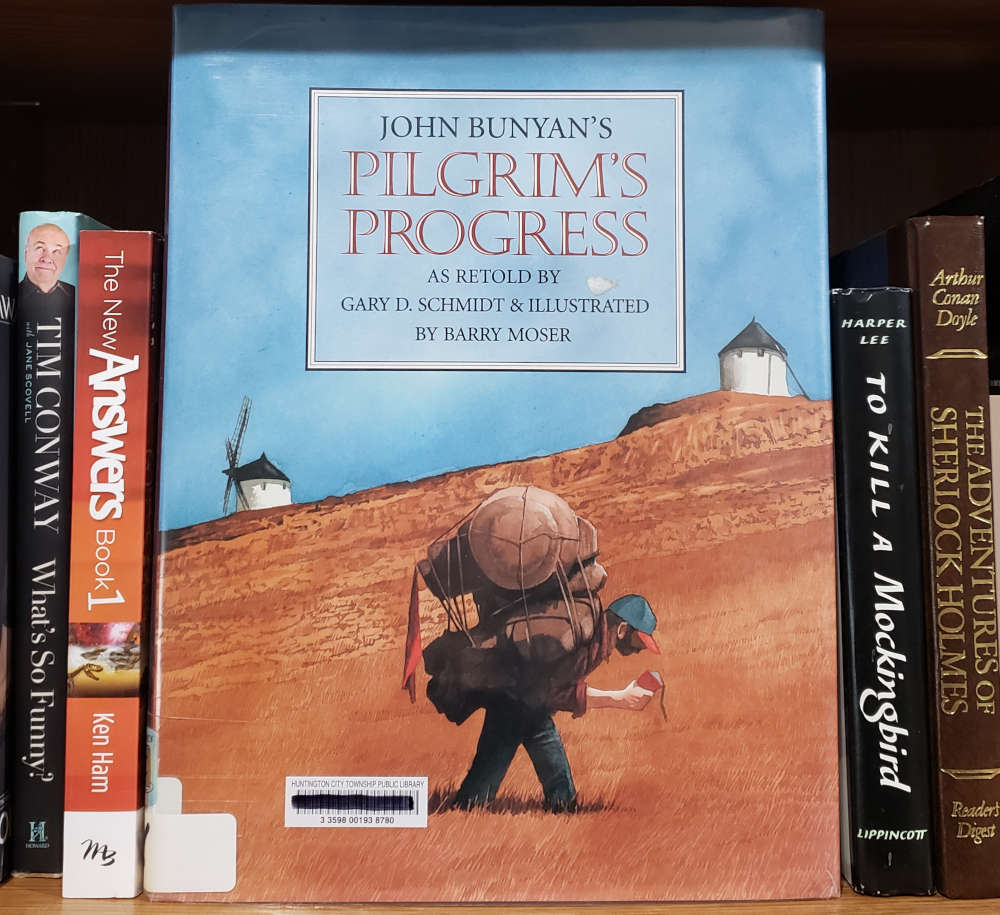
John Bunyan’s Pilgrim’s Progress
as retold by Gary D. Schmidt

My rating: 2 / 5
Genre: Christian allegory

I have long felt that I should read The Pilgrim’s Progress by John Bunyan. I even started to once, but only made it a page before putting it down. So when I found this retelling, putting the story into contemporary language, I knew it was my chance to at least see what the book was all about. So understand going into my review that this is in no way a comparison of this retelling to the original. And my comments are specific to this version, because I can’t say what might be different from the original. With that being said, I do think that some of what I didn’t like about this story would extend back to the original source.

After I finished reading this, as I tried to analyze what I’d read and did some research to understand others’ views on the allegory, I flashed right back to high school. After reading The Great Gatsby, I wrote that I didn’t understand why my teacher would have us read a book that so glorified the drinking and partying in the book. She wrote back about her disappointment that I thought she’d promote those things, and that perhaps I didn’t really understand the book. That it’s the type of book one might have to read multiple times to grasp. That’s kind of how I feel about this book.

My first apparent misunderstanding is that it seemed to me that Christian had to essentially earn his salvation. He struggled with his burden on the way to the cross, after coming to an understanding that he had this burden and needed external help to release it. Others say that he was actually saved when entering through the gate that started this journey, and releasing his burden at the cross was simply an illustration about how we don’t often let go of our guilt upon salvation and have to still come to that understanding that Jesus wants to relieve us of that guilt. However, it was at the cross, after losing his burden, that Christian was handed the Roll, which seemed to be needed in order to enter the Celestial City. I took this as a symbol of his salvation, but then, when he was audacious enough to rest a little too long, he lost the Roll and later had to go back and look for it.

I won’t go into any other details, but for whatever this book might mean to some people, at least the people who “get it,” to me it looks like a book that could send the wrong message to new Christians or curious unbelievers, especially those who, like me, aren’t so great at understanding allegory. From start to finish, it makes me feel like a Christian walk is nothing but trial and tribulation. Constant struggling to stay on the right path, to stay good. Yes, some of that is true to a degree, because it can feel like a constant struggle to avoid temptation to sin, but where’s the other side? Why do we not see much of the joy and peace that can come, in this life, from following Christ? For that matter, why is God so completely absent until Christian reaches the Celestial City? If I were to write an allegory about a Christian journey, it would include God interacting with the pilgrim in a much more tangible way (or at all…).

I seem to be pretty hit-or-miss in my enjoyment of much-loved older books and classics, and this is another for my pile of misses. I’m glad I read it, though. Originally I thought it might end up being a stepping stone to going on and reading the original. I’ve decided to leave it right here, at this simplified version, and just be one of the few who’ve never read the original.

Find out more about this Pilgrim’s Progress retelling and its source material, The Pilgrim’s Progress

See what I’m reading next.

If you’ve either of these books, or read either in the future, feel free to let me know what you think!

Book Review: Little Women

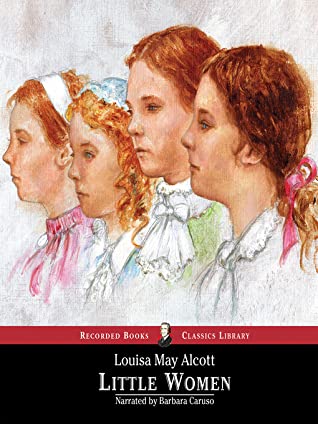
Little Women
by Louisa May Alcott
read by Barbara Caruso

My rating: 5 / 5
Genre: Classic children’s/YA coming of age

This is another classic that I had never read before, but have seen a movie or other adaptation of more than once in the past. In this case, I’ve only seen the 1994 movie with Winona Ryder as Jo, though I have seen it more than once over the years. I also did read the Great Illustrated Classic adaptation with my daughter just over a year ago, but this was my first time reading the full, unabridged version, technically listening to the audiobook. Be aware, there will be spoilers in this review, so read on at your own risk.

One of the things that struck me the most about the full story is how much these sisters thrive in their environment. This is a time period where women are oppressed and kept in their place, and while at some times this makes tomboy Jo unhappy, she doesn’t have to completely rebel in order to make some inroads and even do what she wants to do. In fact, most of what gets in her way as a writer is her own ideas, plans, hopes, dreams, failings, and attempts to be a better person. In modern times, we if we want to write historical fiction where women aren’t just stuck in a box, they are often wild and outrageous (but at least they manage to meet that one man who’s okay with the woman who refuses to wear a dress or attend any formal functions). I think that’s one of the biggest things I love about Jo.

I also really like the fact that most of the way through the story, the March sisters are striving to better themselves. They are quite poor, but vow to be happy with what they have and avoid grumbling, even as they allow themselves hopes for the future in which they find wealth in one way or the other (different for each girl). And though I speak generally, Beth is usually perfectly content with what she has. Speaking of Beth, how well did I relate to that quiet, shy girl. Even too scared to go to the neighbor’s house who’d extended an open invitation so she could exercise her talent on his piano…that would definitely be me.

I loved the references made to Pilgrim’s Progress in the first half of the book, which plays a lot into what I mentioned above, about the sisters trying to be happy with what they have and be good “pilgrims.” I’ve never read Pilgrim’s Progress, though I’ve always thought I should (tried once, but I’m really not good at sticking with books that are hard to read), and now I wish I had. The reference back to the pilgrims and the game the sisters played when they were younger, shortly before Beth’s death, made the tragedy of her death all the more emotional to me.

On probably the most disputed point of this book, though I never lamented over the fact that Jo rebuffed Laurie, it did always seem strange to me that he ended up marrying little Amy. However, after reading this book, I think Louisa May Alcott did a fine job setting up the ways the various romances went. I could certainly see that Jo had no romantic feelings for Laurie and had good reason to think that they wouldn’t have a very pleasant marriage. And when Amy was still young, a connection grew between her and Laurie that paved the way for their love later. Jo’s feelings for Professor Bhaer came very naturally, and it was easy to see why she fell in love with this mature man of integrity and morals.

Before I wrap up, I want to say a few words about Barbara Caruso, the narrator of the audiobook I listened to. I haven’t listened to many audiobooks and can really only listen to certain types of books that way, since my mind tends to miss details if I’m not careful. Also, like many others I’m sure, the narrator can really make or break my enjoyment, and I’ve discovered that I’m really picky about it. Which is why I’m really glad that this is the narrator I listened to for this book, because she did a fantastic job! I really liked how she brought the characters to life and even managed to have slight differences between the sisters. Her reading of foreign words or sentences (French and German) and accents for characters like the German Bhaer are incredible. I will definitely look for her when I listen to other books that she has narrated.

Find out more about Little Women

See what I’m reading next.

If you’ve read this book, or read it in the future, feel free to let me know what you think!

Book Review: Anne of Ingleside

Anne of Ingleside
Book #6
by L.M. Montgomery

My rating: 4 / 5
Genre: Children’s/YA classic

See my review for book #1, Anne of Green Gables.

After watching Anne grow up and become a wife and mother, this book chronicles several years of motherhood, with an eventual six children. Like many of the other books in this series, there’s not exactly a single plot to the book, more a series of vignettes about the children’s antics and some of Anne’s own activities. Some of her children are a lot like her, fanciful and whimsical, and in some ways, it was like seeing Anne as a child again.

It was interesting, and I’m not entirely sure how realistic, that so many of her children’s scrapes led them to be outside on their own at night. I really felt for some of them, considering the ways they tended to let their imaginations run away with them. I can remember being a kid and not fully understanding what was going on, and that leading me to be scared, unhappy, sad, etc. when I probably didn’t need to be.

I did not care at all for Aunt Mary Maria, which I’m sure was intentional, but when she had the audacity to tell one of the kids, as they were about to leave home for 2 weeks, that if he was naughty, a man would grab him up in a big, black bag, I couldn’t believe it! And this after scoffing at one of the other kids for still believing in Santa, which is such hypocrisy. I don’t care what generation you’re from, you wouldn’t get away with scaring my kids like that.

I liked seeing some of the characters back from previous books, and overall, I didn’t mind that Anne had grown up so much. It wasn’t my favorite of the sequels (that honor goes to the previous, Anne’s House of Dreams), but I still liked it a lot. It’s the last book in the series proper, and I may someday read the final two books, but for now, I think I’ll stop here. When I re-read Anne of Green Gables in the future, I may skip past the next few and only re-read books 5 & 6. I’m just not a huge fan of the rest.

Find out more about Anne of Ingleside

See what I’m reading next.

If you’ve read this book, or read it in the future, feel free to let me know what you think!
Book Review: The Return of the King

The Return of the King
The Lord of the Rings #3
by J.R.R. Tolkien
read by Rob Inglis

My rating: 4 / 5
Genre: Classic fantasy

Like with my “review” of the other books in this series, this is going to be less of a real review and more just my thoughts on my experience with this book. This is my first time through the trilogy, and I’m listening to the audiobooks, because I don’t think I’d make it through if I was reading. Also to reiterate–I have watched the movies several times, though it’s now been a few years since I last did so. And keep in mind, there may be some slight spoilers ahead.

So first, let me just say that wow, was I surprised when the ring was destroyed so early in the book! Seriously, does anyone get away with pacing like that these days? I understand a lot more now why the film had so many “endings,” which never bothered me like it did some others. It’s not hard to see how such an epic tale is owed so much wrap-up. But to see that the movies actually toned down the amount of story that took place after the climax was a surprise. And while I could have done without the storyline with Eowyn and Faramir, overall, I didn’t hate all of that follow-up like I expected to. The story of the hobbits taking back the Shire was interesting and gave a culmination for a major character that, when last seen, had become weak and whiny. I’d say maybe Tolkien should have kept this story for another book or appendix, but to be honest, I may not have read it then. So I can’t really complain about the length of the book after the climax. It’s still strange, though.

And in a related note, the relationship between Aragorn and Arwen, which is a huge deal in the movies (maybe too huge) is mostly shown in an appendix, as I understand it. So without reading that, it’s pretty lacking for me. Maybe someday I will, but I’m going to let Middle Earth sit for a while right now.

One more thing–I know a lot of people see Eowyn as a great example of a strong female character. In some ways, yes, she’s strong and determined. But I think I would have admired her more if she had chosen to stay behind. She essentially states that she has sworn to rule Rohan in place of those who are going to war, but seems to simply decide she’s tired of doing so. And she assumes that she was left to do so only because she was a woman. Whether or not that last part is true, I think the important factor here is that she agreed to it, and then decided to leave her homeland anyway. To me, honesty and integrity are more important than showing that women can do as much as men can. But yes, good did come of the action she chose, and if nothing else, it shows her as a real, flawed character.

I find it interesting that the 2nd book in the series was my favorite of the 3, even while I’m pretty sure it was my least favorite of the movies (though I did still like it plenty). I don’t think I’ll ever appreciate these books or the author as much as the diehard Tolkien fans do. However, I do anticipate re-reading these books more than once in the future (probably still as audiobooks, but who knows) and picking up something new each time.

Find out more about The Return of the King

See what I’m reading next.

If you’ve read this book, or read it in the future, feel free to let me know what you think!

Book Review: The Two Towers

The Two Towers
The Lord of the Rings #2
by J.R.R. Tolkien
read by Rob Inglis

My rating: 5 / 5
Genre: Classic fantasy

Like with my “review” of The Fellowship of the Ring, this is going to be less of a real review and more just my thoughts on my experience with this book. This is my first time through the trilogy, and I’m listening to the audiobooks, because I don’t think I’d make it through if I was reading. One note about the audiobook–Rob Inglis, the narrator, does a fantastic job! He even sings the songs, and while I suppose it would be strange if the narrator of these books with so many songs didn’t attempt to sing them, I still think it’s particularly neat.

I liked this book more than the previous, as we jump right back into the story. It felt more swiftly paced, too, even during the part where Frodo and Sam were wandering for a while. As with the previous book, my notes on this book are from a standpoint of having seen the movies several times, and I prefer the movie that goes back and forth between the two storylines, rather than showing all of one, then all of another. But I do appreciate that they were written to be two separate books, and then had to be combined into one. I also liked better, in the movie, not knowing that Sam had taken the ring from Frodo when he thought he was dead, or knowing that Sam was even following him, until the right moment.

One of the things I’m getting most out of reading the books after having a cursory understanding of the story from the movies is getting to understand the world and the characters more. For example, I like having a better understanding that Gandalf is something special (celestial, even), not just a simple wizard (whatever that would mean anyway). Also, Gollum is so wonderfully sarcastic in the book, which I just loved!

I know that I’m not going to appreciate these books the way that many others do; I don’t think I’m the right kind of person to really get into the history and depth Tolkien put into his world. But I’m still enjoying them and am glad I’m reading them.

Find out more about The Two Towers

See what I’m reading next.

If you’ve read this book, or read it in the future, feel free to let me know what you think!
Book Review: Anne’s House of Dreams

Anne’s House of Dreams
Book #5
by L.M. Montgomery

My rating: 5 / 5
Genre: Children’s/YA classic

See my review for book #1, Anne of Green Gables.

After the first book in the series, I have liked each one just a little less than the one before it. It didn’t seem quite the same anymore and also began to feel repetitive. Fortunately, this book brought me back to the love I had for the first book.

It’s not as if there are no more characters or situations that in some way mirror those from earlier books. But there was a lot less of that, and overall, everything felt new and fresh again. I’d say the characters introduced in this book, as well as getting to see Marilla and some of the others a bit more, really made the book for me. Not to mention Gilbert and Anne starting their lives together. I loved Captain Jim and got a kick out of Miss Cornelia, especially the way she and Captain Jim bantered.

Then there’s Leslie Moore. Of all the ways her story could have gone–and I had a few different predictions, believe me–I never imagined that twist.

Overall, I loved this book about as much as I loved the first book in the series. Unfortunately, it only highlighted the slower, drier books in between. I have no idea what to expect of the rest of the books in the series, but I can’t wait to find out.

Find out more about Anne’s House of Dreams

See what I’m reading next.

If you’ve read this book, or read it in the future, feel free to let me know what you think!
Book Review: The Fellowship of the Ring

The Fellowship of the Ring
The Lord of the Rings #1
by J.R.R. Tolkien
read by Rob Inglis

My rating: 4 / 5
Genre: Classic fantasy

Like with my “review” of The Hobbit, this is going to be my less of a real review and more just my thoughts on my experience with this book. After reading The Hobbit, I knew I had to go on to read the LoTR series. However, I also knew that I would never make it through if I read the text. My sister once suggested listening to the audiobook instead, so though it’s not normally my preferred method of reading a book, I gave it a try. For something like this, it turned out to be great.

As someone who has seen these movies many times, it’s interesting to read the source material. I can also see now how other authors and books I’ve read are very influenced by this series of books. It was again, and even moreso in this book, interesting to get more depth on the story, on the world, and on some of the characters that are in the movies I’ve so enjoyed.

The main downside to me is that it just feels like the adventure takes way too long to get going. The events in the Shire before Frodo even leaves weren’t so bad, but I was astounded by how far into the book I was by the time the Hobbits got to Bree. After that, everything else felt super fast by comparison.

I know my reading of these books will be tainted in many ways by having seen the movies first, but there’s nothing I can do about that. But while I knew some things were made up or expanded in The Hobbit movie, and of course I knew that several events and characters were left out of the LoTR movies, I was surprised by some of it. Frodo selling Bag End was a sad shock. Arwen is barely mentioned in the book, and both Legolas and Gimli feel much less important than the movie makes them to be. And again, the amount of time that passes between plot points just amazed me (Frodo is 50 when he begins the journey!).

I am so glad I read The Hobbit first, too, because it adds a connection and even some emotion to know who Gimli’s father is, to know who Balin is, and to understand a bit more about who the dwarves that died in the Mines of Moria were. It’s also interesting to me that the elves know of Frodo, through Bilbo, and that Frodo even knows some of the elvish language! That’s completely lacking in the movies, but makes total sense, given the events of Bilbo’s adventure.

I’ve already started on The Two Towers, and look forward to finishing the series.

Find out more about The Fellowship of the Ring

See what I’m reading next.

If you’ve read this book, or read it in the future, feel free to let me know what you think!

Book Review: The Hobbit

The Hobbit
by J.R.R. Tolkien

My rating: 5 / 5
Genre: Classic fantasy

This is not going to be a structured review with a recommendation or warning to stay away. It’s really just going to be my musings on my first foray into written Tolkien. First, let me give a reference point–as I said, I’ve never read any Tolkien before this. I have seen all of the movies, though. I love the LoTR movies, though have only watched the Hobbit movies once. Going into each of these 6 movies as they came out, I knew absolutely nothing about the stories. I know that having seen the movies, though, and fallen in love with some of the characters will taint the reading of the books for the first time. I’m okay with that.

So now, about this book. I decided some time last year to start with The Hobbit, because it’s written for a younger audience. I figured it’d give me an idea of what the LoTR books were like and of whether I even thought I’d be able to read them. Besides, The Hobbit precedes the other books, even if the movies came out in the opposite order. I am so very glad I did it this way. I enjoyed reading The Hobbit, even as I felt that the story meandered more than I would normally prefer. It was really interesting to get more depth on the story, on the world, on some of the characters.

I knew about some of the things that had been made up for the movie, like the female elf and her romance with one of the dwarves (Kili, I think?) or the fact that Legolas was there at all. But I had thought that the Necromancer was created by the movie makers as well, and it was interesting to see that Sauron was, in fact, a background menace in the book after all. No, we don’t follow Gandalf to see him, but he does speak of ousting him from Mirkwood.

I was surprised by how long the party tended to stay places. Days or even weeks on end, before they moved on. And I’ll tell you, Elrond does not seem to be portrayed well in the movies. I like Hugo Weaving, but I remember his Elrond as aloof, even haughty. He’s so much warmer in The Hobbit. But to be fair, I haven’t watched any of the movies for a few years now, so I wouldn’t be surprised to find out I’m remembering many things wrong. For all I know, I’m mashing Elrond together with Agent Smith.

So now that I’ve read this book, I have decided that I must move on to the LoTR books. I know they’ll be longer and probably harder to read, which is why I’m listening to audiobooks instead of reading physical copies (as I did with The Hobbit). I won’t become a lifelong Tolkien fan, I’m sure, but I’m already glad I’ve embarked on this quest.

Find out more about The Hobbit

See what I’m reading next.

If you’ve read this book, or read it in the future, feel free to let me know what you think!

Book Review: Rosencrantz and Guildenstern Are Dead

Rosencrantz and Guildenstern Are Dead
by Tom Stoppard

My rating: 4 / 5
Genre: Classic farce, play

I remember enjoying this when I read it in high school, assigned by our English teacher on the heels of reading, analyzing, and discussing Hamlet. I haven’t read Hamlet since then, but still enjoyed the re-read of this farcical play. A few times I wished I’d better remembered some of the details of what it is set around, but it didn’t detract from my reading too much.

These two bit characters who were sent to spy on Hamlet are now the focal point, while Hamlet, the king, queen, and others of that ilk merely intrude upon Rosencrantz & Guildenstern’s musings. The quick wit, back and forth, and the foreshadowing of the event that the very title lends knowledge to, make this a fun, snappy read. It’s also very meta from time to time, and doesn’t take itself too seriously. I’m sure some of it went over my head, and if I’d read Hamlet more recently, I may have gotten more out of it. But I am still glad I read it again and refreshed my memory of why I think of this book fondly.

Find out more about Rosencrantz and Guildenstern Are Dead

See what I’m reading next.

If you’ve read this book, or read it in the future, feel free to let me know what you think!

Book Review: Anne of Windy Poplars

Anne of Windy Poplars
Book #4
by L.M. Montgomery

My rating: 3 / 5
Genre: Children’s/YA classic, coming of age

See my review for book #1, Anne of Green Gables.

This book felt like a way station on the way to the rest of Anne’s life. Maybe that was intentional, but I didn’t feel very present with the story or the characters. And much of the book felt very repetitive, both to itself and to the rest of the series so far, like a rinse and repeat with only the names and locations changed.

I really liked Anne’s home for these three years–Windy Poplars, and the three women that came with it. Rebecca Dew was so much fun, especially in regards to poor Dusty Miller. And the situation with the poor, neglected Elizabeth was just about the sweetest, most heart-warming conclusion to a terrible story arc ever.

However, we get a lot of the same two basic storylines: A) Someone(s) is/are grumpy, unhappy, crabby, etc., whether in general or to Anne specifically. In some due course of time (either quickly or longer-term), Anne basically turns them happier or nicer, simply by being herself. B) Anne meets a woman who is a busybody or simply very chatty, who dominates all conversation for several pages, and something may or may not actually come of the entire situation. Any of these things on their own would not have been bad, and a few of these situations I liked more than the rest. But I feel like there could have been a lot more variety in the overall book and the three years Anne spent at Windy Poplars.

Most of the book is written in epistolary form, letters from Anne to Gilbert as they spend these 3 years apart. I’m not sure there was much reason for that, though, and even though some was written in normal 3rd-person narration, we barely got to see much of Anne’s time back at home. This meant missing out on seeing much of the characters we got to know earlier in the series. But we did see enough to see poor Dora slighted even further. Seriously, Montgomery seems to only have created Dora to give young Davy a target for his mischievousness, and she’s just this after-thought even now, 2 books later.

The series has lost a little of its charm for me, but I think this book was a bit of a departure from the rest of the series. I know it was written after books #5 & 6, so perhaps Montgomery was boxed-in, knowing she couldn’t change the later books, so not much could happen? But it just felt dry compared to the rest of the series so far. Here’s hoping that the next book regains the lovely Anne charm.

Find out more about Anne of Windy Poplars

See what I’m reading next.

If you’ve read this book, or read it in the future, feel free to let me know what you think!