Book Review: The Spice King

The Spice King
Hope & Glory #1
by Elizabeth Camden

My rating: 4.5 / 5
Genre: Historical Christian romance
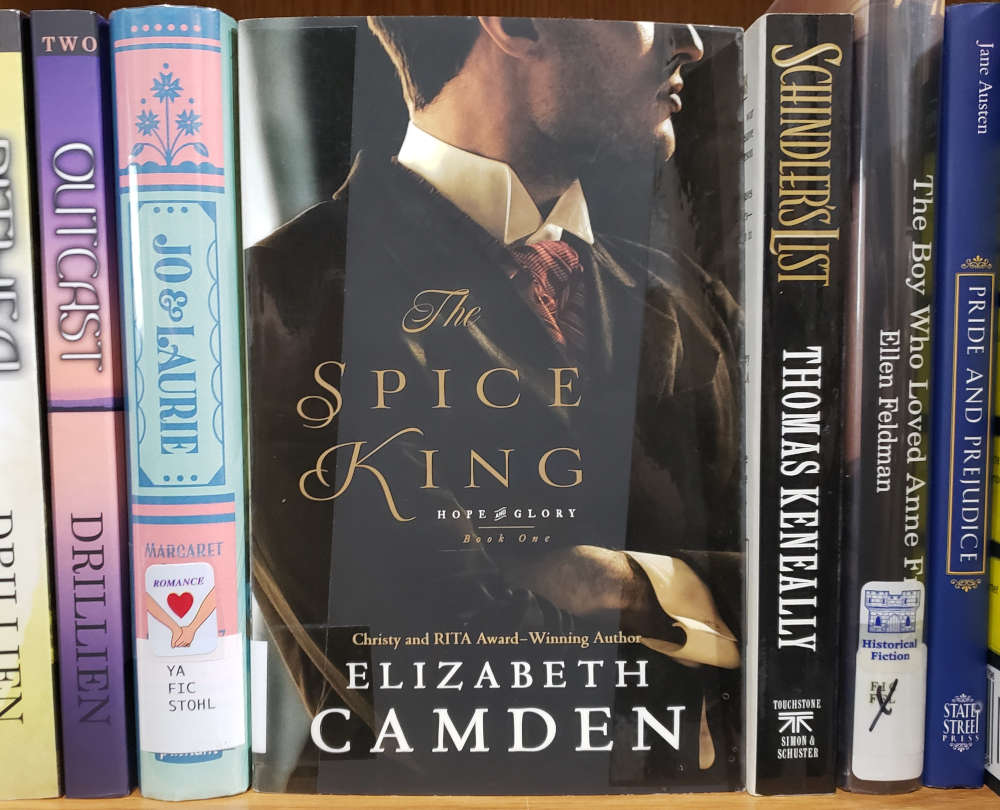
When Annabelle Larkin is tasked with getting access to the plant collection of the Delacroix spice company, she is rebuffed by the man in charge, Gray Delacroix. Success in this endeavor is the only way that Annabelle can assure a long-term position at the Smithsonian, though, which is crucial to her own future, as well as the future of her family back in Kansas. She won’t give up easily. But neither will Gray, who is determined to keep his secrets under lock and key. He has his own family to worry about–a brother who seems to only want to float through life doing nothing productive and a sister who knows how to spend money. Enemies are everywhere, but Gray is ready to trust someone. He’s just not sure if Annabelle is that person.

This is my favorite kind of romance book–one that’s not just about the romance. There’s so much more going on than the synopsis shows. It seemed at first that Annabelle would be more of the focal point of the story, but really it was Gray. His family, his empire, his desire to stop traveling and settle down, and the way that so much of that gets thwarted, I really got caught up in his story. But that doesn’t leave Annabelle on the sidelines. She’s in Washington with her blind sister, helping her navigate the streets and life, and I loved how that side of the story went too.

This is the first book of 3 in the series, and it sets up what appears to be a plot running through all three when a scandal in Gray’s family is exposed. While that could have been a downfall for the story, this grand plot that isn’t very connected to or even resolved in this book, that’s not the case at all. It works, and rather than leaving me disappointed at the lack of resolution, it made me look forward to seeing it all play out.

While at times, the dialog was a bit too modern, it didn’t bother me much. My biggest issue is with a small spot of theology that could imply that one must work to earn salvation. However, I couldn’t quite tell if that was the message there, or if it was more that the person in question was working toward the surrender needed in order to accept the gift of salvation from Jesus, but hadn’t taken the final step yet. It was brief and vaguely expressed. I’ll have to keep an eye out for that as I continue this series, because I do not endorse a works-based salvation. With that in mind, I do recommend this book for all fans of Christian or historical romance.

Find out more about The Spice King

See what I’m reading next.

If you’ve read this book, or read it in the future, feel free to let me know what you think!

Book Review: The Purple Nightgown

The Purple Nightgown
by A.D. Lawrence

My rating: 4 / 5
Genre: Historical Christian romance, crime

Stella Burke, heir to a clothing company and accompanying fortune left when her father died, suffers from near-daily debilitating migraines. When the latest suggested treatment doesn’t work, she comes across a book called Fasting for the Cure of Disease by Linda Burfield Hazzard and then discovers that the doctor has a health spa not too far away. Desperate for anything to ease her pain, she insists that her family chauffeur take her to the spa. Henry is more than just her chauffeur, a close friend and confidante who has been part of her life since they were both kids. He doesn’t trust the doctor’s methods and definitely doesn’t easily agree to take Stella to the spa. When the spa turns into a prison and Hazzard’s methods prove even worse than Henry imagined, can Stella find a way to escape, or will she die alone as one of Hazzard’s walking skeletons?

A solid entry to the True Colors series, which focuses on different true crimes from history, with real historical facts melded with fictional characters and situations. I liked it more than most of the others I’ve read in the series, mostly due to the fact that the crime part of the story was more a focal point than the romance. Though the two main characters’ thoughts about how they feel about each other was brought up at a couple of random or wildly irrelevant times, it was not overly pervasive. Stella’s struggles at the spa, with the treatment, with her uncertainty about whether or not she should stay, and then with her futile attempts to escape, were a well-written driving force.

Adding to that is a sub-plot with Henry and his dream to start a children’s home, which gave the story somewhere to go to avoid a slow, plodding narrative of Stella wasting away. It also allowed a light in the darkness of Stella’s story. I really liked the culmination of all of that at the end of the story. I also appreciated that we weren’t expected to just accept that these two people liked each other simply because we were told they did. They fit together well, had a history, and even had flaws that the other had to be willing to accept.

If I hadn’t known that this woman and her spa were historical fact, I would have had a difficult time believing anyone would go to her for treatments. But I think the author did a good job trying to imagine a scenario in which someone of sound mind would be desperate enough to place themselves in such danger for the hope of relief–not that the victims expected such danger when they checked into the spa. It had a few dark moments as Stella saw things she wasn’t meant to see, the truth about what was going on at the spa; they didn’t bother me, but it seems good to mention it for those who prefer to avoid dead bodies and other things related to that in their reading (it’s a small amount, really).

There was a particular Chekov’s gun-style “prop” that I really expected to come into play more near the end of the book. I’m not sure that’s a fault of the author’s, as the prop definitely had its uses, but I still expected something in the way of even a minor twist involving it. However, overall, I enjoyed the book. It’s not too pushy in its inclusion of Christianity. Stella has to realize that she’s not very good at being still and letting God be in control, but she really doesn’t even come to the place where she “sits still” and turns to him until she’s literally forced to not move for a while. It’s a shallow theme of God’s will being best, but it’s there. I think anyone who enjoys clean romance, especially historical romance, and especially those who like crime or darker content in novels, will like this book.

Thank you to Netgalley and Barbour Publishing, Inc. for providing me a copy of this book to review.

Find out more about The Purple Nightgown

See what I’m reading next.

If you’ve read this book, or read it in the future, feel free to let me know what you think!
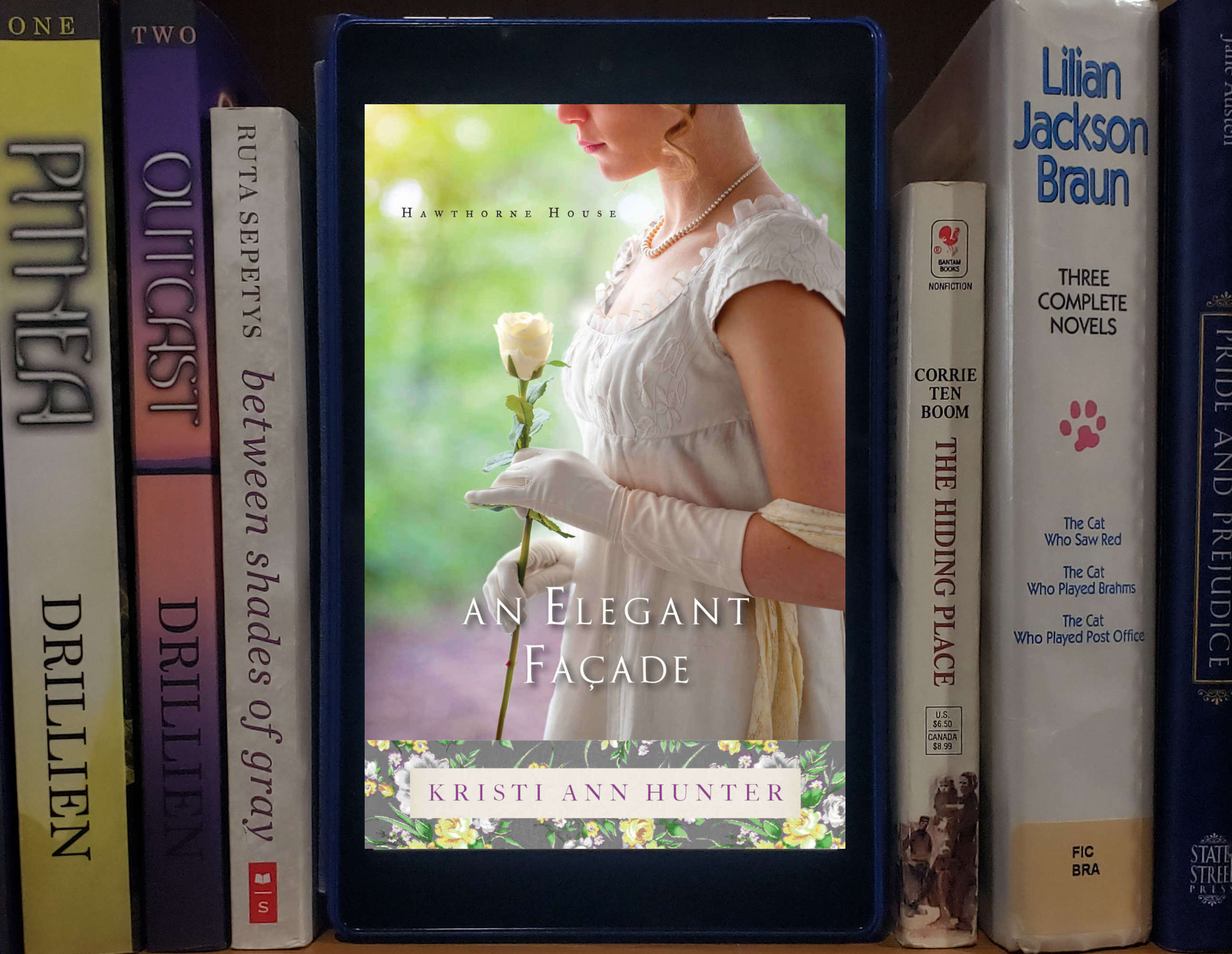
Book Review: An Elegant Façade

An Elegant Façade
Hawthorne House #2
by Kristi Ann Hunter

My rating: 3 / 5
Genre: Historical Christian romance

Spoiler notice: The following review may contain some spoilers for the first book in the series, A Noble Masquerade.

Lady Georgina Hawthorne has spent years planning her debut season, during which she feels a strong need to make the match of the season. She has also spent years cultivating her look, her personality, and the way she is perceived to others, including her own family. She’s certain that her hard work will get her a duke, or at least an earl. Certainly not a mere gentleman like Colin McCrae, who keeps showing up everywhere she goes. What she doesn’t know is that he’s involved in his own game of manipulation, instigated by another, and would rather not see or talk to Georgina any more than she wants to see or talk to him. However, once he sees a tiny glimpse of the real Georgina behind the facade, he begins to think there’s more to her than the spoiled, selfish demeanor she puts on. When he discovers her shameful secret, the one she’s buried since childhood behind that practiced face, he thinks he might be able to help her…but what will it cost them both?

I’ve been going back and forth with how I felt about this book in my mind for a few days now. I think it had some good points, but not quite enough to make it really enjoyable. It was weirdly not so focused on the romance as some pure romance novels are, and yet the attempt at still making the romance front and center made it feel repetitive. There was so much more going on than the building relationship, to a point where many say there wasn’t much romance at all, which is totally fine with me–I like a slow build or a romance that’s in the background. But the MCs would still think about each other before or after each encounter with thoughts like,”Why am I thinking about him/her at all?” and “I keep forgetting I want nothing to do with him/her,” which I guess are supposed to be the insertion of romance. Just made me roll my eyes.

Colin was a really nice guy, smart and thoughtful. It bothered me, though, that the first full chunk of his story was showing how he helped Ryland (male MC from the previous book) manipulate poor Miranda (female MC from the previous book). It just reminded me of why that story bugged me, plus had me forgetting a lot early on that Colin was the MC, not Ryland. As for Georgina, she’s the main reason I read this book. After the last one, which was only okay for me, I probably wouldn’t have continued the series, except that the synopsis for this one really intrigued me, hinting at a secret that was the reason she acted the way she does. I wanted to know what it was. And that part of the story was good, I thought. She was really a lot more real than she appeared, and I loved seeing the shift in her life when things started to change. Her relationship with her sister was a bright spot for me too.

I don’t know if I can quite explain adequately why I felt the way I did about this book. It was okay, but somehow didn’t have much charm to it for me. Many others feel differently, though, so click the link below if you are interested and want to see what others thought. As for me, I won’t be continuing this series.

Find out more about An Elegant Façade

See what I’m reading next.

If you’ve read this book, or read it in the future, feel free to let me know what you think!

Book Review: The Deadly Curse of Toco-Rey

The Deadly Curse of Toco-Rey
The Cooper Kids Adventure Series book #6
by Frank Peretti
read by the author

My rating: 4 / 5
Genre: Children’s Christian adventure

Dr. Cooper is asked to solve the mystery of some treasure hunters who disappeared in the jungles of Central America, and if he happens to find the treasure himself, all the better for those who brought him in. The stories of a curse on the treasure may seem ridiculous at first, but there’s no denying the fact that the treasure hunters who disappeared all have either died or gone crazy. Soon enough, Dr. Cooper and his two kids are in danger themselves and have precious little time to solve the mystery and save lives.

This book had a lot of excitement and even some moments that could be a little scary for kids (not in a bad way). All 3 of the members of the Cooper family are on their own at some point, and all 3 are in peril at some point, upping stakes from previous books. I like the pure reliance on God, turning so quickly to him for help in desperate situations. The curse and other aspects that went along with it were, in the end, an interesting concoction and pretty scary menace.

Though I didn’t quite enjoy this story as much as I did others in the series that I gave 4 stars, I still think it was a solid addition. I listened again to the audiobook, and I’ve decided that I love hearing Peretti read his own books. There are 2 books left in this series, and I’m looking forward to listening to both of them.

Find out more about The Deadly Curse of Toco-Rey

See what I’m reading next.

If you’ve read this book, or read it in the future, feel free to let me know what you think!

Book Review: The Indebted Earl

The Indebted Earl
Serendipity & Secrets #3
by Erica Vetsch

My rating: 4.5 / 5
Genre: Christian historical romance

When her fiance Rich succumbed to injuries sustained near the end of the war between France and her home country of England, Lady Sophia Haverly did not not expect to ever fall in love and marry someone else. Instead, she would continue to care for her elderly almost-mother-in-law, who developed a strong desire to return to the seaside, where she’d grown up. She finds assistance in this endeavor in the form of Captain Charles Wyvern, close friend of her late fiance, who tells her that Rich died saving his life, leaving him indebted to helping Sophia however he can. The captain, while desperate to head back out to sea, has his own reason for going to the coast–his uncle has just died, and he’s inherited the estate and title of earl. When he finds that the estate is in bad shape, not to mention the three young girls he’s inherited as wards, he seeks help from the young woman to whom he owes a great debt.

The third book in the series stands as tall as the first two. I loved how the captain was so out of his element on land, while Sophia equally did not take to the sea very well. The three girls, aged between 5 and 16, added a layer of life to the story that all worked together so well. Sophia, not much older than the eldest girl herself, found herself in the role of mothering the kids simply because she fell in love with them so quickly. And her relationship with her late fiance’s mother-in-law, Mamie, as well as Mamie’s relationship with the three wards, made this book about so much more than the main romance.

In fact, my biggest frustration with the book was the repetitiveness that came with Sophia starting to let herself move on from her loss. She kept sort of chastising herself for holding another man in high esteem and possibly wanting more from that, always ending with a question of whether that was how it should be or not. This may be completely realistic, but the repetition wore on me just a bit. That’s pretty much where the half point rating detraction came from. On the other hand, 5-year-old Betsy’s attachment to the captain’s hat is wonderful!

Here at the end of the series, my favorite character overall has been Marcus Haverly. He also played the most significant role throughout, being the male lead in the 2nd book, while also having decent roles in the first and third. I love that his alter ego gets to play a role in all three books, too, and wish Erica Vetsch would somehow write a little more about him (maybe a short story in which Sophia and Charles learn of his former occupation?).

While I found parts of this story predictable, and one particular part far too convenient, I loved it overall. It’s a great ending to a great series, which I highly recommend to fans of Christian romance, historical or otherwise, and fans of Regency romance. And if you do plan to read these books, or already have, make sure you also look into the book Joy to the World, a collection of 3 novella-length Christmas stories. Vetsch’s contribution to that book takes place directly after this third book in the series and ties up the story of a character that has been involved in the series.

I received a free review copy from the publisher in exchange for my honest unedited feedback.

Find out more about The Indebted Earl

See what I’m reading next.

If you’ve read this book, or read it in the future, feel free to let me know what you think!
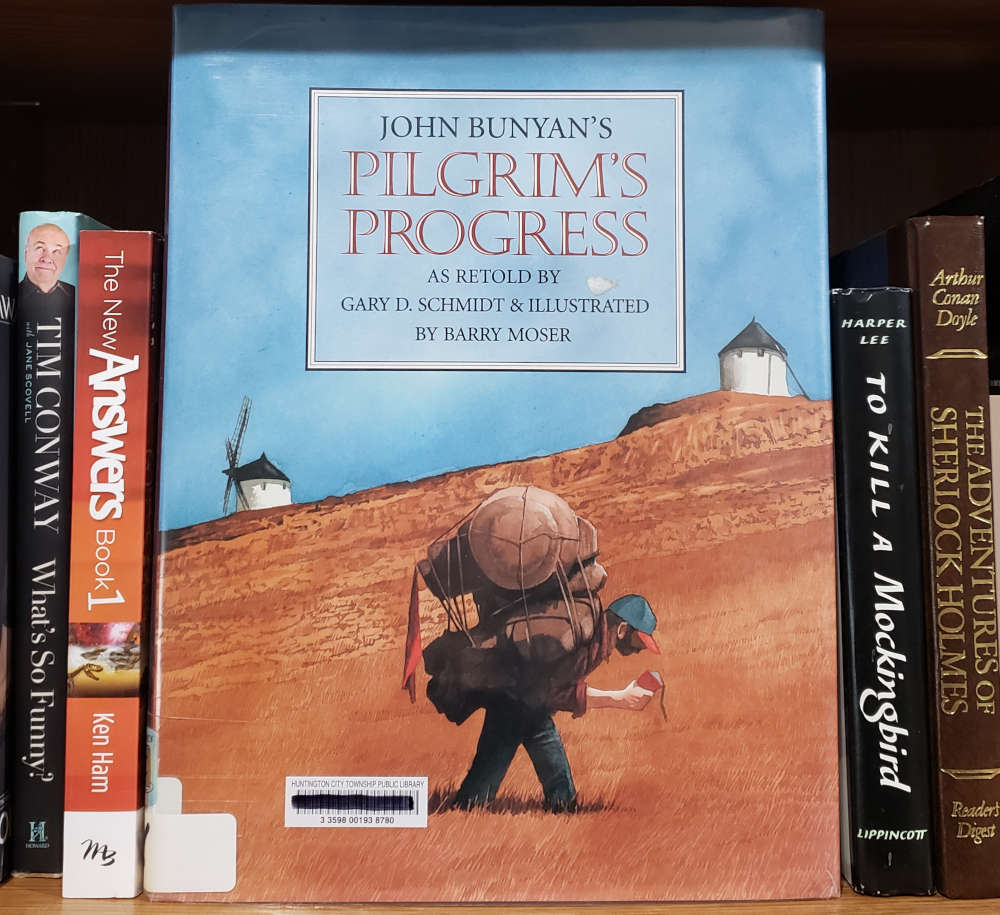
Book Review: John Bunyan’s Pilgrim’s Progress

John Bunyan’s Pilgrim’s Progress
as retold by Gary D. Schmidt

My rating: 2 / 5
Genre: Christian allegory

I have long felt that I should read The Pilgrim’s Progress by John Bunyan. I even started to once, but only made it a page before putting it down. So when I found this retelling, putting the story into contemporary language, I knew it was my chance to at least see what the book was all about. So understand going into my review that this is in no way a comparison of this retelling to the original. And my comments are specific to this version, because I can’t say what might be different from the original. With that being said, I do think that some of what I didn’t like about this story would extend back to the original source.

After I finished reading this, as I tried to analyze what I’d read and did some research to understand others’ views on the allegory, I flashed right back to high school. After reading The Great Gatsby, I wrote that I didn’t understand why my teacher would have us read a book that so glorified the drinking and partying in the book. She wrote back about her disappointment that I thought she’d promote those things, and that perhaps I didn’t really understand the book. That it’s the type of book one might have to read multiple times to grasp. That’s kind of how I feel about this book.

My first apparent misunderstanding is that it seemed to me that Christian had to essentially earn his salvation. He struggled with his burden on the way to the cross, after coming to an understanding that he had this burden and needed external help to release it. Others say that he was actually saved when entering through the gate that started this journey, and releasing his burden at the cross was simply an illustration about how we don’t often let go of our guilt upon salvation and have to still come to that understanding that Jesus wants to relieve us of that guilt. However, it was at the cross, after losing his burden, that Christian was handed the Roll, which seemed to be needed in order to enter the Celestial City. I took this as a symbol of his salvation, but then, when he was audacious enough to rest a little too long, he lost the Roll and later had to go back and look for it.

I won’t go into any other details, but for whatever this book might mean to some people, at least the people who “get it,” to me it looks like a book that could send the wrong message to new Christians or curious unbelievers, especially those who, like me, aren’t so great at understanding allegory. From start to finish, it makes me feel like a Christian walk is nothing but trial and tribulation. Constant struggling to stay on the right path, to stay good. Yes, some of that is true to a degree, because it can feel like a constant struggle to avoid temptation to sin, but where’s the other side? Why do we not see much of the joy and peace that can come, in this life, from following Christ? For that matter, why is God so completely absent until Christian reaches the Celestial City? If I were to write an allegory about a Christian journey, it would include God interacting with the pilgrim in a much more tangible way (or at all…).

I seem to be pretty hit-or-miss in my enjoyment of much-loved older books and classics, and this is another for my pile of misses. I’m glad I read it, though. Originally I thought it might end up being a stepping stone to going on and reading the original. I’ve decided to leave it right here, at this simplified version, and just be one of the few who’ve never read the original.

Find out more about this Pilgrim’s Progress retelling and its source material, The Pilgrim’s Progress

See what I’m reading next.

If you’ve either of these books, or read either in the future, feel free to let me know what you think!

Book Review: From This Moment

From This Moment
by Kim Vogel Sawyer

My rating: 3 / 5
Genre: Christian fiction

Jase is a new youth minister at a small church in an even smaller town in Kansas. Recently moved from San Antonio after his fiancee died, he’s struggling with anger and doubt in his Christian walk. Kenzie is ten years removed from her Amish heritage, leaving the community when she learned how the grace of Christ could free her from the rules and regulations of her family’s religion. She’s been thinking more and more about her family, though, and the darkness they’re still lost in. Lori is a young woman who was emotionally and verbally abused by her father as a teenager. She uses food as a coping mechanism when she feels lonely or inadequate, despite knowing that it’s pointless and wishing she could stop. Jase, Kenzie, and Lori are each searching for answers from God, and when Jase moves to Kansas, he’s welcomed into the friendship that Kenzi and Lori already have. With each other’s help, the three just might find their answers.

Through the first half of this book, I didn’t really understand what it was meant to be about. Part of that is because the official synopsis is atrociously inaccurate and misleading. But it’s also because it really took a while for things to get going. And actually, in the end, it turns out the book really was about what I saw in that first half– these characters each struggling with their doubts, uncertainties, and questions about God and their faith. There were parts of the story that I liked, that I thought came together well in the end, and parts that fell flat for me, or that I questioned why they were included. Overall, it was a decent read, but not a stand-out for me.

The storyline I related to the most was Lori’s over-indulging in times of extreme emotion, good or bad. I haven’t had an abusive past like hers, but over-indulgence is an issue I have struggled with in the past, though not to the degree that she does it. I really liked the way Kenzie’s story shaped up too, after wondering what it had to do with anything for a while near the beginning. Jase’s storyline is the one that I was least connected to, partly because I’ve not experienced loss like that, but also partly because the decisions he made really bugged me. There is a 4th perspective in this story too, which I felt was wholly unnecessary. I couldn’t help but compare it to the previous book I read by this author, which also included 4 perspectives. But where it worked in that one, it just seemed pointless in this one. I’m not sure what the pastor’s perspective added, nor did I feel like it was particularly resolved.

If there was one cohesive lesson this story seemed to bring out, it was the benefit of allowing others to share your burdens. Each of these four people was originally struggling alone and seemed to only see a turning point when they opened up to a fellow Christian about their trouble. Actually, that’s not really true for one of them (I won’t say who), but perhaps it’s just that I wished he/she had let others help him/her along the way. And on a related note, Kenzie really drove me crazy at some points. How can you say “God will provide” and then refuse all of God’s ways of providing? If a really specific incident hadn’t happened, she absolutely would have stayed in the same place, spinning her wheels, still waiting and hoping for God’s providence. (You ever heard the one about the guy sitting on the roof of his flooded house, refusing to get in the boat or helicopter because he knew God would save him? Yeah, she’s kind of like that.)

So in the end, this is not a book I would choose to read again. However, I think that my issues with it will likely not be shared by most others. If you are looking for a Christian book where romance isn’t the main plot and where the author ties multiple storylines together into one story where God’s hand can be seen, this might be a good book for you.

Thank you to Netgalley and WaterBrook & Multnomah for providing me a copy of this book to review.

Find out more about From This Moment

See what I’m reading next.

If you’ve read this book, or read it in the future, feel free to let me know what you think!

Book Review: The Secret of The Desert Stone

The Secret of The Desert Stone
The Cooper Kids Adventure Series book #5
by Frank Peretti
read by the author

My rating: 3 / 5
Genre: Children’s Christian adventure

Dr. Cooper is summoned to a country in Africa to investigate a giant stone that appeared overnight, separating the country’s new dictator and his army from other parts of the population. The stone is miles high and wide, so the big question is, who put it there? When Dr. Cooper and his teenage kids, Jay and Lila, end up stranded on the other side of the stone, will the locals be welcoming or try to harm them? Will they discover the secret of the stone before the dictator loses his patience with them?

This installment of the series didn’t have quite the excitement of previous books, but it still had its moments. I think the best thing about the story is that it sort of brings Romans 1:20 to life. (“For since the creation of the world God’s invisible qualities–his eternal power and divine nature–have been clearly seen, being understood from what has been made, so that people are without excuse.”) I may have already said too much, in regards to avoiding spoilers, but I really appreciated the simple faith and thirst for more understanding about God exhibited by “primitive” people in the story.

I think one of the things that bothers readers most about these books is the unrealistic nature of things that happen. I like that Peretti isn’t afraid to explore what could happen, even while we know things like this don’t really happen much in modern times. Still, he paints an interesting and entertaining picture.

One final note–I listened to the audiobook specifically so that I could hear it read by the author. I love how he did roles like Mr. Henry and even his small role in the movie Hangman’s Curse, and I figured the book would be that much better in his own voice. It did not disappoint! I will most likely listen to the rest of the series this way too.

Find out more about The Secret of The Desert Stone

See what I’m reading next.

If you’ve read this book, or read it in the future, feel free to let me know what you think!
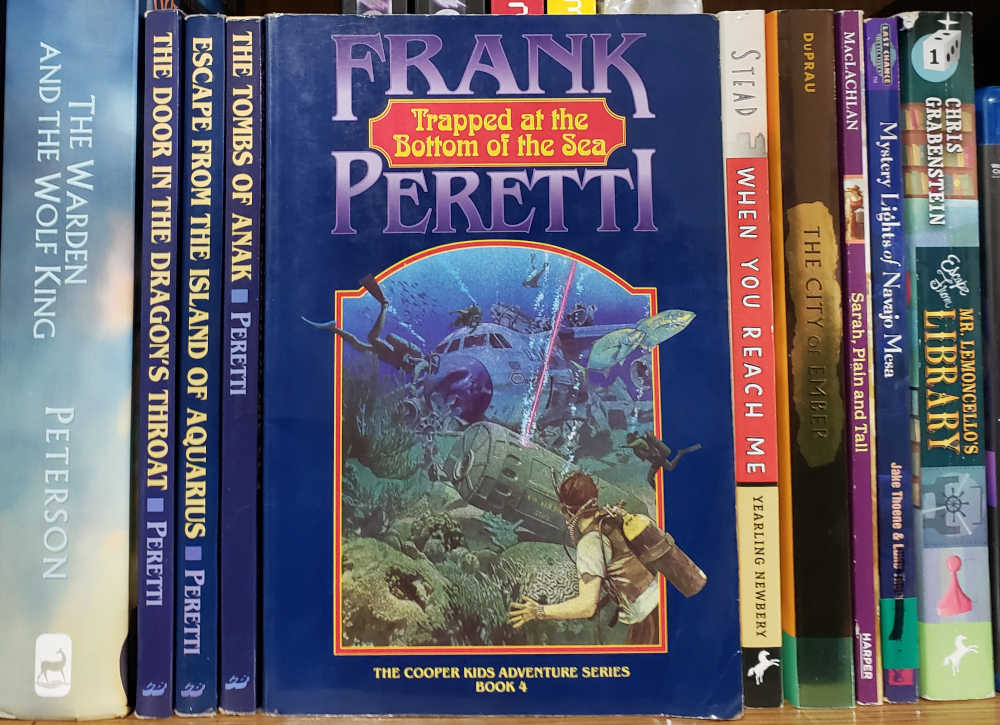
Book Review: Trapped at the Bottom of the Sea

Trapped at the Bottom of the Sea
The Cooper Kids Adventure Series book #4
by Frank Peretti

My rating: 4 / 5
Genre: Children’s Christian adventure

Frustrated by her father’s lack of willingness to discuss her late mother, teenager Lila insists on leaving Japan, where Dr. Cooper is teaching about his work, and going back to the States. But on the way, her plane is hijacked and crashes over the ocean. While she is trapped at the bottom of the sea in an air-tight weapons pod, Lila’s dad and brother try to find her before it’s too late.

This book was quite a departure from what the series has been up to this point. Instead of uncovering secrets in Dr. Cooper’s capacity as biblical archaeologist, it’s more a straight race against time to find and save Lila. I liked it, though, maybe more than the one before it that had been my favorite so far. I liked the adventure and excitement, the ways that Lila tried to keep herself from panicking in the pod and tried to save herself, and the descriptions of the tiny islands in the South Pacific.

Though the heavier supernatural elements that came about in the previous books weren’t here so much, it was still clear God was involved in the story from start to finish. This book has led me to realize that the series is basically a modern-day parallel to certain biblical accounts and truths. It’s as if Peretti started each of these books by asking himself, “How would these certain verses of the Bible look if they happened today?” This one, for example, has shades of the story of Jonah (not subtly so either). It’s a solid addition to this middle-grade series.

Find out more about Trapped at the Bottom of the Sea

See what I’m reading next.

If you’ve read this book, or read it in the future, feel free to let me know what you think!

Book Review: The Orchard House

The Orchard House
by Heidi Chiavaroli

My rating: 3.5 / 5
Genre: Christian drama

After a difficult childhood, Taylor is adopted by her best friend’s parents. But sisterhood is not all it’s cracked up to be, and Taylor ends up leaving home at 21 with the determination to never see her family again. However, when informed 18 years later that her adopted mother is going through treatment for cancer, she returns home. But what starts as a brief visit turns into something more as old wounds are re-opened and this make-shift family struggles to make sense of present struggles. That’s when Taylor and her sister stumble across a story that captivates them and helps distract from real life. In the 1860s, the death of a soldier sparked a friendship between the soldier’s sister, Johanna, and Little Women author Louisa May Alcott. This friendship, and the life and marriage of Johanna, were hidden away for 150 years, to be discovered by Taylor and Victoria just when the story could most affect their lives.

I spent the first half of this book uncertain about a lot of it. Two different storylines had to be established–both the past and the present–and the present one covered several years in a few chapters. Even when the story slowed down and started unfolding in the present day, I struggled to get into it. Taylor’s adolescence had turned her into a confused, broken woman, and she essentially second-guessed her decisions, thoughts, emotions, and reactions every step of the way. And I questioned often what the past storyline had to do with the present one. It was a slow build, to be sure. It did pick up in the second half, but for a while, all I could think about was how terrible each of the characters seemed to be, in one way or the other.

The main thing that I really liked about the story was the way the Christian message was presented. While some reviewers found it “too religious,” I spent at least half the book wondering how on earth this had been labeled as Christian. But the slow build I mentioned earlier can also be applied to the way the main characters learned to first believe in and then trust in Someone bigger than themselves. Though in the end, I felt the “conversions” and overall Christian message were a little light, I still liked the way they shaped up.

There were some things in the book that confused me, and I re-read some passages more than once trying to understand. As an example, Louisa was said to have 2 sisters, but over the course of time 3 were mentioned–Anna, Nan, and Amy. However, Anna and Nan were the same person, and while the author did seem to realize we needed that explanation (I certainly did), it didn’t come until after the sister was referred to by both names at least once. There are other things that confused me too, but fortunately there was less of this in the second half too.

I think that people who love Louisa May Alcott’s books, or at least have read one or more of them, might enjoy this book. Though Louisa herself is only a small part of the story, her books and lasting effect on future fans are prevalent themes. I’ll admit to having a different view of a particular aspect of Little Women than the author (or at least than the main character), but as fiction, it’s certainly open to interpretation. If you’re looking for a light Christian read, this is not it. It’s full of drama and covers some dark topics such as abandonment, abuse (both physical and emotional), and betrayal. If you like time-split novels and stories about finding “home” or families trying to piece themselves back together, you might enjoy this book.

Thank you to Netgalley and Tyndale House Publishers, Inc. for providing me a copy of this book to review.

Find out more about The Orchard House

See what I’m reading next.

If you’ve read this book, or read it in the future, feel free to let me know what you think!