Book Review: The Monster in the Hollows

The Monster in the Hollows
The Wingfeather Saga
#3
by Andrew Peterson
read by the author

My rating: 5 / 5
Genre: Children’s fantasy

monster

Spoiler notice: The following review will contain spoilers for the previous books in the series, On the Edge of the Dark Sea of Darkness & North! or Be Eaten.

The joyful ending of the previous book only carries so far into the Green Hollows, where the residents are wary, to say the least, about having a Grey Fang in their midst. Even as his family defends him, Janner can’t seem to help but be afraid of his brother as well. The Igibys begin to try to make their home in the Green Hollows, but there is more danger nearby than just the little Grey Fang.

Though there were some slower parts for me in this book, as I wasn’t as interested in the school system in the Green Hollows, it was not nearly enough to detract from the rest of the book as an exciting, heart-filled addition to this series.

Looking back on it, most of what I’d want to expand on would be a spoiler, so I don’t feel like I can say much in this review. However, as the danger ramps up, the heroes learn more and more who they are and who they should be. And though there were some dark and gut-wrenching moments, I have so much anticipation for the finale of this great series. More importantly, my 10-year-old daughter has gotten into this series since I started it, and she LOVES it! In fact, she’s kind of obsessed with it. She’s not an avid reader, so I’d say that’s a huge endorsement.

I highly recommend this book, and the series so far, for folks of all ages who enjoy clean, fun fantasy adventures. And to restate from my previous reviews–you might see it labeled as Christian, and there are some references to a deity that many of the people believe in, but it is not overtly Christian.

On a technical note, I initially listened to this as an audiobook, which isn’t normally my thing. It’s narrated by the author, though, and he does such great voices and really makes the characters come alive. When I got a copy of the ARC, I flipped through to find all of the illustrations and extras that the re-release will have, and they are great too! Definitely worth having the physical copy when it comes out someday.

Thank you to Netgalley and WaterBrook & Multnomah for providing me a copy of this book to review.
**Note: This book has been out since 2011, but a new hardcover edition will be released Sept 15, 2020, with a beautiful new cover and new illustrations inside.

Find out more about The Monster in the Hollows

See what I’m reading next.

If you’ve read this book, or read it in the future, feel free to let me know what you think!

Book Review: A Bride of Convenience

A Bride of Convenience
The Bride Ships
#3
by Jody Hedlund

My rating: 3.5 / 5
Genre: Historical Christian romance

Bride

In the 1860s, women were shipped from England to Victoria, in what is now Canada, to become wives for the bachelors who lived and worked in the British colonies. Author Jody Hedlund imagines what might have happened to some of the women on those ships in her series The Bride Ships. This is book #3 of that series, though can be read as a standalone. Only a day off the ship, Zoe becomes the guardian of an abandoned infant. While a local pastor named Abe attempts to find the baby’s father, Zoe resolves to care for the baby herself. But single-motherhood is not only difficult, but nearly impossible in this untamed land. Through a misunderstanding, Zoe and Abe marry and then are faced with the difficult decisions that come from a hasty marriage of convenience.

Marriages of convenience have always been something that draw my attention, especially in a Christian setting. The story of Zoe and Abe and how they get to know each other, become friends, and hope for more, was sweet and captivating. If my rating were based only on that, it would have been at least 4 stars, maybe more. However, my lower rating is because of the physical lust that I had to wade through.

I’ll start with the positives, though, because outside of the physical stuff, or if I’d been able to skip over it, I really enjoyed the overall story. I liked both of the main characters as individuals, which seems fairly uncommon in romances I read these days. Abe had some issues being assertive (which I can relate to), but found a backbone when it was needed. Zoe was uncertain about her ability to be a “proper” pastor’s wife, but had a lot more actionable compassion than she realized. I was able to predict what happened near the end, but would have been pretty surprised about the way the rest of the story had gone if my prediction had not come true. I would actually like to see more of these two, as long as they can keep their physical desires about each other out of the narrative.

So obviously, the fact that Abe and Zoe are married through most of the book is going to involve some physical desires. And because they’re married, even though they’re still basically strangers, it’s okay, right? Sure, I don’t have a problem with a husband and wife lusting after each other, even if they’ve only just met, or if their marriage was not borne of love for each other. And I really appreciate the fact that they were completely respectful of each other, because, as Zoe herself observes, in the confines of being married, Abe may have felt he had the right to take whatever he wanted. But what did bother me was the near-constant leering. More specifically, it’s the fairly detailed descriptions of the leering that made me uncomfortable as I read. Just because two people are married doesn’t mean I want to hear the details of their love lives, lusts, or desires. Even Abe himself, in the story, finds himself uncomfortable in the presence of his friend and friend’s new bride, as they apparently made out in front of him a lot. Just because they’re married doesn’t mean we all want to watch them enjoying each other.

I’m sure it might seem to some like there’s no way around it, given the story presented, but I think that it could have been toned way down. And because this is a Christian book, which will be expected to be clean and okay for younger people, I wanted to make sure to mention this possible issue for others. To be fair, there’s nothing I would call explicit, but it’s about the closest I can remember reading in a Christian book. From the other reviews, it’s clear that I’m in the minority here, but as another reviewer stated, I would not allow my daughter to read this when she’s a teenager, and would be very uncomfortable listening to an audiobook of this with any members of my family around.

I hate to say this, because I do think the story was well-written. I have a feeling the other books in this series, maybe others by the author too, likely don’t have the same problem (I certainly hope not, at least). But I would have a difficult time recommending this book too widely. If you aren’t bothered by this kind of thing and enjoy Christian romance, certainly give it a try. But be careful where you’re reading it or listening to it, and please make sure to read it before allowing your teenager to read it.

Thank you to Netgalley and Bethany House for providing me a copy of this book to review.

Find out more about A Bride of Convenience

See what I’m reading next.

If you’ve read this book, or read it in the future, feel free to let me know what you think!

June in Review

I read 5 books last month, which I’m happy with. Considering how long I went without reading more than a few pages a day (partly because of falling back into an online game black hole, and partly because the book I was reading when that happened was just not very interesting), I picked up a little more later in the month. I’m still not currently reading as much as I had been, but I’ve found a bit of a balance.

Here are the books I read in June:

The Tech by Mark Ravine (3 / 5)
A Soldier’s Promise by Laura Scott (3.5 / 5)
The Monster in the Hollows by Andrew Peterson (review pending) (5 / 5)
North and South by Elizabeth Gaskell (review pending) (4.5 / 5)
Eye of the Storm by Ryan Stevenson (4 / 5)

This list includes 1 ARC. My favorite book from June was The Monster in the Hollows. I finished 0 series, continued 1 series, and started 0 series. My ever-changing short list of to-be-reads, as well as a flag for the book I’m currently reading and an ongoing list of those I’ve read and posted about can be found here.

I’m also keeping my Goodreads page updated with a more extensive list of to-be-reads. Despite my almost too-long TBR list, I’m always looking for more to add. Feel free to offer suggestions of your favorites or just recent reads you enjoyed.

Book Review: Eye of the Storm

Eye of the Storm
by Ryan Stevenson

My rating: 4 / 5
Genre: Memoir, Christianity

AtD

Singer and songwriter Ryan Stevenson shares the story behind his hit song “Eye of the Storm.” Years of struggling in his personal life and his musical life led to doubt and depression. Stevenson had to learn to fully rely on God, to allow Him to be in charge of his dreams and ambitions, but it wasn’t a quick realization, a “flash of inspiration” that fixed everything at once. It took time and some very dark moments, which Ryan lays bare for us in this book.

It’s never easy to read about the difficulties of someone else’s life, and Stevenson had a lot of them. From watching his mom die of cancer, to his wife having a miscarriage of twins, and to Stevenson’s own bad choices that nearly ruined his life. Through all of this, Stevenson had a love for Jesus, though I’m not clear on where his faith really stood. Still, there’s inspiration to be found in the pages of this book.

I appreciate the humble and vulnerable way that Stevenson wrote about his history. He found some success throughout his life, but suffered many setbacks. And he never holds back from taking the blame for his own mistakes. His wrong choices, mingled with things that were out of his control, caused some of the problems he had. Yet, along with the understanding that he should, and could, trust God in everything, he also came to learn that his mistakes did not have to define him. That, as long as he allowed it to happen, God could wipe them away and he could move on from who he used to be.

Though I have not had nearly the hardships in my life that he had, I gleaned plenty of insight from Stevenson’s story. In particular, it was a reminder when I really needed it to continue to do plug away at my writing, which feels stalled at the time of my writing this review. But rather than waiting for a big, obvious lit-up path (which I didn’t even consciously realize I was doing until now), I should be faithful to the work as I know to do it. God may or may not open doors for me, but waiting around for something to happen feels more like giving up than trusting God to use my abilities as he sees fit.

One thing I want to mention for anyone who may read this book–I think it’s important to be clear that not everyone hears that “still small voice” quite so clearly as Stevenson did so many times in his life. If we assume that God will lead us in this way, and we never feel an obvious nudging of the spirit, we may feel like God has abandoned us in the way Stevenson felt at times during his life. Even if we never experience a monologue from God, a whisper in the wind, we can still follow God faithfully, and he can use us in ways we’d never expect. I don’t want to discount Stevenson’s account of how God spoke to him, but it is not the only way, and for those of us who do not have those experiences, we should not feel less important to the kingdom.

With that in mind, I do recommend this book for Christians who could use some inspiration in trusting God in the storms, or for those who enjoy Ryan Stevenson’s music.

Thank you to Netgalley and Harvest House Publishers for providing me a copy of this book to review.

Find out more about Eye of the Storm

See what I’m reading next.

If you’ve read this book, or read it in the future, feel free to let me know what you think!

May in Review

I read 9 books last month, which is pretty good considering that I all but stopped reading right about the middle of the month. For Mother’s Day and my birthday, as a joint gift, since my birthday is always near Mother’s Day, my son bought me the latest expansion and a month of game time for a particular online game that used to eat WAY too much of my time…and clearly that has not changed. I’ve managed to just stay away from it for quite a while, but had recently been a bit jealously watching my son and husband play together. Not a bad move on my son’s part, but I clearly need to learn to find a balance with my free time.

Here are the books I read in May:

4 Years Trapped in My Mind Palace by Johann Twiss (4.5 / 5)
Deep State Stealth by Vikki Kestell (3 / 5)
Time Benders: The Machine by J.B. Yanni (2 / 5)
Healing Her Heart by Laura Scott (3.5 / 5)
Unoffendable by Brant Hansen (5 / 5)
North! Or Be Eaten by Andrew Peterson (5 / 5)
A Lady of Esteem by Kristi Ann Hunter (review pending) (4 / 5)
Daughter of Cana by Angela Hunt (4 / 5)
The Green Dress by Liz Tolsma (4 / 5)

This list includes 3 ARCs and 1 re-read*. My favorite book from May was 4 Years Trapped in My Mind Palace. I finished 1 series, continued 0 series, and started 2 series…sort of. One is a series of novellas/novelettes that I’m not sure I’ll continue. The other was a short story that precedes a series of novels, but I’m not diving into the rest of the series yet. My ever-changing short list of to-be-reads, as well as a flag for the book I’m currently reading and an ongoing list of those I’ve read and posted about can be found here.

*One of the re-reads involved listening to the author read a few chapters of his book every night live on Facebook/YouTube to beat the quarantine blues. I count it the same as listening to an audio book.

I’m also keeping my Goodreads page updated with a more extensive list of to-be-reads. Despite my almost too-long TBR list, I’m always looking for more to add. Feel free to offer suggestions of your favorites or just recent reads you enjoyed.

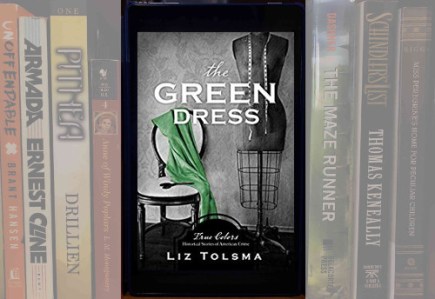
Book Review: The Green Dress

The Green Dress
by Liz Tolsma

My rating: 4 / 5
Genre: Historical Christian romance, crime

Green

Boston, 1886–members of the Robinson family keep falling ill and dying in the same way, with no known cure. When Harriet Peters, who is a close friend of Lizzie Robinson, watches her best friend die, she moves in with the family to care for the youngest members. As the illness claims another life, Harriet enlists the help of a new doctor in town, and he begins to suspect foul play. But how many more have to die before a possible murderer can be caught?

This is my favorite book so far in the True Colors series. It was well-written, the characters were real (and a little scary), and the crime was more interesting and woven into the story better than some of the others in the series (which are stand-alones written by mostly different authors), while also being less gruesome than that of one of the others. I was also a lot more engaged by the romance than I was with most of the others.

From almost the very beginning of the story, I suspected who the mastermind was and turned out to be correct. In fact, it took me a while into the story before I realized the author was attempting to throw us off the trail, make us suspect others. At least, I think that’s what she was trying to do. However, because the book is based on a real story, I think it might have been a bit better to make the criminal plain, at least a little, and add some excitement there. Though this being a Christian story, that might have made it too dark.

My biggest gripe isn’t even all that big. The title of the book was a bit of a stretch, in my opinion. I think the green dress should have been involved a little more for it to make the title seem less like it was forced, just so this book could be in the series. I did like the payoff (and suspected that to be the case as well), but still think it could have been more woven into the story.

The book is not terribly pushy in the Christianity department. Unsurprisingly, given the subject matter, there is discussion about death and what is really required of us humans to be able to go to Heaven. There is also a theme in the later parts of the book regarding God’s will, and how we can pray for healing, but sometimes God’s will is for someone not to be healed in this life. Overall, I enjoyed this book, and I would recommend this book for fans of Christian romance, especially the historical variety.

Thank you to Netgalley and Barbour Publishing, Inc. for providing me a copy of this book to review.

Find out more about The Green Dress

See what I’m reading next.

If you’ve read this book, or read it in the future, feel free to let me know what you think!

Book Review: Daughter of Cana

Daughter of Cana
Jerusalem Road #1
by Angela Hunt

My rating: 4 / 5
Genre: Biblical fiction

Daughter

At a wedding in Cana, Tasmin oversees the week-long feast, with the help of her twin brother Thomas. But Thomas becomes more interested in what a guest from Nazareth has to say than helping his sister. Then that guest appears to turn water into wine, though Tasmin isn’t convinced. And neither is the guest’s brother Jude. After the wedding, Thomas goes with the Nazarene to Capernaum, and both Tasmin and Jude follow, each determined to retrieve their wayward brothers. But it turns out the task is not so easy, and Tasmin’s and Jude’s lives are upset as they try to balance their own lives with still making their brothers see sense–and hope to prove that the Nazarene is not who he claims to be.

This was an interesting take on the ministry of Jesus (referred to by his Hebrew name, Yeshua, in this book) from the perspective of one of his half-brothers, who did not believe he was the Christ during his ministry on earth, and the perspective of a sister to one of the apostles. As Jesus himself put it, no man is a prophet in his own hometown, and that principle applies in some way to both of the main characters (in their view of Yeshua). Most of Jesus’s works are seen from a distance, and I expected that to become tedious, but I appreciated the way the miracles were told by those benefited by the miracles or even bystanders.

I was a little concerned early on, as it seemed Yeshua was being portrayed as lazy and even slightly belligerent to his parents, slacking off while his brothers did all the work, even before his ministry started. I came to see that as the perspective of a frustrated, even jealous, brother, though. There was also one point where Jude talked to his brother in private, and I mentally winced in anticipation of the words the author might choose to put in Jesus’s mouth. Fiction or not, that strikes me as an unwise thing to do. However, his dialog was still right out of scripture. Granted, he obviously said those things to a larger crowd in the Bible, but there is evidence Jesus repeated some parts of his sermons anyway. It was a good decision on the author’s part, I feel.

While Tasmin and Jude spent most of the book with little in the way of their own story, and even of their own personalities, they grew enough later in the book that I still felt some connection to them. The best thing about the book, for me, was that it gave me the ability to feel like I was there, back in Jesus’s day, hearing him speak, seeing him myself, even if from a distance much of the time. There were Hebrew words and phrases sprinkled here and there, and the meaning wasn’t always clear to me. I didn’t quite see the reason for most of that, but that’s a small down-side to an otherwise lovely book. I would recommend it to fans of Biblical fiction.

Thank you to Netgalley and Bethany House for providing me a copy of this book to review.

Find out more about Daughter of Cana

See what I’m reading next.

If you’ve read this book, or read it in the future, feel free to let me know what you think!

April in Review

I read 13 books last month. This is a new record for me in my recent reading life, which will probably stand for a while. It was definitely due to not working for the last month, but I have picked up a bit of work. I don’t know how long it will last (I work as a sub-contractor), but I’ll take it while I can, even though it’ll take away some of my reading time.

Here are the books I read in April:

Landry Park by Bethany Hagen (3.5 / 5)
On the Edge of the Dark Sea of Darkness by Andrew Peterson (5 / 5)
The Outcast by Taran Matharu (3.5 / 5)
Star of Persia by Jill Eileen Smith (4 / 5)
Storm by Evan Angler (4 / 5)
The Wounded Spirit by Frank E. Peretti (5 / 5)
Anne of the Island by L.M. Montgomery (4 / 5)
Harry Potter and the Half-Blood Prince by J.K. Rowling (5 / 5)
Harry Potter and the Deathly Hallows by J.K. Rowling (4 / 5)
Adorning the Dark by Andrew Peterson (4 / 5)
When You Reach Me by Rebecca Stead (5 / 5)
The Sea Before Us by Sarah Sundin (4 / 5)
Fahrenheit 451 by Ray Bradbury (3.5 / 5)

This list includes 2 ARCs and 2 re-reads*. My favorite book from April was When You Reach Me. I finished 2 series, continued 2 series, and started 1 series. My ever-changing short list of to-be-reads, as well as a flag for the book I’m currently reading and an ongoing list of those I’ve read and posted about can be found here.

*One of the re-reads involved listening to the author read a few chapters of his book every night live on Facebook/YouTube to beat the quarantine blues. I count it the same as listening to an audio book.

I’m also keeping my Goodreads page updated with a more extensive list of to-be-reads. Despite my almost too-long TBR list, I’m always looking for more to add. Feel free to offer suggestions of your favorites or just recent reads you enjoyed.

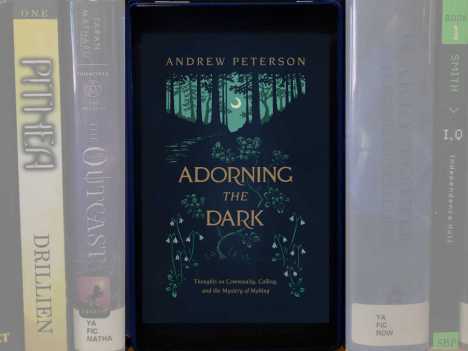
Book Review: Adorning the Dark

Adorning the Dark
by Andrew Peterson

My rating: 4 / 5
Genre: Memoir, Christian living

AtD

Singer, songwriter, and author Andrew Peterson shares his insight on creating in this book. He uses personal experience as well as wisdom from other songwriters and authors to discuss the process of writing songs, the ups and downs of the business, and using one’s creative abilities to tell a story.

I’ll start my review by saying that I was not the main target audience for this book. While Peterson does do his best to expand beyond songwriting into fiction-writing and other kinds of art, the heavy focus is on the musical realm (and poetry to a lesser degree). I’m a fiction writer, but have no experience with or even much of an understanding of writing songs. Plus, he referred to songs and books by various songwriters and authors a lot and talked about them as if the reader should know them as well as he did. I’m not nearly as well read as him, and I am definitely not as immersed in music culture, nor do I listen to as wide a range of music as he. As such, I do think that quite a bit of the book was lost on me.

Another way this book did not resonate with me is that I came to realize by maybe halfway through the book that my personality, and the way I see the world around me, is vastly different from his. He sees beauty in everything, but I’ve never been all that sentimental. So that was another chunk of the book that fell flat for me.

However, that does not mean that I did not find plenty of gems in the book, things that work for any kind of creating. For example: “If you wait until the conditions are perfect, you’ll never write a thing.” Or: “The songs won’t write themselves, and neither will the books, the recipes, the blueprints, or the gardens.” Even with the difference that Peterson describes between songwriting (which can also apply to poetry to a degree) and writing fiction, the clear point is that you have to get through the bad to find the good.

He also addresses the different between “Christian art” and art from a Christian perspective, which I really appreciated. As an author, I’ve struggled in the past with thinking that I should only be using the gift God gave me to write specifically Christian fiction. However, I no longer think that’s true. Instead, I can write stories with a Christian worldview, which will most likely be acceptable to most Christians, and will even be acceptable to many non-Christians who just want something good to read. And in approaching the art that way, perhaps it would allow the artist to actually reach more for Christ.

There were a few things about which I disagreed with the author, but even in those I think it mostly comes down to a difference in mindset or preference. I did agree with the idea that calling some people “creatives” excludes many people who really are more creative than they think. Just because “art” isn’t the end result, pretty much everyone creates in their own way–that can come out as critical thinking or problem solving, or so many other things that don’t seem as creative. In the end, I’m very glad I read this book, as it gave me some interesting insight into a singer whose music goes back as far as my marriage, and plenty of solid advice on writing, some of which I needed to hear even today. I recommend this book for Christians who are interesting in creating, no matter the form it takes.

Thank you to Netgalley and B&H Publishing Group for providing me a copy of this book to review.

Find out more about Adorning the Dark

See what I’m reading next.

If you’ve read this book, or read it in the future, feel free to let me know what you think!

Book Review: Star of Persia

Star of Persia
by Jill Eileen Smith

My rating: 4 / 5
Genre: Biblical fiction

Esther

When the queen of Persia refuses an unreasonable demand of King Xerxes, she is banished. Jewish girl Esther, known as Hadassah for her first fifteen years, is one of many unmarried women who are brought to the palace to contend to be Xerxes’s next wife. Made queen in place of Vashti, Esther and her adopted father Mordecai have to navigate palace politics and eventually, it’s up to Esther to save all of her people from extermination.

Though the Biblical account of Esther is commonly known by most who would read this book, I liked the way the author brought it to life. The struggles that those would have faced due to the politics, culture, and religions of that day were not glossed over. It’s common, and even somewhat necessary, for the author to take creative license in some areas, as not all details are ever known in a Biblical account, and while I didn’t necessarily agree with everything the author chose to do, I don’t think any of it detracted from the story.

I loved the way that Mordecai, who had chosen to stay in Susa when the Jews were allowed to return to Jerusalem, struggled with his decision to keep his heritage a secret. We all know that even the most prominent figures in the Bible (besides God himself) were flawed humans, some more than others, and that is clear with the two main Jews in this book as well. I also think that the way Xerxes was portrayed was realistic, considering that he does often consult others, even his servants, in the Biblical account, so his character in this book was fleshed out from that perspective, and I loved it.

As I mentioned above, I disagree with one main point the author decided on. It is not immediately evident who King Ahasuerus is in the Biblical account, due to language differences, I believe. He seems to be most commonly accepted to be Xerxes. However, Xerxes has only 1 verified wife–Amestris. I did not do nearly as much research as Smith must have for this book, but I see more evidence that Amestris is another name for Vashti, or even possibly for Esther herself. So having a rival wife that is actually directly or indirectly behind much of the shady things that happen in the account seemed unnecessary to me. However, it did provide more intrigue for the fictional version, and while I would have chosen a different route, I respect her decision and am not saying whatsoever that the book was any worse for it.

I would say the writing itself was what mainly detracted from the story for me. I personally think there was at least one POV too many. The story was told from the following perspectives: Esther, Mordecai, Xerxes, Vashti, Haman, and Amestris. If I’m missing one, I wouldn’t be surprised. But I think we could have done without getting to know Vashti, considering what her parts set up aren’t resolved. And she’s just a shadow of the true heroine anyway. There are also a couple of things that happen with Haman that confused me, like him grumbling about his wife and her back-talk, when the entire rest of the book, she seemed nothing but supportive to me, giving him advice that he followed. He even called her wise at one point. Then suddenly, he’s about ready to punish her if she opens her mouth again. I don’t know what was going on there.

Overall, I enjoyed this book a lot. I am one who tends to read romance (not just romance in the traditional sense) into certain accounts in the Bible as I’m reading, and it’s nice to see it come alive in this way. I will likely re-read this someday, but first, I plan to check out Smith’s take on Ruth, which is my favorite book in the Bible. As for Esther’s story, though, I highly recommend it to fans of Biblical fiction.

Thank you to Netgalley and Revell for providing me a copy of this book to review.

Find out more about Star of Persia: Esther’s Story

See what I’m reading next.

If you’ve read this book, or read it in the future, feel free to let me know what you think!