Book Review: A Woman of Words

A Woman of Words
Jerusalem Road #3
by Angela Hunt

My rating: 3.5 / 5
Genre: Biblical fiction

Matthew, one of the twelve apostles and former tax collector for the Romans, has been living in Capernaum in the years since Yeshua’s (Jesus’s) death and resurrection when he is summoned to Jerusalem by Peter and John to help them with the growing church there. He anticipates preaching and performing great miracles like his brothers have been doing over the years, but is disappointed to discover that they are more interested in the skills he honed while collecting taxes. Then Mary, Yeshua’s mother, approaches him with a request that he help her write down all of the teachings of Yeshua and accounts of his miracles before they’re forgotten by those who witnessed them. Matthew does not want to sit and write, either words or numbers, when there are souls to be reached. As he comes to terms with what God wants of him, the Roman emperor prepares to set himself up as a god to be worshiped, which would force the entire Jewish community–Yeshua-follower or not–to make a choice between their life or their obedience to God.

I have really liked this series so far and was excited to read the 3rd installment. It wasn’t quite as good as the first two, to me, but I still really liked reading more in the fictional Biblical world Hunt has set up in the series. I’m not completely sure what it is that I liked less about this one. It seems to have less of the charm the other two had, and I think that might be partly because one of the things I liked the most about the other two was that Yeshua was still on Earth. Even though he was in the background, he was there, and I was really drawn to that. I liked hearing both Mary and Matthew talk about his teachings and how special his friendship and love was, how he made them feel when he talked to them, etc. But despite Hunt’s attempts to infuse emotion into these accounts, somehow it didn’t work as well for me.

I do appreciate that Matthew was led to go back to the Old Testament and discover more about who Yeshua was before he became a man, the connections to the prophesies and such. And to be clear, because I didn’t get this until near the end of the book and also from the author’s note–this is not a fictionalized story of the book of Matthew as we know it being written. Matthew and Mary are writing more of a history of Yeshua’s life on earth, in Hebrew (the book of Matthew was written in Greek), that is not meant to be that which later became scripture. But the idea is that this book essentially became a launching point for the Gospels. I wonder if I would have read it differently with that in mind, but it’s hard to say now.

Another thing I really liked is that both Matthew and Mary are presented as real humans with flaws and issues that they have to deal with as they work together on this story. But I also think it’s important that Mary can tell that people are treating her differently because of her son and that she does her best to remain humble and steer people away from treating her like she’s deity herself. She repeats often throughout the story that she’s always been simply a servant of God. While many of us might fall into the trap of allowing ourselves to be set on a pedestal, God chose her because He knew her heart and that she would willingly serve Him, so I like seeing this woman continuing steadfastly in her role as a servant. I think that the reasons I didn’t like this book as much as I did the first 2 are my own fault, not a fault with the book. And even saying that, I did still like it, would recommend it to fans of Biblical fiction, and am looking forward to seeing what else Hunt has in store for this series (she says in the author’s note that she does have another in mind).

Thank you to Netgalley and Bethany House for providing me a copy of this book to review.

Find out more about A Woman of Words
Publication date: May 4, 2021

See what I’m reading next.

If you’ve read this book, or read it in the future, feel free to let me know what you think!
Book Review: The Purple Nightgown

The Purple Nightgown
by A.D. Lawrence

My rating: 4 / 5
Genre: Historical Christian romance, crime

Stella Burke, heir to a clothing company and accompanying fortune left when her father died, suffers from near-daily debilitating migraines. When the latest suggested treatment doesn’t work, she comes across a book called Fasting for the Cure of Disease by Linda Burfield Hazzard and then discovers that the doctor has a health spa not too far away. Desperate for anything to ease her pain, she insists that her family chauffeur take her to the spa. Henry is more than just her chauffeur, a close friend and confidante who has been part of her life since they were both kids. He doesn’t trust the doctor’s methods and definitely doesn’t easily agree to take Stella to the spa. When the spa turns into a prison and Hazzard’s methods prove even worse than Henry imagined, can Stella find a way to escape, or will she die alone as one of Hazzard’s walking skeletons?

A solid entry to the True Colors series, which focuses on different true crimes from history, with real historical facts melded with fictional characters and situations. I liked it more than most of the others I’ve read in the series, mostly due to the fact that the crime part of the story was more a focal point than the romance. Though the two main characters’ thoughts about how they feel about each other was brought up at a couple of random or wildly irrelevant times, it was not overly pervasive. Stella’s struggles at the spa, with the treatment, with her uncertainty about whether or not she should stay, and then with her futile attempts to escape, were a well-written driving force.

Adding to that is a sub-plot with Henry and his dream to start a children’s home, which gave the story somewhere to go to avoid a slow, plodding narrative of Stella wasting away. It also allowed a light in the darkness of Stella’s story. I really liked the culmination of all of that at the end of the story. I also appreciated that we weren’t expected to just accept that these two people liked each other simply because we were told they did. They fit together well, had a history, and even had flaws that the other had to be willing to accept.

If I hadn’t known that this woman and her spa were historical fact, I would have had a difficult time believing anyone would go to her for treatments. But I think the author did a good job trying to imagine a scenario in which someone of sound mind would be desperate enough to place themselves in such danger for the hope of relief–not that the victims expected such danger when they checked into the spa. It had a few dark moments as Stella saw things she wasn’t meant to see, the truth about what was going on at the spa; they didn’t bother me, but it seems good to mention it for those who prefer to avoid dead bodies and other things related to that in their reading (it’s a small amount, really).

There was a particular Chekov’s gun-style “prop” that I really expected to come into play more near the end of the book. I’m not sure that’s a fault of the author’s, as the prop definitely had its uses, but I still expected something in the way of even a minor twist involving it. However, overall, I enjoyed the book. It’s not too pushy in its inclusion of Christianity. Stella has to realize that she’s not very good at being still and letting God be in control, but she really doesn’t even come to the place where she “sits still” and turns to him until she’s literally forced to not move for a while. It’s a shallow theme of God’s will being best, but it’s there. I think anyone who enjoys clean romance, especially historical romance, and especially those who like crime or darker content in novels, will like this book.

Thank you to Netgalley and Barbour Publishing, Inc. for providing me a copy of this book to review.

Find out more about The Purple Nightgown

See what I’m reading next.

If you’ve read this book, or read it in the future, feel free to let me know what you think!
March in Review

I read 9 books last month, which I’m pretty happy with. Somewhere in the middle of the month I slowed way down on reading, partly due to the book I was reading dragging a lot. The 3 audiobooks I read last month definitely kept me going when my normal reading faltered

Here are the books I read in March:

Jo & Laurie by Margaret Stohl & Melissa de la Cruz (3.5 / 5)
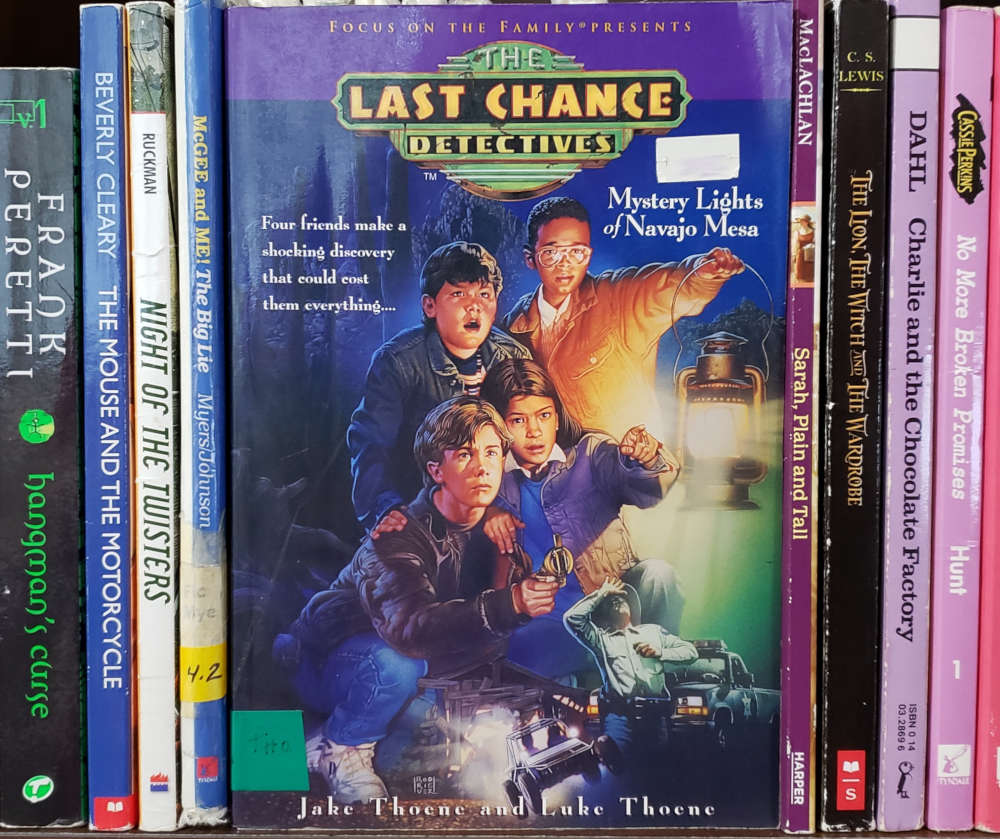
The Lion, the Witch and the Wardrobe by C.S. Lewis (4 / 5)
Maus II by Art Spiegelman (5 / 5)
The Hitchhiker’s Guide to the Galaxy by Douglas Adams (2 / 5)
Wives and Daughters by Elizabeth Gaskell (5 / 5)
Wingfeather Tales by Andrew Peterson and other authors (3.5 / 5)

The Curse of the Pharaohs by Elizabeth Peters (3.5 / 5)
Mr. Lemoncello and the Titanium Ticket by Chris Grabenstein (review pending)

This list includes 2 ARCs and 1 re-read. My favorite book from March was Wives and Daughters. I finished (or caught up on) 4* series and started 1 series. My ever-changing short list of to-be-reads, as well as a flag for the book I’m currently reading and an ongoing list of those I’ve read and posted about can be found here.

*This includes 1 series that I did not reach the end of but decided not to continue reading, after being 2 books into the series.

I’m also keeping my Goodreads page updated with a more extensive list of to-be-reads. Despite my almost too-long TBR list, I’m always looking for more to add. Feel free to offer suggestions of your favorites or just recent reads you enjoyed.

Book Review: Wingfeather Tales

Wingfeather Tales
by multiple authors (see details below)

My rating: 3.5 / 5
Genre: Children’s fantasy short stories

For me, last year will forever be known as the year of the Wingfeathers. I read the entire Wingfeather Saga for the 1st time…and the 2nd time, in a way, as the author, Andrew Peterson, read his books live, a few chapters a day, throughout the year. This book is a collection of 7 stories set in that same world, written by 6 different authors. First, let me get some basic info out of the way: Yes, you really should read this only if you’ve read the Wingfeather Saga in its entirety, which I fully recommend that you do either way. No, none of these stories is a continuation of that series in any way. Well, one sort of is, to a very small degree, but more on that in the details below. Let’s just say that it will not answer the burningest questions you’ve most likely been left with after finishing the series. Andrew Peterson has stated on more than one occasion that he would prefer to leave any answers up to the imagination of his readers, which is fair.

My overall book rating is a reflection of the average of individual ratings for each story. I did not love the stories overall as I might have hoped. However, I did go into this uncertain about how I’d enjoy them. I’m not really huge on short stories in general, but I couldn’t help but give this book a go, considering how much I loved the original series. What follows is a list of each story with its author and illustrator, my rating, and a brief (as much as possible) review for each.

“The Prince of Yorsha Doon” by Andrew Peterson (5 / 5) – This was my favorite short story in the collection, with a ragged, loner street urchin getting the chance to be something more, to do something more. It’s charming and contains a wonderful appearance by one of the bigger characters in the original series. (illustrated by Cory Godbey, Nicholas Kole, & Hein Zaayman)

“The Wooing of Sophelia Stupe” by Jennifer Trafton (3 / 5) – The story of the author of the Creaturepedia books on its own was decent, if open-ended. However, I was slowed down and tripped up by the character’s vocabulary. He had a penchant for using very large, at times ridiculous words, both real and made-up (though a lot more made-up than real, I’m pretty sure). I’m sure it’s meant to be whimsical, and that plenty of people will find the fun in it, but it’s not really my preference. (illustrated by John Hendrix)

“Willow Worlds” by N.D. Wilson (4 / 5) – I really liked seeing young Podo, and perhaps the genesis of what made him who he is in the Wingfeather books. The plot to this story, especially coupled with the story before it, paints such a vastly different fabric for this fantasy world than what was in the original books, leaving me a little surprised and confused. The story is particularly short and abrupt, but I liked the general idea of it and wish there was more on this subject. (illustrated by Joe Sutphin)

“ShadowBlade and the Florid Sword” by Andrew Peterson & Jay Myers (4 / 5) – As alluded to in the first paragraph of my review, this is the one tale in the book that is a continuation of the original series. The title tells it all, and it’s actually in comic-book format. I did like having the chance to see the two together, and wish it had been longer. Though several of the stories in this collection end abruptly and with more that could be told, I think this is the one I most want to see more of.

“From the Deeps of the Dragon King” by A.S. Peterson (2 / 5) – This story was tragic and disturbing, and while it was clearly meant to be so, my rating is not due to the theme or mood. Considering how Podo’s story and character arc went in the original series, especially at the end of North! or Be Eaten, I really think I would have preferred not seeing him at this time of his life. It almost felt like undoing everything related to this that happened in the series. Plenty of others, I’m sure, will be happy to read about Podo’s past, but it just made me sad. (illustrated by Doug TenNapel)

“The Ballad of Lanric and Rube” by Jonathan Rogers (4 / 5) – This story was short and silly, maybe a little predictable to me, but overall just fun. (illustrated by Justin Gerard)

“The Places Beyond the Maps” by Douglas Kaine McKelvey (2 / 5) – This is the kind of story that I wish I could rate higher and feel like a rube rating so low, because I’m sure it’s meant to be beautiful and poignant, but it’s just not for me. It’s the story of a man whose daughter was taken away by the Black Carriage, and all that he goes through as he tries first to get her back, then to get justice, and finally just to find some meaning and purpose after the tragedy. It is long (literally as long as all of the other stories put together, since it started at 50% in the e-book) and moves slowly most of the time. There is a lot of introspection, depression, even self-hatred–all things you might expect in the situation, but I felt like it plodded along most of the time. It didn’t help that the author has a tendency toward long, run-on sentences. Entire paragraphs, long in their own right, can be made up of just one or two sentences. It’s a style choice, I’m sure, but not one I care for.

This story is also one that actually caused squeamish me to wince as injuries and the attempt at mending such were described in fairly vivid detail at least once. The man contemplates killing himself or at least giving up on life multiple times. It’s dark, much darker than even the most serious parts of the original series. There were a few bright points for me, like the inclusion of a wonderful character from the original series and the epilogue that added a little hope after the disturbing (and just plain weird) ending. (illustrated by Aedan Peterson)

Final thoughts: I didn’t mention illustrations in the individual reviews, but I enjoyed every one of them. Andrew Peterson has a way of collecting talented people around him (not to mention his own talented children), and I can imagine the honor of having other authors and artists take part in a project like this for his books. I think, though, that some of this collection lost the charm and feel of the original series, and I especially don’t think I’d say this is as great for the age group that the first series was so well suited for. What’s most telling to me is that my daughter (10 years old), who has read/listened to the Wingfeather Saga in some format probably half a dozen times, only read about a story and a half from this collection and walked away. She’ll go back to it eventually, but clearly it didn’t draw her in like the original books. I do think that fans of the original series should read this collection, or at least some of it. I know I’ll re-read some of these stories again in the future, but I was not quite the right audience for some of them.

Thank you to Netgalley and WaterBrook & Multnomah for providing me a copy of this book to review.
**Note: This book has been out since 2016, but a new hardcover edition is being released tomorrow, with a beautiful new cover and new illustrations, and the inclusion of one new tale (the comic one).

Find out more about Wingfeather Tales

See what I’m reading next.

If you’ve read this book, or read it in the future, feel free to let me know what you think!
February in Review

I read 11 books last month, which was only 1 less than last month, but the total page count was about 1/3 of what I read last month. Apparently I read a lot more short books this month!

Here are the books I read in February:

Awake and Alive to Truth by John L. Cooper (5 / 5)
The Orchard House by Heidi Chiavaroli (3.5 / 5)
The Cat Who Saw Red by Lilian Jackson Braun (5 / 5)
Mr. Lemoncello’s Great Library Race by Chris Grabenstein (3.5 / 5)
Crocodile on the Sandbank by Elizabeth Peters (3 / 5)
Trapped at the Bottom of the Sea by Frank E. Peretti (4 / 5)
The Secret of The Desert Stone by Frank E. Peretti (3 / 5)
The Hiding Place by Corrie ten Boom with John & Elizabeth Sherrill (5 / 5)
John Bunyan’s Pilgrim’s Progress as retold by Gary D. Schmidt (2 / 5)
From this Moment by Kim Vogel Sawyer (3 / 5)
Mr. Lemoncello’s All-Star Breakout Game by Chris Grabenstein (review pending)

This list includes 2 ARCs and 2 re-reads. My favorite book from February was The Hiding Place. I finished 0 series, continued 3 series, and started 1 series. My ever-changing short list of to-be-reads, as well as a flag for the book I’m currently reading and an ongoing list of those I’ve read and posted about can be found here.

I’m also keeping my Goodreads page updated with a more extensive list of to-be-reads. Despite my almost too-long TBR list, I’m always looking for more to add. Feel free to offer suggestions of your favorites or just recent reads you enjoyed.

Book Review: From This Moment

From This Moment
by Kim Vogel Sawyer

My rating: 3 / 5
Genre: Christian fiction

Jase is a new youth minister at a small church in an even smaller town in Kansas. Recently moved from San Antonio after his fiancee died, he’s struggling with anger and doubt in his Christian walk. Kenzie is ten years removed from her Amish heritage, leaving the community when she learned how the grace of Christ could free her from the rules and regulations of her family’s religion. She’s been thinking more and more about her family, though, and the darkness they’re still lost in. Lori is a young woman who was emotionally and verbally abused by her father as a teenager. She uses food as a coping mechanism when she feels lonely or inadequate, despite knowing that it’s pointless and wishing she could stop. Jase, Kenzie, and Lori are each searching for answers from God, and when Jase moves to Kansas, he’s welcomed into the friendship that Kenzi and Lori already have. With each other’s help, the three just might find their answers.

Through the first half of this book, I didn’t really understand what it was meant to be about. Part of that is because the official synopsis is atrociously inaccurate and misleading. But it’s also because it really took a while for things to get going. And actually, in the end, it turns out the book really was about what I saw in that first half– these characters each struggling with their doubts, uncertainties, and questions about God and their faith. There were parts of the story that I liked, that I thought came together well in the end, and parts that fell flat for me, or that I questioned why they were included. Overall, it was a decent read, but not a stand-out for me.

The storyline I related to the most was Lori’s over-indulging in times of extreme emotion, good or bad. I haven’t had an abusive past like hers, but over-indulgence is an issue I have struggled with in the past, though not to the degree that she does it. I really liked the way Kenzie’s story shaped up too, after wondering what it had to do with anything for a while near the beginning. Jase’s storyline is the one that I was least connected to, partly because I’ve not experienced loss like that, but also partly because the decisions he made really bugged me. There is a 4th perspective in this story too, which I felt was wholly unnecessary. I couldn’t help but compare it to the previous book I read by this author, which also included 4 perspectives. But where it worked in that one, it just seemed pointless in this one. I’m not sure what the pastor’s perspective added, nor did I feel like it was particularly resolved.

If there was one cohesive lesson this story seemed to bring out, it was the benefit of allowing others to share your burdens. Each of these four people was originally struggling alone and seemed to only see a turning point when they opened up to a fellow Christian about their trouble. Actually, that’s not really true for one of them (I won’t say who), but perhaps it’s just that I wished he/she had let others help him/her along the way. And on a related note, Kenzie really drove me crazy at some points. How can you say “God will provide” and then refuse all of God’s ways of providing? If a really specific incident hadn’t happened, she absolutely would have stayed in the same place, spinning her wheels, still waiting and hoping for God’s providence. (You ever heard the one about the guy sitting on the roof of his flooded house, refusing to get in the boat or helicopter because he knew God would save him? Yeah, she’s kind of like that.)

So in the end, this is not a book I would choose to read again. However, I think that my issues with it will likely not be shared by most others. If you are looking for a Christian book where romance isn’t the main plot and where the author ties multiple storylines together into one story where God’s hand can be seen, this might be a good book for you.

Thank you to Netgalley and WaterBrook & Multnomah for providing me a copy of this book to review.

Find out more about From This Moment

See what I’m reading next.

If you’ve read this book, or read it in the future, feel free to let me know what you think!

Book Review: The Orchard House

The Orchard House
by Heidi Chiavaroli

My rating: 3.5 / 5
Genre: Christian drama

After a difficult childhood, Taylor is adopted by her best friend’s parents. But sisterhood is not all it’s cracked up to be, and Taylor ends up leaving home at 21 with the determination to never see her family again. However, when informed 18 years later that her adopted mother is going through treatment for cancer, she returns home. But what starts as a brief visit turns into something more as old wounds are re-opened and this make-shift family struggles to make sense of present struggles. That’s when Taylor and her sister stumble across a story that captivates them and helps distract from real life. In the 1860s, the death of a soldier sparked a friendship between the soldier’s sister, Johanna, and Little Women author Louisa May Alcott. This friendship, and the life and marriage of Johanna, were hidden away for 150 years, to be discovered by Taylor and Victoria just when the story could most affect their lives.

I spent the first half of this book uncertain about a lot of it. Two different storylines had to be established–both the past and the present–and the present one covered several years in a few chapters. Even when the story slowed down and started unfolding in the present day, I struggled to get into it. Taylor’s adolescence had turned her into a confused, broken woman, and she essentially second-guessed her decisions, thoughts, emotions, and reactions every step of the way. And I questioned often what the past storyline had to do with the present one. It was a slow build, to be sure. It did pick up in the second half, but for a while, all I could think about was how terrible each of the characters seemed to be, in one way or the other.

The main thing that I really liked about the story was the way the Christian message was presented. While some reviewers found it “too religious,” I spent at least half the book wondering how on earth this had been labeled as Christian. But the slow build I mentioned earlier can also be applied to the way the main characters learned to first believe in and then trust in Someone bigger than themselves. Though in the end, I felt the “conversions” and overall Christian message were a little light, I still liked the way they shaped up.

There were some things in the book that confused me, and I re-read some passages more than once trying to understand. As an example, Louisa was said to have 2 sisters, but over the course of time 3 were mentioned–Anna, Nan, and Amy. However, Anna and Nan were the same person, and while the author did seem to realize we needed that explanation (I certainly did), it didn’t come until after the sister was referred to by both names at least once. There are other things that confused me too, but fortunately there was less of this in the second half too.

I think that people who love Louisa May Alcott’s books, or at least have read one or more of them, might enjoy this book. Though Louisa herself is only a small part of the story, her books and lasting effect on future fans are prevalent themes. I’ll admit to having a different view of a particular aspect of Little Women than the author (or at least than the main character), but as fiction, it’s certainly open to interpretation. If you’re looking for a light Christian read, this is not it. It’s full of drama and covers some dark topics such as abandonment, abuse (both physical and emotional), and betrayal. If you like time-split novels and stories about finding “home” or families trying to piece themselves back together, you might enjoy this book.

Thank you to Netgalley and Tyndale House Publishers, Inc. for providing me a copy of this book to review.

Find out more about The Orchard House

See what I’m reading next.

If you’ve read this book, or read it in the future, feel free to let me know what you think!

January in Review

I read 12 books last month, which is on the high side for me. Though I do think my monthly numbers should be a little higher overall from here on, since I’ve started listening to a few audiobooks a month. I’m glad I managed to figure out how to make use of idle time and which types of books work best for me in audio format!

Here are the books I read in January:

Maus by Art Spiegelman (5 / 5)
The Return of the King by J.R.R. Tolkien (4 / 5)
A Noble Masquerade by Kristi Ann Hunter (3 / 5)
The Thousand-Dollar Tan Line by Rob Thomas & Jennifer Graham (4.5 / 5)
The Haunting at Bonaventure Circus by Jaime Jo Wright (2 / 5)
Poppy Redfern and the Midnight Murders by Tessa Arlen (5 / 5)
Anne of Ingleside by L.M. Montgomery (4 / 5)
The Warden and the Wolf King by Andrew Peterson (5 / 5)
There I Go Again by William Daniels (5 / 5)
Mr. Lemoncello’s Library Olympics by Chris Grabenstein (4 / 5)
When Twilight Breaks by Sarah Sundin (4 / 5)
Little Women by Louisa May Alcott (5 / 5)

This list includes 2 ARCs and 2 re-reads. My favorite book from January was There I Go Again. I finished 2 series, continued 2 series, and started 3 (short) series. My ever-changing short list of to-be-reads, as well as a flag for the book I’m currently reading and an ongoing list of those I’ve read and posted about can be found here.

*One of the re-reads involved listening to the author read a few chapters of his book every night live on Facebook/YouTube to beat the quarantine blues. I count it the same as listening to an audiobook.

I’m also keeping my Goodreads page updated with a more extensive list of to-be-reads. Despite my almost too-long TBR list, I’m always looking for more to add. Feel free to offer suggestions of your favorites or just recent reads you enjoyed.

Book Review: When Twilight Breaks

When Twilight Breaks
by Sarah Sundin

My rating: 4 / 5
Genre: Christian historical romance

Americans living in Germany in the late 1930s had front-row seats as the country sped toward war. Evelyn Brand is a foreign war correspondent living in Munich, her hands tied as a woman in a man’s world. Or maybe there’s more than just her gender causing her boss to edit her stories to death. Peter Lang is a graduate student working on his dissertation and teaching American students how to speak the German language more fluently. He sees the benefits of the current German regime, as he values the order it brings to a country once chaotic and destitute. But he soon learns the price that this order demands.

I really wanted to give this book 5 stars while I was reading it. For the story alone, it’s worth 5–the characters are engaging, the romance well-done, and the suspense is pulse-pounding. I sped through the book compared to my normal speed, wanting to see what the outcome would be. And the ending did not disappoint, wrapping up all storylines satisfactorily. But I had a few issues while reading it, and I felt they were worth a point detraction and that others should know about some of them.

The book made me a little uncomfortable or caused me to blush a few times in the second half with descriptions of physical or visual contact between the main characters. Nothing graphic by normal standards, really just skirting the line of what I am okay with in a Christian book, but I think there are some who would prefer to be aware of this in advance. The romance was overall well done and while certainly a big part of the story, not so in-your-face like most with the tag of romance. I liked it, but it was just a little descriptive here and there.

There were a few issues with perspective–in a book like this that has established the alternating perspectives between two characters, only changing when there is a scene or chapter break, a couple of times the perspective changed from one to the other mid-scene, which was jarring. Also, characters were speaking German, while we were reading it in English, yet the author continually sprinkled German phrases into the dialog. They were never more than I could understand from my years of German in high school and a little in college (except a few times that were also basically translated for us), but they were unnecessary given the context. Maybe they were just supposed to remind us that the characters were speaking German without having to constantly state it in the narration, but I personally would have preferred the simple reminder now and then.

Back to the positives, because I so loved the characters and story, I found Peter’s starting viewpoint about the Nazi regime enlightening, as it shows how it’s possible for intelligent, moral people to be pulled in by a bad ideology. His history, both personal and as it relates to Germany, as well as his position in the country at this time, allow him to see the positives…at least for a while. I also loved some of the side characters, the way the Americans’ lives overlapped with the Germans’, and the fact that the bad guys weren’t only the Germans.

All in all, I thoroughly enjoyed this book. Even with the few issues that I noted, I kept coming back to it in the last half, unable to put it down more than necessary. I’d previously read the Sunrise at Normandy trilogy by Sarah Sundin and loved it, so I’d say Sundin is effectively on my instant-read list. I definitely recommend this book to anyone who likes historical fiction from this time period in the Christian romance genre.

Thank you to Netgalley and Revell for providing me a copy of this book to review.

Find out more about When Twilight Breaks

See what I’m reading next.

If you’ve read this book, or read it in the future, feel free to let me know what you think!

Book Review: The Haunting at Bonaventure Circus

The Haunting at Bonaventure Circus
by Jaime Jo Wright

My rating: 2 / 5
Genre: Historical suspense

Pippa, 1928 – Daughter of circus workers, abandoned and raised by the owner’s family, Pippa is now considered “circus royalty,” above the grit and grime of the circus, yet still feels like she belongs down in the community. Pippa has felt a presence nearby all of her life, watching her, protecting her, calling to her. When The Watchman, as she calls him, begins to step out of the shadows, Pippa will have to decide who to trust.
Chandler, present day – Niece of the new owner of the old circus train depot, Chandler is tasked with determining if the building is a candidate for renovation or if it should simply be demolished.
When the ghosts of the circus’s dark and foreboding past threaten Chandler in the present, she finds herself digging into the story of a serial killer who preyed on the circus in the past. But even in the present day, there’s a very real danger that leads Chandler to be uncertain of who she can turn to.

I had a very difficult time reviewing this book. The idea of an old-fashioned circus as the setting/backdrop, solving a bit of a mystery in the past that connects to the present, it all sounded really intriguing. And though the title certainly doesn’t scream Christian fiction, it’s billed as such. However, there is so much about this book that I struggled with, and in the end, I just don’t understand how it was released like this. I’m going to try to sort out my thoughts in sections below, to at least attempt to keep this review coherent.

Story – The past storyline on its own was decent, if a little muddled. The question of who The Watchman was and what he wanted from Pippa definitely kept me going throughout the book. There was not nearly as much exploration of circus life as I expected, as much of the story takes place in Pippa’s family’s house or in the elephant house, where Pippa is helping to care for an injured baby elephant. But that story on its own was pretty good, from beginning to end.

However, I found the present-day storyline completely pointless. I thought that, as the reader, some of the answers of the past mystery wouldn’t be revealed there in the past, but would come to light when discoveries were made almost 100 years later. I was wrong. It was basically an entire story in itself, with the past storyline a somewhat unnecessary background. And I didn’t like the present-day storyline at all. Seriously, Chandler just needed to put surveillance cameras in the buildings and that would’ve solved an awful lot of her trouble.

Characters – There’s an interesting dynamic between the two main characters. Chandler is fiercely independent, and Pippa is fiercely subordinate to all of the men in her life, even the one in the shadows, obeying his every secretive whim. And this is something the book did mostly well with, as both of these women found their way to a more neutral stance, allowing themselves to breathe a bit and have a bit more freedom. Overall, though, Chandler just drove me crazy. She had some issues that weren’t necessarily unrealistic, but man was she hard to like. In some ways, I felt like the only reason the author included her part of the story at all was so that she could create Chandler, who was perhaps a reflection of the author herself.

One glaring coincidence that I’m surprised more people aren’t bothered by is that both storylines have practically the exact same male romantic interest. They were both large, well-muscled, gruff, brooding men with long hair/beard, and even had the same basic goal driving them. Their names were even similar (Jake & Hank). The author even set up a really easy explanation for this coincidence, but then quickly shoved it aside and let it be just that–pure coincidence.

Writing – I don’t know who edited this book, but it needed a little more work. There were some strange inconsistencies here and there. For example, right from the first chapter, I got the feeling that Pippa was already accepted within the circus and its workers. It mentioned her dear friends in the circus, even listed them by name. Then we proceed through the story to find that most of these people she barely knows. Barely has met. Some of them barely acknowledge her or don’t like her (she’s “above” them, after all). If this was simply meant to show us that Pippa is delusional, imagining these people as her friends because she’s lonely, that never came across to me. Instead, I found myself wondering if the story was written out of order.

Additionally, Linda Pike is said to have disappeared when she was 12. Then later it says she went missing at 18. And I noticed an observation that Pippa made about Jake regarding how good he looked smoking a cigar that was then repeated, almost word-for-word, a few chapters later. There are others, and these aren’t tiny typos, but fairly noticeable mistakes, so many that it took me out of the story quite a bit.

Genre – Now for the thing that bothered me the most throughout the book. It’s listed as Christian fiction, and I’m not sure who decided that was a good idea. I get that for Christian authors, it can be difficult to find a good middle ground sometimes. You don’t necessarily always want to write a book where there’s a solid Christian message, but if you include any Christian talk, it’s deemed too religious to be secular. But wow, the characters were so incredibly confused about their own faith that it could easily leave a reader confused too. I think that if you’re going to write a book where there’s a hint that ghosts and hauntings might be real, and call it Christian, you should definitely come down on one side or the other about whether or not it was a real haunting. At least that way Christians who read the book can agree or disagree. But the “supernatural” events in the present day were really never explained, more just “hand-waved” away at the end. I was left feeling incredibly unsettled (not because it spooked me, but because it was so unpleasant), and I don’t think I’ll read another book by this author.

I don’t read only Christian books, and I don’t necessarily expect every book by a Christian author or in the Christian genre to have a solid Christian lesson or message. But to call it Christian and have one of your main characters this confused over what the Bible even says about what’s going on, or whether or not she should let a psychic contact the spirit world on her behalf, because maybe the psychic was sent by God and Chandler was wasting the opportunity because of a Sunday school lesson (wow!)…to me, this is not a good message anyone should be reading.

Thank you to Netgalley and Bethany House for providing me a copy of this book to review.

Find out more about The Haunting at Bonaventure Circus

See what I’m reading next.

If you’ve read this book, or read it in the future, feel free to let me know what you think!