Book Review: Princess in Love

Princess in Love
The Princess Diaries #3
by Meg Cabot
read by Anne Hathaway

My rating: 4 / 5
Genre: YA contemporary fiction

Still preparing for her impending trip to the country for which she has recently discovered she’s a princess, Mia Thermopolis finally has a boyfriend. The only problem is, she doesn’t really like him that way. When he claims to love her, all she can do is thank him. And she doesn’t really enjoy kissing him. In fact, she’s in love with someone else…who has a girlfriend of his own.

Mia’s dire, the-world-is-ending proclamations are less common in this book, compared to the previous ones, which is nice. She still complains a lot though. Overall, it seems like a fairly simple high school (overly)dramatic story, but where the MC is also adjusting to being princess of a small European country. I really don’t think I would have liked it nearly as well if I hadn’t listened to the audiobook that was narrated, or really more like acted out, by Anne Hathaway. I did enjoy it, though, but I don’t think I’ll read any more of this series, since this is the end of Anne Hathaway’s narration.

Find out more about Princess in Love

See what I’m reading next.

If you’ve read this book, or read it in the future, feel free to let me know what you think!

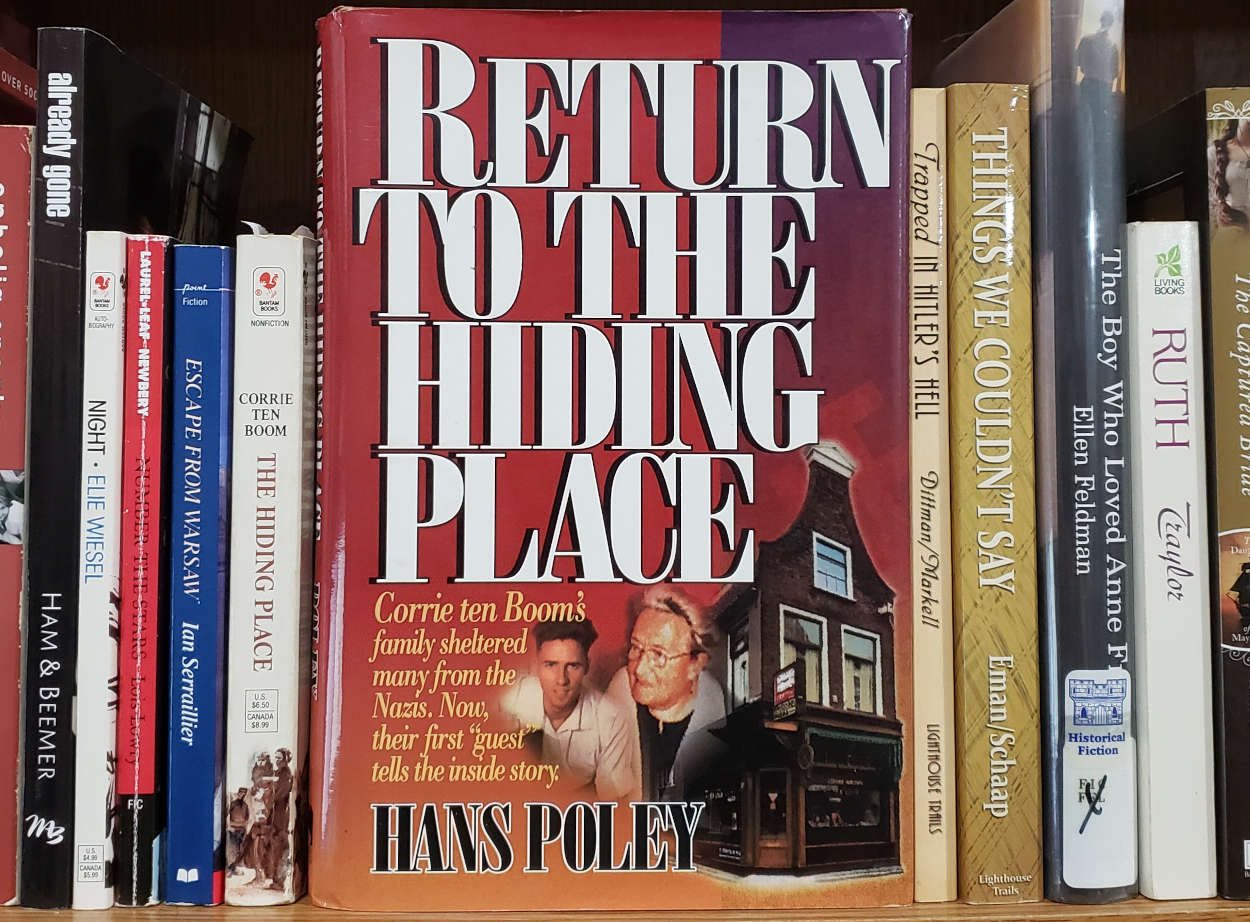
Book Review: Return to the Hiding Place

Return to the Hiding Place
by Hans Poley

My rating: 5 / 5
Genre: Memoir

During the time of Nazi persecution, a Christian Dutch family called the ten Booms welcome into their home various people who were hiding from the Nazis, both Jewish and not. 18-year-old Hans Poley was the first guest, hiding to avoid being sent to Germany to do hard labor in replacement of Germans who’d been sent to fight. Here he tells the story of his time at the ten Booms’ house and his own arrest that took him to a prison, then a concentration camp.

Having read The Hiding Place earlier this year, it was really interesting to see the Beje and the ten Boom family from the perspective of one of their “guests.” Not only does Hans Poley echo Corrie ten Boom’s assertions about the incredible faith of her father and sister, he shows Corrie herself as more open and giving than she portrayed herself in some areas. For example, when her room was chosen as the location for the secret room in her book, she tried to protest it. According to Poley, however, she “readily agreed.” I think we’d all be surprised to find out how others view us, compared to how we view ourselves, and in this case, Corrie ten Boom may have been a little hard on herself. Another small thing I noticed that didn’t match up between the books is that both authors claim to be the one who gave Eusi, one of the most prominent long-term Jewish guests, his fake name, and I wonder if this, and any other possible discrepancy, is simply due to faulty memories.

Yet again I was struck by how incredibly selfless this family was, giving up their own comfort and safety to help so many others. And Casper ten Boom, Corrie’s father, is even more inspirational to me after reading this. He repeatedly expressed a desire to help the Jewish people as if it weren’t even a choice to make. If you’ve read The Hiding Place, you should consider reading this too. Overall, though, I recommend it to anyone interested in true Holocaust accounts, especially those from a Christian worldview.

Find out more about Return to the Hiding Place

See what I’m reading next.

If you’ve read this book, or read it in the future, feel free to let me know what you think!
Book Review: Poison at the Pump

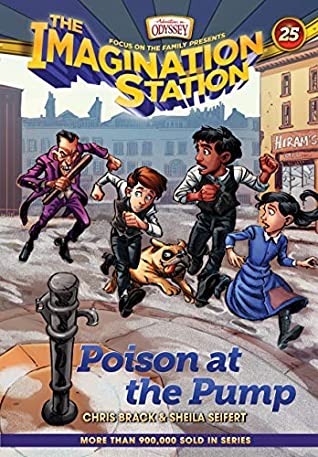
Poison at the Pump
The Imagination Station #25
by Chris Brack & Sheila Seifert

My rating: 4 / 5
Genre: Historical children’s fiction, Christian

In this first of a 3-part story arc, cousins Beth and Patrick are tasked with finding a mystery liquid in London during the cholera epidemic of 1854. They are separated at first and meet historical figures like Dr. John Snow and Curate Henry Whitehead who played important roles in history. But when Patrick learns that he drank water from the contaminated pump, he’s not certain he’ll be able to make it back from 1854 alive.

I actually read part 3 of this story arc (which, in turn, is part of a much larger series) first, then decided to go back and read the preceding stories. I did not like this one quite as much as the third in the arc, which might have been due to the respective subject matters as much as anything. I did still like it, though, and appreciate the way these stories bring somewhat lesser-known pockets of history to life for children. The doctor who first posited that cholera was spread by contaminated water, rather than through the air, for example, is certainly not one that kids this age are likely to have heard about. For that matter, I didn’t know about him either, though I can’t guarantee I didn’t read about him in passing during a history class in school and simply forgot about him. But that’s all the more reason this story is a nice way of making historical events and figures more memorable.

I’m a little confused about the premise for the series, the Imagination Station, and how it works. That’s likely due to not having read the rest of the series, but I did think I knew enough about the Imagination Station from Adventures in Odyssey as a whole to know that it’s…well…all in the imagination. And yet, this story made it seem like the kids were actually sent back in time. So I’m not sure if I misread the book/it was just confusing in that area, or if they’ve changed the way the Imagination Station works (though then the name wouldn’t really make sense either). That confusion aside, I think the book is a great read for kids up to age 12.

Find out more about Poison at the Pump

See what I’m reading next.

If you’ve read this book, or read it in the future, feel free to let me know what you think!
Book Review: Lost in Darkness

Lost in Darkness
by Michelle Griep

My rating: 3.5 / 5
Genre: Historical Christian romance

When Amelia Balfour’s father dies, it puts a halt to her plans to travel to Cairo for her travel-writing career. She was never close to her father, but his death means that she is responsible to help her estranged brother through a surgery meant to cure a disorder that has caused him to grow to giant proportions. The surgery is experimental and risky, and even the surgeon’s new partner, Graham Lambert, has doubts about whether or not it is worth the danger to the patient.

If I could break this story down into parts, the plot would get at least 4 stars, but characters would get maybe 2-3. The writing would get 4-5 stars, but relationship development would get maybe 3. As you can imagine, it was difficult for me to put a single rating on this book, with which I had my ups and down. In the end, I did like the plot, which was mostly dark with a light of hope shining through. It was inspired by Mary Shelley’s Frankenstein, and not subtly, considering that the author herself has a small role in the book. There is a bit of a mystery in the book that I didn’t see the purpose of, but all in all, the story was good.

My biggest issues were with the characters and the relationships that developed between them. Graham is inconsistent in a way that frustrated me, at times attributing hope and sovereignty to God, but at other times saying he’s not a religious man and that God likely wants nothing to do with him. He’s also so often shown to be a man with a short temper and violent tendencies, though Amelia describes him as normally cool and calm. The relationship between the male and female MCs developed about like one would expect from a romance, but the one that bothered me was the friendship between Graham and Amelia’s brother, Colin. We really don’t see much development there, and then suddenly Graham thinks of him like a brother. I would have loved to see that progression.

I wished Amelia would have come to see how idolatrous her superstitions were a lot sooner, but overall I liked the Christian message presented in the book, especially Mrs. Bap and her total reliance on God and her comment that death for a believer is the ultimate healing. In the end, I’m glad I read it, and think most fans of Christian romances of the Regency era will enjoy this book, especially if they’re okay with a little darkness in the story.

Thank you to Netgalley and Barbour Publishing, Inc. for providing me a copy of this book to review.

Find out more about Lost in Darkness

See what I’m reading next.

If you’ve read this book, or read it in the future, feel free to let me know what you think!

October in Review

I read 8 books last month, which is more than I expected it to be by halfway through when I’d only finished a couple of books. I was a bit busier with work last month. This month is NaNoWriMo, and I’ve already slowed down even more on reading, so we’ll see how next month turns out.

Here are the books I read in October:

Library of Souls by Ransom Riggs (4 / 5)
Night Song by Tricia Goyer (4 / 5)
Fan Fiction by Brent Spiner (3 / 5)
Nightmare Academy by Frank Peretti (5 / 5)
The Cat Who Played Post Office by Lilian Jackson Braun (5 / 5)
Skylark by Patricia MacLachlan (5 / 5)
Once Upon a Wardrobe by Patti Callahan (3 / 5)
Poison at the Pump by Chris Brack & Sheila Seifert (review pending)

This list includes 2 ARCs and 1 re-read. My favorite book from October (that wasn’t a re-read) was The Cat Who Played Post Office. I started 0 series (for once), continued 4 series, and finished 1 series. My ever-changing short list of to-be-reads, as well as a flag for the book I’m currently reading and an ongoing list of those I’ve read and posted about can be found here.

I’m also keeping my Goodreads page updated with a more extensive list of to-be-reads. Despite my almost too-long TBR list, I’m always looking for more to add. Feel free to offer suggestions of your favorites or just recent reads you enjoyed.

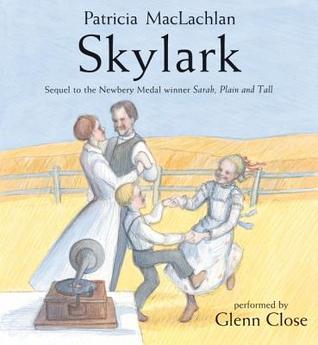
Book Review: Skylark

Skylark
Sarah, Plain and Tall
#2

by Patricia MacLachlan

My rating: 5 / 5
Genre: Children’s historical classic

While Sarah settles into her new home, the looming drought makes her miss her home in Maine more and more. The children, especially little Caleb, worry that this means Sarah won’t be happy with them. The drought eventually poses enough danger, not just due to lack of water, but also due to fire outbreaks and thirsty coyotes, that Jacob sends his new wife and 2 children to Sarah’s family in Maine while he stays to try to take care of the land.

After how much we both enjoyed the first book and subsequent movie-watching, my daughter and I both listened to the audiobook for the 2nd installment in the series, since it was narrated by Glenn Close, who played Sarah in the movies. I liked the second book as much as the first—it’s sweet and emotional, and I’m surprised how attached I can get to characters in such a short story. The author’s style of short, simple sentences makes the reading even quicker, but I never felt like it was lacking.

Caleb remains an incredibly curious and insightful little kid, as shown through the POV of his big sister. And I loved the juxtaposition of the Midwest and New England area, seen a little through Sarah’s explanations in the first book, but shown more fully in this one. My daughter (age 11) and I really enjoyed listening to this book and look forward to watching the movie.

Find out more about Skylark

See what I’m reading next.

If you’ve read this book, or read it in the future, feel free to let me know what you think!

Book Review: The Cat Who Played Post Office

The Cat Who Played Post Office
Book #6
by Lilian Jackson Braun

My rating: 5 / 5
Genre: Cozy mystery

Now that he’s inherited more money than he could possibly spend, former crime reporter Jim Qwilleran sets to work figuring out how not to let it ruin his life. As he settles into the mansion full of antiques and hires some staff to make his life easier, he begins to uncover some secrets about a former employee of the manor. Is the maid missing, or did something more sinister happen to her? Could it be a coincidence that other people connected to her are starting to die?

Another great installment of the series, this book is a good example of how this series doesn’t necessarily follow the mystery format of: crime happens, investigation happens. You can get through a good amount of the book before really understanding that Qwill has been investigating a possible crime the whole time. While he’s settling in to his new home, meeting his lawyers and the local interior designer, and learning how the local diner crowd provides a lot of (mostly useless) gossip, he’s bringing to light a mystery that had been swept under the rug. Of course, this ruffles some feathers and causes some problems by the time it’s clear whether or not he’s really uncovered something important.

I loved the way the cats would play with the mail pouring through the slot, hiding some and bringing some directly to Qwill. Other antics of Koko’s were fun to see come into play too. I’m still really enjoying this series and would recommend this book for fans of the classic whodunit & cozy mystery genres.

Find out more about The Cat Who Played Post Office

See what I’m reading next.

If you’ve read this book, or read it in the future, feel free to let me know what you think!

Book Review: Nightmare Academy

Nightmare Academy
Veritas Project #2

by Frank Peretti

My rating: 5 / 5
Genre: YA Christian thriller

The Springfields are a family of investigators—Dad, Mom, and twin siblings Elijah and Elisha—for the Veritas Project, which seeks to find the truth behind strange mysteries and crimes when others are unable or unwilling to see past the surface. When a teenage boy shows up on a highway in Idaho with no idea who he is or why he’s there and can only answer questions with “I don’t know,” the Springfields are brought in to investigate. Elijah and Elisha go undercover and are soon enough caught up in a world with no absolutes and no way to escape.

For as much as I liked the previous book in this series, I like this one even more. I always have, I’m pretty sure, since I read these several times soon after they came out in the early 2000s. While the warning presented within this book might seem extreme to some, I think it’s an insightful look at what happens to society when truth is left up to the individual. When one rejects God and the Bible, upon what foundations can “right” and “wrong” be based? Only one’s own feelings, beliefs, assumptions, desires, etc. And when that person’s version of right and wrong clashes with someone else’s, who wins? That is what this book examines in a somewhat true-to-life setting. Though some of the mechanics involved in the book are certainly beyond what technology can do these days, the study of “what if” is again the focus in this book, like it was in the previous.

If you read this book and don’t see any parallels to what is going on in real life, you might not be paying very close attention. I know this approach isn’t for everyone, but I do truly believe that the only truth that can really be known is found in the Bible, and the more we get away from that, the more dangerous it can be. Peretti has a way of cutting to the heart of things that I have always loved, and I really wish he had written more in this series. I highly recommend this book to all fans of Christian thrillers, whether you’re a teenager or adult.

Find out more about Nightmare Academy

See what I’m reading next.

If you’ve read any of this series, or read any in the future, feel free to let me know what you think!

Book Review: Once Upon a Wardrobe

Once Upon a Wardrobe
by Patti Callahan

My rating: 3 / 5
Genre: Historical fiction

The year is 1950 and 8-year-old George Devonshire has just read a book that captivated his imagination entirely: The Lion, the Witch, and the Wardrobe. He’s terminally ill and doesn’t leave his house except for trips to the hospital, but he longs to know where Narnia came from. Fortunately, his sister Megs is a student at Oxford, where author C.S. Lewis works. Unable to refuse the request of the little brother she loves so much, Megs attempts to find the answer to his question, even if Mr. Lewis isn’t keen to give a simple answer.

Normally I save recommendations for a book for the end, but I think it’s appropriate this time to start with that. I think that people who are great fans of C.S. Lewis, especially, but not necessarily limited to, the Narnia books, will appreciate this book more than I did. I didn’t dislike it, but I don’t think I’m quite the right audience for this book about how stories and myths affect our lives. Patti Callahan writes beautifully, but that is also lost on me, frankly. I do know that there are many out there who will get caught up in the prose though.

The book mostly revolves around George and Megs, but dips into fictionalized biographical vignettes of C.S. Lewis’s life (or Jack, as he preferred to be called and as he is most often referred to in this book). It made sense to me that he shares with George, through Megs, shows how inspiration for a story can be found all through one’s life, though it takes Megs the entire book to come to that understanding. This is apparently because she is a numbers person—math and physics are her life. She is too caught up in logic and a desire to turn everything into an equation to let imagination have a part. I’m a numbers and logic person too—not quite to the degree that she is, but enough that it was strange to me that she was so against imagination. I thought there was going to be a much deeper reason for why she was confused and questioning things so much, but it didn’t come to that like I expected it to. The story on its own is sweet, but a bit more drama-filled and with a bit less of a clear conflict than I apparently prefer in my stories. There was a moment near the end, though, that was emotional and made me mentally cheer, and I love moments like that.

Overall, I think I just didn’t really connect with Megs, who is the main character in the story. She’s also the main narrator, which leads me to bring up my frustration with the format the author used throughout this book. Megs’s POV was first person, present tense (I don’t generally care for present tense books, but that’s just personal preference). When Megs tells George stories from Jack’s life, it switches to George’s POV for a few paragraphs as he slips into the story. Those sections are third person, present tense. And then the actual stories about Jack’s life are third person, past tense. All of this gets to be a bit jarring/muddling and sometimes just weird. I think these differences in perspectives could have been handled a lot more smoothly.

Since I’ve already mentioned my recommendations for this book above, I’ll close by explaining that I have read very little of C.S. Lewis’s works. My experience extends to my very first reading of, so far, the first 2 Chronicles of Narnia books earlier this year. I can’t honestly say for sure that how much Lewis one has read would make a difference in enjoying this book, but I do believe it would.

Thank you to Netgalley and Harper Muse for providing me a copy of this book to review.

Find out more about Once Upon a Wardrobe

See what I’m reading next.

If you’ve read this book, or read it in the future, feel free to let me know what you think!

Book Review: Night Song

Night Song
World War II Liberator series #1 or 2
by Tricia Goyer

My rating: 4 / 5
Genre: Christian historical fiction

Almost-engaged American Nick and Austrian Evie are separated when Evie’s family has to go back to Austria. Then Nick receives his draft notice and only hopes that he’ll find himself somewhere near Evie when he is sent overseas. Meanwhile, Jakub’s family is torn apart when German mistreatment of Jews in Czechoslovakia ramps up. Taken to a ghetto, then to a work camp, Jakub watches those he loves die or get shipped off somewhere worse. Goyer weaves a tale of survival and compassion as seemingly unrelated storylines join together for the final scenes.

This book was an interesting take on historical fiction set during the Holocaust. Only a little of the focus is on a Jewish family, though what Jakub, his brother, and his mother go through is bad enough. Evie provides a different point of view, and (along with Nick) there’s even a 4th perspective, that being of an SS soldier who’s certain there’s some kind of supernatural power involved in the Nazi party, and he wants some of it for himself. (This is not the first time I’ve read a book with a character like that in it.) The 4 stories mostly advance separately, with Nick’s and Evie’s being the most connected for obvious reasons. Overall, the individual stories were interesting in their own ways, though the SS soldier’s was the one where I most wished to know why I should care about what was going on with him.

It was fairly obvious throughout the book, and because of the series name, how the storylines would all come together. Most of it felt pretty natural, though Nick being there seemed the most randomly coincidental. The official synopsis focuses a lot on the prisoners’ orchestra at Mauthausen that played while fellow prisoners walked to and from their work for the day. It’s a little strange, because this doesn’t come into the story until pretty far into it. There’s a whole lot more to it than that, but the overall theme of music being important even during really tough times does come through. Depending on where you look, this book is first or second in a series focusing on camp liberations during WWII, most likely each a stand alone. As far as this book goes, I think many people who appreciate historical fiction centered around this time period, especially with a Christian angle, would enjoy this book.

Find out more about Night Song

See what I’m reading next.