
NaNoWriMo Day 2

Quick Tip: (If I have these, I’ll put them at the beginning, so if anyone chooses not to read about my progress, they won’t miss the tip!) So you know how you can update your word count by typing the number into the field at the top of the website? I would suggest that every so often, you actually go ahead and check your official word count. I do this at the end of every day, because if I’m 100 words lower than I’d thought, I want to know as soon as possible. The reason for this is that different word processors count words differently, and the NaNo site counts them differently than some of those word processors. By the end of the month, you could be even up to a thousand or more words off, and if you’re just barely getting to 50k, you don’t want to suddenly find out at 11:50 pm on Nov. 30 that you’re 1000 words shy. So just copy & paste your whole novel into the field that comes up when you click on “Check my official word count” under the “update” button.

Now onto my daily update:

The Words: 2025 written today. I did a few word sprints with https://twitter.com/NaNoWordSprints after 9 pm and wrote some in between. I spent as much time talking on my region’s Skype group as I did writing. I was shooting for 1667 and went a little above that, so I’m happy.

The Story: After yesterday’s race to 25k, I had left a little bit of a mess. The story takes place over 9 days, starting on a Saturday. I’d written Saturday, Sunday, and Monday, and then started into Tuesday. But then I had to write some extra I’d forgotten to include for Monday, and when I was done with that, I got the next few days mixed up and started into Wednesday, with some of Tuesday’s events.

Because it’s NaNo, I didn’t fix the mistake, but instead restarted Tuesday and left the mess to sort out later. So today I wrote about Darcy, the MC, interviewing her dad and a friend of the family, both blacksmiths, for a video that is meant to be a tribute to the blacksmith community in their area. This is the main plot, or at least the backdrop to the conflict. The actual conflict, a missing blade smith, didn’t really come up in today’s writing. But it will tomorrow.

Total word count: 27,035

Don’t forget to check out today’s NaNoToons if you haven’t already: 2015 – November 2nd

If You’re Struggling With NaNo…

This video might help. I know some people didn’t have the first day of NaNo they were hoping for. I also know that seeing excitement and high numbers from others isn’t necessarily the most helpful encouragement. I wanted to share ‘Manda Whitney’s vlog about her first day trouble, because she totally gets it!

The important thing is not to give up. This is just the beginning!

NaNoWriMo Day 1

The Words: 25,010 written today! Okay, yeah, so wow. I basically decided some time in the last week to go for a 25kDayOne. I figured I’d be writing for basically 24 hours with little mini breaks now and then. And I had this little hope in the back of my mind that maybe I’d do so well that I’d actually get close to 50k.

The main thing I learned today is that just because I can write this fast doesn’t mean I should do it too often.

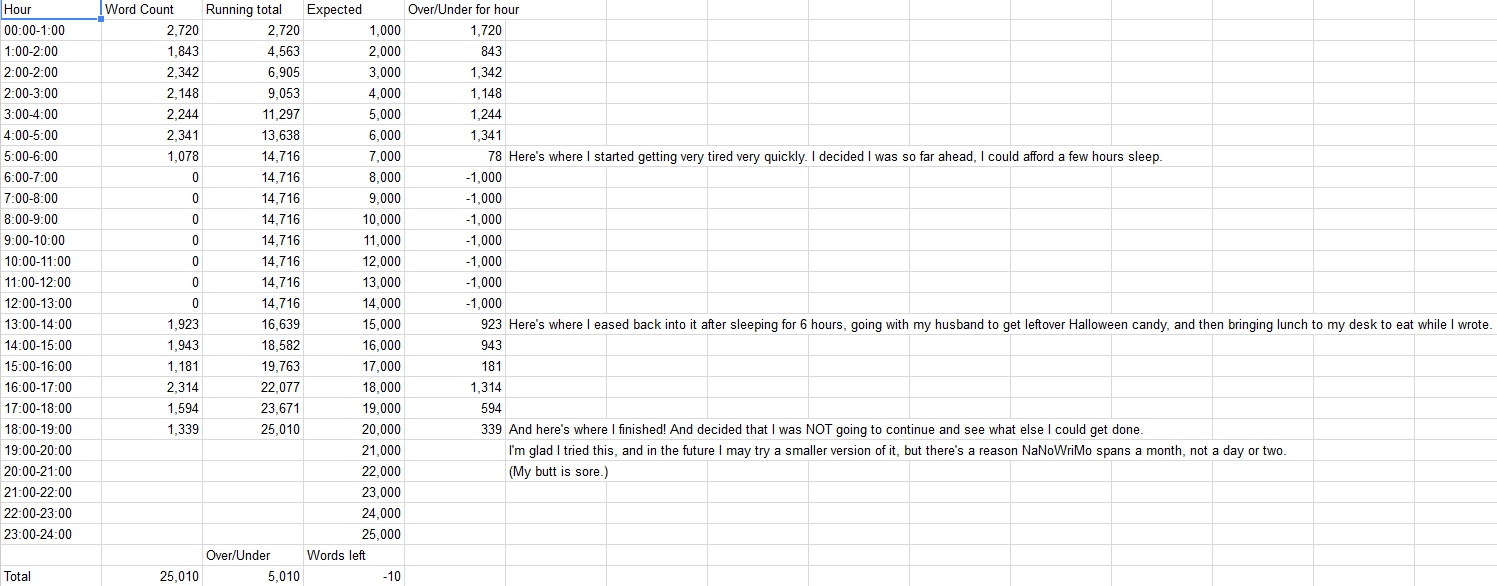
Basically, I averaged 2k per hour, for the first 7 hours, at which point I realized I was fading hard. I went to bed, woke up and went with my husband to pick up some leftover Halloween candy. Got back to writing while eating my lunch, never quite got back up to the same pace, and decided that when I hit 25k, I’d call it for the day. That happened just before 7 pm.

25KDayOne

This is a screen shot of the spread sheet I kept throughout the day. I took a few notes in case I wanted to remember things later.

I’m still going to write every day this month. For at least the next few days, if I get the daily minimum done and feel like stopping, I will. I came pretty close to burning out today, and don’t want to risk it.

The Story: I’ll be honest. This story went nowhere good in 25,000 words. I barely got to the actual plot. Most of what I wrote was just showing what life is like at a reenactment. If I decide someday to try to do something further with this story, the first thing I’ll probably have to do is figure out how to break some of that up throughout the rest of the story so the main plot and conflict start sooner. The blade smith, Shawn Mallory, did finally go missing, though, and the MC, Darcy, has started doing video interviews with the different blacksmiths at the reenactment, at the behest of one of the older smiths, so they can compile a tribute to a retiring smith and the community he’s fostered in their region. (Yes, the word “smith” or “blacksmith” came up a lot just in this paragraph. Imagine how the rest of the story sounds. But that is the focal point of the story, so that’s just how it’s going to be. It’s easier when they have names, but I figured trying to include them all here would just be more confusing.)

Total word count: 25,010

Don’t forget to check out today’s NaNoToons if you haven’t already: 2015 – November 1st
And in honor of November 1st, the first episode of the NaNoMusical!

NaNoWriMo Tag

I’ve been seeing this on WordPress over the last week, so I’ve decided to join the party. It’s really just a way of procrastinating, but it sounds like fun to answer too. These questions were originally posed by Kristine Horner in a YouTube video, but I don’t do videos. I’m only barely a blogger, really. So anyway, here are the questions with my answers:

1. How many times have you done NaNoWriMo?
I have done NaNo 5 times before, with the first being in 2007.

2. How did you first find out about NaNoWriMo?
The admin of a fanfiction forum I was part of, specifically fanfiction for Ragnarok Online, mentioned it in October 2007. I will always be grateful that she made that off-hand comment about who was going to be participating, because it’s opened up a whole world to me.

3. What was the name of the first novel you attempted with NaNo?
It was called “Outcast,” it was fanfiction, and it was the best thing I’d ever written. It’s still one of my absolute favorites, and will be revisited and adapted to the world I’ve created for my series of novels eventually.

4. Give us a 1 sentence summary of what you’re writing this year.
A loud, obnoxious blade smith disappears during a historical reenactment, and the daughter of a neighboring blacksmith begins to suspect foul play when she notices the suspicious behavior of some of the other reenactors.

5. What’s the best writing advice you’ve ever been given?
Don’t edit the crap out of your writing. I’ve read so many articles and blog posts by writers who make it seem like a manuscript will never be ready. It will always need another draft. While it’s true it will never be perfect, just maybe it doesn’t have to be. That’s given me a lot of freedom in my current revision of my first novel to not feel like I have to keep going for another 2 years, editing it to death and probably losing my voice at the same time.

6. Did you ever take a year off from NaNo? Why?
Yes, I skipped 2008, 2010, and 2011. 2008 was mostly because I didn’t have any ideas for what to write and didn’t know how to coax inspiration at the time. I was also wishing I could transition from fanfiction to original fiction, and it wasn’t working out. The other two years were mostly because having a baby (in 2010) and then young toddler (in 2011) along with homeschooling an older kid made me feel that doing NaNo would be too overwhelming. Add to that the same “lack of idea” issue from 2008, and I gave those years a pass. Though I spent at least half of November those years thinking “maybe I could still jump in.”

7. What’s your biggest inspiration when figuring out what to write?
All sorts of things. I don’t know if I can narrow it down. Song lyrics, a movie I watched and thought, “What if this were different?” Some random thing someone said, or something that came out during free writing. My husband also makes a great sounding board, and helps me break through blocks in planning sometimes.

8. Read us the first sentence from one of your novels.
“Thousands of years ago, the world was much more technologically advanced than it is now.”

9. Why do you love writing?
It’s so much fun to develop these random ideas into something real. Something that’s outside of my head. Something I can share with someone. There’s just something about letting the thoughts spill out that is better than keeping them swirling around in my head. It’s become such a part of who I am that I don’t think I would be the same if I couldn’t write anymore.

(My plan to write 25K words on the first day took a bit of an unexpected turn around 7 this morning when I realized I had no choice but to get some sleep. I haven’t stayed up all night in quite a while, and apparently I can’t do it anymore. But I’m still on target, and if you want to check my progress, you can do so here.)

Why do they call this a “tag” anyway? I thought it was because we’re supposed to tag others to do it, but I’ve yet to see anyone tagging anyone in these posts. Feel free to share your own answers to any of these questions.

NaNoWriMo Eve

NaNoWriMo has been on my brain since September. I’ve been posting about it since September, planning my novel throughout the last month, and talking about it enough to drive some family members nuts. And now it’s here.

Last year, the first year I had this blog, I posted daily updates about my progress through NaNo. I posted about my word count for the day, as well as when or how I’d gone about writing them. I also shared a little about the progress of my novel, though since that novel was one I hope to publish someday, I was vague about some of the details.

I plan to do the same thing again this year. I am not trying to inflate my ego or shame anyone who may not have as many words as I do (assuming, of course, that the month is going well enough for either of these to be applicable). I’m sharing my daily progress for anyone who may be curious about how others go about doing NaNo, or how others fit the writing into their lives. And so I can share anything new I’m learning about NaNo or writing as it happens. I’m also going to share because I like being able to look back a year later and see how the story shaped up. Or remind myself of those new things I learned along the way. And because I’m already in the habit of posting here every day that I’ve done some writing work.

Now and then I may even offer more tips (on top of the many I’ve already shared) that I didn’t think about until the month started, or that I’ve just picked up myself. However, I know some people get annoyed when people post about their word count often, so if you’re one of those, by all means, don’t read my posts over the next month. I won’t be offended.

I plan to spend all day tomorrow writing, from midnight to midnight. I’ve never done this before, usually just stick to the midnight sprint (get as many words in from midnight until you go to bed) and a normal day after, but I decided to try it. I’ve often wondered if I could pull of the 50k1day, but I don’t want to exhaust myself physically, mentally, or creatively. 2000 words per hour could easily do that.

So I’m aiming for more like 25k words, but even then, I’m not going to stick to it strictly. This will be my last chance to try something like this until Nov. 1 falls on a weekend again in the year 2020, so I’m going for it. I’ve created a spreadsheet that I’m going to update hourly with my word count, in case anyone feels like checking in at any point throughout the day.

As for the rest of the month, I usually keep my head down and focus only on my writing during November, but last year, I was involved in a Skype chat group for my region. The mutual encouragement in there (and word wars) was a great new depth to NaNo that I really enjoyed!

Please feel free to add me as a writing buddy. Let me know you came from here, and I’ll add you back. If you need encouragement throughout the month, give me a shout somehow and I’ll do my best to provide some!

nano word count totalAre you ready for NaNo to begin? Do you plan to do the midnight sprint tonight?

Tips for NaNoWriMo, Part 4

crest-bda7b7a6e1b57bb9fb8ce9772b8faafbThis is a continuation of the list I posted last week. Today’s tips are more specific to the words and reaching the word count. This will (probably) be the last post I make about how to prepare for NaNoWriMo, or how to make it through the month. It will not be my last post this year about NaNo, though. Oh no…not even close.

So without further ado, the rest of my suggestions for how to survive (and thrive in) NaNoWriMo:

1. Do not edit.
I used to think this was an understood “rule” of NaNo, but last year, I found out how wrong I was. Not only do some people not follow this guideline, some don’t even know about it.

This works on multiple levels. If your plot starts to go awry and you don’t want to follow it (which is sometimes the thing to do), don’t delete anything. Figure out where you want to pick it up again and start there. The rest of the text that you don’t want to use, use strikethrough on it, make the text white, or just copy and paste it to the bottom of the document to get it out of the way.

But it’s not just big changes like this that fall under this tip. If you’re typing and you realize the last two sentences aren’t what you really wanted to say, or you simply started the sentence wrong, you can just ignore it and keep going. Fix it in editing, right? That may be the smarter way to go, but it drives me crazy to finish a sentence that I know I don’t like, or leave something in I know is going to be deleted. But I don’t get rid of them. I just flag them so that I can find them later. For this kind of thing, some people may use strikethrough again. I prefer to put a bracket on the end of it. To use strikethrough, I’d have to highlight what I want to flag and click the strikethrough button. In other words, I’d have to take my hands off the keyboard. It breaks the flow. To type a bracket, I just hit the key with my right pinky and keep going. It looks like this:

“The militia members warned Lex and Leahna to be careful, and to contact them if she showed up, or if they had any way of knowing what she] where they could possibly find her.

This might not work for everyone, because it doesn’t provide a flag for the beginning of what needs changed. So when it’s time to edit later, it does probably take me a bit more work than if I had just used strikethrough on the whole thing. But it saves time during NaNo, and that’s the key here. Oh, and since I do 95% of my writing with Write or Die, strikethrough isn’t an option during the writing anyway, so I’d have to remember to flag it after I’d copied and pasted the text into my word processor. Not really helpful overall.

One more thing for this first tip (which will be the longest one, I promise). Don’t fix typos like misspelled words, accidental capitals (or lack thereof) or whatever other things we usually quickly backspace and delete. Fixing those doesn’t lose you words, but it does lose you time. The time it takes to go back and fix, but also the lost flow of writing. It can be very difficult to train yourself not to fix these things, and I often will still do it out of habit, but as much as I can, I just ignore it and keep going.

too many errors

I still love this error. MS Word yelled at me a lot near the end of NaNo. Not when I tried to use spell-check, even (because why would I do that during NaNo?), but just randomly on its own. It was too overwhelmed to even show all of the red squiggly underlines that my mistakes produced.

2. Don’t go back and read.
The temptation may be high to go back and read through some of what you’ve written on previous days, but fight it. If you can’t remember something you established earlier and you need to know it in today’s writing, do your best to bluff your way through it for now. If you can’t remember the name you gave a town or person who hasn’t shown up since then, put in a placeholder name for now (see next tip). If you just want to remember what you’ve written…don’t. If you start reading back, not only will you use up time you could be writing, you may find things you want to fix, and that’s just a bad path to start down before December.

3. Use placeholder words.
Don’t take time thinking of details, if they don’t come to you quickly. For example, names for unplanned characters, towns, organizations, whatever. Previous years, I often gave characters names like Bill or Steve, though they didn’t fit in the fantasy-esque world, just so I could keep going. Or for a town, I’ll write “TOWN NAME” to keep moving (yes, every time that town name comes up). The same idea applies to time elements. If you can’t remember for sure how long ago two characters met when they’re reminiscing later, don’t go back and look it up. Not yet. Instead do something like, “Do you remember when we first saw each other SO MANY MONTHS ago?” Or for distance, if you’re not sure how far away or far apart you want something to be–“The party was SO MANY MILES out of town, so…” The caps is so it’ll stick out when you’re editing and you’ll be sure to fix it later.

Anything like this that comes up, if you don’t have a plan or can’t come up with something you’re sure about on the fly, stick a placeholder in, make it clear you need to fix it still, and move on.

4. Take notes of things to fix later.
As I’ve already said at least once, though it’s not wise to delete or fix as you go, if you’re hoping to go back and fix your draft up some day, it might be a good idea to keep a list somewhere of things to fix later. I don’t mean things like typos or even the above things. I mean bigger things.

Last year there were several times that I would be days away from a certain scene, and it would hit me that I forgot to include something crucial. Or I forgot a character that actually needed to be in the scene. Now, if I’d gone back when I realized it, yeah, I probably would’ve added more words to the scene. I may have upped my word count. But since it would most likely involve some rewriting of what was there, and some thinking of how to make what I’d forgotten fit in, it wasn’t worth doing. I kept a list in a notebook of things I wanted to remember to address later.

The same can go for plot holes you find along the way, discrepancies in timeline, or if a character changes in your mind so much by the time you’re 15 days into NaNo that the way they acted at the beginning is just all wrong now (not referring to a character who changes within the context of the story).

5. Stop in the middle of a scene
Sitting down to start writing often takes a lot of willpower. There are a lot of things out there that beckon us, because they’re easier on the brain or because we’re tired or whatever other reason. Once you sit down, the best thing you can do is just start writing. But if you ended your last writing session at the end of a scene, it can be difficult to figure out where to start this one.

That’s why any time you can, end your writing session in the middle of a scene, even the middle of a paragraph. Some people say middle of a sentence or word, but I can’t do that. It would drive me nuts.

So, say you’re approaching your planned word count goal for the day, whether that be 500, 1667, 2000, or even 5000 words, don’t let yourself get to anything that feels like a stopping point. Stop short, and you can dive back in so much more easily the next time.

6. Don’t be afraid to go off-script.

This is where planners can take a cue from pantsers. No matter how detailed or sketchy your outline is, if the writing takes you in a new direction, it’s okay to follow it. If you really don’t care for that new direction, it doesn’t feel right, it’s too different from what you want, by all means, go back to the outline. But if the new direction intrigues you–whether it be a plot twist you’d never anticipated, a character throwing a wrench in your plans, or a plethora of other things–follow it. If you can get back to the outline, great. If not, don’t be afraid to throw it out. Or fix it to follow the new direction.

The outline is just a guideline. Don’t let it feel like a noose.

7. Don’t use contractions (or do).
Not using contractions during the entire month is just one of the dirty tricks that some Wrimos use. I will give you both sides of this tip, because it has its pros and cons. On the pro side, it can pad your word count; it’s not a whole lot, but it can be enough to be worth it when you’re struggling to make the daily goal. On the con side, it makes editing a chore.

I did this trick in 2013, and one of the first things I did when I started into revision was to do a find & replace on every contraction pairing I could think of–I am, I have, she is, he is, we are, they are, do not, have not…and on and on. It took a long time, and I still didn’t get them all. The rest I found and fixed manually in my first revision read-through. Not to mention the ones that had been changed by the replace function that shouldn’t have, like, “You may not be excited, but I’m.”

Anyway, hopefully you get the picture. Again, if you’re writing for fun and know for sure you’re not going to want to fix up the draft you end up with, the downside isn’t much of one. If you have any desire to go further with it, just keep this in mind.

This goes the same for any other dirty tricks out there–they may pad your word count for now, but be sure to consider if they’ll be difficult to clear out of your draft later.


I can’t believe NaNo starts in one week. I feel like I’ve been waiting months–maybe because I started posting about it in September! I’ve spent these last few months reading others’ posts about NaNo to bolster my own enthusiasm. And I’ve been doing my best to share as much advice for NaNoWriMo as I can think of.

Here’s one more I just thought of: Two years ago, I had a really detailed outline, but didn’t know how to open the novel. I sat for long enough thinking about it after midnight came that I finally started with the narrator giving sort of a pep talk to the other characters. It was ridiculous, really, and was only about a paragraph. It was enough to get my creative juices flowing, and I was ready to dive into the actual story!

In the end, the best advice I can give is that when November 1st comes, you just start writing. Whether you’re a planner, a pantser, or somewhere in between, make sure you know how the story will begin so that when you sit down for your first writing session you don’t freeze up.

Are you as excited for NaNo to start as I am? Are you prepared? Do you have any more tips or tricks to add that I’ve forgotten?
My 2015 NaNoNovel

“Too Many Irons in the Fire”

During the Midwest’s biggest annual historical reenactment, a local blade smith named Shawn Mallory disappears. Twenty-five-year-old Darcy Preston watches her dad worry over his missing friend. Darcy looks for clues about where Shawn may have gone, but the crowd and her own obligations to the event slow her down.

The more Darcy watches and talks to the many other blacksmiths attending the event, the more she begins to suspect that Shawn’s disappearance may have been orchestrated. By the end of the week, as the busiest day of the rendezvous approaches, Darcy is convinced that her own father is in danger.

Can she convince her dad of her suspicions in time to save him?

cover1

I’ve never made a cover for a NaNoNovel before. Rather than make it official with words and such, I went simply with an image. It’s better than I’ve ever had before.

The Sights and Sounds of NaNoWriMo

The countdown to NaNoWriMo is picking up speed. Okay, so that’s a physical impossibility, but with only 12 days left, it does feel like the time I have left to get ready is dwindling more than I’d like.

While NaNo is so often seen as scary, panic-inducing mania, it’s good to remember the fun of the event. Today, I thought I’d share some of my favorite things about NaNo that don’t specifically relate to the writing itself.

Errol
Fair warning: all of these involve the same over-excited, over-active Asian guy. It’s not that there aren’t other great NaNo-related songs or comics out there, but these are some of my favorites (for good reason).

NaNoToons: A webcomic about a group of characters who participate in NaNoWriMo. The comic runs daily throughout the month of November. Some years it starts partway through October so the story can ramp up before NaNo starts. I’ve seen no indication as to whether that will happen this year or not, but until it does start, you can catch up on the NaNoToons from previous years.

During November, you can check in every day to see the continuing adventures of the group as they eat their weight in chips, pass out early at the yearly overnight event, and write their way through November.

NaNo songs: There are a plethora of songs about NaNoWriMo on YouTube. One only need search for “nanowrimo songs” to find plenty of fun tunes. My favorites are in this playlist, or this site.

Songs about NaNo are great for hyping yourself up for the day’s writing or for playing over the next few weeks during your prep time.

NaNoMusical: Yes, it’s a musical about NaNoWriMo. And it’s one of my favorite things of all time. It’s a 6-part web series made by WE Tangent, with music by Debs & Errol. From the site itself: “NanoMusical follows Dale, a legend who has surpassed the 50,000 word count every year, and his three friends as they navigate their way through the exciting and often tumultuous month of November…with music.”

The musical came out in 2012, one episode per week from the days before NaNo started until the week after. I personally think that was the best way to watch it–spread throughout the event. However, as with binge watching on Netflix, it’s fully accessible now and can be watched all in a row. Still, if you watch the first episode and like it, you can use the following episodes as rewards for finishing certain milestones in your writing.

Do you have favorite NaNo-related songs or other fan creations like these? Are you already anxiously awaiting the start of this year’s NaNoToons? Is there a bit too much Errol in this post? Feel free to share your thoughts in the comments.

Tips for NaNoWriMo, Part 3

crest-bda7b7a6e1b57bb9fb8ce9772b8faafbWe’re halfway through October and I still have so many tips I want to share for how to survive (and thrive in) NaNoWriMo. So far, I’ve given tips about how to get ready for NaNo–not just planning the story, but planning your space and getting your writing tools ready. There is certainly still plenty of time for those things.

But now I am going to start sharing my tips and tricks for how to make it through the event itself. I’ve split these into two posts of 7 tips each, so here are the first 7:

1. Break up the words.
50,000 words sounds like a lot (and it is). If you plan to write every day, it’s 1667 words per day. Because life can’t stop for NaNo, as much as we may want it to, there will be things that keep us from writing some days. If you know about these things in advance, you can count those days out of the total 30. Then you could divide 50,000 by the days you have left.

So then you have 1667 (or however many you come up with) words to write per day. Even that can seem like a lot, especially if your day is really busy. That’s when you divide the words even further. 500 words isn’t so much, right? That might take you 20-30 minutes to write. So three times throughout the day, take 20-30 minutes  (or less if you’re in a groove) to write 500 words. The extra 167 words may be made up during those times, if you write a bit over 500, or you could just make sure to get them in before you go to bed.

If you have a whole chunk of time, maybe an hour or two, to write, you may not need to break the words down further. But if you’re finding yourself overwhelmed by the daily word count, this might just be a useful tip for you.

2. Write in sprints.
A continuation of the previous tip, this one can be useful whether you’re writing in smaller session throughout the day, or all at once. I’ve found that I run up against a mental block when I sit down at 9 pm and think, “Okay, time to write my words for today.” Rather than just diving in and going for 1667, I will write in sprints.

All that means is that I set a time (usually 20 minutes) and write until the time is up. No stopping to check Facebook/email/whatever, no alt-tabbing to look something up, no stopping for a snack, or getting up at all. Then I take a short break, get a drink, visit the bathroom, stretch, glance at Facebook or the NaNo forums, or whatever, before starting another sprint. Single sprints can fit into work breaks, doctor visit waits, or other smallish amounts of downtime. Just set your time limit accordingly.

I strongly recommend checking out https://twitter.com/NaNoWordSprints. Throughout November (not necessarily 24/7) volunteers tweet word sprints that anyone can take part in. They announce the start time and the time limit, and sometimes a theme or prompt you can use if you need inspiration. Between sprints, people are often invited to tweet their word count for the recent sprint and maybe a sentence you liked.

Word wars are also a super effective tool for NaNo. Two or more participants agree on a start time and time limit, then write as many words for their novel as they can. Afterwards they compare word counts to see who won. I’ve seen first-hand how doing word wars throughout November can breed high word counts and/or early wins. If you can get to a write-in for your region, that’s the best way to do word wars. You can also do them online with writing buddies, or find people to war against on the forums.

I use the website writeordie.com (technically I still use the old version of the web app) for my sprints and word wars. I posted about that site yesterday, so I won’t say more about it here.

3. Reward yourself.
A helpful trick for NaNo is to set smaller milestones throughout a week, a day, or even one writing session, and find ways to reward yourself when you’ve reached them. For example, you could decide that if from Monday through Friday of one week, you wrote 10,000 words, you’d take Saturday off and relax (watching a movie, go outside) during your normal writing time. Or it could be as simple as having a pile of candy just out of reach and only letting yourself have one or two after each 20-minute writing sprint.

I will sometimes decide that once I’ve written 1667 words for the day, I’ll stop and watch 30 minutes of TV. Then I’ll see how much more I can get done before bedtime. Figure out what works for you and let that motivate you to get the words out.

4. Stay hydrated.
This one might seem unnecessary, but I know sometimes I can forget to make sure to drink plenty of water on a normal day when I have lots to do. During NaNo, especially when I have a day in which I have more time than usual to write, I can get so caught up in the sprints or wars that I forget to stop and refuel.

Snacks, coffee, and other caffeinated drinks are fuel for Wrimos, but just make sure you’re drinking plenty of water too.

5. Back up your work.
I don’t always remember this one myself, and I’ve had some scares. If you write with pencil & paper, it’s not as crucial, but we all know how fickle computers can be. Make sure you’re keeping a copy of your novel in more than one place. Some people back it up to the cloud (with Google drive, for example), while others may keep a copy on a thumb drive. Some keep several copies in every way they can think of. The key is to make sure you don’t have just the one copy.

6. Limit your time on the forums (and other online activities).
Have you been to the NaNo forums? The whole place is just this giant black hole of time sink on par with TV Tropes or Pinterest. There are boards for the genre you’re writing, for your age group, for almost any type of advice you may need…and so much more. And they are crazy busy during November.

It is really easy to go check out the forums at the beginning of your writing time and then realize half an hour has gone by. That’s why it’s important to put some sort of limit on how long you browse the forums. And really, this same thing can be said for any online time sink you may be inclined toward.

If you’re like me, your writing time may also be the first time all (or most of) the day that you’ve even had a chance to be at a computer. You may have email to check, Facebook to peruse, blog posts to read… But you have to set a limit, even if you use a timer to do so, or you’ll lose a lot of your writing time. It can also help if you can find other times during the day, time that you have at the computer (or with a mobile device) that isn’t really long enough to write. Do some of your normal online activities then, and save the rest for when your daily word count is done. Or December.

7. Don’t expect too much.
I’ve heard from people recently who were disappointed after their first NaNo, because they’d expected to end the month with a manuscript all ready to send off to publishers. That is not going to happen. Don’t go into this thinking you’re going to speed-write a novel, and it’s going to be great. I won’t rule out that possibility, but I’m sure it is super rare.

This may not be the first time you’ve heard this, but the focus during NaNo is on quantity, not quality. That right there is why many people think NaNo is pointless. If they’re expecting to end the month with 50,000 words of crap, why bother? Well, for one thing, it may not be pure crap. You may have a lot of unneeded filler, mistakes, and scenes that just didn’t work out. But you also may have the beginnings of a great novel. Perhaps it needs a complete rewrite, or maybe just a good round of revisions. But you’d have nothing if you hadn’t pushed yourself to write 50k words in a month.


Since there are still 2 weeks before November start, I’ll finish this post with another reminder to be writing every day, even now. It’s not necessary to success, but it sure can’t hurt, especially if you’re new to NaNo or haven’t been able to finish one yet. Starting cold with 1667 words on day 1 can be a real shock and even mental stumbling block. Whatever time of day you expect to be using for NaNo, start using that time now for pre-writing for your novel or (especially if you’re a pantser) simple freewriting about anything.

Are you doing NaNoWriMo this year? How are you preparing? Do you have any tips or tricks for getting through the month?

Tools for NaNoWriMo: Write or Die

crest-bda7b7a6e1b57bb9fb8ce9772b8faafbUpdate: In the time since I made this post, Write or Die has moved on to a 3rd version. The original version that I described in this post doesn’t exist anymore. It still works generally the same way, with even a few more options, but I personally don’t use it anymore, because I don’t like it as much. Now I just write on my Neo (great for avoiding distractions) and set a timer on my phone.

I came across Write or Die for the first time a few years ago. I believe my region’s ML posted it in a list of other tools for writers. I was hooked as soon as I tried it out.

The idea behind Write or Die is that an immediate consequence for not writing is more effective than a far-off reward for writing. The biggest benefit for me is that using Write or Die helps me avoid distractions while I’m writing.

There is a downloadable software that you can buy, or you can use the web app. I’ve only ever used the web app, not because I don’t think it’d be worth buying, but because my family’s budget hasn’t afforded me the ability to buy the software yet. For that matter, I prefer the older web version to Write or Die 2. The older version is what I’ll be using to explain the tool further.

writeordieThe above is what you see when you go to the link for the web app (now obsolete). There are four choices to make: word goal, time goal, consequences, and grace period. The first two are self-explanatory. You choose how long you want to write–sprint for 10-20 minutes, go for hours, etc. I usually set my word count goal higher than my average for the time I’m choosing, so I don’t quit early. (Edit: I recently discovered that if you leave the word goal at 0, the program won’t let you quit until you reach the time limit. So if you’re wanting to time your sprint, and just get as many words as you get, that’s the way to go.)

Once you start typing, if you stop to think about what to write next, you will start to incur the consequences. There are four modes for consequences: gentle, where a box pops up to remind you to keep writing if you stop for a while; normal, where some sort of obnoxious noise plays if you stop writing for a while; and kamikaze, where your words begin to be deleted if you stop writing for a while. (I’ll let you figure out the electric shock setting for yourself.)

After a few seconds of inactivity, the screen will begin to turn red in increasing shades. The amount of time you can pause in your writing before your chosen consequence kicks in is determined by the grace period you choose.

There is a pause button in the top, right corner. If you push it, a dialog box pops up and gives you as much time as you need to stop writing with no consequences (though sometimes when you unpause, the consequence is going off, so you just need to type something quickly to make it stop). You get one pause per session, so use it wisely. I save them for when my time is interrupted by a family member, or when I spill my water on my lap. I try very hard not to pause it just to think of the next thing I want to write.

When your time is up or your word count is reached, make sure you copy and paste your words to a file in a word processing program. Write or Die does not save your work. There will be a reminder before you leave the page, so it’s not something you should be extremely worried about, unless you tend to have bad luck with this sort of thing.

I love Write or Die when I’m writing on my own, or especially for word wars. The time set by fellow Wrimos can be set in the app, and I can see my time going down and words going up. I use this during almost all of NaNo, only writing without it when I have to write in a notebook for some reason, when I’m warming up for word wars, or when I am just so into what I’m writing, nothing could possibly distract me anyway.

The newer version has its merits, but I like the old version, I’m used to it, and it suits what I need it for well enough to not need to mess with the new one. If you have any interest in using Write or Die for your writing, during NaNo or any time of the year, you can play around with the features, and both versions, and figure out what works best for you, or if it works for you at all.
