Book Review: The Hitchhiker’s Guide to the Galaxy

The Hitchhiker’s Guide to the Galaxy
Book #1
by Douglas Adams
read by Stephen Fry

My rating: 2 / 5
Genre: Science fiction

This will probably be my shortest review ever, because I just don’t have a lot to say. I really wanted to like this book, to find it humorous and enjoyable like so many people I know. But I didn’t. I could see where the humor was supposed to be, but most of the time I didn’t find it particularly funny. Maybe a little clever, and I do remember laughing out loud once. I think part of this is that the humor was a bit too British for me, though I’ve enjoyed plenty of British comedy in the past, and part of it is because it just felt forced a lot of the time.

There was barely a plot, until maybe the last third or so, but not nearly soon enough to hook me. And from early in the book, I got the distinct impression that Douglas Adams does not hold much regard at all for humankind. It left me feeling a bit sad, really. I listened to the audiobook read by Stephen Fry and at times would just zone out when descriptions of insignificant things went on at length. As strange as it might sound after I gave it 2 stars, I might (might) read it again in the future, but this time read the actual book, and going into it knowing what kind of book it is, maybe I’ll be able to appreciate it more. But in the end, it’s probably just not the type of book for me.

Find out more about The Hitchhiker’s Guide to the Galaxy

See what I’m reading next.

If you’ve read this book, or read it in the future, feel free to let me know what you think!

Book Review: Maus II

Maus II
Book #2
by Art Spiegelman

My rating: 5 / 5
Genre: Historical non-fiction graphic novel

The 1st volume of the story of Polish Jew Vladek Spiegelman took him right up to the gates of Auschwitz. In this second volume, Vladek and his wife survive the horrors of two of the deadliest camps the Nazis ran, but at what cost? As seen in their lives after the war, as well as in the life and psyche of their son, coming out alive at the end of the Holocaust was just the first battle (though granted, a very, very difficult battle).

The previous book was rough enough in some ways, but this one is like a gut punch. The images portrayed of Vladek and those around him, the death and torture, can be difficult to handle. Add to that the depression that Art Spiegelman himself goes through as he works on putting his father’s story on paper, and it is not a book to be taken lightly. Amidst the terror, I am still fascinated to read about Vladek’s ingenuity, the tricks he used to stay alive. Sometimes it was pure luck, but often it was intelligence and quick thinking.

The emotions were heavy when the separated Vladek and Anja manage to even simply hear word that each other is alive. That hit me hard, thinking about my husband and me being in a similar situation. When I finished the book, I was left with a feeling of heaviness that was hard to shake. There’s just no way to be able to imagine a fraction of what those involved in the Holocaust went through, living easy lives as we are. I think it’s important for us to never forget what humanity is capable of, lest we begin to believe something like this could never happen again. I would recommend this to be read by anyone interested in this part of history, even if you don’t normally read graphic novels. I don’t either, but these books have captivated me for years.

Find out more about Maus II

See what I’m reading next.

If you’ve read this book, or read it in the future, feel free to let me know what you think!

Book Review: The Lion, the Witch and the Wardrobe

The Lion, the Witch and the Wardrobe
The Chronicles of Narnia #1 (original order)

by C.S. Lewis

My rating: 4 / 5
Genre: Children’s classic fantasy

This is my first foray into The Chronicles of Narnia. I’ve seen the movies (or at least some of them), but only once when they first came out, and don’t remember much past the first one. So overall, this will all be very new for me. This is yet another book I wish I’d read when I was younger; I have a feeling I would have liked it more as a kid. Overall, I did enjoy it, but it was a lot shorter and shallower than I would have expected it to be. Be aware, there will likely be spoilers ahead.

I can appreciate the parallel to Christ in Aslan, though I went into the story expecting the entire thing to be an allegory, just from things I’ve heard. So some things really confused me, like Father Christmas showing up and giving everyone gifts. Or the kids needing to fight against the witch and her army, weakening her before Aslan could then defeat her. However, I’m understanding more that the entire book (and series) was not necessarily meant to be an allegory, even while one can certainly draw a Christ-like parallel in Aslan’s actions in this book. That does change my perspective on it after the fact.

Now to Edmund…oh, Edmund…he’s a bit of a brat, even before he betrays his siblings, but I kinda get it. He’s a middle child and struggling to find a place under his big brother. I’m in the same position in my family of 4 kids and definitely remembering struggling sometimes to feel special (though I have all sisters, we did not always get along at all). Of course it seems as though he went too far, though we’re supposed to understand he was under some sort of enchantment. His mental reasoning, though, as he prepared to betray his siblings, sounded less like enthrallment and more like sibling rivalry to me. In the end, though, I did like how the entire thing turned out.

As soon as I finished this book, I recommended it to my 10-year-old daughter. I can see similarities in it to books that she has already read and enjoyed, so I think she’ll love it. I’m looking forward to hearing her thoughts; it’s always fun when we both read and enjoy the same books and then get to talk about them, and I see that being a possibility with this series.

Find out more about The Lion, the Witch and the Wardrobe

See what I’m reading next.

If you’ve read this book, or read it in the future, feel free to let me know what you think!

Book Review: Jo & Laurie

Jo & Laurie
by Margaret Stohl & Melissa de la Cruz

My rating: 3.5 / 5
Genre: Romantic retelling, YA historical fiction

If you’ve ever read Little Women and wondered what could have been between Jo and Laurie, if the author had allowed it, this book might be for you (or even if you haven’t). It’s a bit meta and can be difficult to fully understand, but the authors are not so much rewriting the second half of Little Women as they are imagining that the book that we know was itself written by another fictional Jo March (and it was, within the context of the book), and that the second half (originally published as a sequel novel titled Good Wives) was more of a departure from her real life than the first half was.

I’d say the primary audience for this book is those who really wish Jo and Laurie had ended up together. However, I think there’s still a place for the rest of us to read it, out of curiosity if nothing else. Or for die-hard fans of Little Women who want to revisit that world in a way. (Though those seem to be the strongest opponents to this retelling.) As for myself, I only really read this book to see if it’s something I’m okay with my 10-year-old daughter reading. We read the Great Illustrated Classic version of Little Women together just over a year ago, and the little romantic that she is, she was quite unhappy that Jo and Laurie both married other people. I’ve since read the original book, and personally have no problems with the way the whole thing worked out.

My rating on this book, however, is wholly unrelated to the re-imagining of fictional-author Jo’s life and love, but based on the book itself. I think the authors did a pretty good job with the historical fiction feel to the book, and even with making it feel similar to the source material (though understand I’ve only read it once, so I’m not exactly an expert). However, to me, it seemed repetitive and a bit slow through most of it. Jo rehashed her confusion about how she felt about Laurie so many times. And for being a feminist and bucking against the way women are treated in her time, Jo doesn’t have the slightest problem seeing a woman she doesn’t care for only as a pair of bosoms. That really bugged me.

In the end, I did like the culmination of the romance, which itself was fairly unromantic most of the time (though even that is true to who Jo is). I think that Laurie himself reflects the reaction a lot of readers would have, especially those that I mentioned above, who read Little Women and really wished Jo and Laurie had married each other. The book is listed as young adult, though I do think it’s good for readers of all ages.

Find out more about Jo & Laurie

See what I’m reading next.

If you’ve read this book, or read it in the future, feel free to let me know what you think!

Book Review: Mr. Lemoncello’s All-Star Breakout Game

Mr. Lemoncello’s All-Star Breakout Game
Mr. Lemoncello’s Library book #4
by Chris Grabenstein

My rating: 3.5 / 5
Genre: Children’s adventure

If Kyle Keeley and his team thought the previous Lemoncello game was big, they haven’t seen anything yet. The next competition Kyle’s hero has dreamed up will be broadcast live on national television! And the winners will get to choose one from their team to be the host of a new kids’ game show, while the rest of the team are the first contestants. It’s game on as Kyle is up against his nemesis Charles Chiltington and some other competitors that will be tough to beat.

These books are beginning to become a bit formulaic, which is probably not good for this type of book. Kyle almost can’t compete for some reason, and then he can. Kyle/his team stops normal game play to solve some side mystery/issue. Spoiler: Kyle/his team wins almost by default because all or most of the other kids/teams were disqualified or gave up or joined Kyle’s team. Considering how much I loved the first book, I want to continue enjoying this series. But it’s starting to become repetitive and just silly. I did like the game, putting the kids into their own fictional stories in a way like holodecks work in Star Trek shows. Who of us hasn’t wanted to be able to do that? I still miss the more escape room, puzzle-y nature of the first book, though. There was a tiny bit of that again here, with 5 locks to open per team, but the puzzles, riddles, etc. that gave the codes were a lot lighter this time around.

I really appreciated that the game forced the kids (or at least Kyle) to see the “bad guy” in a new light. I only wish a little more had come from that. The thing that bugged me the most as I read this book was the dialog. I don’t know if this is new to this book, or if I simply didn’t notice it before, but all of the kids seem to talk the same way, in a particular format that I began to find grating. I won’t take the time to explain what I mean, because it seems really petty, but it happened enough that it started to bring the rest of the story down for me. And seriously…the TV-star kids were just over-the-top silly and ridiculous in their shticks.

I wonder if maybe they wouldn’t feel so formulaic if I wasn’t reading through them so quickly. It’s hard to know. I also want to stress that this book is meant for kids around 8-12 years old, and the things that bother me may well not be noticeable to them. My 10-year-old daughter loved this book as much as the previous ones, and I think that’s important to remember.

Find out more about Mr. Lemoncello’s All-Star Breakout Game

See what I’m reading next.

If you’ve read this book, or read it in the future, feel free to let me know what you think!

February in Review

I read 11 books last month, which was only 1 less than last month, but the total page count was about 1/3 of what I read last month. Apparently I read a lot more short books this month!

Here are the books I read in February:

Awake and Alive to Truth by John L. Cooper (5 / 5)
The Orchard House by Heidi Chiavaroli (3.5 / 5)
The Cat Who Saw Red by Lilian Jackson Braun (5 / 5)
Mr. Lemoncello’s Great Library Race by Chris Grabenstein (3.5 / 5)
Crocodile on the Sandbank by Elizabeth Peters (3 / 5)
Trapped at the Bottom of the Sea by Frank E. Peretti (4 / 5)
The Secret of The Desert Stone by Frank E. Peretti (3 / 5)
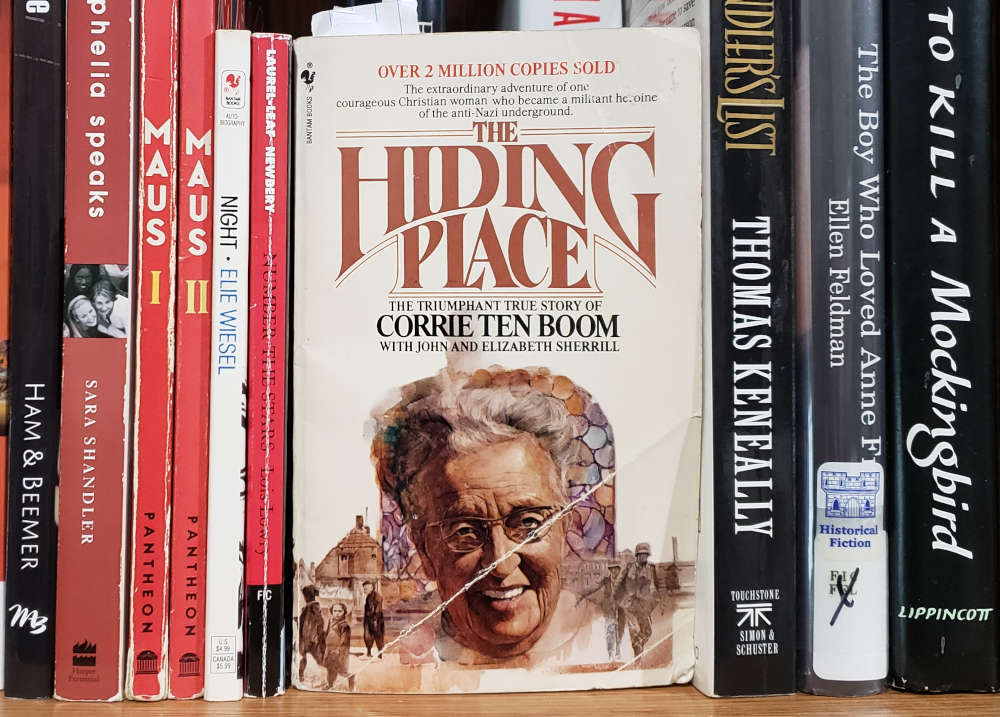
The Hiding Place by Corrie ten Boom with John & Elizabeth Sherrill (5 / 5)
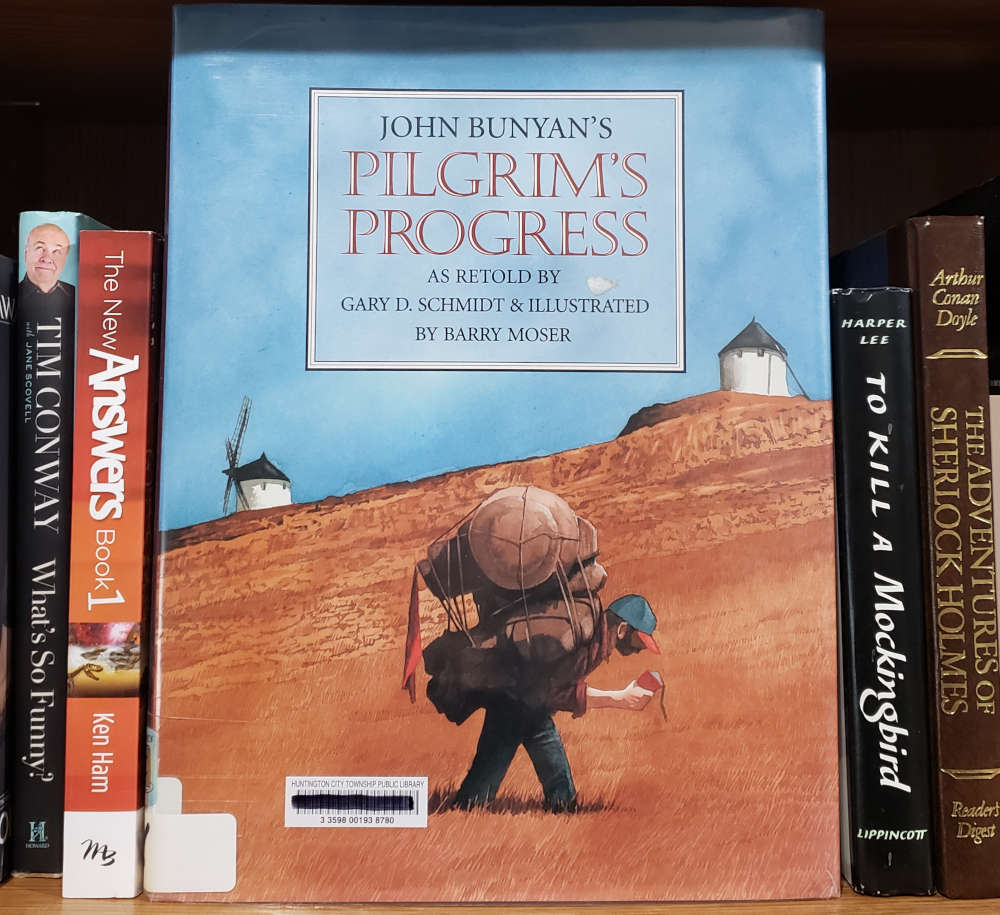
John Bunyan’s Pilgrim’s Progress as retold by Gary D. Schmidt (2 / 5)
From this Moment by Kim Vogel Sawyer (3 / 5)
Mr. Lemoncello’s All-Star Breakout Game by Chris Grabenstein (review pending)

This list includes 2 ARCs and 2 re-reads. My favorite book from February was The Hiding Place. I finished 0 series, continued 3 series, and started 1 series. My ever-changing short list of to-be-reads, as well as a flag for the book I’m currently reading and an ongoing list of those I’ve read and posted about can be found here.

I’m also keeping my Goodreads page updated with a more extensive list of to-be-reads. Despite my almost too-long TBR list, I’m always looking for more to add. Feel free to offer suggestions of your favorites or just recent reads you enjoyed.

Book Review: John Bunyan’s Pilgrim’s Progress

John Bunyan’s Pilgrim’s Progress
as retold by Gary D. Schmidt

My rating: 2 / 5
Genre: Christian allegory

I have long felt that I should read The Pilgrim’s Progress by John Bunyan. I even started to once, but only made it a page before putting it down. So when I found this retelling, putting the story into contemporary language, I knew it was my chance to at least see what the book was all about. So understand going into my review that this is in no way a comparison of this retelling to the original. And my comments are specific to this version, because I can’t say what might be different from the original. With that being said, I do think that some of what I didn’t like about this story would extend back to the original source.

After I finished reading this, as I tried to analyze what I’d read and did some research to understand others’ views on the allegory, I flashed right back to high school. After reading The Great Gatsby, I wrote that I didn’t understand why my teacher would have us read a book that so glorified the drinking and partying in the book. She wrote back about her disappointment that I thought she’d promote those things, and that perhaps I didn’t really understand the book. That it’s the type of book one might have to read multiple times to grasp. That’s kind of how I feel about this book.

My first apparent misunderstanding is that it seemed to me that Christian had to essentially earn his salvation. He struggled with his burden on the way to the cross, after coming to an understanding that he had this burden and needed external help to release it. Others say that he was actually saved when entering through the gate that started this journey, and releasing his burden at the cross was simply an illustration about how we don’t often let go of our guilt upon salvation and have to still come to that understanding that Jesus wants to relieve us of that guilt. However, it was at the cross, after losing his burden, that Christian was handed the Roll, which seemed to be needed in order to enter the Celestial City. I took this as a symbol of his salvation, but then, when he was audacious enough to rest a little too long, he lost the Roll and later had to go back and look for it.

I won’t go into any other details, but for whatever this book might mean to some people, at least the people who “get it,” to me it looks like a book that could send the wrong message to new Christians or curious unbelievers, especially those who, like me, aren’t so great at understanding allegory. From start to finish, it makes me feel like a Christian walk is nothing but trial and tribulation. Constant struggling to stay on the right path, to stay good. Yes, some of that is true to a degree, because it can feel like a constant struggle to avoid temptation to sin, but where’s the other side? Why do we not see much of the joy and peace that can come, in this life, from following Christ? For that matter, why is God so completely absent until Christian reaches the Celestial City? If I were to write an allegory about a Christian journey, it would include God interacting with the pilgrim in a much more tangible way (or at all…).

I seem to be pretty hit-or-miss in my enjoyment of much-loved older books and classics, and this is another for my pile of misses. I’m glad I read it, though. Originally I thought it might end up being a stepping stone to going on and reading the original. I’ve decided to leave it right here, at this simplified version, and just be one of the few who’ve never read the original.

Find out more about this Pilgrim’s Progress retelling and its source material, The Pilgrim’s Progress

See what I’m reading next.

If you’ve either of these books, or read either in the future, feel free to let me know what you think!

Book Review: From This Moment

From This Moment
by Kim Vogel Sawyer

My rating: 3 / 5
Genre: Christian fiction

Jase is a new youth minister at a small church in an even smaller town in Kansas. Recently moved from San Antonio after his fiancee died, he’s struggling with anger and doubt in his Christian walk. Kenzie is ten years removed from her Amish heritage, leaving the community when she learned how the grace of Christ could free her from the rules and regulations of her family’s religion. She’s been thinking more and more about her family, though, and the darkness they’re still lost in. Lori is a young woman who was emotionally and verbally abused by her father as a teenager. She uses food as a coping mechanism when she feels lonely or inadequate, despite knowing that it’s pointless and wishing she could stop. Jase, Kenzie, and Lori are each searching for answers from God, and when Jase moves to Kansas, he’s welcomed into the friendship that Kenzi and Lori already have. With each other’s help, the three just might find their answers.

Through the first half of this book, I didn’t really understand what it was meant to be about. Part of that is because the official synopsis is atrociously inaccurate and misleading. But it’s also because it really took a while for things to get going. And actually, in the end, it turns out the book really was about what I saw in that first half– these characters each struggling with their doubts, uncertainties, and questions about God and their faith. There were parts of the story that I liked, that I thought came together well in the end, and parts that fell flat for me, or that I questioned why they were included. Overall, it was a decent read, but not a stand-out for me.

The storyline I related to the most was Lori’s over-indulging in times of extreme emotion, good or bad. I haven’t had an abusive past like hers, but over-indulgence is an issue I have struggled with in the past, though not to the degree that she does it. I really liked the way Kenzie’s story shaped up too, after wondering what it had to do with anything for a while near the beginning. Jase’s storyline is the one that I was least connected to, partly because I’ve not experienced loss like that, but also partly because the decisions he made really bugged me. There is a 4th perspective in this story too, which I felt was wholly unnecessary. I couldn’t help but compare it to the previous book I read by this author, which also included 4 perspectives. But where it worked in that one, it just seemed pointless in this one. I’m not sure what the pastor’s perspective added, nor did I feel like it was particularly resolved.

If there was one cohesive lesson this story seemed to bring out, it was the benefit of allowing others to share your burdens. Each of these four people was originally struggling alone and seemed to only see a turning point when they opened up to a fellow Christian about their trouble. Actually, that’s not really true for one of them (I won’t say who), but perhaps it’s just that I wished he/she had let others help him/her along the way. And on a related note, Kenzie really drove me crazy at some points. How can you say “God will provide” and then refuse all of God’s ways of providing? If a really specific incident hadn’t happened, she absolutely would have stayed in the same place, spinning her wheels, still waiting and hoping for God’s providence. (You ever heard the one about the guy sitting on the roof of his flooded house, refusing to get in the boat or helicopter because he knew God would save him? Yeah, she’s kind of like that.)

So in the end, this is not a book I would choose to read again. However, I think that my issues with it will likely not be shared by most others. If you are looking for a Christian book where romance isn’t the main plot and where the author ties multiple storylines together into one story where God’s hand can be seen, this might be a good book for you.

Thank you to Netgalley and WaterBrook & Multnomah for providing me a copy of this book to review.

Find out more about From This Moment

See what I’m reading next.

If you’ve read this book, or read it in the future, feel free to let me know what you think!

Book Review: The Hiding Place

The Hiding Place
by Corrie ten Boom with John & Elizabeth Sherrill

My rating: 5 / 5
Genre: Memoir

At 50 years old, Corrie ten Boom lived a simple life with her older sister, both of them unmarried, and their elderly father in a small house in Holland. When the Nazis invaded and occupied their country, Corrie quickly saw the need around her as Jews began to be shipped out. The ten Boom house and watchmaker shop became part of the Dutch Underground, helping those who were persecuted find a safe place, even to the point of building a small hiding place in their own house. In this book, Corrie shares much of her life before the occupation, including the faith that led her and her family to help those in needs, culminating in the arrest and imprisonment of many members of her family, and later to her time in a concentration camp alongside her sister Betsie.

This book is incredible in so many ways. It’s inspirational, and not only because of what the ten Booms did to help others. It’s the reason behind their desire to help, the way that it really wasn’t even a question about whether or not they would help, and the way that they affected everyone around them, even in the darkest of places. The strong faith in God that Corrie’s parents had, exhibited, and passed on to their children shows through every page of this book. Corrie herself struggled the most in this area, constantly learning from her other family members and being surprised by their heart for the oppressors. Yet she never questioned whether or not she should help the Jews around her at the risk of her own well-being.

Not many Holocaust-related accounts that I have read are from a Christian perspective, and I really appreciated seeing the little and big ways that Corrie and Betsie could see God involved in their plight. Though they never demanded that He help them, they trusted Him (again, Betsie more than Corrie) and gave Him credit when they saw Him work. I can only hope that in my everyday life, and even moreso when times of difficulty come, I can have the wisdom of Mr. ten Boom, the love of Mrs. ten Boom, the hope of Betsie ten Boom, the courage of Corrie ten Boom, and the faith exhibited by all of them.

Below are some quotes from the book that I marked to remember.

Casper ten Boom (Corrie’s father) upon the realization that Holland would soon be invaded:

“…I am sorry for all Dutchmen now who do not know the power of God. For we will be beaten. But He will not.”

Corrie discovered that a large piece of sharp debris had landed on her pillow while she was out of bed:

“Betsie, if I hadn’t heard you in the kitchen–“

But Betsie put her finger on my mouth. “Don’t say it, Corrie! There are no ‘if’s’ in God’s world. And no places that are safer than other places. The center of His will is our only safety…”

And the one that stuck out to me the most, from an elderly member of Corrie’s family who spent much of her life running clubs, writing tracts, always trying to further God’s kingdom. When she learned she didn’t have long to live, her family members told her she was going to the Father with hands full, due to all of her work. She replied:

“Empty, empty! How can we bring anything to God? What does He care for our little tricks and trinkets?”

And then as we listened in disbelief she lowered her hands and with tears still coursing down her face whispered, “Dear Jesus, I thank You that You have done all–all–on the cross, and that all we need in life or death is to be sure of this.”

Find out more about The Hiding Place

See what I’m reading next.

If you’ve read this book, or read it in the future, feel free to let me know what you think!

Book Review: The Secret of The Desert Stone

The Secret of The Desert Stone
The Cooper Kids Adventure Series book #5
by Frank Peretti
read by the author

My rating: 3 / 5
Genre: Children’s Christian adventure

Dr. Cooper is summoned to a country in Africa to investigate a giant stone that appeared overnight, separating the country’s new dictator and his army from other parts of the population. The stone is miles high and wide, so the big question is, who put it there? When Dr. Cooper and his teenage kids, Jay and Lila, end up stranded on the other side of the stone, will the locals be welcoming or try to harm them? Will they discover the secret of the stone before the dictator loses his patience with them?

This installment of the series didn’t have quite the excitement of previous books, but it still had its moments. I think the best thing about the story is that it sort of brings Romans 1:20 to life. (“For since the creation of the world God’s invisible qualities–his eternal power and divine nature–have been clearly seen, being understood from what has been made, so that people are without excuse.”) I may have already said too much, in regards to avoiding spoilers, but I really appreciated the simple faith and thirst for more understanding about God exhibited by “primitive” people in the story.

I think one of the things that bothers readers most about these books is the unrealistic nature of things that happen. I like that Peretti isn’t afraid to explore what could happen, even while we know things like this don’t really happen much in modern times. Still, he paints an interesting and entertaining picture.

One final note–I listened to the audiobook specifically so that I could hear it read by the author. I love how he did roles like Mr. Henry and even his small role in the movie Hangman’s Curse, and I figured the book would be that much better in his own voice. It did not disappoint! I will most likely listen to the rest of the series this way too.

Find out more about The Secret of The Desert Stone

See what I’m reading next.

If you’ve read this book, or read it in the future, feel free to let me know what you think!