Book Review: In Search of a Prince

In Search of a Prince
by Toni Shiloh

My rating: 3.5 / 5
Genre: Christian romance

Content as a 25-year-old middle school teacher in New York City, Brielle Bayo never planned to move to an island off the coast of Africa and rule a nation. But that’s just what she’s asked to do when her mother informs her that she’s heir to a throne, and that the king, her grandfather, doesn’t have long to live. Uncertain about whether she can be a queen, or even wants to, she is then also faced with a requirement to marry before her grandfather dies, in order to be legally allowed to reign. It’s too much to handle alone, but maybe it’s a chance for Bri to learn to let God be in control.

This story shows that finding out you’re a princess isn’t always the fairy tale little girls might dream it to be. But it can be a blessing, especially if you can see God’s hand at work throughout. Though it takes Brielle a while to fully trust that “God’s got this,” it’s one of the biggest themes in the book. I’ll admit, it was a little disheartening to see the main character be reminded of God’s sovereignty often, and continue to be stressed and question whether she’s made the right decision. I also feel that she puts way too much stock in the world’s definition and view of love, which is more about passion, attraction, and the feeling of “falling in love,” even when she’s reminded that that’s not what love really is, especially from a biblical standpoint. Fortunately, another character was a lot more grounded overall, but I’m not sure it ever fully rubs off on Brielle.

I think the title of the book does an injustice to the story, as it focuses on Bri’s requirement to marry, and the romance side of the story, when there’s really so much more to it than that. Or at least, it seemed like there was trying to be more to it than that. Bri’s desire to help the people of her ancestral home, the fictional island of Ọlọrọ Ilé, to bring them into modern times, and to be the ruler God designed her to be, is the primary plot, with the romance a large side plot. And I liked that part of the story overall. The love interest (only not mentioning his name in case it’s a spoiler to anyone) was almost too good to be true, with only perceived faults that the reader can see aren’t really true. However, he was still one of my favorite characters.

Contemporary romance books are often less enjoyable for me, due in part to me feeling fairly detached from the modern world, and this was no exception, as dialog was very modern and full of slang (even from some of the Olorans). My bigger frustration with the writing, though, was the tendency for the main character and one major side character to talk almost solely in murmurs to each other for a good chunk earlier in the book. For one thing, it was a gross overuse of a single verb in a small space (seems like it should have been caught by editors), but for another…well, how often do people really murmur in normal conversation? It made me feel like there was just a lot of mumbling going on for a while, and was peppered here and there later in the book too. This is more personal preference, though; overall, the story was good, and I think most fans of contemporary Christian romance will enjoy this book.

Thank you to Netgalley and Bethany House for providing me a copy of this book to review.

Find out more about In Search of a Prince

See what I’m reading next.

If you’ve read this book, or read it in the future, feel free to let me know what you think!

January in Review

I read 12 books last month, the same amount as the previous month, and a little higher than average for me. It was several hundred total pages more than the previous month, though, and a good amount higher than my average. I owe this larger-than-normal reading month to being more organized with audiobooks I want to listen to.

Here are the books I read in January:

A Map of Days by Ransom Riggs (4 / 5)
Weave a Circle Round by Kari Maaren (3.5 / 5)
The Austere Academy by Lemony Snicket (2.5 / 5)
The Ladies of Ivy Cottage by Julie Klassen (4 / 5)
Genius Camp by Chris Grabenstein (4 / 5)
Harry Potter and the Prisoner of Azkaban by J.K. Rowling (re-read)
The Cat Who Knew Shakespeare by Lilian Jackson Braun (4 / 5)
Until Leaves Fall in Paris by Sarah Sundin (5 / 5)
Project Hail Mary by Andy Weir (re-read)
Kitty Hawk by Roland Smith (4 / 5)
The Adventures of Sherlock Holmes by Arthur Conan Doyle (4 / 5)
The Ersatz Elevator by Lemony Snicket (review pending)

This list includes 2 ARCs and 3 re-reads. My favorite book from January (that wasn’t a re-read) was Until Leaves Fall in Paris. I started 1 series, continued 6 series, and finished (or caught up on) 1 series. My ever-changing short list of to-be-reads, as well as a flag for the book I’m currently reading and an ongoing list of those I’ve read and posted about can be found here.

I’m also keeping my Goodreads page updated with a more extensive list of to-be-reads. Despite my almost too-long TBR list, I’m always looking for more to add. Feel free to offer suggestions of your favorites or just recent reads you enjoyed.

Book Review: The Adventures of Sherlock Holmes

The Adventures of Sherlock Holmes
Sherlock Holmes
#3
by Arthur Conan Doyle

My rating: 4 / 5
Genre: Classic mystery

This is the first Sherlock Holmes I’ve ever read, though like many, I’ve seen various adaptations. I started with this book of short stories mostly because it was the one I owned. I’ve never been a huge fan of short stories, though, and while I wish now that I’d started by checking A Study in Scarlet out from the library, I’m still glad I’ve started reading Holmes in any form. The issue with reading this book of shorter mysteries, though, is that a lot of the clients start to blend together, as many of them talk and act similarly when they bring Holmes their case. I did spread the stories out, reading 3 at a time, then reading other books before coming back for more, and I think that helped some.

My view of Holmes and Watson, and even some of the other characters, started with an understanding based on some of the adaptations I’ve seen, and while Holmes was indeed standoffish and generally assumed he was the smartest one in the room, I didn’t think he was quite as cold as I’ve seen him portrayed. A few of the cases were really interesting, while there were a couple that I thought had a much less intriguing solution. The introduction of Irene Adler wasn’t at all what I expected, but I wonder if she’ll be back in a future story. Overall, I enjoyed reading these vignettes, and have a feeling I’ll appreciate even more the longer stories when I get to them.

Find out more about The Adventures of Sherlock Holmes

See what I’m reading next.

If you’ve read this book, or read it in the future, feel free to let me know what you think!

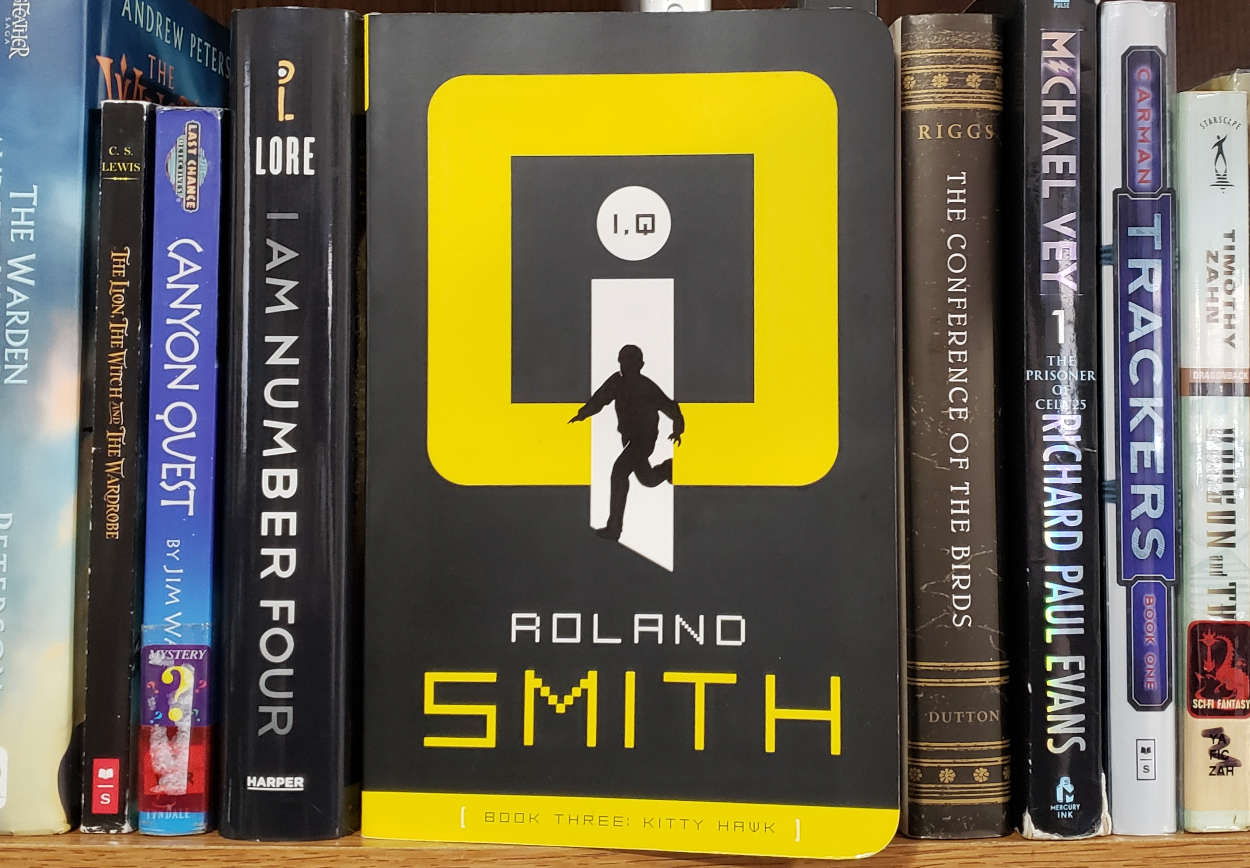
Book Review: Kitty Hawk

Kitty Hawk
I, Q #3
by Roland Smith

My rating: 4 / 5
Genre: Children’s spy thriller

Spoiler notice: The following review will contain some spoilers for the previous books in the series, starting with Independence Hall.

New step-siblings Q (short for Quest) and Angela continue to trail a ghost terrorist cell along with SOS, a team made up mostly of retired operatives from the CIA and other organizations. Most importantly, they’re following Angela’s mother and the First Daughter, and it’s vital that they don’t fall for the ghost cell’s attempts to confuse whoever might be following them. Meanwhile, some unexpected new developments are thrown into the mix, and it’s not always clear who is friend, foe, or neither.

We start in the middle of the chase again in this book, though I had no difficulty diving back in. I’m glad I’m reading the series after it’s all out, or I’d probably struggle with remembering what’s going on if I had to wait a year or more to continue on. The first two books were largely from Q’s POV (1st person), with other scenes shown to us as 3rd person and in italics. This book, though, has a lot more from other people’s POVs, still 3rd person, and fortunately loses the italics, because it would have been a lot of italics, and that’s not always pleasant to read. It seemed strange to still be 1st person when following Q, since there was so much 3rd person this time, but it would have also been weird to suddenly drop the 1st person completely after 2 books. It was only a little confusing to go back to 1st person now and then, so overall, not a problem. And I really appreciated being able to follow the multiple sub-sets of the SOS team in one particular part of this book.

Two big things happened in this book that intrigued me the most. One was not clear to me by the end whether or not there’s more going on than what is stated (there’s not much more I can say without giving spoilers). The second new development is the big one, that being the sudden supernatural elements that seem to come out of nowhere. Though when I examine it further, I don’t think it’s completely out of nowhere. There were certainly signs that something unusual was going on in the first two books, but I definitely did not expect this. I’m willing to give both of these uncertain elements a chance, though. The books have been enjoyable so far, and I am still looking forward to seeing where the overall story goes from here.  At this point, I still recommend this series for younger readers who want something exciting or thrilling, or even adults who don’t necessarily care for adult spy thrillers but enjoy a good adventure story.

Find out more about Kitty Hawk

See what I’m reading next.

If you’ve read this book, or read it in the future, feel free to let me know what you think!

Book Review: The Cat Who Knew Shakespeare

The Cat Who Knew Shakespeare
Book #7
by Lilian Jackson Braun

My rating: 4 / 5
Genre: Cozy mystery

After inheriting millions of dollars, former crime reporter Jim Qwilleran has started to make the far-north town of Pickax home. When a prominent local man dies, Qwilleran can’t help but question whether or not it was really an accident. And is there a connection to the sudden rash of fires in the small town?

There is so much tragedy and loss in this book, it’s a little heavier than other recent entries in the series. It was good to see some of the characters from previous books, like Hixie Rice from The Cat Who Saw Red, though not necessarily good to see her luck hasn’t really changed. To be fair, it isn’t as bad as poor Mrs. Cobb’s luck with men. One thing is for sure—Braun does not let things stagnate in this series; one can never get too comfortable with anything, as it could change at any time.

I liked this book but not as much as the several preceding it. Part of my issue was that I was thrown off by the mention of Qwill having already lived in Pickax for over a year? Apparently a lot of time had passed between this book and the previous, or I’m remembering the previous one wrong, but I was really confused for a while and felt like I’d missed something. There is also a lot of off-mystery story in this one that I didn’t feel were particularly interesting or worth including. Maybe it was meant to add some red herrings to the main mystery, but it felt detached to me. Still, I’m really into the series now and looking forward to reading more.

Find out more about The Cat Who Knew Shakespeare

See what I’m reading next.

If you’ve read this book, or read it in the future, feel free to let me know what you think!

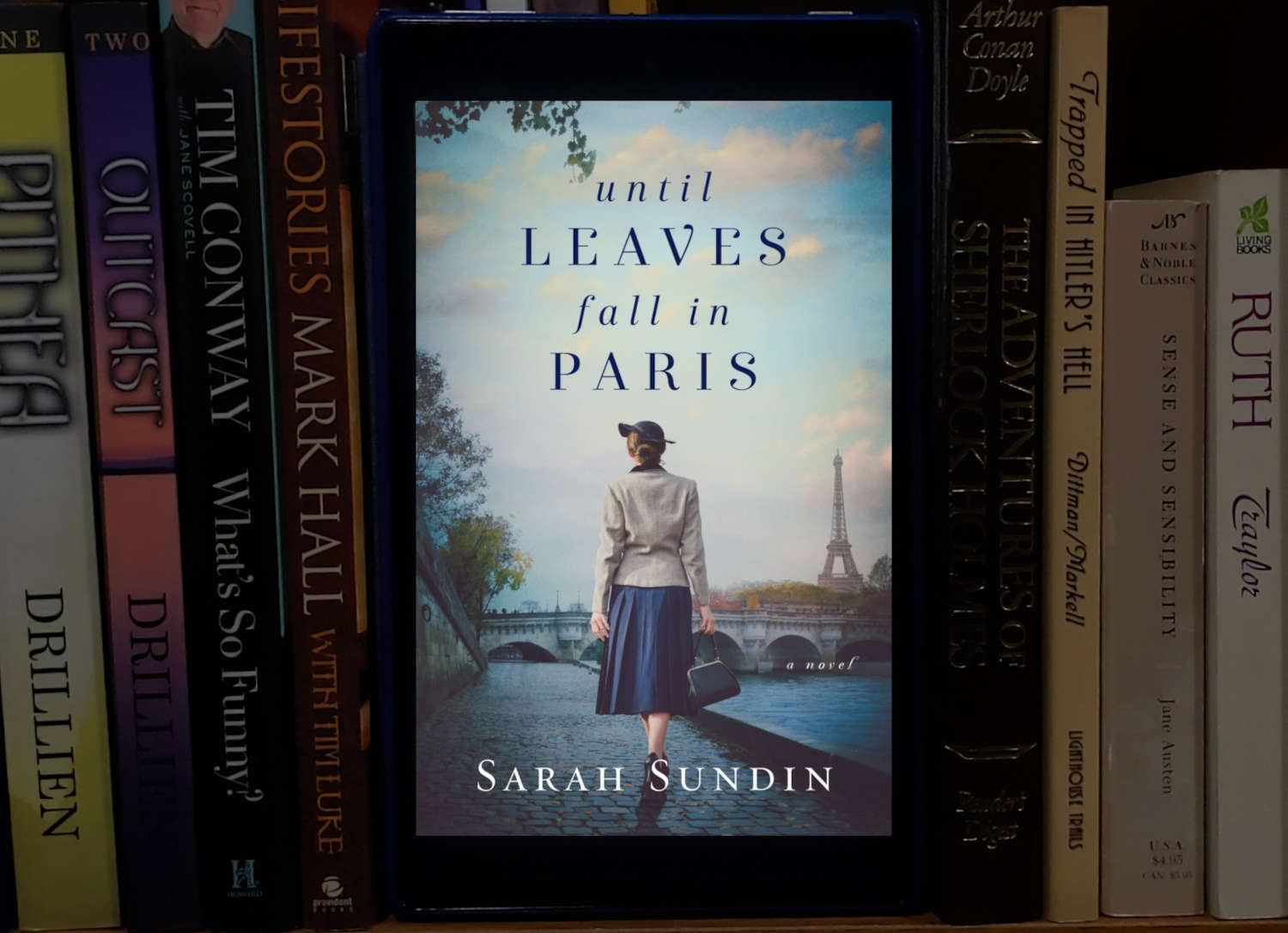
Book Review: Until Leaves Fall in Paris

Until Leaves Fall in Paris
by Sarah Sundin

My rating: 5 / 5
Genre: Christian historical romance

Lucie Girard, American ballerina living in Paris, decides to quit ballet and buy the English-language bookstore run by her Jewish friends, allowing them to escape to America before Hitler’s noose closes around them. While she struggles to keep the store running with so many English speakers fleeing France or being interned, she discovers that members of the local resistance are using her store to pass messages, and she wants to help. Meanwhile, Paul Aubrey, widower with a very creative 4-year-old daughter named Josie, runs a factory that produces trucks for civilian use. Because he sells those trucks to the Germans, he’s seen as a collaborator by all of his friends, who shun him and his daughter. He can’t tell them about the work he’s doing to help the US military, especially after it grows into other work for the local resistance. When the time comes for American’s to flee or be interned as well, Paul and Lucie will have to trust each other in order to get themselves and little Josie to safety.

This book was beautiful and touching, heartbreaking and uplifting, and I don’t think I can say enough about how much I loved it. The symbolism of leaves and the color green is woven throughout the entire book in a way I enjoyed—not always subtly, but I still appreciated how the author built a theme around it all. I adored Josie and the relationship between her and Lucie, as well as Paul’s attempts to understand his daughter better. Josie and Feenee are a major highlight of the book.

It seems like it’s been a while since I’ve given a fiction book 5 stars, but this one deserves it. The two main characters are both likeable and interesting. The ballet angle was a new one for me, and while it’s not something I know much about, I really enjoyed reading about it. Paul’s integrity, even in the face of undeserved hatred, and the way he relies on God to help him through it, is wonderful. The relationship between the two builds in a believable way, without much angst, and it’s not the only focus of the book, all of which I appreciate. The first meet between these two is one of the best I’ve ever read.

Tension builds as the war ramps up, and the last third or so of the book is filled with pulse-pounding, tear-jerking scenes. I loved everything about it, and know without a doubt I will re-read this book in the future. My only real complaint is that Lucie and Josie’s names are similar enough in style and appearance that a few times I was confused about what was going on in a scene or who was talking. But other than that, this book has cemented Sarah Sundin as one of my favorite authors (a distinction I don’t assign easily). And though it doesn’t appear to be part of any series, it is clearly connected to Sundin’s previous release, When Twilight Breaks, as the two MCs from that book appear briefly in this one. And it appears that her next book, which I’m excited to read, will be connected as well! In case it’s not clear, I definitely recommend this book to anyone who likes historical fiction from this time period in the Christian romance genre.

Thank you to Netgalley and Revell for providing me a copy of this book to review.

Find out more about Until Leaves Fall in Paris

See what I’m reading next.

If you’ve read this book, or read it in the future, feel free to let me know what you think!

Book Review: The Ladies of Ivy Cottage

The Ladies of Ivy Cottage
Tales from Ivy Hill #2
by Julie Klassen

My rating: 4 / 5
Genre: Historical Christian fiction

In this return to the village of Ivy Hill, we shift focus a bit to Rachel Ashford, who has recently been removed from her family home and is now living in Ivy Cottage with the two Miss Groves, who run a girls’ school in the cottage. Rachel isn’t much of a teacher, but she also has no income and wants to contribute to the household. Thanks to some advice and a lot of help, she opens a subscription library. Unfortunately, neither the library nor the girls’ school may last when Mercy, the younger Miss Grove, is given an ultimatum that will likely result in the loss of her way of life, not to mention her plans for the future, no matter which choice she makes.

It’s a little difficult to boil this book down to a succinct summary, because there’s so much going on. I believe Rachel Ashford’s POV is shown the most, with Mercy Groves second, but Jane Bell, the main character from the previous book, might have as much “screen time” as Mercy. While we do see a continuation of Jane’s story, the fate of the two younger women of Ivy Cottage is definitely the focus of the book. The downside to all of this is that it can get a little difficult to keep everyone and their situations (and their suitors) straight. When perspectives changed, it was always made clear soon enough which character’s head we were in, but sometimes I had to take a moment to remember what the story was with the current character. Not to mention which man/men was/were possibly interested in her.

That aside, however, I really enjoyed my time spent in Ivy Hill. So much so that when the book was finished, I felt a little bit of loss, which is not a common thing for me after finishing a book. Though some storylines were tied up in this book, there is clearly more to come, and I particularly want to see where Mercy’s story goes. I anticipate another difficult decision ahead for her. I continue to appreciate that, while there certainly is some romance in this book, it’s not a focal point. One thing that could be a detractor, though, is that there are an awful lot of illegitimate relationships uncovered in this book. If you’re a fan of historical Christian fiction, keep that in mind when considering this book. I do recommend it, and am looking forward to finishing the series.

Find out more about The Ladies of Ivy Cottage

See what I’m reading next.

If you’ve read this book, or read it in the future, feel free to let me know what you think!

Book Review: Genius Camp

Genius Camp
The Smartest Kid in the Universe #2
by Chris Grabenstein

My rating: 4 / 5
Genre: Children’s adventure

12-year-old Jake and his scientifically enhanced, super-smart brain are invited to Genius Camp for a week by Zane Zinkle, a man who had once held the title of the smartest kid in the universe. Now he owns a large corporation (the 2nd wealthiest in the world) and has created an AI computer, which he wants to pit against Jake’s smarts.

This book was just as fun as its predecessor. I really appreciated that Jake was insecure about his newfound genius, partly because he wasn’t sure if/when it might suddenly wear off, and partly because he knew the jelly beans don’t cover every subject. I like his connection to Haazim Farooqi (jelly bean creator) and Farooqi’s involvement in this story. And I love that a certain other book series by Grabenstein is officially in the same universe as this series (I really want to say more, but I won’t, to avoid spoilers).

Kojo started to drive me a little crazy in this book, with his insistence on adding “baby” into his dialog so often. If I met this kid in real life, I’d have to walk away pretty quickly. I also was initially put off by the incredibly ridiculous immaturity of the villain, but I mentioned this to my 11-year-old daughter who had already read the book, and she pointed out that it wasn’t necessarily unrealistic, given the villain’s backstory, and I was able to look past it more easily after that. I did predict the sort-of-twist at the end, but I think that’s mostly because of a certain movie I’ve seen several times (I won’t name it, because it would spoil the ending), which I’m sure kids in the age range that this book is meant for would be a lot less familiar with. As I mentioned above, my 11-year-old daughter read it before me, and she loved it as much as the previous. That’s the strongest endorsement I can ever give for a middle grade book, so make sure to check it out for your kids (or you)!

Thank you to Netgalley and Random House Children’s Books for providing me a copy of this book to review.

Find out more about Genius Camp

See what I’m reading next.

If you’ve read this book, or read it in the future, feel free to let me know what you think!

Book Review: The Austere Academy

The Austere Academy
A Series of Unfortunate Events #5
by Lemony Snicket
read by the author

My rating: 2.5 / 5
Genre: Children’s fiction

The three Baudelaire orphans have been sent to boarding school. Except Sunny isn’t old enough for school, so instead she works as an administrative assistant. Yeah. But Count Olaf is there, along with some of his henchmen, and even though the kids have been proven right each time they’ve made that claim in the past, Mr. Poe doesn’t believe them.

The author continues to be redundant, I suppose in an attempt at humor, but it’s done so often it’s just started to bother me along the way. But then again, this is not my kind of humor anyway—far too much injustice and even child abuse, none of which gets addressed or remotely amended, for my taste.

The formula that’s been so frustratingly followed for this series so far is broken slightly, in that the kids actually get to make some friends. But if you think that will work out well, you don’t know this series at all. It didn’t go the way I feared it would, and actually, I didn’t mind the way the story was left in the end, regarding the two friends. What I didn’t like is that the author nearly ruined the mild suspense provided by that ending, what made me feel, for a moment, at least, that I actually have an interest in the next story. Ah, well. I’ll continue on either way, because Tim Curry comes back with the next installment, and his narration is the only reason I got into any of this. I wouldn’t be continuing with this series if I wasn’t being read to by Tim Curry while I go about my day (except for the last 3 books, which I endured for the sake of…well, you get it).

Find out more about The Austere Academy

See what I’m reading next.

If you’ve read this book, or read it in the future, feel free to let me know what you think!

Book Review: A Map of Days

A Map of Days
Miss Peregrine’s Peculiar Children #4
by Ransom Riggs

My rating: 4 / 5
Genre: YA fantasy

Spoiler notice: The following review will contain some spoilers for the previous books in the series.

After their victory over the wights and hollows, Jacob and Miss Peregrine’s peculiar children are disappointed in the assignments they’re given in the Devil’s Acre as part of the reconstruction process. Jacob, in particular, really wants to follow in his hollow-fighting grandfather’s footsteps, so he does whatever he can to make that happen. But peculiardom in America is vastly different from what he and the others are used to in Europe, and there’s a whole new menace to defend against.

It was really nice to see these “kids” who have been through so much have a chance at a little rest. Certainly not as much as they want or deserve, but the book started out more leisurely than the 2 before it. The explanation for why America’s peculiar community is so much wilder than Europe’s makes complete sense, and I loved the overall change of scenery from the first 3 books. I’m also perfectly okay with Jacob and Emma’s relationship cooling off, considering that it always weirded me out anyway.

This book was a lot longer than the previous 3, but it didn’t feel all that long. I don’t remember at any point thinking that something could have easily been cut out. It’s the set up to another 3-book arc in the series and unsurprisingly ends with a cliffhanger. I wasn’t sure how much I’d like continuing on in this series, but I’m excited to see what comes next!

Find out more about A Map of Days

See what I’m reading next.

If you’ve read this book, or read it in the future, feel free to let me know what you think!