Words/Time: 20 minutes working on prep for my 2015 NaNoNovel. The weekend is over, so I wanted to make sure to do some writing work today. However, there’s still a lot of craziness as I recover from my work’s busy season. My head isn’t in the right space yet, and probably won’t be until at least Thursday. For now, though, I’m making lists of things that I want to use in my writing next month–observations I made at the last few rendezvous and things I remember from 12 years of attending these shows. And I started writing up a more detailed synopsis for the plot, only to decide it was getting too detailed (I was aiming for no more than 5 paragraphs). I’ll have to work on that some more.
Author: Kristi
Tools for NaNoWriMo: Coffitivity

When I was in high school, I remember realizing that to be able to concentrate on my homework, I needed complete silence. Though I tried to convince my mom (and myself) that I could study in front of the TV, she never bought it, and really, neither did I.
Fast forward to now, and things have changed a little. What I’d like to do is listen to music while I’m writing, plotting, or revising, but that’s usually a bad idea. The only time it really works is when I’m doing something that doesn’t require as much focus, like transferring edits I made on my hard copy into the computer (which, frankly, barely counts as writing work anyway, but it has to be done now and then).
The lyrics are the main reason music is a problem for me. I start singing along, even in my head, and I lose what I’m doing. Music without lyrics would work–I know people who like to write to sound tracks from epic movies about adventure and magic. I don’t listen to that kind of music normally, so it would really just take too long trying to track down a playlist that I like or fits the mood of my story.
So I stay away from music most of the time, but I don’t like absolute silence either.
That’s why I use Coffitivity. I just found out about this website sometime earlier this year, but I use it almost every time I sit down to do any kind of writing work. It’s basically just the sound of a coffee house or diner. On a loop. There are three options (or more, if you want to pay), though I honestly don’t see how any one is better than the others.
This doesn’t work as well for people who write with the internet turned off to avoid distractions, but for the rest of us, it could be a crucial part of our writing environment. If you’re not sure if you need silence, noise, music, or something else, try it out now, during NaNoPrep season while you plan your novel.
Daily Challenge Check-in: October 10, 2015
Words/Time: 0. I’m physically tired…and sore…and just mentally exhausted. It’s a rendezvous weekend, and I’m technically in the middle of said rendezvous (Mississinewa 1812 in Marion, IN). I was up early this morning to drive out there and join my parents, for whom I work, helping to take money for things we sell, while my dad demonstrates blacksmithing. Normally rendezvous are a full-weekend event for me, meaning that I’m gone all weekend. This one is close enough that I came home tonight. I have to teach children’s church at my church tomorrow, and couldn’t really get out of it (we’re low on teachers), so I’ll go to church tomorrow, then back into my funny clothes and back out to the rendezvous for the rest of the afternoon.
I don’t enjoy rendezvous as much these days because they leave me tired, sore, and often headache-y. And I’ve never enjoyed teaching children’s church because I’m not great with kids and really not much of a teacher, but our church is small and the need for children’s workers has always been great, so I accept the role I was asked to fill. However, doing that on a rendezvous weekend is sort of a conglomeration of stress for me. So I’m taking the weekend off with writing work.
One thing I have realized during all of this (rendezvous season has been non-stop the last 5 weeks) is that writing is somewhat therapeutic for me. I’ll probably make a separate blog post about that soon (in which I may repeat a lot of what I just said, so sorry for anyone who reads this and then that one too). I also have a whole list of tips for the actual month of November that I want to share soon, for NaNo hopefuls (especially newbies).
I’m looking forward to delving further into the plot I’m working on for November, and getting more revision done on “Pithea.” I’m just too tired to do any of it right now.
Daily Challenge Check-in: October 9, 2015
Words/Time: 35 minutes figuring out character names for my 2015 NaNoNovel. There are nine (for now) reenactors that the main character will interact with at some point during the story. That’s more characters than I’ve ever planned for at the outset of a story. I’ll have to work on a way to make sure they’re distinct enough. If I get confused during the writing, there’s no hope that future readers won’t be lost.
Daily Challenge Check-in: October 8, 2015
Words/Time: 58 minutes developing my 2015 NaNoNovel. I’ve reworked the synopsis a bit from my original plan and given it a more official title. I then set to work on naming the main character’s husband, father, and mother, all of whom have prominent roles in the story. And I have a cast of about 8 characters who are all important side characters, and they all need names. I think I’m actually so used to coming up with fantasy names now that picking normal names that I like is…a lot harder than I thought it would be.
I’m going to make a full post later once I’ve fleshed out the synopsis from 2 sentences into a few paragraphs, but for now, here is what I have:
“Too Many Irons in the Fire”
When a loud, obnoxious blade smith disappears during a historical reenactment, the daughter of a neighboring blacksmith attempts to track him down. Her search is hindered by the rendezvous crowd, her own obligations to the event, and the odd behavior of the other blacksmiths.
Daily Challenge Check-in: October 7, 2015
Words/Time: 613 words of writing practice I did. After a full day of work and a rough evening, I didn’t get to my writing time until 11:30. My brain wasn’t in the best space for quickly figuring out what to work on, so I pulled up a prompt and wrote for 15 minutes.
Daily Challenge Check-in: October 6, 2015
Words/Time: 2121 words, most of which was revising “Pithea” with two of my sisters over Skype. Also known as the 57th meeting of the Tri-County Sisterhood of the Traveling Book. We got through 5 pages of double-spaced text. There was less off-topic discussion tonight than we’ve had for a while now. But we came across more areas than usual that hung us up because we couldn’t come to agreements on how to fix them. More than one of them ended in the, “I’m the author so I’m just going to pull rank,” line. I don’t like doing that, because I’m sure it makes them feel like I’m dismissing their concerns. But when the concern isn’t a mistake but more of a difference of opinion, sometimes “pulling rank” is the only way to move on.
The rest of the words were from some writing practice I did. I’ve been trying to do a prompt every few days, partly because I’m still generating ideas to fill out the plot for my NaNoNovel, and partly to be in the groove of actual writing (instead of revising) before November comes. The prompt I pulled wasn’t one that I connected with, but I refused to let myself pass on it. I’ve been trying to stretch topics and themes that I can or will write about, so I’ve done some writing practice that was awkward or fell flat lately. This one, though, turned out rather interesting to me. So I’m going to do something I rarely do, and share what I wrote.
Keep in mind that this is raw (unedited) and I wrote it quickly without any forethought or pausing to think through where I wanted to go. The prompt came from 1000 Awesome Writing Prompts.
Prompt: Staging a fake kidnapping to get money out of your rich parents
Tools for NaNoWriMo: Aeon Timeline
Years ago, when I was writing fanfiction, I struggled to create a timeline for my large group of stories that stretched across many years and contained a lot of the same characters. I started on paper, and eventually tried to make something with Excel. I did end up with a format that I have since used for other writing, but it was still a pain to use and especially to make edits.
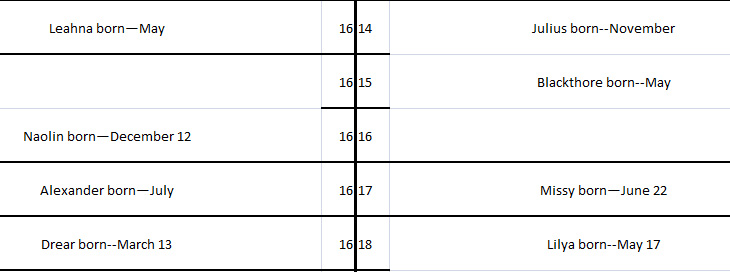
It gets really messy when the events of the story pick up.
A few years ago, at the end of NaNoWriMo, I noticed amongst the winner goodies a discount for a program called Aeon Timeline. I downloaded the free trial and spent a few days putting several stories worth of information into it. I discovered very quickly that it was exactly what I needed.
There are many settings you can play with, including having the timeline stretch out over thousands of years, or one single day. If you choose the latter, the timeline will show much more detail than with the former. I’ve read that a user can create their own calendar system in the program too, which would be useful for fantasy writers, though I haven’t used the feature myself.
You can have individual sections for different stories, different story arcs, or whatever else you may need. You can also toggle those individual arcs on or off to your liking.
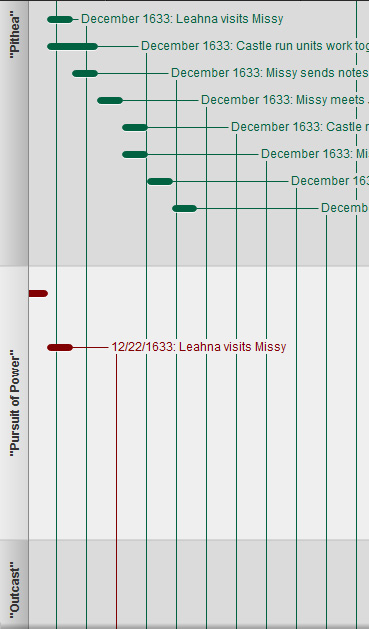
“Arcs” are shown along the left.
And one of my favorite things about the program is that you can add in all of your characters and attach them to the entries. If you set up a birth date, it will even tell you how old the character is at the time of that entry. The feature is called “Entities,” because it pertains to more than just characters too. I used it to remind myself of when a particular device (listed in the picture below as “com-disc”) was introduced into my story world, because I was having a hard time remembering when it was available to be used by characters.
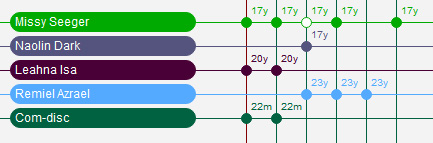
The lines go up to entries. The dots indicate that the character was a participant in that event (the one that’s not colored in indicates “observer” rather than “participant”).
Not every story needs a timeline. Sometimes events only happen over the course of a few days. The story I’m planning for NaNo this year will cover 9 days. I still plan to make a timeline for it as I plan this month. Even if in the end it turns out to be unnecessary, I know I’d rather have it anyway.
Though I’ve been mocked (all in fun, I assure you) for how meticulous I am with my timeline, it is crucial for keeping track of things for my group of stories that include “Pithea,” “Pursuit of Power,” “Outcast,” and other plans that will take place before, after, and during the others. There is so much to keep straight–character’s ages, how long ago a certain event happened, how long a certain event lasted, etc. So whether your writing is as complicated as mine or not, if you’ve ever felt the need for a timeline for your stories, Aeon Timeline is worth checking out.
How about you? Have you ever used Aeon Timeline before? Do you have a program you use for keeping track of a timeline?
Daily Challenge Check-in: October 5, 2015
Words/Time: 155 words and 30 minutes, the latter of which was spent adding revisions for “Pithea” that were made on paper into the computer.
The words were a short introduction I wrote for the main character of my NaNoNovel. Just a few minutes ago, when I went to put my novel into the newly relaunched NaNo site, I decided to title it “Too Many Irons in the Fire.” I’m not sure I’ll keep it, because it’s a little long, but for now, I like it. Maybe just “Too Many Irons” would be better? It implies the same expression but is more succinct. Any thoughts?
Outlining for NaNoWriMo
If you’re just coming across this now, at the beginning of October, there’s still plenty of time to plan a story from scratch. Here is a list of posts I’ve made about NaNo, which includes starting with story seeds and beginning to develop a plot. I’m not finished with that series of posts, as I wanted to give people time to work on the various steps. Personally, I’m still in the “take a nugget of a plot and see what you can flesh out of it” stage myself. However, I think this is a good time to talk about outlining, in case anyone is ready for that step.
The Great Debate
This isn’t a new topic. Even I have discussed the debate between panters and planners more than once before. I’ve been doing a lot of reading about others’ NaNo prep on WordPress in the last month, and have come to a few conclusions about pantsing and planning: Most pantsers actually do some planning, but not enough to consider themselves planners. Most planners leave room to pants along the way, but still find that they need to have a certain amount of stuff planned in advance.
So basically, there are extreme panters–all they know at the beginning of NaNo is a basic idea like, “It’s set on Mars and involves werewolves.” Or more of a plot point like, “Everywhere she goes, Sarah hears voices. She thinks she’s schizophrenic until the things the voices say start coming true.” With no more than that basic idea, they start writing on November 1st and just let the words flow out of them.
There are extreme planners–they have a 10,000-word outline, detailed character sheets for everyone down to the MC’s hairdresser, and a notebook full of notes about the world they’ve built.
Most of us fall somewhere in between these extremes–plan a little and wing most of it, or plan a lot but still let the story change itself. And I’ve noticed that many panters think that having an outline before starting to write the story means you’re locked into what is in that outline.
The Case for Outlining
Let me just say right now that most planners do give themselves room to follow the story or characters in unexpected directions. Sometimes, I write 2/3 of an outline, then start writing, knowing that I’ll veer off the outline before I get to the end anyway. Or I’ll change the outline to suit the new direction, or throw it out completely. Not too long ago I took a little offense at a blogger who implied that pantsing was creative, and writing from an outline wasn’t. Don’t take my tone to be too severe here, but I’d just like to state that writing fiction is creating, no matter what way you go about it. Simply because I do more of my creating before I start the actual writing by no means makes it less creative.
And let me just put this out there–the more you plan before you write, the more intricate your story can be. You can weave subplots together, work in foreshadowing more easily, and find plot holes before you’ve written them into the story. Outlining doesn’t make your story perfect, but I do believe it adds more potential for depth.
One more reason that I find planning to be important is that if I don’t write down ideas as I have them, and get them into place in the story, I will simply forget them. Even for this post, when I was falling asleep last night, I had an idea for a random plot point for the example up above. I really liked it, even if it was just an illustration. By this evening, I’d forgotten it completely.
Types of Outlines
1.) Perhaps the first thing that comes to most people’s minds when they hear the word “outline” is the formal outline. You know the kind–with the roman numerals and indentation and such.  They provide some scene organization and truly, if this works for you, great! Though they always made writing research projects easier, I still disliked making these in school. And a few years ago, I tried to make one for my NaNo project anyway. About 1/4 of the way through the outline, I decided it was more difficult than it was worth and switched to my normal way of outlining.
 2.) My outlines usually look like this. Actually, they’re normally handwritten, but this one I typed was easier to share. I simply write plot point after plot point, events as I want them to happen. Sometimes a single line in the outline is so broad that it takes several pages to write that plot point. Sometimes the story flows quickly through several pages of outline. The important thing is that I’m getting down, in order, what I want the story to look like. And sometimes the details don’t require much extra thought during the writing (which, by the way, can be really helpful during NaNo…less slowing down to think of what else should happen means I get the words out faster). But sometimes the outline only tells me that “MC grows up after the important thing happens at the beginning of the story,” and I end up spending several thousand words making up things that happened to him while he was growing up.
3.) I recently learned about worksheets and templates for outlining. I knew of them for characters, so it makes sense that they’d exist for outlining too. If you think you’d benefit from having a template, you may try doing a web search for one that works for you. From what I can tell, there are those that give you lines to fill in an introduction, several plot points with supporting material, a climax, and a conclusion. Or there are some that show the image of a story (sort of like a mountain) and tell you to fill in the points along the way. If you’re new to fiction writing or even just new to outlining, perhaps the structure would help.
4.) Another way of outlining or plotting I have heard of, but never tried, is making a plot board. Some sort of board on which you place individual cards, post-its, whatever, each one of which is a different plot point or detail. You can color code it (which to my thinking would come in handy to show different subplots), see it all at a glance, and move points around as you need to. Something like this can probably be done on different mediums, and there are probably online that you can find better information on this than I can provide.
I personally plan to try outlining in Scrivener this year. I still have the free trial, though it won’t last all through November. But I’m still testing out different aspects of the program to decide if it’s worth buying. Since you can create a new scene for each outline point and then write directly into the scene space, thus organizing your story as you write, it seems like a nice tool…I’m just not sure how it will work for me in practice.
During October
Wherever you may be in your NaNo prep, I strongly advise that you start gearing up for NaNo now (if you haven’t already been). It’s not that it’s impossible to dive right in on Nov. 1 and win, but there are certainly ways to make it easier. As I’ve mentioned before, making writing part of every day now will make needing to do that in November easier. Even if you only spend 15 minutes per day free writing or working on novel planning, you can start building the habit now.
Are you gearing up for NaNo too? Do you have a different style of outlining?

